



































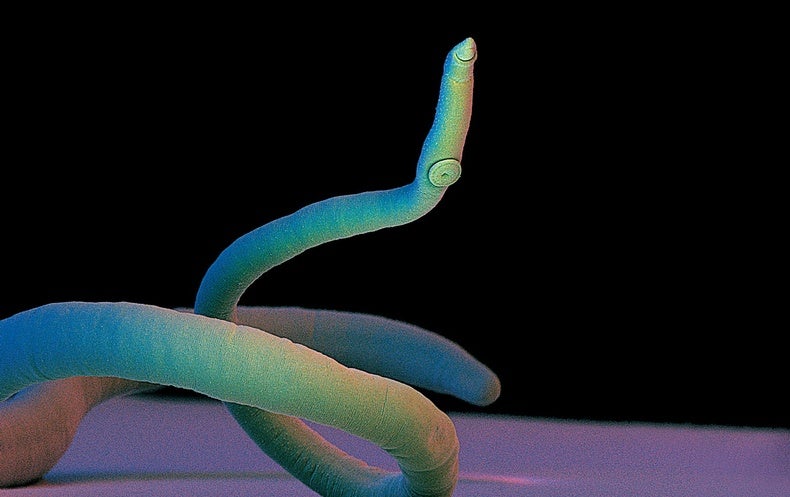
I was preparing dinner, portioning a piece of cod, when a small, pink blemish appeared in the pristine white muscle of fish. Removing the splotch with a knife tip, I realized something was very wrong. What had looked like a bulbous vein began unfurling into a thin squiggle the length of my pinky finger—and it was moving.
Like a scene from a horror movie, I watched, entranced, as the serpentine creature swayed its body, dismayed, it seemed, at finding itself ripped from the embrace of fish flesh. Before putting it in the compost bin, I snapped a few photos. I knew exactly who to send them to for identification help: Chelsea Wood, a parasite ecologist at the University of Washington—and perhaps the world’s only person who uses words like “beautiful” to describe bloodsucking worms.
Wood’s answer arrived the next morning: Anisakidae, she wrote—probably Anisakis simplex or Pseudoterranova decipiens—a common nematode that spends its larval stage in fish or squid. Wood went on to congratulate me: “What better way to start off the new year than to find a real live worm in your cod fillet?”
Given that Wood had told me about the abdominal pain, vomiting, diarrhea and bloody stool I would have experienced had the live worm managed to find its way into my esophagus, stomach wall or intestines, the congratulations seemed odd. In her enthusiastic manner she explained why such a discovery was positive: the typical hosts of this parasite are whales, dolphins, seals and sea lions—animals at the top of the food chain. “The presence of the worms in the fish is actually a sign that the ecosystem it came from is healthy and that there is a healthy population of marine mammals nearby,” Wood wrote. “Celebrate that squirmy harbinger of good news!”
Parasites are organisms that live in an intimate, lasting and costly relationship with their hosts, and scientists estimate that fully 40 to 50 percent of all animal species fall into this group. Just about every free-living species on the planet has at least one parasite specially evolved to exploit it. The broadest definition of “parasite” includes pathogens such as bacteria, viruses, fungi and protozoans. But many parasitologists like Wood focus on multicellular metazoans: animals that encompass hundreds of thousands of species, including up to 300,000 different types of worms that parasitize vertebrates alone.
Metazoan parasites are as diverse as they are abundant. They span 15 phyla, ranging from microscopic, barely multicellular blobs to 130-foot-long tapeworms snuggly coiled inside whale guts—species as phylogenetically different from one another as humans are from insects and jellyfish. They live in every habitat on every continent and in every orifice, organ and body part of their hosts. And they are some of the world’s most extreme specialists, with wildly intricate life cycles sometimes requiring up to five different hosts to allow them to get from egg to larva to adult. “It’s just such a beautiful expression of the complexity of nature and its interconnectedness,” Wood says.
Yet relatively few biologists—and hardly anyone else—are more than faintly aware of parasites beyond the tiny sliver of species such as tapeworms, pinworms and hookworms that are irksome or harmful to humans. As a result, nearly everything we know about parasites today comes from studying how to kill them. “The depth of our ignorance is really unforgivable,” Wood says.
That’s beginning to change. “Disease ecology and parasite ecology is the now fastest-growing subset of the ecological sciences,” says Skylar Hopkins, a parasite ecologist at North Carolina State University. With a recent influx of early-career researchers, “we have this critical mass of scientists and practitioners.” As the field grows, more evidence is emerging that points to parasites playing an outsized role in nature. One new study reveals that parasites account for 75 percent of the links in food webs; another study shows that they provide us with valuable ecosystem services, including pest control estimated to be worth billions of dollars.
Like predators, parasites can exert an effect on populations of other organisms in their habitat, which shapes everything from nutrient cycling to the types of plants that grow there to the abundance of top predators. In other words, parasites “play a major role in the natural world that was previously just overlooked,” says Armand Kuris, a parasite ecologist at the University of California, Santa Barbara. “Their top-down control of populations operates differently than predation—it’s slower—but their effect can, frankly, be just as massive.”
Just as parasites’ critical roles are being revealed, pioneering work conducted by Wood and others is beginning to show that many of these important animals are in trouble. They are contending with the same threats as better-known species: climate change, habitat destruction, pollution, and more. Because their fate is tied to their hosts—many of which are also in decline—they are often doubly vulnerable, particularly if they are specialists that live on or in only one species. “Every species you can think of that’s endangered has parasites that rely on it,” Hopkins explains. “If those species go extinct, then their parasites can also go extinct.”
But parasite conservation is a hard sell. Saving certain parasites—and, in turn, preserving their roles in nature—will depend on convincing policy makers, the public and a wider community of scientists that protecting them is worthwhile.
Not all body invaders are bad
Ask a parasite ecologist how they got into parasites, and they’ll likely tell you it was by accident. Wood grew up on New York’s Long Island and dreamed of becoming a marine biologist. She imagined a career spent swimming with dolphins. In college, however, there were no opportunities for undergraduate marine biology research. The closest thing she could find to get on the water was an internship collecting marine snails infected with trematodes in New Hampshire and Maine. The parasites interested her “in no way, shape or form,” she says. “I wasn’t there for them.”
Wood’s mindset shifted slowly, then completely. In parasites, she began to discover an unseen world operating in parallel to the one of free-living species. Her undergraduate courses had hardly mentioned those animals. “It’s possible to get a degree in biology and never learn anything about parasites,” she says, citing a 2011 study that found that 72 percent of 77 conservation biology textbooks either did not mention parasites at all or only portrayed them as threats to the hosts they occupy. As Wood learned more, she felt as though she were waking up out of the Matrix: she could suddenly see a hidden layer of intricacy and connection in every part of life. She also sensed an opportunity for scientific exploration. Fewer than 10 percent of parasite species have even been given names, much less studied in any detail.
Wood now leads her own parasitology laboratory at the University of Washington—“a 24-hour dissection machine,” as she calls it. Her team of technicians, graduate students and postdoctoral researchers are all women. “I can’t explain why women like parasites so much,” Wood says. “There was no gender selection on my part, other than picking the very best people.”
Wood’s lab tackles a single question from different angles: How do the things people do to ecosystems influence parasites? One project is comparing parasite transmission in coral reefs that experience varying levels of human impacts. Another is looking into how the ecology of rivers, lakes and ponds that serve as access points for water collection affect the burden of schistosomiasis infection for people in West Africa. But what excites Wood most is investigating the ways that parasites have changed over time.
Understanding the past tells ecologists what was normal before humans started meddling with the environment and what baseline conditions conservationists should aspire to preserve or restore. Unlike well-studied, charismatic animals such as elephants or tigers, wildlife parasites represent a data void: scientists have no idea how, if at all, their populations have changed over time. Yet Wood had observed that both scientists and the media tended to promote the idea that parasite populations are growing out of control, driven by human impacts to the environment.
Wood refers to this as the “sky is falling” narrative. In a 2015 paper published in the Proceedings of the National Academy of Sciences USA, for example, researchers wrote that because “host diversity inhibits parasite abundance … anthropogenic declines in biodiversity could increase human and wildlife diseases.” This is based on an assumption, however, that parasites are always bad. “The knee-jerk expectation is that as environments have degraded, parasites will increase because they are seen as yet another stress on the system,” says Kevin Lafferty, a disease ecologist at the U.S. Geological Survey. That prediction, he says, belies “a strong ignorance” of parasite ecology in general.
Wood agrees that the story is probably more complex. Like any other wildlife facing environmental change, she hypothesizes, over time there would be parasite winners and parasite losers. The only way to test this hypothesis would be to compare present parasitism rates with those from the past.
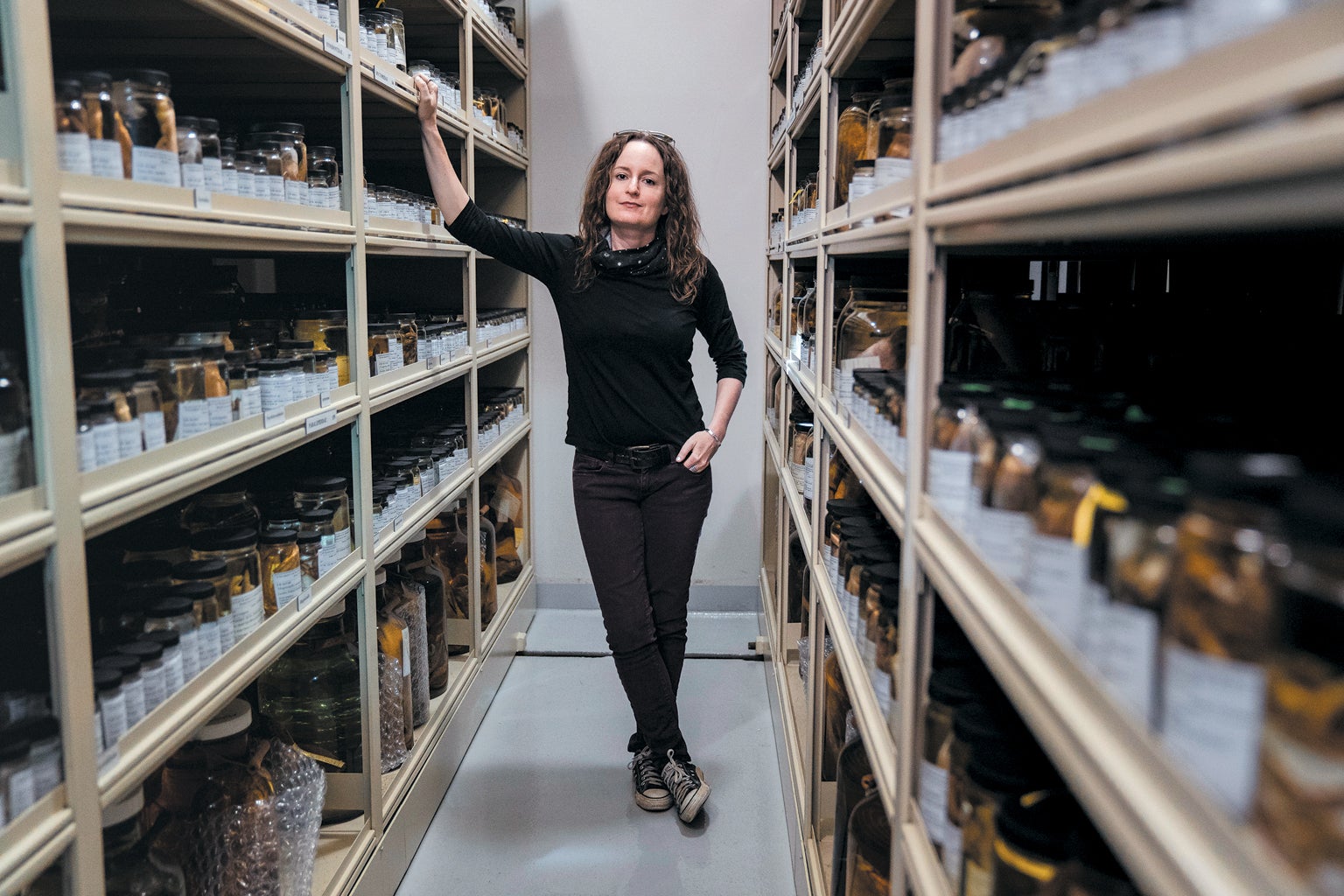
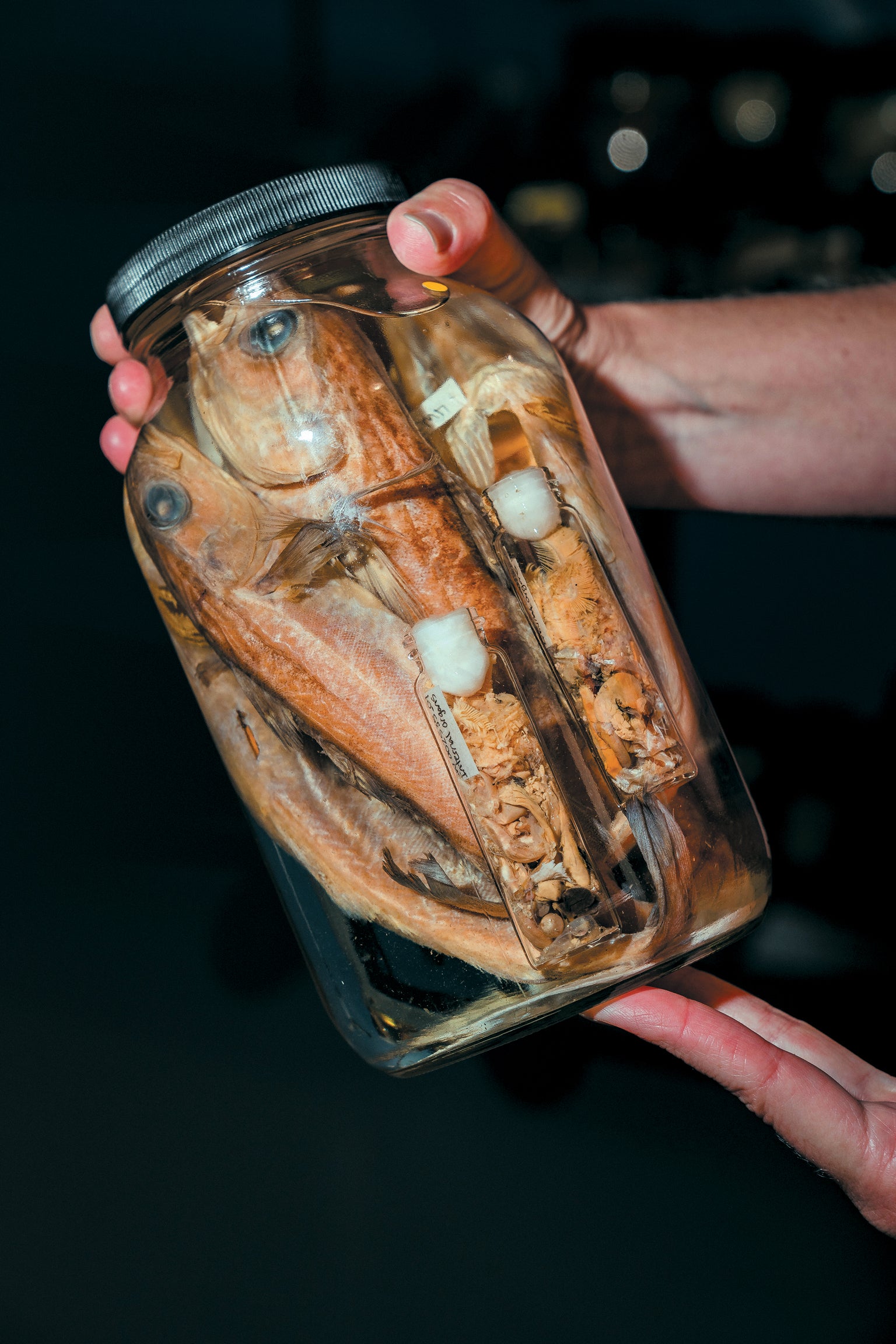
For nearly a decade Wood pondered unconventional resources that might help fill the void of historical data. She eventually found a portal to the past in an unlikely and convenient place: the University of Washington Fish Collection at the Burke Museum of Natural History and Culture, located just one building over from her office. In this unexceptional basement room, the remains of some 13 million marine specimens are preserved and suspended in 40,000 ethanol-filled jars. It is the largest fish collection in North America. But the scaly souls stored here are vastly outnumbered by parasites, tens of millions of which are clamped to the fishes’ skin, gills, muscles and guts. The fish are like “parasite time capsules,” Wood says. All she needed to do was peek inside.
Katherine Maslenikov, the museum’s ichthyology collections manager, was hesitant when Wood first approached her with the idea. “We were sort of nervous, like, ‘You want to do what to our specimens?’” Maslenikov recalls. Many conversations later, she came around. Wood’s project, Maslenikov realized, “is a whole new avenue of research”—a chance to fulfill the museum’s mission of aiding cutting-edge scientific studies. As Maslenikov put it, “This is not dead storage. A collection is meant to be used.”
Historical Ecology
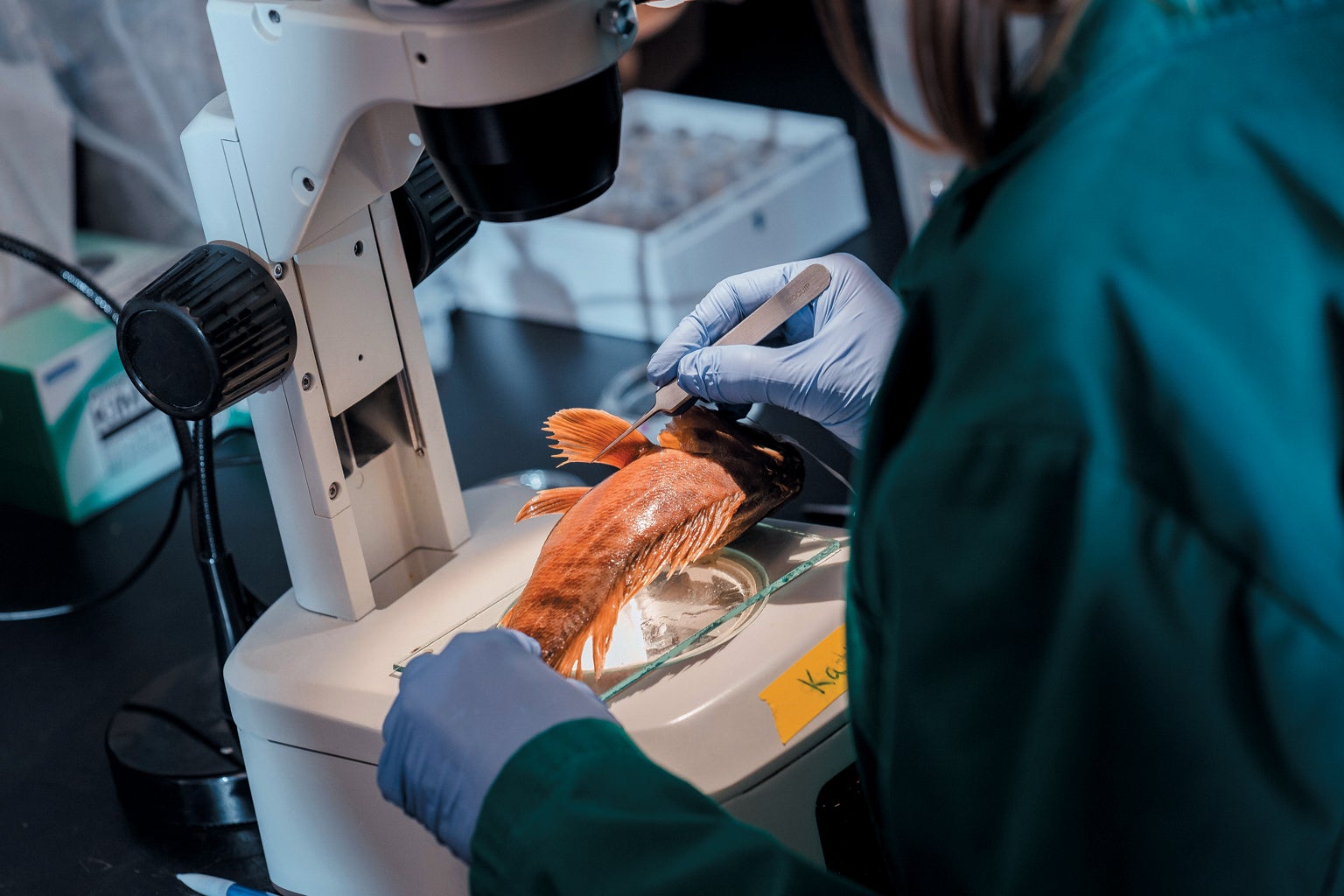
Katie Leslie is sorting through ribbons of intestines belonging to a rockfish that’s been dead for 41 years. So far Leslie, a research technologist in Wood’s lab, has found only the remnants of the animal’s last meal. Rockfish are notoriously wormy, but this specimen is proving to be exceptionally parasite-free, until
“Oh, wait, yes!” Leslie calls out. “Here’s an acanthocephalan!”
Under the microscope is the first parasite of the day, a thorny-headed worm. Leslie goes on to tally seven more parasites, including flatworms and nematodes. She then carefully places the fish, along with its neatly labeled vial of organs, back into its jar, and reaches for the next one.
To begin investigating the question of winners and losers, Wood chose eight common Puget Sound fish species from the collection. Maslenikov helped her identify up to 15 specimens per species per decade, starting as far back as the 1880s. In the lab, each fish undergoes a full physical, inside and out, first for sea lice attached to the animal’s skin and then for parasitic worms in its organs and gills. Technologically speaking, the method, Wood admits, is “like banging two rocks together.”
Finding the parasites is just the first step. Worms can be incredibly difficult to tell apart, with visual differences coming down to the number of teensy spines or hooks on a microscopic appendage. Species identification is therefore an exercise in patience and meticulous taxonomic expertise. “Our work supports the value of morphological taxonomy,” says Rachel Welicky, a former postdoctoral researcher in Wood’s lab, now working as an assistant professor at Neumann University in Pennsylvania. “It’s really becoming a lost art form.”
In July 2021 the Wood lab reported findings in Frontiers in Ecology and the Environment from its first analysis, on English sole collected from 1930 to 2019. In more than 100 specimens, the researchers identified nearly 2,500 parasites representing at least 23 taxa, of which 12 were prevalent enough to analyze their population trends over time. Of those 12, nine did not change in abundance across the decades; two, a trematode and a thorny-headed worm, decreased; and another, a trematode, increased. In another study that spun out from the same analysis of English sole, published in 2018 in the Journal of Applied Ecology, the team also found that a nematode called Clavinema mariae—a bloodworm that creates unsightly lesions on its host’s skin—underwent an eightfold increase over the 86-year period.
According to Lafferty, who was not involved in the research, those results “demonstrate a new value for the millions of pickled fish in jars on museum shelves across the world.” The findings themselves are notable, he continues, because they add an important data point about how parasites respond differently to environmental change. English sole parasites have been surprisingly stable over time, but for those whose populations did shift, not all went up. “Just like for free-living species, some parasite species do well under stress, and others don’t,” Lafferty says. Wood and her colleagues are preparing another study for publication with even greater power to test the “winners and losers” hypothesis.
As the team meticulously works through museum specimens, the scientists are also turning to other resources. Although there are few long-term data sets on any parasite species, there are one-off studies that document the abundance of parasitism at a particular place and time. In a 2020 Global Change Biology paper, Wood and her group synthesized these results for two types of common parasites found in raw fish often used in sushi and ceviche. One of the worms, they found, is just as prevalent today as it was in the past, but the other worm underwent an incredible 283-fold increase since the 1970s.
Wormy sushi can lead to a bad case of vomiting and diarrhea when consumed by people, but Wood is concerned about marine mammals—the worm’s intended targets. Typically a single worm does not extract much energy from its host. But if the number of worms is skyrocketing, they could pose a problem for marine mammals, especially for populations that are already stressed. The Puget Sound’s endangered pod of resident killer whales, for example, suffers from pollution, noisy ships and a lack of Chinook salmon to eat. In 2018 an emaciated killer whale calf turned up in the sound. Authorities launched an unsuccessful effort to save her, and before the calf died, scientists found that her scat was loaded with parasite eggs of the same sushi worm family identified in Wood’s study.
This does not prove that parasites played a role in the calf’s death. But it does hint at the possibility that parasites might be making life harder for an already beleaguered population, Wood says. To learn more, Natalie Mastick, a doctoral student in Wood’s lab, is using several approaches to understand whether whales are facing a greater threat of intestinal parasitism today than they did in the past—such as collecting whale poop found by sniffer dogs on boats and analyzing it for hormones, diet and parasite load. “If parasites turn out to be this huge stressor we didn’t know about, at least that’s a treatable ailment,” Mastick says. Wildlife managers can tuck anthelmintic drugs inside the salmon they feed to worm-stricken marine mammals (“like hiding your dog’s pill in a blob of peanut butter,” Wood says) or use darts to administer the pharmaceuticals from a distance.
In addition to the possible impacts on health for humans and wildlife, spikes in parasite populations can harm certain industries. The Puget Sound, for example, is famous for producing Pacific oysters with pearly, unblemished shells. But in 2017 a colleague dropped a shell on Wood’s desk marked with squiggly canals and dark, ugly spots—signs of a shell-boring oyster pest called Polydora. Although the parasites themselves are not dangerous for people to consume, they form blisters on the oyster shells filled with mud and worm feces and scar them with their voracious tunneling. It’s not something diners want on their plates. Since the 1860s Polydora outbreaks have devastated oyster industries in Australia, Hawaii and the U.S. East Coast, but Washington State—the U.S.’s largest producer of farmed bivalves—had long been spared. In March 2020, however, Julieta Martinelli, one of Wood’s postdocs, and her colleagues wrote in the journal Scientific Reports that one notorious species, Polydora websteri, had indeed invaded the Puget Sound.
Martinelli is now studying the ecology of the parasite in hopes of finding ways to help oyster growers treat and contain it. She and Wood are also trying to untangle the history of Polydora and other shell-boring polychaetes. An accidental introduction seems like the obvious answer, but the story may be more complex. Martinelli is turning to oyster middens—essentially, piles of shells left over from ancient oyster feasts—to unravel Polydora’s history in the Pacific Northwest. She confirmed that 1,000-year-old native Olympia oyster shells recovered from Jamestown S’Klallam Tribe middens bear signs of some type of burrowing worm. Martinelli guesses that this is a different species—but it could also be that Polydora has been lying in wait in very low numbers and only now has been unleashed by some as yet unknown environmental trigger.
Martinelli plans to excavate more recent oyster middens to see if she can pinpoint the parasite’s introduction into local bivalve populations. “The tricky thing about paleo work,” she says, “is we’ll never have the definite answer. But we do have traces of the past that are comparable to the present.”
Save the parasites
Parasite increases still get most of the attention—which is why Wood is attuned to parasite decreases and their implications for humans and wildlife. Some are to be celebrated, such as the effort to eradicate the Guinea worm, a spaghettilike parasite that grows up to 2.5 feet long inside an infected person’s digestive system before migrating to and eventually breaking through their skin. But for parasites that do not impact humans—the vast majority of species—some of the losses are concerning. One 2017 Science Advances paper estimated that up to 30 percent of parasitic worms may go extinct in the coming decades because of climate change and other pressures, and we’re only just beginning to learn how such a staggering loss of biodiversity will reverberate.
Take, for instance, the phenomenon of parasitic puppet mastery that occurs in many species. “Parasites shunt energy from lower to higher trophic levels by making prey reckless,” Wood says. Euhaplorchis californiensis, for one, is a trematode flatworm that, in its larval stage, looks a bit like a sperm, with a big head and long tail. The flatworm begins its life in a snail, then moves into a California killifish, then to its final destination in the gut of a predatory water bird, such as a heron or egret. Killifish typically spend their days hiding, however, which runs counter to the flatworm’s agenda. So the parasite creates cysts on its host’s brain, causing the hapless killifish to splash around on the surface of the water and flash its shiny belly, baiting the birds. Infected killifish, researchers have found, are 10 to 30 times more likely to be eaten by a bird than noninfected ones. Collectively, trematodes make a significant proportion of killifish populations more readily available as meals for birds—effectively subsidizing those predators’ diets. If certain parasite species are in decline or even disappear, it’s possible that “it could be way harder to conserve predators,” Wood explains.
Likewise, in Japan a 15-inch-long nematomorph worm causes infected crickets to dive into streams, where the adult worms burst out of their hosts to partake in a parasitic orgy. Meanwhile the doomed crickets become food for endangered Japanese char, providing up to 60 percent of the fish’s calories. Not only does the nematomorph worm help feed an endangered species, but by relieving pressure on other invertebrate species the fish eat, it also changes the stream’s overall ecology.
As scientists learn more about parasites’ roles in ecosystems, a small but growing cadre is beginning to think seriously about the need for targeted parasite conservation. In August 2020 parasite ecologist Colin Carlson of Georgetown University, along with Wood, Hopkins and nine others, published a 12-point plan for conserving parasites over the next decade. For starters, they wrote in the journal Biological Conservation, we cannot care about or conserve what we do not know exists. They challenged the scientific community to shine a light on parasite diversity by describing more than 50 percent of parasite species by 2030. “We basically have barely scratched the surface,” Hopkins says.
Once descriptions and data about each species’ ecology and life cycle start rolling in, the authors suggest, parasites in need of conservation could be identified, then integrated into existing species-protection schemes fairly simply. Parasite conservation can simply piggyback on existing efforts to save imperiled free-living species. Threatened parasites can likewise be added to various inventories for tallying and protecting endangered plants and animals. Only one animal parasite, the pygmy hog-sucking louse, is currently included on the International Union for Conservation of Nature’s Red List of Threatened Species, and none are included on the U.S. Endangered Species List.
Hopkins, Wood and their peers know that parasites have a serious image problem but are hopeful they can be rebranded. They liken the state of parasite conservation to where the field of predator conservation was just a few decades ago. At the time, many researchers and the public thought of bears, wolves and other meat eaters as damaging to the environment and dangerous to humans and livestock. Those assumptions proved not only false but harmful. Scientists now know that predators are keystone species—ones on which entire ecosystems depend. Removing them can cause cascades of negative impacts, from disease outbreaks and disruption of nutrient cycling to shifts to entirely different habitat types. As researchers realized the importance of predators, the public warmed to them, too.
“My hope is that people are willing to peer into this black box we’ve put parasites into,” Wood says. “Parasites aren’t this monolithic threat.”