








































Earth’s inner core cannot be watched directly. It sits inside the liquid outer core, more than 5,000 kilometres below the surface, and our evidence about its motion comes from seismic waves. That makes the language around a supposed reversal unusually easy to misread.
The important word is relative. The inner core has not started spinning westward through space while the rest of the planet turns eastward. A 2024 paper in Nature, led by geophysicist Wei Wang, found that the solid inner core first moved slightly ahead of the mantle and later moved slightly behind it. In a reference frame fixed to the crust and mantle, that later motion looks like backtracking.
The finding is worth taking seriously, but it should not be read as the final word. It is an inference from one unusually dense collection of repeating earthquakes, not a direct view of Earth’s centre. A later paper also suggests that physical deformation near the inner-core boundary can alter some of the same seismic signals.
How repeating earthquakes became markers inside Earth
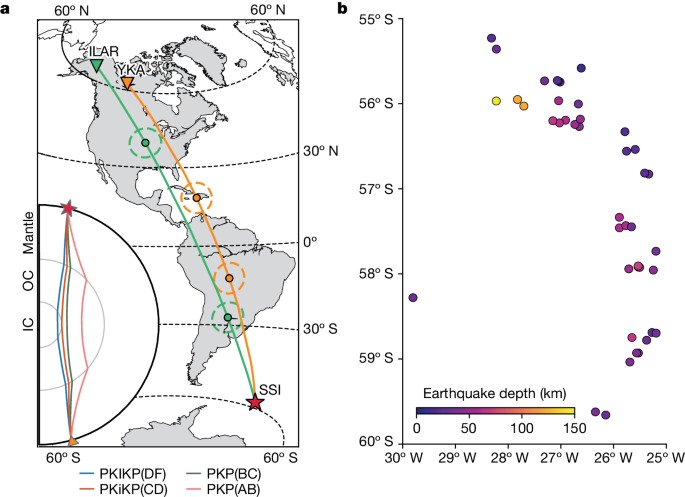
Wang and colleagues assembled records from 121 earthquakes that occurred near the South Sandwich Islands between 1991 and 2023. Those events formed 143 distinct repeating pairs, many grouped into 16 multiplets of three to seven events. The researchers then compared signals recorded at two medium-sized seismic arrays in northern North America: Eielson in Alaska and Yellowknife in Canada.
Repeating earthquakes are valuable because they rupture nearly the same patch of fault in a similar way. Their waves begin from approximately the same place and follow approximately the same route, reducing the uncertainty that would come from comparing unrelated earthquakes.
The team focused on PKIKP waves. These are compressional waves that travel through the mantle, cross the liquid outer core, pass through the solid inner core and emerge again. Their names encode the materials and boundaries they traverse. By stacking signals across each array, the researchers improved the signal-to-noise ratio enough to compare fine structure in the waveforms and the later reverberations called coda.
The useful clue was not simply that some waveforms changed over time. Some changed and then later returned to an earlier form. Meanwhile, phases that did not penetrate the inner core showed no comparable change in arrival time or shape. The returning pattern therefore suggested that the inner core had come back to an earlier orientation relative to the mantle.
This is a clever natural experiment, but it is still an indirect one. Seismologists are tracking how waves scatter through a complex solid sphere. They are not watching a visible marker rotate beneath our feet.
What “drifting backward” actually means
The authors reconstructed gradual super-rotation from 2003 to 2008. Super-rotation here means that the inner core moved slightly faster than the mantle. From 2008 to 2023, it sub-rotated back across the same relative path, taking roughly two to three times longer to retrace it. The University of Southern California’s account of the study described the transition as beginning around 2010.
That is the basis for saying the core reversed or drifted backward. Earth as a whole continued turning eastward, and so did the inner core. But the inner core went from running slightly ahead of the mantle to running slightly behind it. Imagine two runners circling a track in the same direction: when the inner runner slows below the other’s pace, their position moves backward in the faster runner’s frame even though neither runner has turned around.
The difference is tiny. Earlier estimates cited in the paper put differential rotation around 0.05 to 0.15 degrees per year. Changes of tenths of a second in the relative arrival time of seismic phases are not changes in the length of Earth’s day.
The dates also deserve care. This is not a reversal newly beginning in 2026. The dataset indicates forward relative motion in the early 2000s, a transition around 2008 to 2010, and slower backtracking that continued through the end of the observations in 2023.
One reversal, or part of a long oscillation?
Another group has proposed a broader pattern. Yi Yang and Xiaodong Song analysed repeated seismic waves from the early 1990s along with Alaskan records extending to 1964. Their 2023 paper in Nature Geoscience argued that the recent pause and turn-back may belong to an approximately seven-decade oscillation, with another turning point in the early 1970s.
Inner-core motion should respond to competing forces. The liquid outer core can exert electromagnetic and viscous stresses, while mantle density variations and deep boundary topography can exert gravitational torques. A solid sphere suspended inside moving metal need not maintain one differential speed.
Still, one inferred earlier turning point and one recent one do not establish a reliable 70-year clock. Different studies have produced different rotation histories because they use different earthquakes, stations, seismic phases and assumptions about whether waveform changes represent rigid motion or local structural change. The 2024 study’s returning waveforms strengthen the case for backtracking along the sampled path. They do not settle every proposed period or mechanism.
The asymmetry also matters. The later backtracking was about two to three times slower than the earlier forward movement. A simple repeating pendulum would be expected to trace a more symmetric path. Wang and colleagues concluded that models of the interactions among inner core, outer core and mantle will need to explain why the two rates differ.
Why milliseconds of day length enter the story
Earth’s rotation is not perfectly uniform. The atmosphere, oceans, tides, mantle and core exchange angular momentum. When one component gains a little, another must respond, producing small changes in the rotation rate measured as length of day.
Different sources dominate at different timescales. Atmospheric circulation, ocean currents and tides matter over shorter periods. Over decades, exchange between the rocky mantle and fluid outer core becomes important. A 2013 Nature analysis identified a roughly 5.9-year day-length oscillation alongside a longer trend and abrupt changes associated with geomagnetic jerks.
One class of models attributes the roughly six-year signal partly to gravitational coupling among mantle density anomalies, topography at the core boundaries and the inner core. Earlier seismic estimates of an inner-core reversal had a timing and amplitude compatible with that oscillation. Other explanations have also been proposed, including processes in the fluid outer core itself.
This is why the backtracking result is tied to millisecond-scale changes in day length, but the distinction between observation and model is crucial. The 2024 earthquake study did not measure a change in the day and prove that the inner core caused it. John Vidale told USC that any surface consequence would be on the order of a thousandth of a second, almost hidden by the much noisier movement of oceans and atmosphere.
The magnetic-field connection is real but indirect
Earth’s main magnetic field is generated not by the solid inner core spinning like a bar magnet, but by the geodynamo in the liquid outer core. As the US Geological Survey explains, turbulent motion of electrically conducting iron induces currents, and those currents sustain a magnetic field through feedback.
The inner core nevertheless belongs to the same coupled system. As it grows, solidification releases heat and light elements that can help drive convection. Its boundary has structure that can interact gravitationally and electromagnetically with the mantle and outer core. In turn, churning liquid metal can exert forces on the inner core. Changes in one layer may therefore provide clues about dynamics in the others.
That broader connection is why the Nature paper says the inner core influences the pattern of outer-core convection and therefore Earth’s magnetic field. It does not report that the observed backtracking produced a particular magnetic change. Nor does a reversal in relative inner-core motion mean a reversal of Earth’s magnetic poles. Those are different phenomena with different evidence.
ScienceBlog’s earlier report on how Earth’s inner core may have begun to crystallise adds the longer view. Nucleation, growth and the release of buoyant material concern the geodynamo’s history over geological time. The new rotation work concerns subtle coupling that can vary within decades.
What a newer result changed
In 2025, Vidale and colleagues extended the repeating-earthquake analysis and compared event pairs from times when the inner core appeared to have reoccupied the same relative position. Their Nature Geoscience paper reported changes at Yellowknife between 2004 and 2008 that were not seen at Eielson. Because the two arrays sample different depths near the inner-core boundary, the authors tentatively attributed the mismatch to shallow deformation rather than rotation.
A changing seismic waveform need not have one cause. Some of the pattern can track rigid-body rotation, while some may record local change near the inner-core surface. The authors described the answer as tentatively both. That refines rather than demolishes the backtracking evidence.
My reading of the evidence is therefore deliberately narrow. Repeating-earthquake waveforms show the inner core returning to earlier positions relative to the mantle after moving ahead of it in the early 2000s. The return was slower than the forward motion. The timing fits some models linking deep-Earth dynamics to small variations in day length, while the inner core’s interaction with the surrounding liquid matters to geodynamo models.
What remains unresolved is just as important. We do not yet know whether the recent reversal is one phase of a stable multidecadal cycle, exactly which torques control it, or how much of every waveform change comes from rotation rather than deformation. A few decades of high-quality seismic records are enough to reveal that Earth’s deepest layers are active on human timescales, but not enough to make their rhythm look simple.