
July 20, 2023, 2:02pm
Do you like this sentence?:
How surely are the dead beyond death. Death is what the living carry with them. A state of dread, like some uncanny foretaste of a bitter memory. But the dead do not remember and nothingness is not a curse. Far from it.
How about this one?:
They were watching, out there past men’s knowing, where stars are drowning and whales ferry their vast souls through the black and seamless sea.
Or this?:
He walked out in the gray light and stood and he saw for a brief moment the absolute truth of the world. The cold relentless circling of the intestate earth. Darkness implacable. The blind dogs of the sun in their running. The crushing black vacuum of the universe
If you answered “yes” to any of these, you probably are, or should be, a Cormac McCarthy fan. For over half a century the famously aloof novelist, playwright, and screenwriter, who died last month at the age of 89, plunged into the dark, arid subconscious of the American west and surfaced with a series of bleak and terrifying visions.
To mark what would have been McCarthy’s 90th birthday, here’s a look back at what the critics wrote about each of his twelve novels.
*
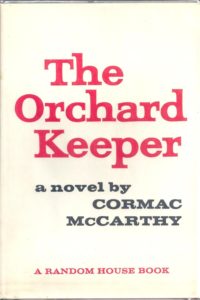
The Orchard Keeper (1965)
They are gone now. Fled, banished in death or exile, lost, undone.
“Woods and fields, mountains and cabins, isolation and cranky independence, these seem good to the literary mind; and especially good if the writer in childhood had a fleeting glimpse of some last outpost of rural America. Traditional folkways and folk speech, the sounds and smells of the natural world, and the violent behavior of men not yet truly civilized are irresistibly appealing as material for fiction.
Some novelists can write with brilliance and a fresh point of view about such familiar matters…Others, although they are highly gifted too, are sorely handicapped by their humble and excessive admiration for William Faulkner. Cormac McCarthy, author of The Orchard Keeper, is one of these.
…
“In his The Orchard Keeper he has his own story to tell; but he tells it with so many of Faulkner’s literary devices and mannerisms that he half submerges his own talents beneath a flood of imitation.
There are no marathon sentences in these pages, but most of Faulkner’s other famous characteristics are present: the wandering pronouns with no visible antecedents; the recondite vocabulary and coined words; the dense prose packed with elaborate figures of speech; the deliberate ambiguity, the hints and withheld information; the confusion in time and place, and the flashbacks that fall to shed much light into the intermittent gloom.
All these factors insure that The Orchard Keeper is an exasperating book. But the wonder is that in spite of them it is also an impressive book.
Mr. McCarthy is expert in generating an emotional climate, in suggesting instead of in stating, in creating a long succession of brief, dramatic scenes described with flashing visual impact. He may neglect the motivation of some of his characters. He may leave some doubt as to what is going on now. But he does write with torrential power.”
–Orville Prescott, The New York Times, May 12, 1965
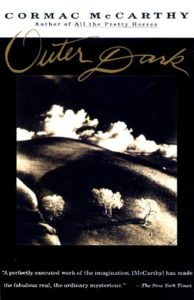
Outer Dark (1968)
I’ve seen the meanness of humans till I don’t know why god ain’t put out the sun and gone away
“Cormac McCarthy’s second novel, The Outer Dark, combines the mythic and the actual in a perfectly executed work of the imagination. He has made the fabulous real, the ordinary mysterious. It is as if Elizabeth Madox Roberts’ The Time of Man, with its earthbound folkways and inarticulate people, has been mated with one of Isak Dineson’s gothic tales.
…
“In the outline the story has a Faulknerian profile. In a shack in the woods, a young girl is about to give birth to a child, one she has conceived by her brother. The girl struggles through the delivery without any help except for the fumbling attention of the boy. After the baby is born, the young man exposes it to die in the woods. But a tinker who has been suspicious of what was going on in the cabin, carries the baby off. The girl learns of it an sets off in search of her incestuous son; the boy sets off in search of her. The double quest is the heart of the story.
…
“Mr. McCarthy has, however, not merely written a gothic tale. The shadows and dark corners are not only there for atmosphere. A stubborn, impenetrable society lives in this book, one we hoped had long since disappeared. And in it are acted out the old patterns of crime, punishment and sacrifice.”
–Thomas Lask, The New York Times, September 23, 1968
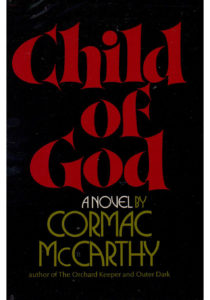
Child of God (1973)
At one time in the world there were woods that no one owned
“Cormac McCarthy is perhaps the most gifted of all the current generation of Southern novelists. He has a poet’s feeling for language and the ability to conjure up effectively in a page what a lesser writer would take a chapter to do. Child of God, McCarthy’s third novel, is a transitional work which attempts to go beyond The Orchard Keeper and Outer Dark.
…
“McCarthy’s gift is akin to that of Poe: the ability to bring up from the unconscious fears which seem to go back to the beginning of the race. Unfortunately, he seems here to believe that he is writing a naturalistic novel, that is, that poor Ballard’s obsessions are the result of his heredity and his environment. The solution is reductive. In fiction, explanations of madness are always simplistic. It is true that McCarthy insists that Ballard is not mad, but it is difficult to see what else he could be.
…
“And yet Child of God is a marvel. McCarthy’s writing is more compressed and beautiful that ever. Page by page, sentence by sentence, the writing is the work of a master. Many of the scenes have a kind of hallucinatory power which etch them indelibly on the mind. Ballard is an authentic revenant; the problem is that McCarthy seems to think that he is a mountain man who has been badly treated.”
–William Parrill, The Tennessean, January 27, 1974
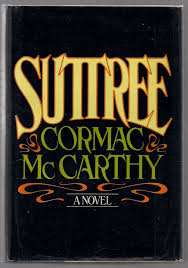
Suttree (1979)
But there are no absolutes in human misery and things can always get worse.
“Suttree is a fat one, a book with rude, startling power and a flood of talk. Much of it takes place on the Tennessee River, and Cormac McCarthy gives us a sense of river life that reads like a doomed Huckleberry Finn.
…
“At times Mr. McCarthy’s picture of hell becomes bloated and strained with thick, gassy language, as ‘troops of ghost cavalry clashed in an outraged sky, old spectral revenants armed with rusted tools of war colliding parallactically upon each other like figures from a mass grave shorn up and girdled and cast with dread import across the clanging night and down remoter slopes between the dark and darkness yet to come.’
But the bombast disappears as quickly as it arrives, and Mr. McCarthy creates images and feelings with the force of a knuckle on the head.
…
“The book comes at us like a horrifying flood. The language licks, batters, wounds—a poetic, troubled rush of debris. It is personal and tough, without that boring neatness and desire for resolution that you can get in any well-made novel. Cormac McCarthy has little mercy to spare, for his characters or himself. His text is broken, beautiful and ugly in spots. Mr. McCarthy won’t soothe us with a quiet song. Suttree is like a good, long scream in the ear.”
–Jerome Charyn, The New York Times, February 18, 1979
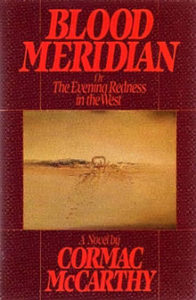
Blood Meridian or the Evening Redness in the West (1985)
War is the ultimate game because war is at last a forcing of the unity of existence. War is god.
“Blood Meridian comes at the reader like a slap in the face, an affront that asks us to endure a vision of the Old West full of charred human skulls, blood-soaked scalps, a tree hung with the bodies of dead infants. But while Cormac McCarthy’s fifth novel is hard to get through, it is harder to ignore. Any page of his work reveals his originality, a passionate voice given equally to ugliness and lyricism.
…
“This latest book is his most important, for it puts in perspective the Faulknerian language and unprovoked violence running through the previous works, which were often viewed as exercises in style or studies of evil. Blood Meridian makes it clear that all along Mr. McCarthy has asked us to witness evil not in order to understand it but to affirm its inexplicable reality; his elaborate language invents a world hinged between the real and surreal, jolting us out of complacency.”
–Caryn James, The New York Times, April 28, 1985
“McCarthy aspires to be the Goya of American letters … McCarthy’s style is a pastiche of bad Faulkner, and his vocabulary is apparently drawn from Jacobean tragedies and translations of Beowulf…This archaic diction does give the novel an epic tone, intimating that brutality is eternal and ineradicable. McCarthy could have stopped there, not without honor. But no: He tries to name the cause, and here he waffles. Maybe it’s war, or maybe it’s lucre. Or maybe it’s God: The narrative is littered with portentous phrases like ‘Gods years’ and ‘lies by God lies.’ These held-thought-out pronouncements, after a while, become irksomely hollow and pretentious … Down in Hades, John Gardner must be grinding his teeth. Blood Meridian is certainly bold and disturbing—but does that make it a masterpiece?”
–Allen Boyer, The Detroit Free Press, March 24, 1985
“The first time I read Blood Meridian, I was so appalled that while I was held, I gave up after about 60 pages. I don’t think I was feeling very well then anyway; my health was going through a bad time, and it was more than I could take. But it intrigued me, because there was no question about the quality of the writing, which is stunning. So I went back a second time, and I got, I don’t remember… 140, 150 pages, and then, I think it was the Judge who got me. He was beginning to give me nightmares just as he gives the kid nightmares. And then the third time, it went off like a shot. I went straight through it and was exhilarated. I said, ‘My God! This reminds me of Thomas Pynchon at his best, or Nathanael West.’ It was the greatest single book since Faulkner’s As I Lay Dying … to have written even one book so authentically strong and allusive, and capable of the perpetual reverberation that Blood Meridian possesses more than justifies him. I don’t think McCarthy will ever match it, but still… He has attained genius with that book … More than successful. It’s not only the ultimate Western, the book is the ultimate dark dramatization of violence.”
–Harold Bloom, The AV Club, June 15, 2009
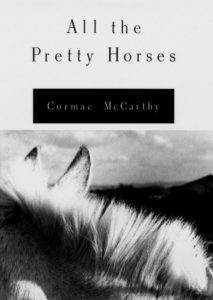
All the Pretty Horses (1992)
I can normally tell how intelligent a man is by how stupid he thinks I am.
“Cormac McCarthy’s formidable prose is indebted to the Old Testament. His landscapes are wide, blazing and biblical with conflagrations. His characters are not thick, psychologically resonant creations, but are subordinate to the breadth and muscle of the world that surrounds them. In the Old Testament, of course, the surrounding world belongs to God. But in McCarthy’s novels, it is nature—nasty, brutish and short.
…
“In his sixth and best novel, All the Pretty Horses, McCarthy attempts some things he hasn’t attempted before, and mostly he succeeds … Cole runs away with a friend, Lacey Rawlins, searching for a land where he can ride his horse uninterrupted by fences, and where property is constantly improved through hard, honest labour rather than parcelled off in lots. What Cole discovers, however, is the same muddy, awful horrors which usually destroy McCarthy’s characters – bad love, dishonest cops, bloody conflicts, and people made dangerous by their disillusionment. Unlike the characters in Faulkner (the writer to whom McCarthy is most often compared), McCarthy’s people endure rather than prevail; yet in Horses John Grady Cole approaches more heroic stature.
…
“For the most part, All the Pretty Horses reads like the sort of classic western revisionism that can be found in films like Eastwood’s Unforgiven or Peckinpah’s The Wild Bunch. McCarthy succeeds best as a writer about men and male friendships, and neither the love story at the centre of this book, nor the female character, Alejandra, ever really come off. But the prose, as always in McCarthy’s work, is stunning, and the story far more absorbing than that in any of his previous books. As a result, All the Pretty Horses is the best place to start for anyone interested in exploring McCarthy’s weird and violent fictional landscapes. It possesses both intelligence and integrity, and while the world it describes may not always seem real, it always feels realized.”
–Scott Bradfield, The Independent, April 16, 1993
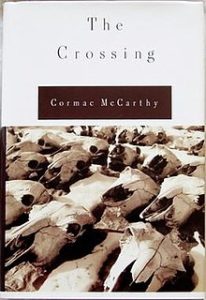
The Crossing (1994)
Deep in each man is the knowledge that something knows of his existence.
Something knows, and cannot be fled nor hid from
“The Crossing is a miracle in prose, an American original. It deserves to sit on the same shelf certainly with Beloved and As I Lay Dying, Pudd’nhead Wilson and The Confidence-Man, and if it will put readers in mind of Faulkner, Twain, Melville and Shakespeare, it will also put them in mind of Ernest Hemingway, Flannery O’Connor, Miguel de Cervantes, Samuel Beckett, Joseph Conrad and, for good measure, John Ford, Sam Peckinpah and Sergio Leone. But The Crossing is a tale so riveting—it immerses the reader so entirely in its violent and stunningly beautiful, inconsolable landscapes—that there is hardly time to reflect on its many literary and cinematic echoes or on the fact that Mr. McCarthy is a writer who can plunder almost any source and make it his own.
…
“This first section of the book reads, indeed, like a cross between Faulkner’s novella The Bear and Don Quixote. It is about the length of a novella, and it is written with such force and momentum—the reader is so ransacked emotionally by the end of it—that it seems, one-third of the way into the book, that Mr. McCarthy can have nowhere to go.
…
“Mr. McCarthy, because he is interested in the mythic shape of lives, has always been interested in the young and the old or, if not the old, then those who have already performed some act so deep in their natures (often horrific, though not always) that it forecloses the idea of possibility. ‘Doomed enterprises,’ Mr. McCarthy’s narrator remarks, ‘divide lives forever into the then and the now.’ So The Crossing is full of encounters between the young boys, who look so much like the pure arc of possibility, and the old they meet on the road, all of whom seem impelled, as if innocence were one of the vacuums that nature abhors, to tell them their stories, or prophesy, or give them advice.
…
“It is Mr. McCarthy’s gift that he can signal his literary intentions to his readers without archness. If he seems post-modern in his sense that everything is a quotation of a quotation, he parts company with post-modern practice in thinking, not that everything therefore refers to nothing, but that in human life certain ancient stories are acted out again and again. A writer’s moral relation to these stories is like nothing so much as a craftsman’s relation to his tools, and nothingness is not to be counted for the pleasure of merely circulating, but built against, sentence by sentence—and here certain Faulknerian adjectives might come into play—if hopelessly, in the knowledge of the doom of all human intention, then indefatigably, in the knowledge of the skills of a trade that has been passed down to one and that will be passed in turn to other hands.”
–Robert Hass, The New York Times, June 12, 1994
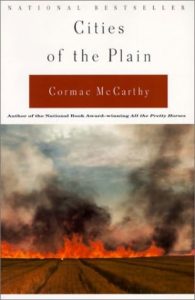
Cities of the Plain (1998)
Our waking life’s desire to shape the world to our convenience invites all manner of paradox and difficulty.
“Like its brilliant predecessors, All the Pretty Horses and The Crossing, Cities of the Plain tells a riveting story that is simple in form but presses outward toward the archetypal and the infinite.
…
As the title’s reference to Sodom and Gomorrah suggests, Cities of the Plain is about the end of things. But the end of what? John Grady Cole has an extraordinary innocence and openness of heart (something quite different from stupidity or naivete) that does not seem to belong in the dailiness of the modern world. But Cities of the Plain is also about the end of an American way of life. Gathered around Parham and Cole at the ranch is a collection of drifters and aging cowboys, each with a history and a story to tell. The book is filled with moving depictions of the routines of cowboy life, adventures high in the hills above the cities spreading out across the plain. McCarthy has a special ear for the horse- and landscape-bound language of cowboys, a way of speaking that has all but disappeared, and he seems intent on salvaging that language and all it represents.
McCarthy’s view of the world is austere. As in the previous novels, his characters encounter brutality, as well as the sublime. If he offers any real hope, it lies in the redemptive power of language. McCarthy is perhaps the finest American prose stylist writing today. As poet Robert Hass has written, ‘McCarthy seems incapable of writing a boring sentence.’ Cities of the Plain contains passages of rare and hypnotic beauty. It completes a series that will surely become an American literary classic.”
–Alden Mudge, BookPage, June, 1998

No Country For Old Men (2005)
How does a man decide in what order to abandon his life?
The body count in No Country for Old Men is high, but the renderings of death are muted, truncated, abrupt. We do not find the gore heightened as it is in Blood Meridian … Aside from Sheriff Bell, who is more a conscience than a character, none of these figures can rightfully be called the protagonist, which is probably McCarthy’s intention. Without a universal moral code, humanity is reduced to a nebulous relativism that can make a right of any wrong, a wrong of any right and can justify any action with ease … Redemption, honor, dignity, hope: McCarthy portrays these notions as the foolish nostalgia of an old and dying generation. What the future holds for us in his vision is brute violence, the rule of shameless force, a world in which power, not conscience, is the only commodity of value.
–Eric Miles Williamson, The Los Angeles Times, July 24, 2005
“To read Cormac McCarthy is to enter a climate of frustration: a good day is so mysteriously followed by a bad one. McCarthy is a colossally gifted writer, certainly one of the greatest observers of landscape. He is also one of the great hams of American prose, who delights in producing a histrionic rhetoric that brilliantly ventriloquizes the King James Bible, Shakespearean and Jacobean tragedy, Melville, Conrad, and Faulkner … Curiously, McCarthy’s new novel has almost none of the battered ormolu that makes his earlier prose so distinctive…McCarthy is continent here, which is in keeping with the spirit of the novel. Everything is tight, reduced, simple, and very violent … The book gestures not toward any recognizable reality but merely toward the narrative codes already established by pulp thrillers and action films. The story is itself cinematically familiar … The problem with a novel like No Country for Old Men is that it cannot give violence any depth, context, or even reality. The artificial theatre of the writing makes the violence routine and showy. And McCarthy’s idea—his novelistic picture—of life’s evil is limited, and literal: it is only ever of physical violence … His myth of eternal violence asserts, in effect, that rebellion is pointless because this is how it will always be. Instead of suffering, there is represented violence; instead of struggle, death; instead of lament, blood.”
–James Wood, The New Yorker, July 25, 2005
“With a title that makes a statement about Texas itself, McCarthy offers up a vision of awful power and waning glory, like a tale told by a hermit emerging from the desert, a biblical Western from a cactus-pricked Ancient Mariner … Through squinted eyes this novel can be seen as a morality tale nestled within a fast-paced and compelling crime saga. The narrative seethes with a rhetorical thrust that likens to Dickens’ anger at the poverty of England in Bleak House, only here McCarthy rails against the drug trade that is ruining the Texas-Mexico borderland … Like these doomed cowboys, McCarthy cannot turn away from the horror he sees around him. His voice is hoarse, his visions are often nightmares. In No Country for Old Men he has conjured up a heated story that brands the reader’s mind as if seared by a knife heated upon campfire flames.”
–William J. Cobb, The Houston Chronicle, July 17, 2005
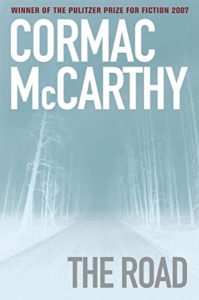
The Road (2006)
Keep a little fire burning; however small, however hidden.
“The paradox in every part and sentence of the post-apocalyptic narrative—evoking even as it denies—is repeated as if fractally by The Road as a whole … All the elements of a science fiction novel of the post-apocalypse are present or at least hinted at…There are bits of satire of a very dark order in the hints that religious extremism caused the holocaust, and in the relentless way McCarthy deprives the foolish reader of the reassurances … The Road is neither parable nor science fiction, however, and fundamentally it marks not a departure but a return to McCarthy’s most brilliant genre work, combined in a manner we have not seen since Blood Meridian: adventure and Gothic horror.”
–Michael Chabon, The New York Review of Books, February 15, 2007
“This is an exquisitely bleak incantation—pure poetic brimstone. Mr. McCarthy has summoned his fiercest visions to invoke the devastation. He gives voice to the unspeakable in a terse cautionary tale that is too potent to be numbing, despite the stupefying ravages it describes. Mr. McCarthy brings an almost biblical fury as he bears witness to sights man was never meant to see … His use of language is as exultant as his imaginings are hellish, a hint that The Road will ultimately be more radiant than it is punishing. Somehow Mr. McCarthy is able to hold firm to his pessimism while allowing the reader to see beyond it. This is art that both frightens and inspires.”
–Janet Maslin, The New York Times, September 25, 2006
“The Road is a frightening, profound tale that drags us into places we don’t want to go, forces us to think about questions we don’t want to ask. Readers who sneer at McCarthy’s mythic and biblical grandiosity will cringe at the ambition of The Road. At first I kept trying to scoff at it, too, but I was just whistling past the graveyard. Ultimately, my cynicism was overwhelmed by the visceral power of McCarthy’s prose and the simple beauty of this hero’s love for his son … The book’s climax—an immaculate conception of Pilgrim’s Progress and Mad Max—is a startling shift for McCarthy, but a tender answer to a desperate prayer.”
–Ron Charles, The Washington Post, October 1, 2006
The Passenger (2022)
Grief is the stuff of life. A life without grief is no life at all.
“McCarthy in afflatus mode is magnificent, vatic, wasteful, hammy … McCarthy’s deflatus mode is a rival rhetoric of mute exhaustion, as if all words, hungover from the intoxication, can hold on only to habit and familiar things … For the first time in his career, McCarthy is aiming to write fiction about ‘ideas’ … In the new pair of novels…a fresh space is made to enable the exchange of ideas, and the rhetorical consequences are felt in the very textures of the fiction … His ear for dialogue has always been impeccable … People think and speak rationally, mundanely, intelligently, crazily, as they do in real life; only for a writer as strange as McCarthy would this innovation deserve attention. And along with the excellent dialogue there are scores of lovely noticings, often of the natural world … The new and welcome thing in The Passenger and Stella Maris is the lucidity of this bitter metaphysics. McCarthy’s earlier books were so shrouded in obscurity, rang with so much hieratic shrieking and waving, that it was perfectly possible to extract five contradictory theological ideas at once from their fiery depths.”
–James Wood (The New Yorker)
“Much of The Passengerhappens in a room, or a couple of rooms, where the same scene, with variations, runs on a loop. I suspect that many readers will resist or resent spending as much time there as we do. I came to find the goings-on sometimes captivating, but almost feel that I am covering for my abuser in confessing that … I’m not sure why Alicia’s therapy transcripts have been made a separate volume, in Stella Maris. That is, I’m not sure why McCarthy felt that The Passenger could absorb her hallucinations but not her treatment. Seems arbitrary, as formal choices go … The Passenger is far from McCarthy’s finest work, but that’s because he has had the nerve to push himself into new places, at the age of all-but-90. He has tried something in these novels that he’d never done before.”
–John Jeremiah Sullivan (The New York Times Book Review)
Stella Maris (2022)
The world has created no living thing that it does not intend to destroy.
“Cormac McCarthy, who is pushing 90, has arrived with a pair of audacious linked novels, one a total banger and the other no embarrassment. If this is what it sounds like to be on your last legs, young writers should ask their server for whatever he’s having. If McCarthy’s voice is any indication, he’s still limber enough to outrun an aggrieved cheetah in his drawers and stocking feet … Novels aren’t made, generally, to be filled entirely by talk. But that’s what Stella Maris is — transcriptions of therapy sessions with one of the hospital’s shrinks. This is a Tom Stoppardesque bull session. Does it work? Uh-huh. Does it work more fully if you’ve already read The Passenger? Absolutely … Stella Maris is, by comparison, a small and frequently elegiac novel. It’s best read while you are still buzzing from the previous book. Its themes are dark ones, and yet it brings you home.”
–Dwight Garner (The New York Times)
“If you read the books in order, you might find Stella Maris…coldly underwhelming despite, or perhaps because of, the erudition of the twenty-one-year-old, debatably schizophrenic, suicidal math genius Alice Western … McCarthy is not interested in the psychology of character. He probably never has been. He’s interested in the horror of every living creature’s situation. Brilliant, beautiful Alice is barely believable as a female human being. And why should she be? … Alice is the sturdy vessel for McCarthy’s thinking. Perhaps too sturdy a vessel; one might prefer a bit of spillage, some froth, some fun.”
–Joy Williams (Harper’s)