









































Walk down almost any block in Manhattan, and the metal tells the building’s age. Bronze doors have gone brown, brass kick plates have dulled, and iron railings show rust at the joints.
That wear is normal. What matters is how it’s treated, because the wrong cleaning method can erase more history in an afternoon than decades of weather did.
New York’s Buildings Are Old
The age of the housing and office stock explains why this comes up so often. NYC Department of City Planning’s PLUTO data, release 26v2, records a year built for about 40,100 Manhattan tax lots.
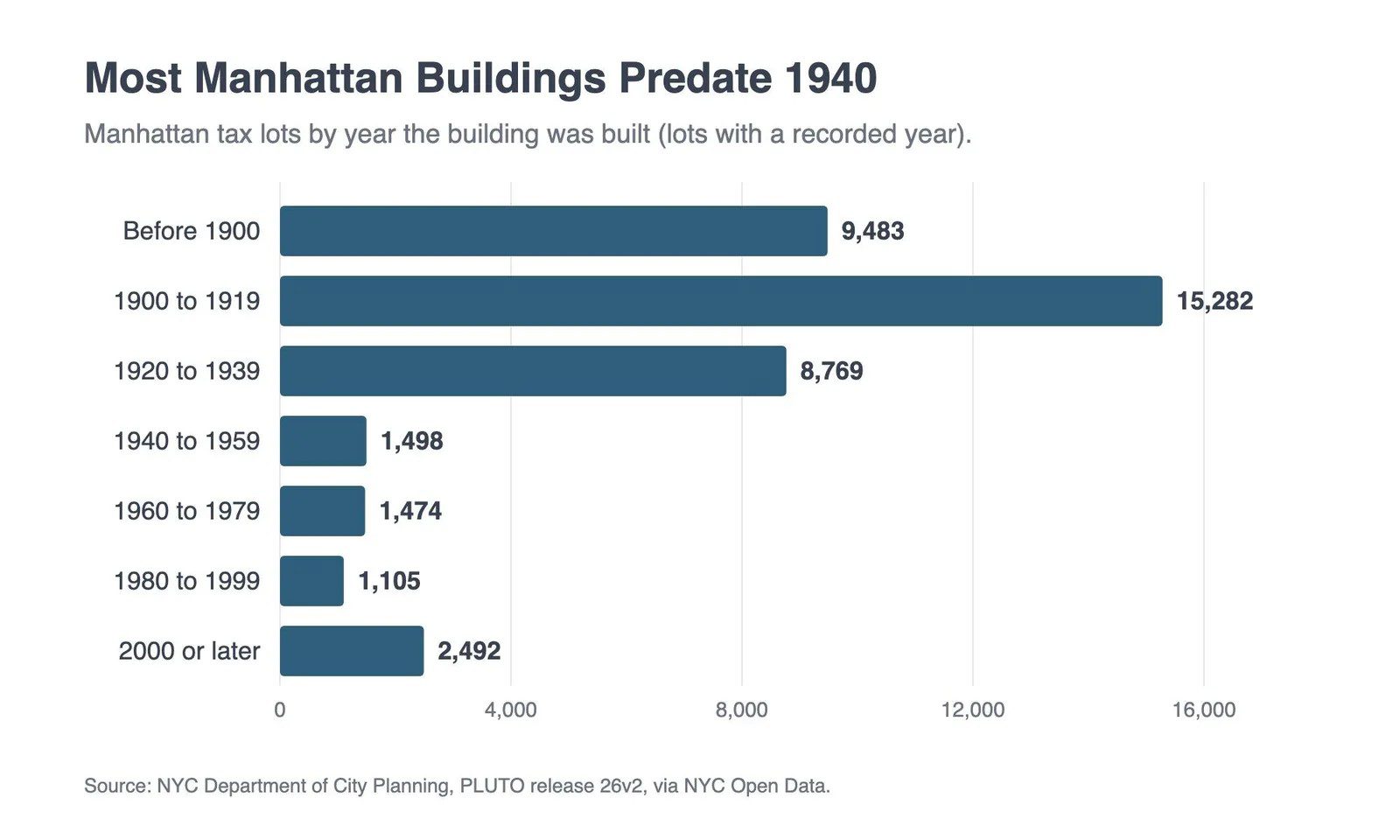
About 84 percent of Manhattan lots with a recorded year were built before 1940.
About 33,500 of them, or roughly 84 percent, were built before 1940. The largest single group dates from 1900 to 1919, and nearly 9,500 lots predate 1900.
Many of those buildings are also protected. The city’s Landmarks Preservation Commission says New York City has more than 38,000 landmark properties, most of them in 157 historic districts and extensions, along with 1,470 individual landmarks.
Why Metal Breaks Down
Each metal ages differently. Brass and bronze tarnish and darken with exposure, while iron rusts and, left alone, can lose material over time.
The National Park Service’s Preservation Brief 27, on architectural cast iron, describes how fast that can happen. It says rusting occurs rapidly when cast iron is exposed to moisture and air, and that the minimum relative humidity needed to promote rusting is 65 percent, lower when corrosive agents are present.
The same brief flags a problem that catches owners off guard. Galvanic corrosion can occur when two dissimilar metals react in the presence of an electrolyte, such as salt-containing water. A steel fastener in a bronze fitting, or a careless repair with the wrong metal, can start trouble that ordinary cleaning will not fix.
The Rule for Cleaning: Gentlest First
The core principle for historic materials is simple. The Secretary of the Interior’s Standards for Rehabilitation say that treatments such as sandblasting that cause damage to historic materials shall not be used, and that surface cleaning shall be undertaken using the gentlest means possible.
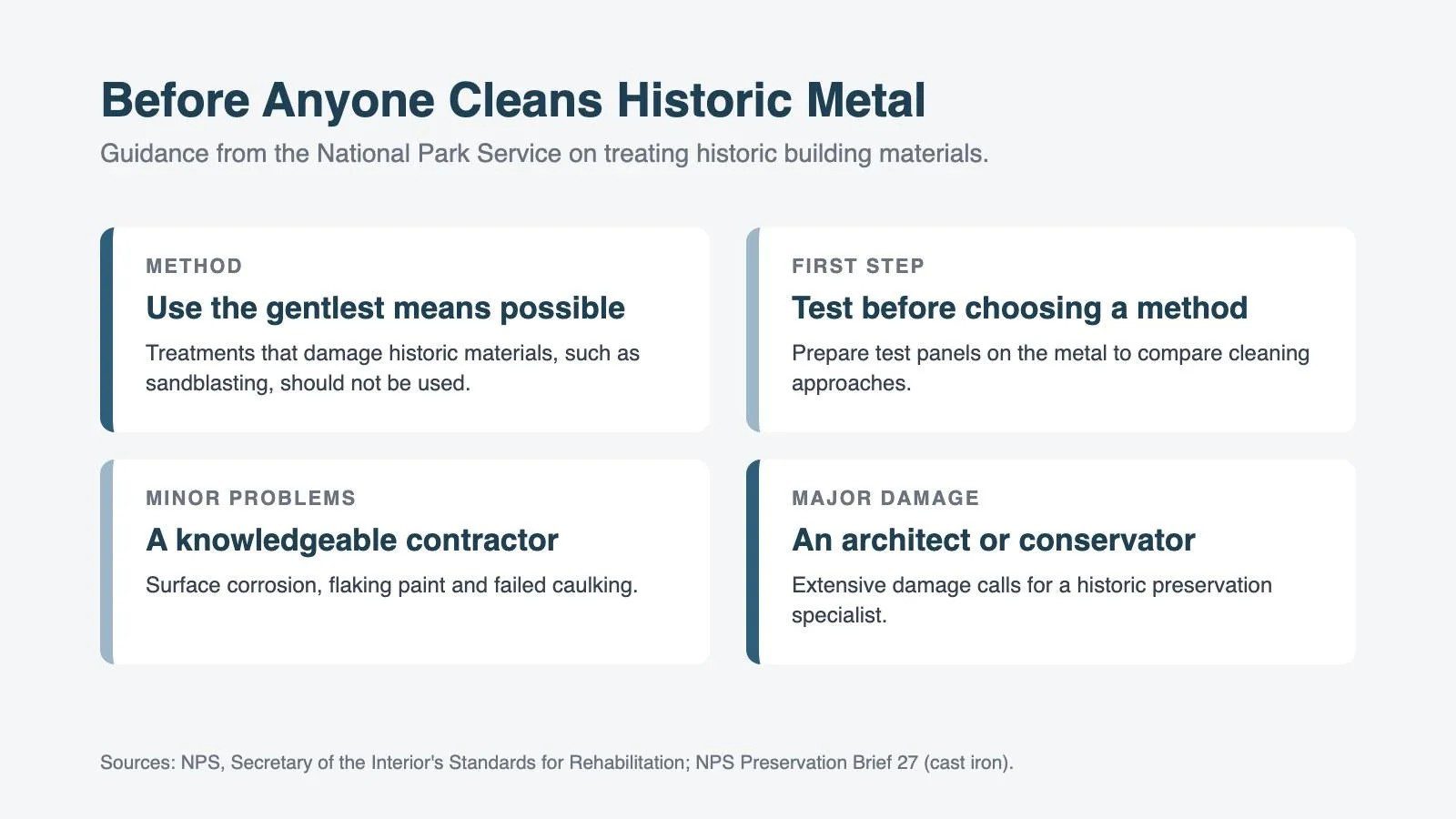
National Park Service guidance on treating historic building metal.
Preservation Brief 27 adds a practical step for iron. Before settling on a process, prepare test panels on the metal to compare how well different cleaning approaches work.
It also warns against shortcuts that look efficient. Wet sandblasting, the brief notes, causes instantaneous surface rusting on cast iron and drives water deep into open joints.
Cleaning Is Not Polishing
Owners routinely use the words interchangeably, but they describe different work. Cleaning and maintenance protect the existing finish, while polishing removes material to create a new one.
That difference matters on old metal. Every aggressive polish removes more of the original surface, so a building cleaned and protected on a schedule tends to need heavy refinishing less often.
Protective coatings are part of the job. A clear lacquer or wax slows tarnish on brass and bronze, but it wears down with weather and handling and has to be renewed before it fails.
Damage You Cannot See From the Sidewalk
Not every problem shows on the surface. Preservation Brief 27 describes graphitization, a less common form of corrosion that occurs in the presence of acid precipitation or seawater.
As the iron corrodes this way, it keeps its appearance and shape but becomes structurally weaker. The brief says it tends to appear where cast iron has been left unpainted for long periods, or where caulked joints have failed, and acidic rainwater has worked on the iron from behind.
The test is blunt. Scraping through the surface with a knife reveals crumbling iron underneath, and where graphitization is extensive, replacing the damaged element is usually the only fix.
That is why the brief calls for a close physical inspection of every section of the ironwork, including bolts, fasteners, and brackets. On a facade, that typically means scaffolding or a mechanical lift rather than a look from the street.
When to Call Which Kind of Help
The scale of the damage decides who should handle it. Preservation Brief 27 says that if the problems are minor, such as surface corrosion, flaking paint, and failed caulking, a property owner may be able to work directly with a knowledgeable contractor.
For major trouble or extensive damage, the brief recommends an architect or conservator who specializes in historic buildings. Landmark status adds another layer, since work on designated properties is regulated by the Landmarks Preservation Commission.
A few questions help sort out the first call:
- Is the metal dull and dirty, or is it cracked, pitted, or missing pieces?
- Are there signs of two different metals touching where corrosion is concentrated?
- Is the building a designated landmark or inside a historic district?
- Has anyone tested a cleaning method on a small area first?
What Routine Care Looks Like
For most buildings, the answer is maintenance, not a dramatic restoration. In the New York area, Metal Man Restoration is one company that describes architectural metal cleaning and maintenance this way.
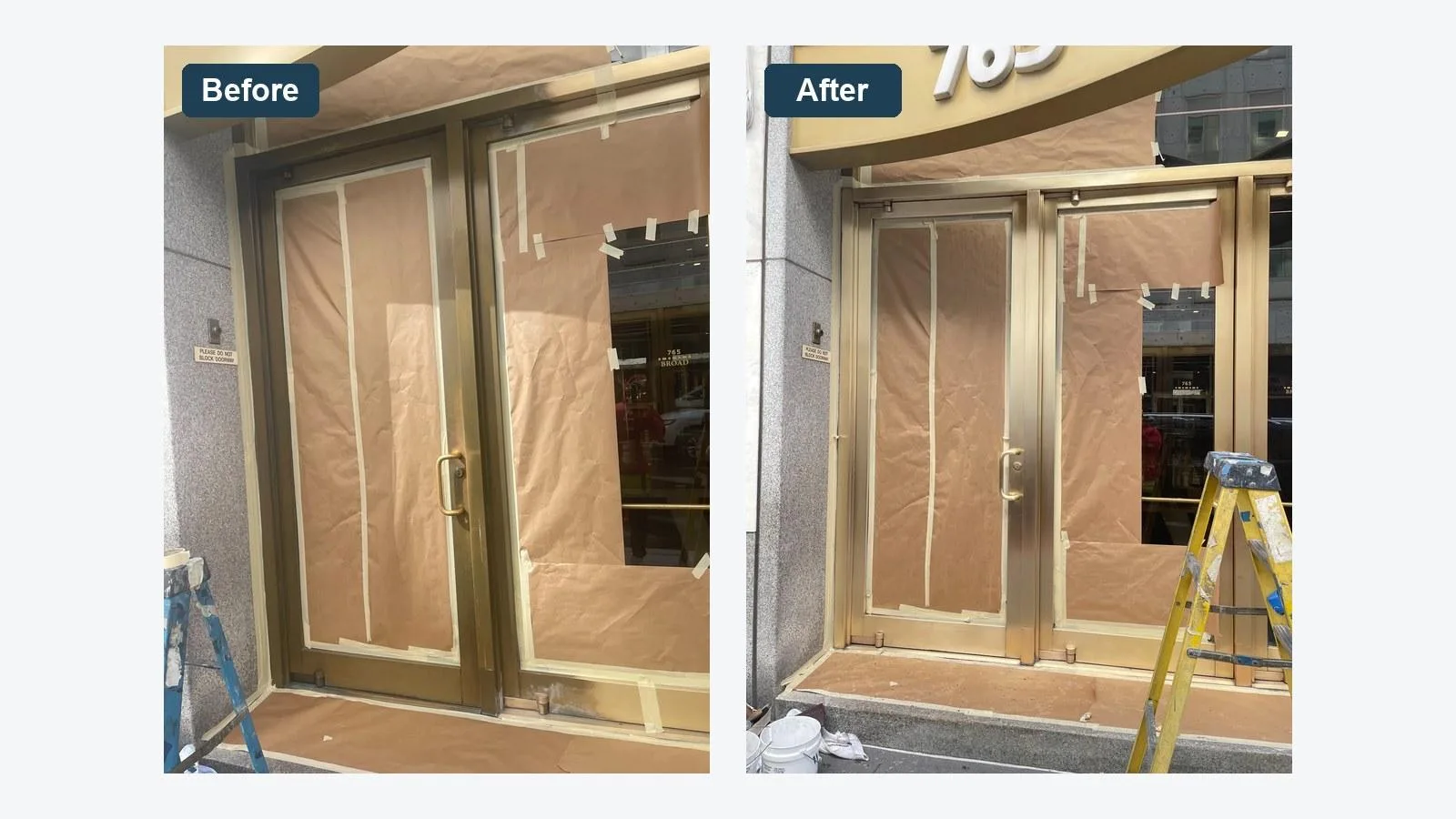
The company says most entrances and lobbies benefit from a scheduled clean and a coating check once or twice a year, with high-traffic and street-level metal often needing more. In September 2026, it refinished and clear-coated a brass entranceway in Newark, New Jersey, masking the glass and stone while the work was done.
Where Building Metal Care Is Heading
Stock won’t get any younger. With most Manhattan lots built before 1940 and tens of thousands of landmark properties across the city, older metal will keep needing attention.
The buildings that hold their character will be the ones treated gently and on a schedule. Cleaning that protects the original surface and repairs matched to the real problem keep a century-old entrance looking like itself.