








WashingtonWeeklyTimes.com
  • Home
  • US News

    Ben Jones, who played Cooter Davenport on ‘The Dukes of Hazzard,’ dead at 84

    NASCAR makes major change to 2027 Daytona 500 week, fans furious with another change & race wife in Costa Rica

    Brooks Koepka calls his season pathetic after missing FedExCup Playoffs

    AOC dismisses past socialist rhetoric as crazy ‘Woke 1’ era times

    AOC dismisses past socialist rhetoric as crazy ‘Woke 1’ era times

    Christopher Nolan filmed ‘The Odyssey’ in Greece, Italy, Scotland, Morocco and more

    Christopher Nolan filmed ‘The Odyssey’ in Greece, Italy, Scotland, Morocco and more

  • Politics

    WOW! Anti-Redistricting RINO Indiana State Senator LOSES to Pro-Trump Challenger Following Recount Three Months After He was Certified the ‘Winner’

    AOC Goes On National Television And Devastates Donald Trump

    Boat Carrying 14 Overturns Near Statue of Liberty Killing Mother and 5-Month-Old Baby – Captain Arrested as Authorities Investigate Possible Illegal Charter

    House Democrats Are Planning A Massive Investigation Into All Of Trump’s Corruption

    House Democrats Are Planning A Massive Investigation Into All Of Trump’s Corruption

  • Business

    ‘A prisoner can oppose incarceration while remaining confined’: The paradox of Gen Z, capitalism, and consumption

    Exclusive: Corma raises $60M from Sequoia, Khosla Ventures for AI trained to defend against cyberattacks

    Apollo’s Slok: AI’s profits are ‘being funded by investors rather than earned from customers’

    An airline canceled a flight and rebooked passengers because a child wouldn’t sit down and buckle up

    An airline canceled a flight and rebooked passengers because a child wouldn’t sit down and buckle up

  • Science

    A California Program Is Bringing Down the Cost of Heat Pumps by Buying Bulk

    About 90 million years ago, a temperate rainforest grew just 900 kilometres from the South Pole; an Antarctic seafloor core preserved its roots, pollen and spores beneath what is now a world of ice

    Europe’s wildfires are igniting forgotten WWII and Cold War bombs

    Here Are the First Images of the Crater Left on the Moon by SpaceX’s Rocket

    Here Are the First Images of the Crater Left on the Moon by SpaceX’s Rocket

  • Technology

    Orange Crush: TAG Heuer Drops a Bright Revamp of the Original Metal F1 Watch

    Google Play adds Venmo as a payment option

    Space Agencies Are Trying to Keep Astronauts From Losing Their Sight

    Embattled hedge fund Situational Awareness invests 0M in chip startup Source Foundry

    Embattled hedge fund Situational Awareness invests $400M in chip startup Source Foundry

  • Lifestyle

    Best Foods for Hair Growth: A Nutritionist’s Guide

    The Real Temperature of Healthcare Capacity

    Charred Corn and Stone Fruit Salad With Feta

    Here’s Why Your Chimney Still Matters in Summer

    Here’s Why Your Chimney Still Matters in Summer

  • Music

    Iceage Announce North American Tour

    Kelly Clarkson Jokes About ‘Perfect’ Body Part Peeking Out During Show

    Eddie Vedder pays tribute to friend Glen Hansard by busking in his spot in Dublin city centre

    Why Nikki Sixx Doesn’t ‘Believe in Making’ LPs Anymore

    Why Nikki Sixx Doesn’t ‘Believe in Making’ LPs Anymore

  • Television

    House of the Dragon Season 3 Finale Somehow Makes the Worst Character One of the Best

    Savannah Guthrie Returns to ‘Today’ After Weeks-Long Break

    Emma D’Arcy Interview About Rhaenyra’s Reaction To Helaena’s Death

    Lioness Season 3 Episode 2 Review: An Adrenaline-Inducing “No Sorrow Like the Survivor” Ups the Stakes

    Lioness Season 3 Episode 2 Review: An Adrenaline-Inducing “No Sorrow Like the Survivor” Ups the Stakes

  • Film

    ‘Tony’ Biopic Was Dreamed Up in Anthony Bourdain’s Favorite Dive Bar

    6 Classic Sci-Fi Movies From 1982 That Prove It’s The Genre’s Greatest Year Ever

    Bouchra review – idiosyncratic furry cinema

    James Gray Learned About a Locarno Award. His Wife Mentioned the Trash

    James Gray Learned About a Locarno Award. His Wife Mentioned the Trash

  • Literature

    Literary Hub » “We Live Inside the Sun.” Who Studies the Universe Changes How We See the Universe

    There’s a Better Version of Myself in These Woods

    Book Riot’s Deals of the Day for August 8, 2026

    Lit Hub Daily: August 7, 2026

    Lit Hub Daily: August 7, 2026

    Aftermath of an Intervention, Part I

    Aftermath of an Intervention, Part I

    Book Riot’s Deals of the Day for August 9, 2026

    Book Riot’s Deals of the Day for August 9, 2026

    Lit Hub Weekly: August 3 – 7, 2026

    Lit Hub Weekly: August 3 – 7, 2026

    7 Memoirs About Discovering Close Relatives Late in Life

    7 Memoirs About Discovering Close Relatives Late in Life

    Right Wing “See You at the Library” Event Back for 2026

    Right Wing “See You at the Library” Event Back for 2026

  • Contact
    • About
  • Home
  • US News

    Ben Jones, who played Cooter Davenport on ‘The Dukes of Hazzard,’ dead at 84

    NASCAR makes major change to 2027 Daytona 500 week, fans furious with another change & race wife in Costa Rica

    Brooks Koepka calls his season pathetic after missing FedExCup Playoffs

    AOC dismisses past socialist rhetoric as crazy ‘Woke 1’ era times

    AOC dismisses past socialist rhetoric as crazy ‘Woke 1’ era times

    Christopher Nolan filmed ‘The Odyssey’ in Greece, Italy, Scotland, Morocco and more

    Christopher Nolan filmed ‘The Odyssey’ in Greece, Italy, Scotland, Morocco and more

  • Politics

    WOW! Anti-Redistricting RINO Indiana State Senator LOSES to Pro-Trump Challenger Following Recount Three Months After He was Certified the ‘Winner’

    AOC Goes On National Television And Devastates Donald Trump

    Boat Carrying 14 Overturns Near Statue of Liberty Killing Mother and 5-Month-Old Baby – Captain Arrested as Authorities Investigate Possible Illegal Charter

    House Democrats Are Planning A Massive Investigation Into All Of Trump’s Corruption

    House Democrats Are Planning A Massive Investigation Into All Of Trump’s Corruption

  • Business

    ‘A prisoner can oppose incarceration while remaining confined’: The paradox of Gen Z, capitalism, and consumption

    Exclusive: Corma raises $60M from Sequoia, Khosla Ventures for AI trained to defend against cyberattacks

    Apollo’s Slok: AI’s profits are ‘being funded by investors rather than earned from customers’

    An airline canceled a flight and rebooked passengers because a child wouldn’t sit down and buckle up

    An airline canceled a flight and rebooked passengers because a child wouldn’t sit down and buckle up

  • Science

    A California Program Is Bringing Down the Cost of Heat Pumps by Buying Bulk

    About 90 million years ago, a temperate rainforest grew just 900 kilometres from the South Pole; an Antarctic seafloor core preserved its roots, pollen and spores beneath what is now a world of ice

    Europe’s wildfires are igniting forgotten WWII and Cold War bombs

    Here Are the First Images of the Crater Left on the Moon by SpaceX’s Rocket

    Here Are the First Images of the Crater Left on the Moon by SpaceX’s Rocket

  • Technology

    Orange Crush: TAG Heuer Drops a Bright Revamp of the Original Metal F1 Watch

    Google Play adds Venmo as a payment option

    Space Agencies Are Trying to Keep Astronauts From Losing Their Sight

    Embattled hedge fund Situational Awareness invests 0M in chip startup Source Foundry

    Embattled hedge fund Situational Awareness invests $400M in chip startup Source Foundry

  • Lifestyle

    Best Foods for Hair Growth: A Nutritionist’s Guide

    The Real Temperature of Healthcare Capacity

    Charred Corn and Stone Fruit Salad With Feta

    Here’s Why Your Chimney Still Matters in Summer

    Here’s Why Your Chimney Still Matters in Summer

  • Music

    Iceage Announce North American Tour

    Kelly Clarkson Jokes About ‘Perfect’ Body Part Peeking Out During Show

    Eddie Vedder pays tribute to friend Glen Hansard by busking in his spot in Dublin city centre

    Why Nikki Sixx Doesn’t ‘Believe in Making’ LPs Anymore

    Why Nikki Sixx Doesn’t ‘Believe in Making’ LPs Anymore

  • Television

    House of the Dragon Season 3 Finale Somehow Makes the Worst Character One of the Best

    Savannah Guthrie Returns to ‘Today’ After Weeks-Long Break

    Emma D’Arcy Interview About Rhaenyra’s Reaction To Helaena’s Death

    Lioness Season 3 Episode 2 Review: An Adrenaline-Inducing “No Sorrow Like the Survivor” Ups the Stakes

    Lioness Season 3 Episode 2 Review: An Adrenaline-Inducing “No Sorrow Like the Survivor” Ups the Stakes

  • Film

    ‘Tony’ Biopic Was Dreamed Up in Anthony Bourdain’s Favorite Dive Bar

    6 Classic Sci-Fi Movies From 1982 That Prove It’s The Genre’s Greatest Year Ever

    Bouchra review – idiosyncratic furry cinema

    James Gray Learned About a Locarno Award. His Wife Mentioned the Trash

    James Gray Learned About a Locarno Award. His Wife Mentioned the Trash

  • Literature

    Literary Hub » “We Live Inside the Sun.” Who Studies the Universe Changes How We See the Universe

    There’s a Better Version of Myself in These Woods

    Book Riot’s Deals of the Day for August 8, 2026

    Lit Hub Daily: August 7, 2026

    Lit Hub Daily: August 7, 2026

    Aftermath of an Intervention, Part I

    Aftermath of an Intervention, Part I

    Book Riot’s Deals of the Day for August 9, 2026

    Book Riot’s Deals of the Day for August 9, 2026

    Lit Hub Weekly: August 3 – 7, 2026

    Lit Hub Weekly: August 3 – 7, 2026

    7 Memoirs About Discovering Close Relatives Late in Life

    7 Memoirs About Discovering Close Relatives Late in Life

    Right Wing “See You at the Library” Event Back for 2026

    Right Wing “See You at the Library” Event Back for 2026

  • Contact
    • About
No Result
View All Result
WashingtonWeeklyTimes.com
No Result
View All Result
Home Business

‘A prisoner can oppose incarceration while remaining confined’: The paradox of Gen Z, capitalism, and consumption

by
August 10, 2026
in Business


“A worker can oppose capitalism while still being forced to sell labor and buy necessities,” the reader wrote to me, “just as a prisoner can oppose incarceration while remaining confined.” Buying a secondhand jacket or a $5 treat—or waiting on a long line in a bout of “democratized snobbery” or “conspicuous waiting”—doesn’t abolish wages, rent, debt or the fact someone else owns the means of production. It just changes how a person survives inside a system they have no way to leave.

He’s right. Just because you spend money in capitalism doesn’t mean you love it as a way of organizing economic life. What’s interesting to me, though, is every generation since the original countercultural capitalists—the baby boomers—has expressed some version of this antipathy. What’s changing is what happens to that opposition afterward, as a generation grows up, gets a mortgage and a career, and joins the masses. Even if you think generational framing is like financial astrology, these dynamics reveal something genuine about the evolution of society—and business’ role in it.

Up until now, this tension has more or less resolved itself as generations grow up and grow less radical as the fruits of their labor are recognized. But economic data increasingly suggests this mechanism may be breaking down. And maybe, to paraphrase a cultural critic who still haunts these times, Gen Z is responding to a future that has slowly been getting canceled for a long time.

The prison that doesn’t need bars

The reader’s prisoner metaphor is useful beyond the economics. The British writer Mark Fisher, aka “K-punk,” spent much of his career arguing capitalism’s most effective tool isn’t coercion—it’s the capture of the imagination. His term for this was “capitalist realism“: the system’s capacity to make itself feel like the only conceivable arrangement. He built on Frederic Jameson‘s quote that “it is easier to imagine the end of the world than the end of capitalism” to argue it’s easier to imagine the end of capitalism than whatever comes afterward. To paraphrase my reader, the prison works not because the bars are strong, but because the prisoner can no longer picture the outside. Opposition persists; the idea of an alternative doesn’t.

Fisher’s related concept—”the slow cancellation of the future“—extended this to culture. Since the 1990s, he argued, art and music had been stuck recycling the past not because nothing was happening, but because the culture had lost the capacity to imagine a future meaningfully different from the present. The music critic Simon Reynolds reached the same destination from a different direction in his 2011 book Retromania: Pop culture had become addicted to its own past, the internet making all of recorded music history simultaneously accessible and paradoxically producing less genuine innovation rather than more. Where previous generations related to a specific, bounded nostalgia, the post-internet era recycled everything at once, all decades available for simultaneous revival, none of them pointing forward.

The writer Freddie deBoer has argued something compatible but distinct, what he calls “the long boring“: the stagnation isn’t a recent phenomenon. The American cultural and technological landscape has been flat since at least the 1970s, he contends—predating both 2008 and the internet—and most of what reads today as political urgency is really just content, media cycling through moral controversies that generate engagement but no leverage. Economic historian Marc Levinson offered up this thesis in book form with An Extraordinary Time, which argued everything following the 1970s in American culture and society has reflected a less innovative, less productive economy. Brad DeLong also took a spin on the subject in book form, arguing for a productivity boom in the 1990s, petering out by 2008.

Here is how the last four generations have weathered this great economic slowdown, and how it shaped their attitudes down to the present.

1971: the revolution’s own verdict on itself

In 1971, Pete Townshend wrote arguably the sharpest line the counterculture ever produced about itself. “Won’t Get Fooled Again” arrived on The Who’s classic album Who’s Next after Kent State, after the peak of New Left radicalism, and its refrain—meet the new boss, same as the old boss—was a warning revolution doesn’t touch the underlying structure of power; it just replaces the faces at the top. The man who had previously written the line, “hope I die before I get old” rode that message to massively lucrative rock stardom in his own old age and world tours that lasted until 2025, at the latest count.

Townshend’s cynicism proved prescient as the generation that marched, occupied, and dropped out in the late 1960s spent the 1970s watching the New Left splinter. Tom Wolfe caught the pivot in real time: His 1976 essay “The Me Decade” argued postwar prosperity had given ordinary Americans, for the first time in history, enough surplus wealth and leisure to stop thinking about collective politics and start thinking about themselves. Est, primal therapy, encounter groups—the communal energy of the 1960s didn’t die so much as it privatized. By the 1980s, the generation that had once marched on the Pentagon had become the yuppie class—homeowners, 401(k) pioneers, the cohort that built the modern investor class. Oliver Stone made Gordon Gekko a villain in 1987 and watched a generation decide he was actually the hero for saying “greed is good.”

Youthful radicalism wasn’t crushed so much as absorbed—capitalist realism operating exactly as Fisher would come to describe it, the system making ownership feel not just desirable but natural, inevitable, the only sane endpoint for a person who had been young once and was now just practical. Pew’s long-running surveys showed roughly seven in 10 baby boomers holding a positive view of capitalism as of 2022—the highest of any living generation. (More recent data, from Gallup, shows a decline in this faith, but doesn’t break out along generational lines.)

Baby boomers’ advice to their children was almost always the same: “Follow your heart and your intuition,” as Steve Jobs put it in the 2005 Stanford commencement address that became the most-watched graduation speech in history—and it likely stemmed from the fact it paid off for all the hippies-turned-stockbrokers and tech moguls just fine.

Generation X’s quieter dissent, and the decade that punished it

Generation X never got its own Kent State. Its anti-establishment current ran through grunge, slacker cinema, and the “sell-out” stigma that governed 1990s indie culture—a real skepticism of consumer capitalism that dissolved more often into irony and withdrawal than organized action. Kurt Cobain wrote the generation’s self-critique into the opening line of In Utero, his last studio album: “Teenage angst has paid off well / Now I’m bored and old.” He died at 27 the following year, which meant he never had to figure out how to age into the system the way Townshend did. The one moment it did mobilize at scale, the 1999 Seattle protests against the World Trade Organization, came right before the internet boom and bust reshuffled the economy again.

Then came 2008. They were 28 to 43 years old when the housing market collapsed—precisely the years most people buy their first homes and build retirement savings—and studies of the Great Recession found Gen X suffered the deepest home-equity losses of any cohort, with net worth down roughly 40% at the crisis’ trough. They did eventually recover, becoming the only generation to fully regain its lost wealth by the mid-2010s. But the recovery came through rising asset prices, not rising wages, and Gen X now carries the highest average credit-card debt of any generation. They didn’t get out from under capitalism’s demands. They got pulled back in on worse terms.

The fork in the road

The recovery from the 2008 crisis grew the value of assets—homes, stocks, and portfolios—faster than it grew wages or employment. Economists studying the post-recession years have found this asymmetry systematically rewarded people who already owned capital before the crash and penalized everyone who didn’t yet have any.

That single fact splits the four living generations into something more complicated than a clean divide. Baby boomers got out before the door closed; most had already built home equity and retirement savings by 2008. Gen X got hurt badly but had enough of a head start to claw back through the same asset appreciation that was leaving wage-earners behind. Older millennials appear to have caught the last window: In their late 20s and early 30s as the recovery took hold, many were able to lock in 30-year mortgages at 3% or 4% before the rate spike that followed—the final cohort to ride low interest rates into something resembling the asset-building ladder their parents climbed.

Younger millennials and Gen Z weren’t so lucky. They graduated into the worst hiring market in decades, and research on recession-era graduates shows that each additional point of unemployment at graduation costs a worker years of depressed wages. By the time they had saved enough to buy in, both prices and rates had moved against them. Gen Z arrived even later, inheriting a labor and housing market already reshaped by that double squeeze.

Gallup’s trend data captures the result. Compared with the same age bracket in 2010, today’s under-50 adults are dramatically less likely to hold a positive view of capitalism, while opinions among older Americans have barely moved. Some see it as just the way life goes; others see it as something more like a prison you can’t escape.

Millennials organized. Then the door stayed closed

Millennials did organize, chaotically, around this dynamic. Occupy Wall Street, in 2011, was the largest anti-capitalist mobilization in decades, and it put “the 99 percent” into permanent political vocabulary. It assumed, explicitly, the terms were negotiable—that naming the asymmetry loudly enough would compel the system to address it.

Five years later, Sen. Bernie Sanders (I-Vt.) converted that same energy into something the political system could almost absorb: a primary campaign that came closer to a major-party presidential nomination than any explicitly anti-capitalist candidate in a century. His platform—Medicare for All, student debt cancellation, and a wealth tax—was radical by American standards and entirely conventional by the standards of most rich democracies. It lost twice, on controversial terms some still debate. What followed wasn’t another organizing cycle; it was a slow dispersal of that energy into causes more legible to existing institutions, or into exhaustion.

Student debt remains a hot-button issue for the younger generations, as it both encouraged organization, preserved relative impoverishment, and fueled lingering resentment. You can’t become a homeowner-investor and a debtor simultaneously, not when housing prices are moving the way they have. Millennials spent the decade after 2008 demanding a fairer system while still trapped inside it.

Gen Z’s different starting point

Gen Z’s opposition looks different from the start, and the difference shows up in trust data before it shows up in memes. A Gallup and Walton Family Foundation survey found Gen Z’s confidence running low across most major institutions—just 16% in the news media, 17% in technology companies, and 23% in the criminal justice system—while Pew Research has separately found adults under age 30 consistently less confident than older Americans across a wide range of institutions, from the military (69% vs. 92% for those 65 and older) to police and religious leaders.

The phrases that followed—bare minimum Monday, quiet quitting, and “Gen Z does not dream of labor“—are not demands. They are descriptions: work as a transaction to be minimized, not a system worth arguing with. It’s a fitting takeaway for a generation whose childhood was defined by the “jobless recovery” of the 2010s.

The unsettling part is this isn’t only a story about 2008. It’s happening again, right now, without a recession to explain it. Labor force participation—the share of Americans age 16 and older working or actively looking for work—fell from about 62.5% last November to 61.4% in July, the lowest reading outside the pandemic in roughly 50 years, as Michigan State professor Jason Miller pointed out on LinkedIn after dramatically disappointing jobs report data.
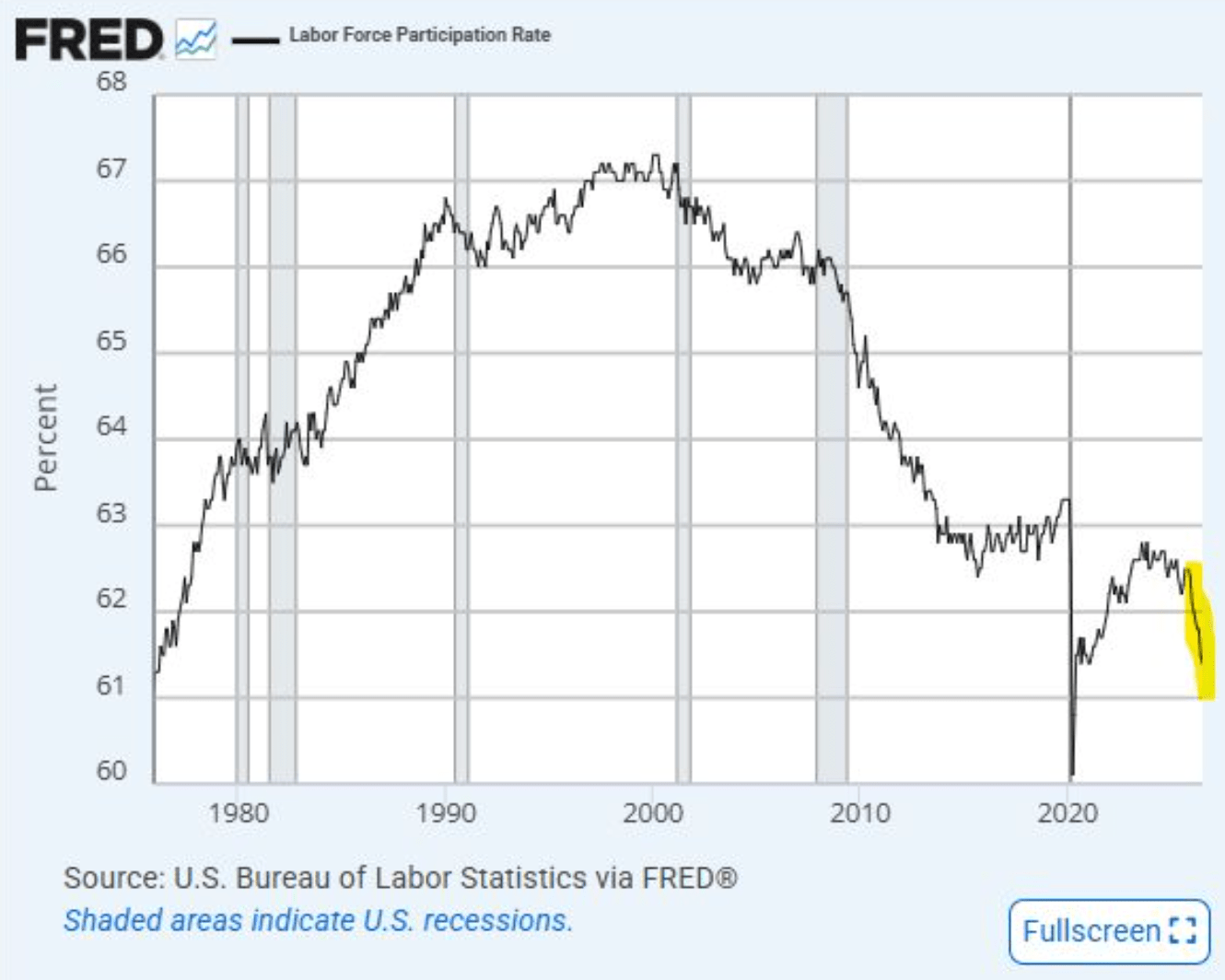
Economists at the St. Louis Fed have flagged the speed of the drop as unusual: Participation had held in a narrow band for nearly three years before suddenly falling off, with the steepest declines concentrated not among retirees but among workers age 25 to 54—prime working age. That rules out the comfortable explanation older Americans are simply retiring early on appreciated stock portfolios. The people leaving the labor force are the people who are supposed to be building careers, buying homes, and raising families—the ones who need to see capitalism as a solution, not a prison.

Unemployment, meanwhile, sits at a placid 4.1%, and GDP growth remains modestly positive. Economists disagree about why. Some point to a genuine shortage of available workers as immigration slows and the population ages, others to discouraged workers giving up the search. But either explanation describes an economy quietly closing doors rather than opening them.

Layered onto this is a second problem: The productivity boom that AI enthusiasm has assumed is coming may not arrive on schedule. The U.S. has produced only two sustained productivity booms since World War II, in the 1960s and the 1990s, and both rode alongside above-trend growth in real GDP and the labor force itself. Most current forecasts, including Goldman Sachs’ and the Wharton Budget Model’s, project AI’s contribution to productivity as gradual—a percentage point or two of GDP over a decade, not a 1990s-style surge—because a shrinking, disengaged labor force can’t generate the kind of broad-based growth that made past booms feel real to ordinary workers.

A productivity gain achieved by fewer people working, rather than by more people working more effectively, won’t feel like prosperity. It will feel like exactly what the last two years have felt like: a healthy economy on paper, and a shrinking set of paths into it in practice. The future: still canceled.




Original Source Link

Previous Post

WOW! Anti-Redistricting RINO Indiana State Senator LOSES to Pro-Trump Challenger Following Recount Three Months After He was Certified the ‘Winner’

Next Post

Iceage Announce North American Tour

Next Post

Iceage Announce North American Tour

Literary Hub » “We Live Inside the Sun.” Who Studies the Universe Changes How We See the Universe

PopularPosts

Victim of sexual and spiritual abuse by famous Jesuit goes public

Victim of sexual and spiritual abuse by famous Jesuit goes public

February 21, 2024
Bon Iver’s Justin Vernon Publishing Poems for the First Time in Literary Arts Magazine

Bon Iver’s Justin Vernon Publishing Poems for the First Time in Literary Arts Magazine

March 14, 2025
David Letterman, Colbert Cancelled, ‘Late Show’ CBS, Statement

David Letterman, Colbert Cancelled, ‘Late Show’ CBS, Statement

July 26, 2025
Rey Mysterio on His A&E ‘Biography’ & Being WWE’s Biggest Underdog Success

Rey Mysterio on His A&E ‘Biography’ & Being WWE’s Biggest Underdog Success

August 27, 2022
Slipknot’s Clown Worries About Future Festival Headliners

Slipknot’s Clown Worries About Future Festival Headliners

December 16, 2024
Bill Gates says he’s ‘not involved’ in crypto, sees it as ‘greater fool’ investment

Bill Gates says he’s ‘not involved’ in crypto, sees it as ‘greater fool’ investment

June 15, 2022

Categories

  • Business (7,735)
  • Events (12)
  • Film (7,665)
  • Lifestyle (5,417)
  • Literature (5,781)
  • Music (7,719)
  • Politics (7,435)
  • Science (7,107)
  • Technology (7,660)
  • Television (7,728)
  • Uncategorized (6)
  • US News (7,768)

RecentPosts

Literary Hub » “We Live Inside the Sun.” Who Studies the Universe Changes How We See the Universe

by
August 10, 2026

On Wednesday, the small slice of humanity which is scattered...

Iceage Announce North American Tour

by
August 10, 2026

Iceage will head to North America for a tour next...

‘A prisoner can oppose incarceration while remaining confined’: The paradox of Gen Z, capitalism, and consumption

by
August 10, 2026

“A worker can oppose capitalism while still being forced to...

WOW! Anti-Redistricting RINO Indiana State Senator LOSES to Pro-Trump Challenger Following Recount Three Months After He was Certified the ‘Winner’

by
August 10, 2026

RINO Indiana State Senator Spencer Deery. Credit: Indiana General Assembly...

Ben Jones, who played Cooter Davenport on ‘The Dukes of Hazzard,’ dead at 84

by
August 10, 2026

NEWYou can now listen to Fox News articles! "The Dukes...

Orange Crush: TAG Heuer Drops a Bright Revamp of the Original Metal F1 Watch

by
August 10, 2026

One element of the ’80s F1 rubber straps that has...

Archives

Editor's Picks

Book Riot’s Deals of the Day for August 9, 2026

Book Riot’s Deals of the Day for August 9, 2026

August 9, 2026
How spaceflight changes astronauts’ ability to eat and drink

How spaceflight changes astronauts’ ability to eat and drink

August 9, 2026
WWE news: Brie Bella reveals broken scapula after six-woman SummerSlam match

WWE news: Brie Bella reveals broken scapula after six-woman SummerSlam match

August 4, 2026

Browse By Category

  • Business (7,735)
  • Events (12)
  • Film (7,665)
  • Lifestyle (5,417)
  • Literature (5,781)
  • Music (7,719)
  • Politics (7,435)
  • Science (7,107)
  • Technology (7,660)
  • Television (7,728)
  • Uncategorized (6)
  • US News (7,768)

Useful Links

  • Anti-Spam Policy
  • Copyright Notice
  • DMCA Compliance
  • Earnings Disclaimer
  • Fair Use Disclaimer
  • FTC Compliance
  • Medical Disclaimer
  • Privacy Policy
  • Social Media Disclaimer
  • Terms and Conditions

Copyright © 2022 by Washington Weekly Times. All rights reserved. All articles, images, product names, logos, and brands are property of their respective owners. All company, product and service names used in this website are for identification purposes only. Use of these names, logos, and brands does not imply endorsement unless specified. By using this site, you agree to the Terms of Use and Privacy Policy.

No Result
View All Result
  • Home
  • US News
  • Politics
  • Business
  • Science
  • Technology
  • Lifestyle
  • Music
  • Television
  • Film
  • Literature
  • Contact
    • About

Copyright © 2022 by Washington Weekly Times. All rights reserved. All articles, images, product names, logos, and brands are property of their respective owners. All company, product and service names used in this website are for identification purposes only. Use of these names, logos, and brands does not imply endorsement unless specified. By using this site, you agree to the Terms of Use and Privacy Policy.

We use cookies on our website to give you the most relevant experience by remembering your preferences and repeat visits. By clicking “Accept All”, you consent to the use of ALL the cookies. However, you may visit "Cookie Settings" to provide a controlled consent.
Cookie SettingsAccept All
Manage consent

Privacy Overview

This website uses cookies to improve your experience while you navigate through the website. Out of these, the cookies that are categorized as necessary are stored on your browser as they are essential for the working of basic functionalities of the website. We also use third-party cookies that help us analyze and understand how you use this website. These cookies will be stored in your browser only with your consent. You also have the option to opt-out of these cookies. But opting out of some of these cookies may affect your browsing experience.
Necessary
Always Enabled
Necessary cookies are absolutely essential for the website to function properly. These cookies ensure basic functionalities and security features of the website, anonymously.
CookieDurationDescription
cookielawinfo-checkbox-analytics11 monthsThis cookie is set by GDPR Cookie Consent plugin. The cookie is used to store the user consent for the cookies in the category "Analytics".
cookielawinfo-checkbox-functional11 monthsThe cookie is set by GDPR cookie consent to record the user consent for the cookies in the category "Functional".
cookielawinfo-checkbox-necessary11 monthsThis cookie is set by GDPR Cookie Consent plugin. The cookies is used to store the user consent for the cookies in the category "Necessary".
cookielawinfo-checkbox-others11 monthsThis cookie is set by GDPR Cookie Consent plugin. The cookie is used to store the user consent for the cookies in the category "Other.
cookielawinfo-checkbox-performance11 monthsThis cookie is set by GDPR Cookie Consent plugin. The cookie is used to store the user consent for the cookies in the category "Performance".
viewed_cookie_policy11 monthsThe cookie is set by the GDPR Cookie Consent plugin and is used to store whether or not user has consented to the use of cookies. It does not store any personal data.
Functional
Functional cookies help to perform certain functionalities like sharing the content of the website on social media platforms, collect feedbacks, and other third-party features.
Performance
Performance cookies are used to understand and analyze the key performance indexes of the website which helps in delivering a better user experience for the visitors.
Analytics
Analytical cookies are used to understand how visitors interact with the website. These cookies help provide information on metrics the number of visitors, bounce rate, traffic source, etc.
Advertisement
Advertisement cookies are used to provide visitors with relevant ads and marketing campaigns. These cookies track visitors across websites and collect information to provide customized ads.
Others
Other uncategorized cookies are those that are being analyzed and have not been classified into a category as yet.
SAVE & ACCEPT