




















The titular last photograph in Zack Snyder’s morally vile, intellectually void, badly made and interminably dull The Last Photograph is a nude. Ethan Black (Stuart Martin) once shared a moment of instinctive, animal passion with his brother’s bride Catherine (Costanza Andrade) while driving her back to “graduate school at Georgetown,” but both knew it couldn’t last. As a parting gift, she gifted him a rosary and posed for a Polaroid, something by which he’ll always be able to remember this moment out of time. Right before he takes the snap, she pulls her top down, like Judy Greer in Arrested Development: Say goodbye to these, because it’s the last time you’ll ever see them.
Ethan eventually sees Catherine again, in another photograph. Having left behind his old life as a DEA agent, he now lives in Iceland, working as a shepherd; he has a talent — comparable, it is said, to some sort of high priest of death — for leading the lambs to slaughter, soothing them with prayer before slitting their throats. Bringing home a lamb loin wrapped in newspaper one evening for dinner, he happens to see, on the front page of a Reykjavík daily, that Catherine and his brother, a mid-level diplomat, have been murdered in an unnamed South American country. The apparently widely reprinted photo of her execution style-death, a horrific image in the lineage of Eddie Adams’ ‘Saigon Execution’, was captured by Joe Wallace (Fra Fee), a conflict photographer who had been hired to take some snaps of Catherine’s son’s ninth birthday party.
Get more Little White Lies
So Ethan carries that last topless photograph of Catherine close to his heart as he returns to his old ways and to the Global South, where he once served as some kind of military advisor. Guilt-stricken over his brother and Catherine’s death, and the abduction of their son and daughter, he tracks down Wallace, who can ID the triggerman, paying him to accompany him upriver to find Catherine’s daughter. Wallace brings his heroin kit and his many, many beaded bracelets.
What follows, in which Ethan and his sidekick chase a lost girl taken deep into the wilderness by ethnic others, is a loose remake of John Ford’s The Searchers, a fact underscored by frequent shots framed through a doorway. In The Searchers, John Wayne, the iconic movie cowboy, played the haunted and hateful Ethan Edwards, whose dark obsession with rescuing his brother’s daughter Debbie from her Comanche abductors serves to reveal the violent pathology and profound racial animus by which the West was won. Snyder’s Ethan, in contrast, is a total badass, kicking ass and taking no names as he carves a swath of extrajudicial through a sinister city of used or lecherous sex workers and decadent genderqueer brothels, and a jungle of paedo crime lords, vicious militia factions and toothless jungle priests ritually brutalizing women.
In contrast to these primitive South Americans (the film was shot in Colombia, though the location is not specified), Ethan is a Christlike figure, complete with a bullet wound right where the Lance of Longinus would have pierced the flesh of Jesus, just down and to the side of his bulbous abs. In his earlier life, he had been deep in the jungle, training a tribe of Indigenous freedom fighters — the massacre and abduction may be a form of blowback for American military intervention in South American guerrilla warfare, though it is entirely unclear whose side Ethan was or is now on. While in the jungle, he went native, taking so much ayahuasca that he “forgot [his] Christian name,” and was taken by the tribespeople as a messianic figure. The script calls in a more or less constant stream of symbolic lost lambs, making Ethan’s vigilante rampage into a messiah’s return, and his search into a self-sacrificial quest to unburden himself of the violence he has committed and continues to commit across an endless 135 minutes of CGI squibs. Martin conveys Ethan’s moral anguish by fixing his face in a more or less permanent grimace.
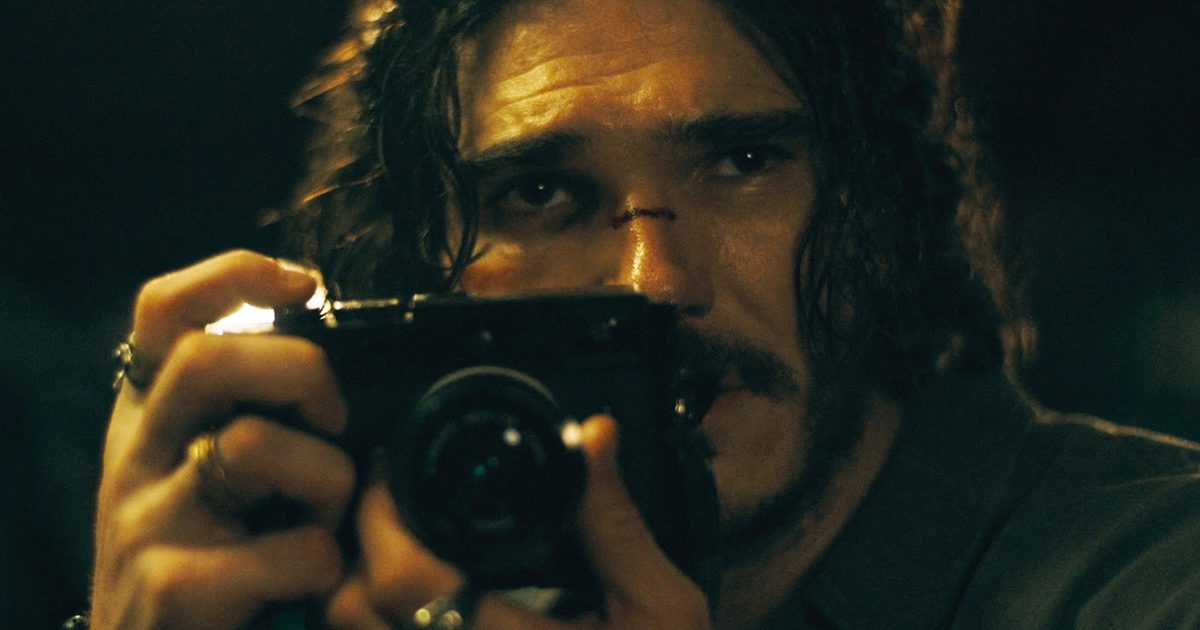
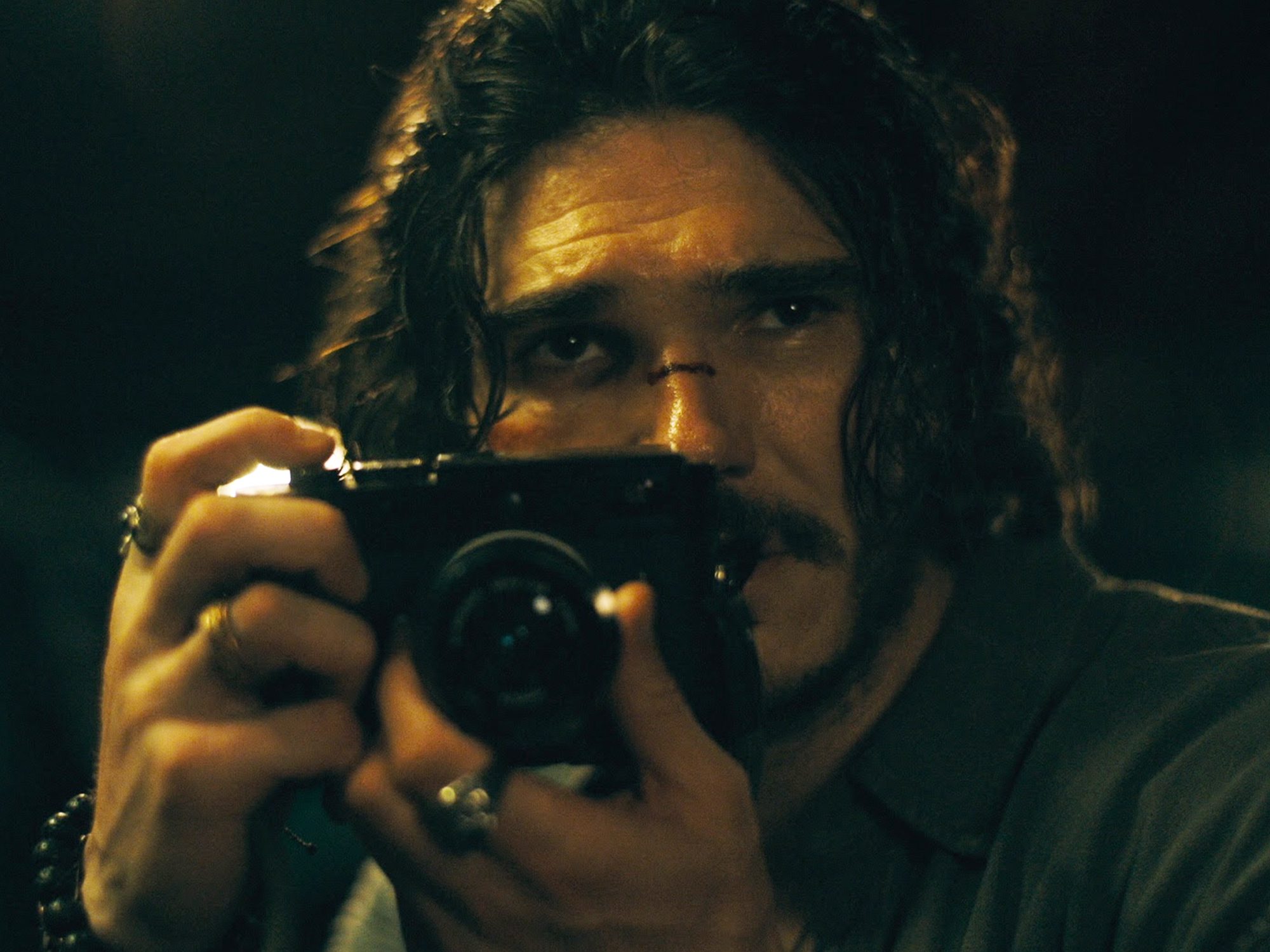
As Ethan wields his gun, Wallace wields his camera. In the film’s opening scene, his assistant initiates a quickie right before they’re supposed to go photograph Catherine’s son blowing out the cameras; Snyder’s camera pans away from her face down to her breasts as she wriggles out of her dress (the character does not appear in the film after this sequence). But even as she’s riding him, he grabs his camera — “ever the voyeur,” she chides him, but he’s not photographing her, he’s photographing the butterfly flitting around a lightbulb, “like a moth to a goddam flame,” a line of dialogue will clarify much later. Wallace reaches for his camera reflexively, like a fidget spinner, whenever the bullet starts flying, beginning at the birthday party, when he rushes toward the sound of gunfire and follows directly behind the assassins, apparently just outside of their peripheral vision, as they stalk through the party headshotting numerous small children.
Quite shredded for a heroin addict, the frequently shirtless Wallace is detached from the moral implications of his photography. In showing Wallace as a benumbed bystander, chasing thrills as he chases the next shot, Snyder, who has described The Last Photograph as a very personal story, performs penitence for his career-making kickass images of extreme suffering. Wallace finally chooses a side; rather than a staying a wishy-washy atheist (“I can intellectualize morality” is a typically turgid line of dialogue), he finally becomes a man of action and conviction by becoming Ethan’s acolyte, following him upriver across a border where military cover isn’t authorized, like a covert incursion into Cambodia during the Vietnam War.
For a film about war photography, The Last Photographic is remarkably bereft of dynamic images. Snyder, who has worked on some version of this material across two decades (it came close to being made in 2011, with Sean Penn and Christian Bale), finally made the film independently for around $10 million, and works as his own cinematographer, rendering Colombia in a dull and lurid palette of muddy colors. Action scenes are handheld, cramped and disjointed, rather than the splash-panel extravaganzas and slo-mo virtuosity that have earned Snyder the reputation in some quarters as a pop virtuoso. His one attempt at a comic-book setpiece, when a Jeep driver pops in a tape of Morrissey’s gangbanger anthem “First of the Gang To Die” and then crashes through a roadblock for no reason, is forced and truncated.
A skyward-gazing pilgrim’s progress larded with religious iconography, whose characters speak in long parables that end with homilies like “all we’re left with is the cries of the dying,” The Last Photograph is awestruck by the harsh violence and epic antihero’s journeys of the Vietnam War, or more accurately of Vietnam movies. It shocks and awes the viewer, confusing brute force for real power; its God is an awesome God. A bitchin’ God. A totally rad God.