













_case.jpg "Nothing’s New Headphone (1) Pro Are Made for the Studio")























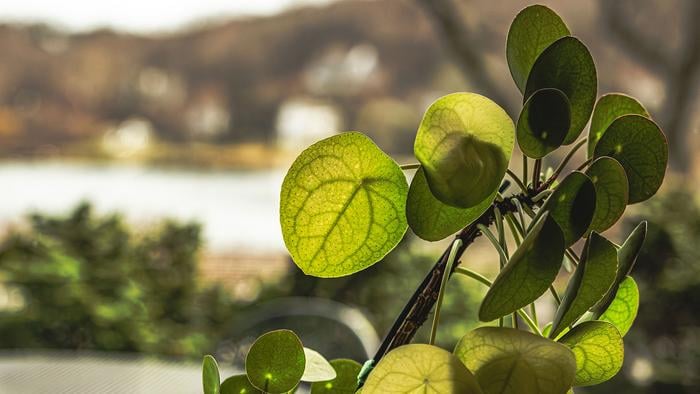
Somewhere in your house, or your colleague’s, or balanced on a shelf in practically every Instagram flat you’ve ever seen, there’s probably a Chinese money plant. Round leaves on long stems, each one like a little satellite dish pointed at the light. Pilea peperomioides, to give it its full name, native to Yunnan and Sichuan in southern China, wildly popular as a housewarming gift. It turns out the veins inside those leaves have been quietly executing one of the oldest problems in computational geometry, without a computer, without measuring anything, using only the chemistry of plant hormones. Nobody noticed for centuries.
The pattern is called a Voronoi diagram, and it is, at root, a way of dividing space fairly. Picture a map of a city and its schools: a Voronoi diagram would draw district boundaries so that every child lives closer to their own school than to any other. The boundaries form polygons, each enclosing one school. The principle has been used in city planning, epidemiology, mobile network design, and archaeology for hundreds of years. It also appears, now, to govern the venation of a houseplant.
Saket Navlakha, an associate professor at Cold Spring Harbor Laboratory, specialises in what he calls “algorithms in nature,” the mathematical rules that organisms follow without knowing they’re following them. Working with graduate student CiCi Zheng, he mapped the positions of structures called hydathodes on Pilea leaves, those prominent pores you can just make out as small dots near the leaf margins, and the looping veins that surround them. The match, when they overlaid a computed Voronoi diagram on cleared and stained leaf tissue, was close enough to make you look twice. Each hydathode sat at the centre of a vein polygon, with the boundaries of that polygon running equidistant between it and all its neighbours. “Voronoi diagrams have been used for centuries in a variety of applications ranging from city planning to network design,” Navlakha says. Finding one growing on a windowsill was something else.
Three Tests, One Geometry
The claim required rigour. Lots of things in nature superficially resemble Voronoi diagrams, including giraffe patches and dragonfly wing veins, but in most cases only the polygon boundaries are present, not the central points that define them. Pilea offered something unusual: both the polygons (veins) and the centres (hydathodes) are visible and biologically distinct. So the team developed three independent statistical tests. The first checked whether the vein boundaries perpendicularly bisected the lines between adjacent hydathodes, which is the geometric corollary of a true Voronoi pattern. The angle error when using actual hydathode positions was 8.23 degrees on average, considerably lower than when the team used centroids, midpoints, or random locations within each polygon. The second test measured how much area would overlap between a mathematically computed Voronoi diagram (generated from real hydathode positions) and the actual vein network: 72 per cent, comparable to what you’d get from a perfect Voronoi diagram with about 15 per cent biological noise added. The third ran the problem backwards, predicting hydathode positions from vein geometry alone, and found the predictions landed closer to the real pores than to any reference location. Thirty-four leaves from six plants, 1,836 adjacent polygon pairs. Not a near-miss. An approximate but real Voronoi diagram.
They also tested whether stress disturbed the pattern. Plants were exposed to shade, high temperatures, and intense light for five weeks. Hydathode sizes shifted, leaf morphology varied, but the Voronoi geometry held. Which suggested something important: the pattern isn’t pre-specified in some developmental blueprint. It emerges, afresh, from local chemistry, whatever the conditions.
Waves That Build Walls
The harder question was how. The prevailing theory of vein formation in plants, called canalization, proposed by Sachs more than half a century ago, describes a positive feedback between auxin (a key plant hormone) and the proteins that transport it. In that model, auxin flows from sources to sinks and, as the flow intensifies, carves increasingly narrow channels. The result is tree-like, branching structures. But Pilea’s veins don’t connect hydathodes; they run between them, bisecting the space. Canalization, as classically understood, can’t explain that.
The team, now including world-renowned plant modeller Przemysław Prusinkiewicz of the University of Calgary, proposed something different. Hydathodes, they argued, act as auxin sources. Each one emits a wave of high auxin concentration that propagates outward through the leaf tissue. When two waves, spreading from neighbouring hydathodes, collide, they form a ridge of maximum auxin concentration exactly halfway between the two sources. That ridge then triggers the differentiation of vascular cells, which become the vein boundary. The boundaries of all the polygons are, therefore, lines of collision between expanding hormone waves, and colliding waves naturally bisect the space between their sources. The Voronoi geometry isn’t planned. It falls out of physics.
Prusinkiewicz, who has spent decades on problems of exactly this kind, was struck by the elegance of it. “It’s remarkable how mathematical yet another aspect of plant form and patterning turns out to be,” he says. “For decades, the question of how reticulate veins form has remained open, and finally we have a plausible answer.” The computational model, run on a grid of simulated cells clipped to the actual outline of a Pilea leaf, with hydathode positions taken from real data, reproduced the vein network in very close agreement with an ideal Voronoi diagram computed from the same hydathode positions. Immunolocalisation data from developing leaves at stages P4 through P6 provided experimental support: PIN proteins (the auxin transporters) were concentrated at and around hydathodes, absent from forming secondary veins, and polarly oriented toward those veins in the adjacent ground cells, all consistent with the wave-propagation model.
The mechanism is, in this sense, a genuine alternative to canalization. Not a replacement, exactly; the primary midvein appears to form first, before most hydathodes exist, and by a different process. But for the secondary veins, the looping mesh that defines the Voronoi structure, the wave model fits where canalization does not.
Zheng, now a postdoc at the Allen Institute, puts it plainly. “Just as humans have to solve problems to survive, the same goes for other organisms,” she says. “But unlike humans, plants cannot explicitly measure distances. Instead, they rely on local biological interactions to achieve the same Voronoi solution.” There is no central processor deciding where the veins should go. Each cell responds only to its immediate chemical neighbourhood. The global geometry is a byproduct of many local negotiations, none of which knows what the others are doing.
Beyond One Plant
Pilea is a member of Urticaceae, the nettle family, and related species including several Ficus seem to show similar vein-around-hydathode arrangements. Whether they follow the same strict Voronoi geometry is an open question, and the paper’s authors are careful not to overclaim. The parameters of auxin timing and transport could vary, and it’s possible that closely related species produce only approximate Voronoi-like patterns rather than the unusually clean version found in Pilea. For plants without laminar hydathodes entirely, some other distributed auxin source may play an analogous role.
What makes the discovery interesting beyond plant biology is the algorithmic framing. “We think of these algorithms in nature as an explanation for how organisms will behave and as a way to try to make sense of the world,” Navlakha says. “This example is a nice merger of classical geometry, modern plant biology, and computer science.” That merger matters for a specific reason: Voronoi diagrams are optimal in a precise mathematical sense. They minimise the distance between each polygon’s centre and its boundary. A plant that builds its vascular network this way is, in effect, solving a distribution problem, getting water and nutrients from veins to pores via the most efficient possible partitioning of space. Evolution arrived at the same solution mathematicians formalised centuries ago, but it did so without computation, without planning, one auxin wave at a time. The question of whether Voronoi geometry actually confers a hydraulic advantage over other network patterns remains, for now, unanswered. Perhaps some houseplant research is only just beginning.
https://doi.org/10.1038/s41467-026-71768-3
Frequently Asked Questions
Why would a plant’s veins form a Voronoi pattern rather than a simpler branching structure?
The Voronoi pattern appears to be an emergent consequence of how the plant hormone auxin spreads and collides, not a deliberate design. Waves of auxin emanate from each hydathode and meet halfway between neighbouring pores; those collision ridges trigger vein formation, so the boundaries naturally bisect the space between sources. The result is a looping, closed network that efficiently distributes water and nutrients, something a simple branching system cannot do as well, particularly under damage or fluctuating flow.
Is Pilea the only plant known to do this?
It’s currently the clearest known example, and the first in which both the polygon boundaries and their mathematical centres are present and biologically functional. Related species in the nettle family appear to show similar vein-around-hydathode architecture, but whether they satisfy the strict geometric tests applied to Pilea is not yet established. For the many flowering plants that have reticulate veins but no laminar hydathodes, the jury is still very much out.
Does this mean plants are doing computation?
Not in any conventional sense, though the framing is genuinely useful. Each cell responds only to local chemical signals; no cell has any information about the overall pattern being produced. The global Voronoi geometry falls out of those purely local interactions, in the same way that the overall shape of a snowflake falls out of simple rules about water crystallisation. Researchers who study natural algorithms use this kind of emergent problem-solving as inspiration for distributed computing systems, where you want global coordination without central control.
How does this challenge what we thought we knew about vein formation?
For more than 50 years, the dominant theory, known as canalization, has held that veins form when auxin flows from sources to sinks and channels itself into progressively narrower paths. That produces branching, tree-like networks. The Pilea finding requires a different mode: weak polar transport that allows auxin waves to propagate outward and form ridges upon collision, rather than concentrate into directed channels. The two mechanisms may coexist in the same plant, with canalization governing the central midvein and the wave-collision model governing the secondary, loop-forming veins.
Quick Note Before You Read On.
ScienceBlog.com has no paywalls, no sponsored content, and no agenda beyond getting the science right. Every story here is written to inform, not to impress an advertiser or push a point of view.
Good science journalism takes time — reading the papers, checking the claims, finding researchers who can put findings in context. We do that work because we think it matters.
If you find this site useful, consider supporting it with a donation. Even a few dollars a month helps keep the coverage independent and free for everyone.