




































For months at a time, the sun does not rise over Concordia Station. That is precisely the point. Perched on the Antarctic plateau, more than 3,000 metres up and colder than almost anywhere humans willingly live, a modest 40-centimetre telescope called ASTEP spends the long polar night staring at a single patch of sky. No sunrise to interrupt it, no clouds to speak of, just darkness and the faint, faithful glow of distant stars. And on a few of those nights, the telescope caught something falling across the face of a star 1,110 light years away: a shadow that took more than 11 hours to pass.
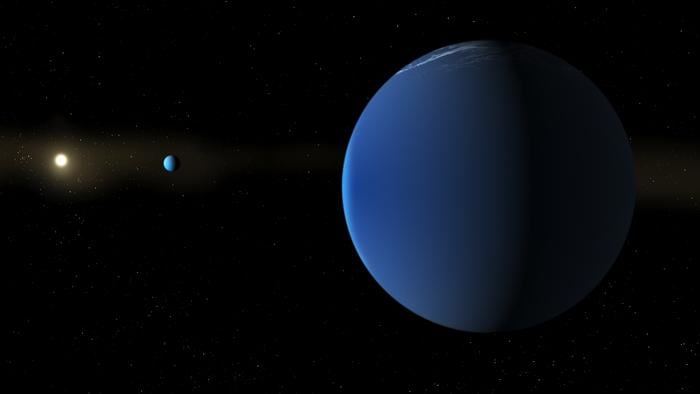
That shadow, it turns out, belonged to one of the strangest planets we have found. Two of them, in fact, orbiting a star called TOI-791 in the southern constellation Volans. Both are roughly the size of Jupiter. Neither weighs much of anything. TOI-791 b has a density of 0.038 grams per cubic centimetre; its sibling, TOI-791 c, comes in at 0.047. To put that in perspective, candy floss clocks in at around 0.05. Jupiter, for its part, is some 28 to 35 times denser. These are planets you could not stand on, could barely weigh, and which by rights should hardly hold together at all.
Astronomers call them “super-puffs”, and they are rare beasts. Only a handful are known anywhere, and finding two huddled in the same planetary system is rarer still. “Only a handful of these super-puffy planets are known, and it is even rarer to find two in the same system,” says Dr George Dransfield of the University of Oxford, who led the work, published today in Monthly Notices of the Royal Astronomical Society. “Their extremely low densities make them fascinating targets for understanding how planetary systems form and evolve.”
A gravitational waltz, eight years in the watching
What makes TOI-791 b and c more than a curiosity is the way they move. The two planets are locked in what astronomers call a 5:3 mean-motion resonance: for every five laps the inner planet completes, the outer one manages almost exactly three. They are siblings in the truest sense, born from the same disc of gas and dust that once swaddled their young star, and now caught in a slow gravitational waltz that has them tugging on one another, lap after lap, nudging each other slightly off schedule.
Those nudges are the whole trick. A planet passing in front of its star dims the light by a measurable fraction, and the depth of that dip tells you how big the planet is. But here the timing of each transit wobbles, arriving as much as 50 minutes early or late depending on how the two worlds happen to be pulling on each other. Read those wobbles carefully and you can weigh the planets without ever measuring their gravity directly. That is how the team arrived at masses so low they seemed, at first, almost too good to be true.
It was not quick. The discovery rested on eight years of observations stitched together from telescopes scattered across Chile, Australia, South Africa, and Antarctica, plus NASA’s TESS space telescope overhead. The two planets had first been spotted, fittingly, by volunteers. Members of the public sifting through TESS data as part of the Planet Hunters citizen-science project flagged the inner world back in 2019 and the outer one in 2023, long before anyone knew quite what they were looking at.
And then there was Antarctica. Because these planets orbit far from their star, their transits are both long and infrequent, the sort of event that slips through the cracks for most ground-based observatories, which lose their target every time the sun comes up. Not so at Concordia in the dead of winter. The months of unbroken darkness let ASTEP watch entire 11-hour transits from start to finish in a single sitting, the longest continuous planetary transits ever recorded in full from the ground. Eleven hours is a long time for anything to hold still.
Made of almost nothing, but how?
So what are these things actually made of? Nobody is entirely sure, and that is the interesting part. The leading idea is that super-puffs carry enormous, bloated atmospheres of hydrogen and helium, gas envelopes so vast they account for a hefty slice of the planet’s total mass. Such envelopes could have piled up if the planets formed far out in the cold reaches of the protoplanetary disc, where gas cools and gathers readily around a solid core. There is a competing, cheekier explanation too: that super-puffs are really ordinary planets wearing wide, optically thick rings turned face-on toward us, fooling our telescopes into reading them as fluffier than they are. The trouble with rings is that you would need both planets to wear them, which starts to feel like a stretch.
Untangling all this is going to take more watching, and more powerful eyes. The masses themselves cannot be pinned down further by the usual method of measuring the star’s wobble, because TOI-791 spins too fast and burns too hot for that technique to work. So the team is turning skyward. “This system offers a unique laboratory for understanding how super-puff planets form and evolve,” says Professor Amaury Triaud of the University of Birmingham, a co-author and the UK lead on ASTEP. “We propose to carry out space-based observations using the James Webb Space Telescope to assess if the puffy atmosphere contains carbon-, nitrogen-, and oxygen-bearing species, revealing new insight into how these unusual planets formed.”
TOI-791 is only the ninth system known to host more than one transiting giant planet, which makes it a sort of natural experiment that cannot be ordered up on demand. Two worlds, same star, same birth, wildly low densities, slowly trading gravitational shoves over decades. The full rhythm of their interaction plays out over more than 88 years, far longer than anyone has yet watched, so the picture we have now is a snapshot of something much larger and slower. “These multi-planetary systems are complex, with gravitational interactions between the planets that evolve over very long periods, tens of years or more,” says Professor Tristan Guillot of the Université Côte d’Azur, who leads the ASTEP project. “Bringing together observations from Antarctica, space telescopes and observatories across several continents was essential to revealing the true nature of these extraordinary planets.” For now, two improbable worlds keep circling, lighter than the spun sugar at a fairground, waiting for us to work out how they got that way.
DOI / Source: https://doi.org/10.1093/mnras/stag864
Frequently Asked Questions
How can a planet be lighter than candy floss and still stay in one piece?
Gravity, mostly. A planet the size of Jupiter has enough mass to hold itself together even when that mass is spread across an enormous, puffed-up volume of gas. The leading explanation is that super-puffs like TOI-791 b and c are wrapped in vast hydrogen and helium atmospheres that make up a large share of their total mass, leaving the average density absurdly low. Whether that is the whole story is exactly what astronomers are now trying to settle.
Why did astronomers go all the way to Antarctica to study these planets?
Because the planets orbit far from their star, each transit lasts more than 11 hours, and most ground-based telescopes lose sight of their target the moment the sun rises. During the Antarctic winter, the sun does not rise for months, so the ASTEP telescope at Concordia Station could watch an entire transit unbroken. Those are the longest continuous planetary transits ever observed in full from the ground.
How do you weigh a planet without measuring its gravity directly?
You watch its clock slip. The two planets at TOI-791 tug on each other as they orbit, making each transit arrive slightly early or late, by up to about 50 minutes. The size of those timing shifts depends on the planets’ masses, so reading the wobbles carefully lets astronomers calculate how heavy each world is. For this system, that timing method was the only option, since the host star spins too fast for the usual technique to work.
Could these planets just be ordinary worlds with rings fooling our telescopes?
It is a possibility, and one of the open questions. A planet circled by wide, optically thick rings turned face-on could look far puffier than it really is. The catch is that both planets would need such rings to explain their matching low densities, which many astronomers find a stretch. Future observations, including with the James Webb Space Telescope, should help tell a true super-puff from a ringed impostor.