WashingtonWeeklyTimes.com
  • Home
  • US News
    Lindsey Graham warns Republicans who ‘try to destroy’ Trump will lose

    Lindsey Graham warns Republicans who ‘try to destroy’ Trump will lose

    Selfie video captures scary moment baseball fan at Mariners game gets hit in the skull by foul ball

    Selfie video captures scary moment baseball fan at Mariners game gets hit in the skull by foul ball

    401(k) account takeover fraud drained 1,430 in a single phone call

    401(k) account takeover fraud drained $751,430 in a single phone call

    Trump rips Democrats after UN climate committee drops extreme projections

    Trump rips Democrats after UN climate committee drops extreme projections

    Five Alive citrus drink fans still ask why Coca-Cola killed their favorite beverage

    Five Alive citrus drink fans still ask why Coca-Cola killed their favorite beverage

  • Politics
    A Planned Democratic Investigation Is The First Step In Trump Family Corruption Charges

    A Planned Democratic Investigation Is The First Step In Trump Family Corruption Charges

    Pete Buttigieg Totally Wrecks Trump Transportation Secretary Sean Duffy

    Pete Buttigieg Totally Wrecks Trump Transportation Secretary Sean Duffy

    The Iran War Has Broken Trump

    The Iran War Has Broken Trump

    Trump Doesn’t Have Enough Votes To Get His Ballroom Money

    Trump Doesn’t Have Enough Votes To Get His Ballroom Money

  • Business
    CDC to escalate Ebola response after WHO declares emergency

    CDC to escalate Ebola response after WHO declares emergency

    The top foreign holders of US debt may soon dump Treasury bonds and bring their money back home

    The top foreign holders of US debt may soon dump Treasury bonds and bring their money back home

    How Reese Witherspoon built a 0 million company from a problem Hollywood wouldn’t fix

    How Reese Witherspoon built a $900 million company from a problem Hollywood wouldn’t fix

    U.S. allows Russia oil sales waiver to expire despite tight market

    U.S. allows Russia oil sales waiver to expire despite tight market

  • Science
    SpaceX is about to launch tallest and most powerful rocket in history

    SpaceX is about to launch tallest and most powerful rocket in history

    The First Atomic Bomb Test in 1945 Created an Entirely New Material

    The First Atomic Bomb Test in 1945 Created an Entirely New Material

    Losing Weight Fast Really Does Work Better, and the Evidence Is Hard to Ignore

    Losing Weight Fast Really Does Work Better, and the Evidence Is Hard to Ignore

    NASA reveals new clues to 2027’s Artemis III, the final test mission before a moon landing

    NASA reveals new clues to 2027’s Artemis III, the final test mission before a moon landing

  • Technology
    Apple’s Siri revamp could include auto-deleting chats

    Apple’s Siri revamp could include auto-deleting chats

    Oto Smart Sprinkler Review (2026): Solar-Powered and Simple to Use

    Oto Smart Sprinkler Review (2026): Solar-Powered and Simple to Use

    Marketing operating system Nectar Social raises M Series A led by Menlo

    Marketing operating system Nectar Social raises $30M Series A led by Menlo

    Cybercriminal Twins Caught After They Forgot to Turn Off Microsoft Teams Recording

  • Lifestyle
    27 Easy Dishes for Your BBQ

    27 Easy Dishes for Your BBQ

    5 Summer Hosting Outfit Formulas That Make Getting Dressed Easy

    5 Summer Hosting Outfit Formulas That Make Getting Dressed Easy

    13 Healthy Summer Cookbooks for Light, Seasonal Cooking

    13 Healthy Summer Cookbooks for Light, Seasonal Cooking

    Inside a French Rustic Home Rooted in Nature and Nostalgia

    Inside a French Rustic Home Rooted in Nature and Nostalgia

  • Music
    Watch Will Ferrell’s ‘SNL’ monologue get hijacked by doppelgänger Chad Smith of Red Hot Chili Peppers

    Watch Will Ferrell’s ‘SNL’ monologue get hijacked by doppelgänger Chad Smith of Red Hot Chili Peppers

    Official Paul Di’Anno Documentary Coming to North America in June

    Official Paul Di’Anno Documentary Coming to North America in June

    Weekend Update’s Joke Swap Was Even More Brutal Than Usual

    Weekend Update’s Joke Swap Was Even More Brutal Than Usual

    Jermaine Jackson Told to Pay .5 Million After Failing to Contest Rape Case

    Jermaine Jackson Told to Pay $6.5 Million After Failing to Contest Rape Case

  • Television
    How Kim Wolfe’s Husband and Kids Supported Her Return to HGTV for ‘Rock the Block’ (Exclusive)

    How Kim Wolfe’s Husband and Kids Supported Her Return to HGTV for ‘Rock the Block’ (Exclusive)

    Joey King Had A Small But Memorable Role On New Girl

    Joey King Had A Small But Memorable Role On New Girl

    Days of Our Lives Spoilers For The Week of 5-18-26 Celebrate Steve And Kayla While Half of Salem Is Miserable

    Days of Our Lives Spoilers For The Week of 5-18-26 Celebrate Steve And Kayla While Half of Salem Is Miserable

    ‘Brady Bunch’s Eve Plumb Talks About Working With Angela Lansbury and Lynda Carter

    ‘Brady Bunch’s Eve Plumb Talks About Working With Angela Lansbury and Lynda Carter

  • Film
    Gentle Monster – first-look review

    Gentle Monster – first-look review

    As Hollywood Pulls Back, Northern Ontario Steps Up

    As Hollywood Pulls Back, Northern Ontario Steps Up

    Dragonbreak Is Your Perfect Excuse To Dive Back Into Skyrim

    Dragonbreak Is Your Perfect Excuse To Dive Back Into Skyrim

    Colony – first-look review | Little White Lies

    Colony – first-look review | Little White Lies

  • Literature
    Literary Hub » Lucy Ives Offers a Few Creative Prompts to Knock You Off Kilter

    Literary Hub » Lucy Ives Offers a Few Creative Prompts to Knock You Off Kilter

    A Deaf Manifesto on Motherhood

    A Deaf Manifesto on Motherhood

    Book Riot’s Deals of the Day for May 17, 2026

    Book Riot’s Deals of the Day for May 17, 2026

    Literary Hub » Lit Hub Daily: May 15, 2026

    Literary Hub » Lit Hub Daily: May 15, 2026

    Exclusive Cover Reveal of “Distortion” by Kathryn Bromwich

    Exclusive Cover Reveal of “Distortion” by Kathryn Bromwich

    Goodreads Has Summer Reading Lists Galore

    Goodreads Has Summer Reading Lists Galore

    May 11 – 15, 2026

    May 11 – 15, 2026

    12 Books About Losing Perspective in Los Angeles

    12 Books About Losing Perspective in Los Angeles

    The Gilded, Fifth Format of Books

    The Gilded, Fifth Format of Books

  • Contact
    • About
  • Home
  • US News
    Lindsey Graham warns Republicans who ‘try to destroy’ Trump will lose

    Lindsey Graham warns Republicans who ‘try to destroy’ Trump will lose

    Selfie video captures scary moment baseball fan at Mariners game gets hit in the skull by foul ball

    Selfie video captures scary moment baseball fan at Mariners game gets hit in the skull by foul ball

    401(k) account takeover fraud drained 1,430 in a single phone call

    401(k) account takeover fraud drained $751,430 in a single phone call

    Trump rips Democrats after UN climate committee drops extreme projections

    Trump rips Democrats after UN climate committee drops extreme projections

    Five Alive citrus drink fans still ask why Coca-Cola killed their favorite beverage

    Five Alive citrus drink fans still ask why Coca-Cola killed their favorite beverage

  • Politics
    A Planned Democratic Investigation Is The First Step In Trump Family Corruption Charges

    A Planned Democratic Investigation Is The First Step In Trump Family Corruption Charges

    Pete Buttigieg Totally Wrecks Trump Transportation Secretary Sean Duffy

    Pete Buttigieg Totally Wrecks Trump Transportation Secretary Sean Duffy

    The Iran War Has Broken Trump

    The Iran War Has Broken Trump

    Trump Doesn’t Have Enough Votes To Get His Ballroom Money

    Trump Doesn’t Have Enough Votes To Get His Ballroom Money

  • Business
    CDC to escalate Ebola response after WHO declares emergency

    CDC to escalate Ebola response after WHO declares emergency

    The top foreign holders of US debt may soon dump Treasury bonds and bring their money back home

    The top foreign holders of US debt may soon dump Treasury bonds and bring their money back home

    How Reese Witherspoon built a 0 million company from a problem Hollywood wouldn’t fix

    How Reese Witherspoon built a $900 million company from a problem Hollywood wouldn’t fix

    U.S. allows Russia oil sales waiver to expire despite tight market

    U.S. allows Russia oil sales waiver to expire despite tight market

  • Science
    SpaceX is about to launch tallest and most powerful rocket in history

    SpaceX is about to launch tallest and most powerful rocket in history

    The First Atomic Bomb Test in 1945 Created an Entirely New Material

    The First Atomic Bomb Test in 1945 Created an Entirely New Material

    Losing Weight Fast Really Does Work Better, and the Evidence Is Hard to Ignore

    Losing Weight Fast Really Does Work Better, and the Evidence Is Hard to Ignore

    NASA reveals new clues to 2027’s Artemis III, the final test mission before a moon landing

    NASA reveals new clues to 2027’s Artemis III, the final test mission before a moon landing

  • Technology
    Apple’s Siri revamp could include auto-deleting chats

    Apple’s Siri revamp could include auto-deleting chats

    Oto Smart Sprinkler Review (2026): Solar-Powered and Simple to Use

    Oto Smart Sprinkler Review (2026): Solar-Powered and Simple to Use

    Marketing operating system Nectar Social raises M Series A led by Menlo

    Marketing operating system Nectar Social raises $30M Series A led by Menlo

    Cybercriminal Twins Caught After They Forgot to Turn Off Microsoft Teams Recording

  • Lifestyle
    27 Easy Dishes for Your BBQ

    27 Easy Dishes for Your BBQ

    5 Summer Hosting Outfit Formulas That Make Getting Dressed Easy

    5 Summer Hosting Outfit Formulas That Make Getting Dressed Easy

    13 Healthy Summer Cookbooks for Light, Seasonal Cooking

    13 Healthy Summer Cookbooks for Light, Seasonal Cooking

    Inside a French Rustic Home Rooted in Nature and Nostalgia

    Inside a French Rustic Home Rooted in Nature and Nostalgia

  • Music
    Watch Will Ferrell’s ‘SNL’ monologue get hijacked by doppelgänger Chad Smith of Red Hot Chili Peppers

    Watch Will Ferrell’s ‘SNL’ monologue get hijacked by doppelgänger Chad Smith of Red Hot Chili Peppers

    Official Paul Di’Anno Documentary Coming to North America in June

    Official Paul Di’Anno Documentary Coming to North America in June

    Weekend Update’s Joke Swap Was Even More Brutal Than Usual

    Weekend Update’s Joke Swap Was Even More Brutal Than Usual

    Jermaine Jackson Told to Pay .5 Million After Failing to Contest Rape Case

    Jermaine Jackson Told to Pay $6.5 Million After Failing to Contest Rape Case

  • Television
    How Kim Wolfe’s Husband and Kids Supported Her Return to HGTV for ‘Rock the Block’ (Exclusive)

    How Kim Wolfe’s Husband and Kids Supported Her Return to HGTV for ‘Rock the Block’ (Exclusive)

    Joey King Had A Small But Memorable Role On New Girl

    Joey King Had A Small But Memorable Role On New Girl

    Days of Our Lives Spoilers For The Week of 5-18-26 Celebrate Steve And Kayla While Half of Salem Is Miserable

    Days of Our Lives Spoilers For The Week of 5-18-26 Celebrate Steve And Kayla While Half of Salem Is Miserable

    ‘Brady Bunch’s Eve Plumb Talks About Working With Angela Lansbury and Lynda Carter

    ‘Brady Bunch’s Eve Plumb Talks About Working With Angela Lansbury and Lynda Carter

  • Film
    Gentle Monster – first-look review

    Gentle Monster – first-look review

    As Hollywood Pulls Back, Northern Ontario Steps Up

    As Hollywood Pulls Back, Northern Ontario Steps Up

    Dragonbreak Is Your Perfect Excuse To Dive Back Into Skyrim

    Dragonbreak Is Your Perfect Excuse To Dive Back Into Skyrim

    Colony – first-look review | Little White Lies

    Colony – first-look review | Little White Lies

  • Literature
    Literary Hub » Lucy Ives Offers a Few Creative Prompts to Knock You Off Kilter

    Literary Hub » Lucy Ives Offers a Few Creative Prompts to Knock You Off Kilter

    A Deaf Manifesto on Motherhood

    A Deaf Manifesto on Motherhood

    Book Riot’s Deals of the Day for May 17, 2026

    Book Riot’s Deals of the Day for May 17, 2026

    Literary Hub » Lit Hub Daily: May 15, 2026

    Literary Hub » Lit Hub Daily: May 15, 2026

    Exclusive Cover Reveal of “Distortion” by Kathryn Bromwich

    Exclusive Cover Reveal of “Distortion” by Kathryn Bromwich

    Goodreads Has Summer Reading Lists Galore

    Goodreads Has Summer Reading Lists Galore

    May 11 – 15, 2026

    May 11 – 15, 2026

    12 Books About Losing Perspective in Los Angeles

    12 Books About Losing Perspective in Los Angeles

    The Gilded, Fifth Format of Books

    The Gilded, Fifth Format of Books

  • Contact
    • About
No Result
View All Result
WashingtonWeeklyTimes.com
No Result
View All Result
Home Science

Toxic Slime Contributed to Earth’s Worst Mass Extinction–And It’s Making a Comeback

by Admin
July 6, 2022
in Science
Toxic Slime Contributed to Earth’s Worst Mass Extinction–And It’s Making a Comeback


At sunrise on a summer day in Australia, about an hour’s drive from Sydney, we clambered northward along the base of a cliff on a mission. We were searching for rocks that we hoped would contain clues to the darkest chapter in our planet’s history.

Life on Earth has experienced some terrifyingly close calls in the past four billion years—cataclysmic events in which the species driven to extinction outnumbered the survivors. The worst crisis occurred 252 million years ago, at the end of the Permian Period. Conditions back then were the bleakest that animals ever faced. Wildfires and drought scoured the land; oceans became intolerably hot and suffocating.

Very few creatures could survive in this hellscape. Ultimately more than 70 percent of land species and upward of 80 percent of ocean species went extinct, leading some paleontologists to call this dismal episode the Great Dying.

This calamity has been etched in stone across the globe but perhaps nowhere as clearly as on the rocky coasts of eastern Australia. By midmorning we had found our target: an outcrop of coal within the cliff face. Sedimentologist Christopher Fielding of the University of Connecticut, one of our longtime colleagues, had recently identified these rocks as river and lake sediments deposited during the end-Permian event. Following his lead, we had come to sift through the sediments for fossil remains from the few survivors of the arch extinction.

From our vantage point on the outcrop, we could see our first hint of ancient devastation: the absence of coal beds in the towering sandstone cliffs above us. During our dawn scramble across the rocks, we had spotted numerous coal beds sandwiched between the sandstones and mudstones in the lower rock levels. These coals date to the late Permian (around 259 million to 252 million years ago). They represent the compacted remains of the swamp forests that existed across a vast belt of the southern supercontinent Gondwana. In contrast, the younger, overlying rocks that span the early part of the subsequent Triassic Period, some 252 million to 247 million years ago, are devoid of coal. In fact, not a single coal seam has been found in rocks of this vintage anywhere in the world. Instead these strata reflect the peaceful deposition of sand and mud by rivers and lakes, seemingly undisturbed by life.

Historically ignored because of its paucity of fossil fuels for humans to exploit, this so-called coal gap has recently emerged as a key to understanding the history of life on Earth. We now know it was a symptom of a sick world. At the end of the Permian, not only did terrestrial and marine ecosystems collapse, but so, too, did freshwater ones. Recent studies by our team have shown that as global temperatures surged at the close of the Permian, blooms of bacteria and algae choked rivers and lakes, rendering them largely uninhabitable. Our findings help to explain why the ensuing mass extinction was so devastating—and raise concerns about the future of biodiversity in our warming world.

Scorched Earth

As the sun rose higher in the sky, its heat beat down on us relentlessly. We managed to pack in a few productive hours of fossil and rock collection before the outcrop became unbearably hot. At that time, in the early summer of 2018, it seemed warmer than the previous field season. Maybe it really was warmer, or maybe it was just because we had recently arrived from chilly Stockholm, where we work at the Swedish Museum of Natural History. Regardless, by midmorning we retreated to the shade for a couple of hours to cool down and ponder what we had seen.
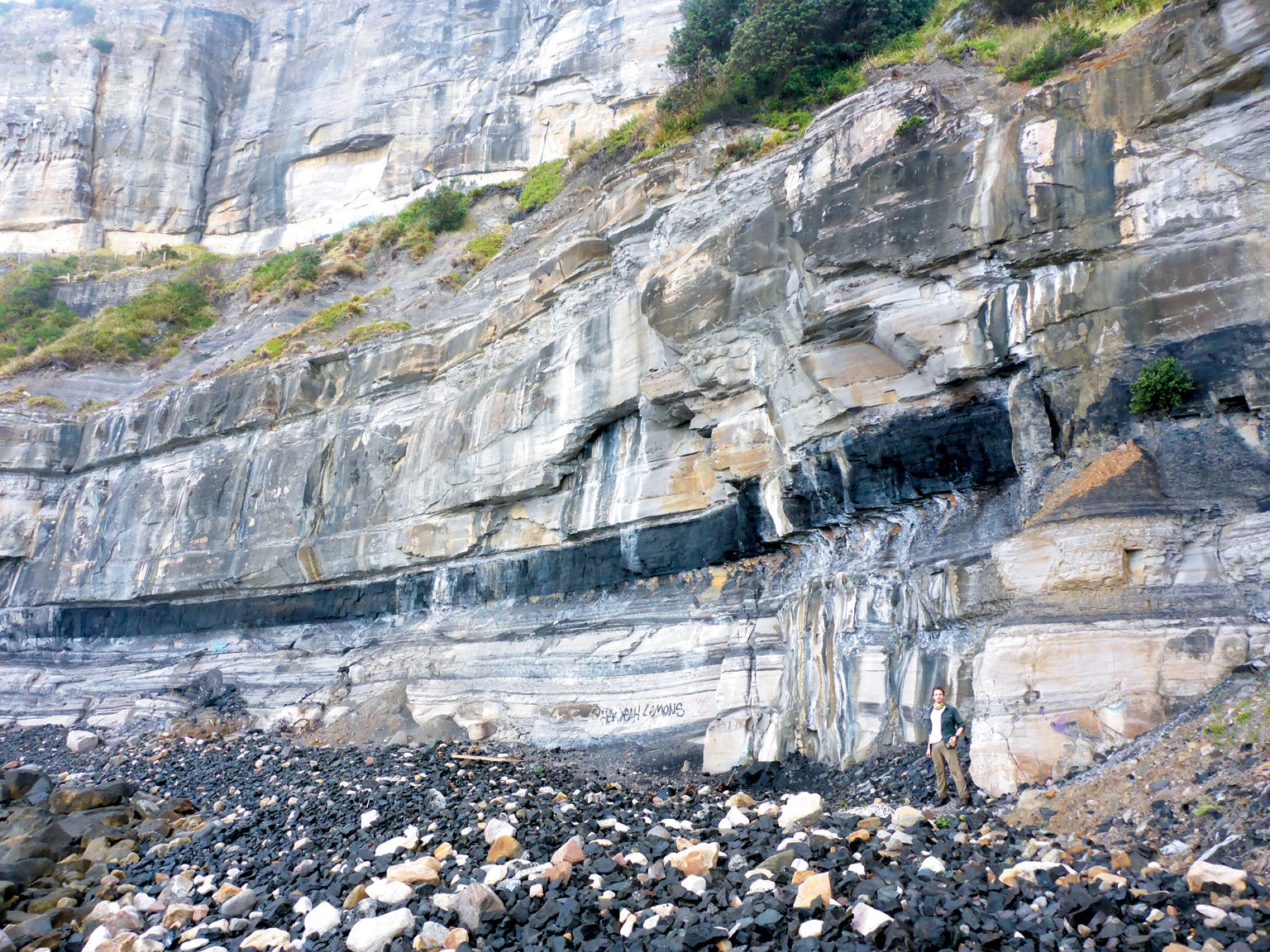
LAST COAL DEPOSIT of the Permian Period, which appears as a black band in the exposed rock layers, is overlain by cliffs of fossil-barren Early Triassic sandstone. Credit: Chris Mays

We found the coals to consist almost entirely of compacted leaves, roots and wood belonging to trees in the genus Glossopteris. Glossopteris trees flourished in wetlands and readily formed peat, a precursor to coal. Directly above the coals we saw no fossils at first. All the outcrops of similar age around Sydney seemed to contain a fossil dead zone. There were no leaves or roots and scarcely a fossil of any kind, with one critical exception: simple, curved sand-filled burrows up to two meters long. Based on the sizes and shapes of these burrows, we concluded that they were most likely excavated by small mammal-like reptiles roughly the size of modern gophers or mole rats. The busy burrowers had made their homes in the muddy dead zone, implying that these animals had survived the end-Permian catastrophe. Moreover, their burrowing strategy was probably key to their success: it provided a refuge from the scorching surface.

All organisms must bend to the forces of nature. Like our ancestors that survived the end-Permian event, we sought a reprieve from the punishing temperatures during our fieldwork. Fortunately, we had to hide for just a few hours before we could emerge. But what if the insufferable heat had lasted months— or millennia?

Before long the sun crept westward, casting us in the cliff’s shadow, and we concluded the day’s work by collecting more rock samples to analyze back in the laboratory. For most paleontologists, the absence of observable fossils, as occurs within the dead zone of a mass extinction, makes for a short expedition. But we suspected that the full story lay hidden in fossils that couldn’t be seen with the naked eye.

We combined the day’s samples with those we had collected from other rocks of the same age around Sydney, then split them into three batches. We sent one batch off to Jim Crowley of Boise State University and Bob Nicoll of Geoscience Australia to obtain precise age estimates for the extinction event. The second batch went to our colleague Tracy Frank of the University of Connecticut so she could calculate the temperatures that prevailed during the late Permian. We took the third batch with us to the Swedish Museum of Natural History, where we sifted through the samples for microscopic fossils of plant spores and pollen, as well as microbial algae and bacteria, to build a blow-by-blow account of the ecological collapse and recovery.

As expected, our analyses of the microfossils showed that abundances of plant spores and pollen dropped off precisely at the top of the last Permian coal deposit, reflecting near-total deforestation of the landscape. To our surprise, however, we also found that algae and bacteria had proliferated soon after the extinction, infesting freshwater ecosystems with noxious slime. In fact, they reached concentrations typical of modern microbial blooms, such as the record-breaking blooms in Lake Erie in 2011 and 2014. Because explosive microbial growth leads to poorly oxygenated waters, and many microbes produce metabolic by-products that are toxic, these events can cause animals to die en masse. In the wake of the end-Permian devastation, the humblest of organisms had inherited the lakes and rivers and established a new freshwater regime. We wondered how these microbes came to flourish to such a great extent and what the consequences of their burgeoning were. To answer these questions, we needed more context.

Insights came from analyses of the other two samples. The age estimates revealed that the ecosystem collapse coincided with the first rumblings of tremendous volcanic eruptions in a “large igneous province” known as the Siberian Traps, in what is now Russia. The term “volcanic” seems inadequate in this context; the volume of magma in the Siberian Traps was a whopping several million cubic kilometers. Thus, the Siberian Traps province is to a volcano as a tsunami is to a ripple in your bathtub. Studies have consistently implicated the Siberian Traps igneous event as the ultimate instigator of the end-Permian mass extinction, in large part because of the composition of the rocks in the area. Prior to this event, the rocks underneath Siberia were rich in coal, oil and gas. When the Siberian Traps erupted, the heat of the intrusive magma vaporized these hydrocarbons into greenhouse gases, which were then emitted into the atmosphere. Atmospheric carbon dioxide levels increased sixfold as a result.

The timing lined up with Tracy’s new geochemical temperature estimates, which revealed an increase of 10 to 14 degrees Celsius in the Sydney region. The age estimates also nailed down the duration of the observed changes in the Sydney area: the temperature spike and ecosystem collapse had occurred within tens of thousands of years. This geologically rapid change in conditions drove animals from temperate zones to extinction or compelled them to live part-time in the cooler temperatures underground. It also triggered the widespread microbial blooms we detected in our microfossil studies: the slime revolution had begun.

The ancient recipe for this toxic soup relied on three main ingredients: high carbon dioxide, high temperatures and high nutrients. During the end-Permian event, the Siberian Traps provided the first two ingredients. Sudden deforestation created the third: when the trees were wiped out, the soils they once anchored bled freely into the rivers and lakes, providing all the nutrients that the aquatic microbes needed to multiply. In the absence of “scum-sucking” animals such as fish and invertebrates that would otherwise keep their numbers down, these microbes proliferated in fits and starts over the following 300 millennia. Once this new slime dynasty had established its reign, microbe concentrations at times became so high that they made the water toxic, preventing animals from recovering their preextinction diversity for perhaps millions of years. We had just discovered that freshwater, the last possible refuge during that apocalyptic time, was no refuge at all.

A recurrent symptom

Author Terry Pratchett once wrote of revolutions: “They always come around again. That’s why they’re called revolutions.” Although the end-Permian was uniquely ruinous to life, it was probably just the end of a spectrum of warming-driven extinction events in Earth’s history. If the environmental conditions that led to the end-Permian microbial blooms are typical for mass extinctions, then other ecological disasters of the past should reveal similar uprisings. Indeed, almost all past mass extinctions have been linked to rapid and sustained CO2-driven warming. One might therefore expect to see similar, albeit less dramatic, microbial signatures for many other events.

From the precious little previously published data we found on freshwater systems during other mass extinctions, the pattern held up. So far, so good. But the best sign that we were onto something significant came when we placed the end-Permian event, along with the others, on a spectrum from least to most severe. The extinctions appeared to show a “dose- response relationship.” This term is often used to describe the reaction of an organism to an external stimulus, such as a drug or a virus. If the stimulus is really the cause of a reaction, then you would expect a higher dose of it to cause a stronger response. When we applied this reasoning, we saw that the global severity of these microbial “infections” of freshwater ecosystems really seemed to have increased with higher doses of climate warming. The relatively mild warming events barely elicited a microbial response at all, whereas the severe climate change of the end-Permian gave rise to a metaphorical pandemic of aquatic microbes.

We then compared this pattern with the most famous mass extinction of all: the end-Cretaceous event that took place 66 million years ago and led to the loss of most large-bodied vertebrate groups, including the nonbird dinosaurs. In a matter of days some of the most awesome animals to walk the land, swim the seas or fly the skies were snuffed out. Although massive volcanic eruptions are known to have occurred at this time, the majority of extinctions from this event are generally attributed to the impact of an asteroid at least 10 kilometers in diameter that struck an area off the coast of modern-day Mexico at a speed of up to 20 kilometers a second. The resultant global cloud of dust, soot and aerosols may have inhibited the proliferation of photosynthetic microbes in the immediate aftermath of the event. Once the sun broke through, some microbes did multiply, but their reign was short-lived and relatively restricted, probably because of the modest increases in global CO2 and temperature.

Source: “Lethal Microbial Blooms Delayed Freshwater Ecosystem Recovery following the End-Permian Extinction,” by Chris Mays et al., in Nature Communications, Vol. 12; September 17, 2021 (reference material).


Source: “Lethal Microbial Blooms Delayed Freshwater Ecosystem Recovery following the End-Permian Extinction,” by Chris Mays et al., in Nature Communications, Vol. 12; September 17, 2021 (reference material). Credit: Graphic by Jen Christiansen

Without a simmering Earth to prop them up, we found, a new world order for microbes quickly breaks down. The contrasting microbial responses to magma- and asteroid-driven extinction events highlight the importance of high CO2 and temperature for fueling harmful algal and bacterial blooms. This link between greenhouse gas–driven warming and toxic microbial blooms is both satisfying and alarming: an elegant theory of freshwater mass extinction is emerging, but it may be simpler than we thought to cause widespread biodiversity loss—and it all seems to start with rapid CO2 emissions.

On the Rise

Today humans are providing the ingredients for toxic microbial soup in generous amounts. The first two components—CO2 and warming—are by-products of powering our modern civilization for nearly 200 years. Our species has been industriously converting underground hydrocarbons into greenhouse gases with far more efficiency than any volcano. The third ingredient—nutrients—we have been feeding into our waterways in the form of fertilizer runoff from agriculture, eroded soil from logging, and human waste from sewage mismanagement. Toxic blooms have increased sharply as a result. Their annual costs to fisheries, ecosystem services such as drinking water, and health are measured in the billions of dollars and are set to rise.

Wildfires can exacerbate this problem. In a warming world, droughts intensify, and outbreaks of fire become more common even in moisture-rich environments, such as the peat forests of Indonesia and the Pantanal wetlands of South America. Wildfires not only increase nutrient levels in water by exposing the soil and enhancing nutrient runoff into the streams, but they also throw immense quantities of soot and micronutrients into the atmosphere, which then land in oceans and waterways. Recent studies have identified algal blooms in freshwater streams of the western U.S. in the wake of major fire events. Farther afield, in the aftermath of the 2019–2020 Australian Black Summer wildfires, a widespread bloom of marine algae was detected downwind of the continent in the Southern Ocean.

Wildfire could have helped nourish aquatic microbes in the deep past, too. Our investigation of the sediments above the coal seams around Sydney revealed abundant charcoal, a clear sign of widespread burning in the last vestiges of the Permian coal swamps. As in the modern examples, a combination of surface runoff and wildfire ash may well have led to nutrient influx into late-Permian waterways and the proliferation of deadly bacteria and algae.

These ancient mass extinctions hold lessons for the present and the future. Consider the following two premises of Earth system science. First, the atmosphere, hydrosphere, geosphere and biosphere are linked. If one is significantly modified, the others will react in predictable ways. Second, this principle is as true today as it was throughout Earth’s past. The Intergovernmental Panel on Climate Change (IPCC) applied this logic in its latest assessment of the causes and impacts of global warming.

TOXIC BLOOMS of microbes in freshwater ecosystems such as Lake Erie (left) are on the rise as carbon dioxide, temperatures and nutrient runoff increase. Wildfires such as those in the Pantanal wetlands of Brazil (right) can worsen the problem. Credit: Andy Morrison/The Blade/AP Photo

Drawing on ice, rock and fossil records, this consortium of more than 200 scientists concluded that the world has not experienced the present levels of CO2 in more than two million years. In periods with such levels of CO2 in the past, how high were sea levels? How did these conditions affect soil-weathering rates? How were the forests distributed? In other words, how did this difference in the air affect the oceans, land and life? Our society should be desperate to answer such questions in relation to our modern CO2 levels of 415 parts per million (ppm), not to mention 800 or 900 ppm, which is where the IPCC estimates we’ll be by the year 2100 if the world continues to burn fossil fuels at the current rate. As CO2 keeps rising, we need to look further back in time for clues about what to expect. The records of past extreme warming events are only becoming more relevant.

The analogy between the end-Permian event and today breaks down in at least two important ways, yet these discrepancies may not be as comforting as we might hope. For one thing, the pace of warming was probably different. Life struggles to cope with large environmental changes on short timescales, so perhaps the end-Permian event, the worst struggle in history, occurred much more quickly than modern warming. It is more likely that modern warming is much faster, however. Our team and others have shown that the sixfold increase in CO2 during the end-Permian collapse happened over the course of perhaps tens of thousands of years. At business-as-usual rates, the IPCC projects the same increase in CO2 concentration within hundreds, not thousands, of years.

A second strike against the analogy is the human element. Humans are becoming a force of nature, like a magma plume or a rock from space, but the diversity of ecological stressors they exert is unique in Earth’s history. For this reason, we argue that extreme warming events from the past, such as the one that occurred at the end of the Permian, potentially provide a clear signal of the consequences of climate change. If we listen carefully enough, the fossils and rocks can tell us the results of warming alone, without additional, possibly confounding influences from humans such as nutrient influx from agriculture, deforestation via logging or extinctions from poaching.

Here is the message these past events are telling us with increasing clarity: one can cause the extinction of a large number of species simply by rapidly releasing a lot of greenhouse gas. It does not matter where the gases come from—whether the source is volcanoes, airplanes or coal-fired power plants, the results end up being the same. When we add to that mix the myriad other stressors generated by humans, the long-term forecast for biodiversity seems bleak.

There is, however, a third way in which our species could break the analogy, one that is far more hopeful. Unlike the species that suffered the mass extinctions of the past, we can prevent biodiversity loss through the intelligent application of our ideas and our technologies. Case in point: we can prevent a microbial takeover by keeping our waterways clean and curbing our greenhouse gas emissions.

It is increasingly clear that we are living through the sixth major mass extinction. Freshwater microbial blooms, wildfires, coral bleaching and spikes in ocean temperature are becoming more frequent and intense in our warming world. Where along the extinction-event spectrum the present warming will place us is, for the first time in Earth’s history, up to just one species.



Original Source Link

Previous Post

Pokémon: Why Pikachu Never Evolved

Next Post

Wonderbelly is taking on Tums – TechCrunch

Admin

Admin

Next Post
Wonderbelly is taking on Tums – TechCrunch

Wonderbelly is taking on Tums – TechCrunch

23 best men’s shorts of 2022

23 best men's shorts of 2022

GOP Representatives Want to Know Why Biden’s DOJ Is Firing Trump Immigration Judges

GOP Representatives Want to Know Why Biden's DOJ Is Firing Trump Immigration Judges

PopularPosts

Robert Downey Jr.’s Casting as Doctor Doom Earns Mixed Reactions

Robert Downey Jr.’s Casting as Doctor Doom Earns Mixed Reactions

July 29, 2024
Maryland thieves connected to theft ring from South America, in US illegally: ICE

Maryland thieves connected to theft ring from South America, in US illegally: ICE

March 18, 2024
The Trump Texas Gerrymander Is Backfiring

The Trump Texas Gerrymander Is Backfiring

August 10, 2025
Amazon ends support for third-party HIPAA-compliant Alexa skills • TechCrunch

Amazon ends support for third-party HIPAA-compliant Alexa skills • TechCrunch

December 9, 2022

Zero-trust architecture may hold the answer to cybersecurity insider threats

May 17, 2022
Ted Nugent and son Rocco share ‘Who Shot Trump’ – a song about attempted Donald Trump assassination

Ted Nugent and son Rocco share ‘Who Shot Trump’ – a song about attempted Donald Trump assassination

August 3, 2024

Categories

  • Business (7,409)
  • Events (9)
  • Film (7,340)
  • Lifestyle (5,266)
  • Literature (5,455)
  • Music (7,388)
  • Politics (7,246)
  • Science (6,781)
  • Technology (7,335)
  • Television (7,402)
  • Uncategorized (6)
  • US News (7,440)

RecentPosts

How Kim Wolfe’s Husband and Kids Supported Her Return to HGTV for ‘Rock the Block’ (Exclusive)

How Kim Wolfe’s Husband and Kids Supported Her Return to HGTV for ‘Rock the Block’ (Exclusive)

by
May 18, 2026

Kim Wolfe is back on HGTV after previously stepping away...

Literary Hub » Lucy Ives Offers a Few Creative Prompts to Knock You Off Kilter

Literary Hub » Lucy Ives Offers a Few Creative Prompts to Knock You Off Kilter

by
May 18, 2026

On Writing Without Measurement This first appeared in Lit Hub’s Craft...

Watch Will Ferrell’s ‘SNL’ monologue get hijacked by doppelgänger Chad Smith of Red Hot Chili Peppers

Watch Will Ferrell’s ‘SNL’ monologue get hijacked by doppelgänger Chad Smith of Red Hot Chili Peppers

by
May 17, 2026

Will Ferrell’s SNL opening monologue was hijacked by his doppelgänger, Red Hot Chili...

CDC to escalate Ebola response after WHO declares emergency

CDC to escalate Ebola response after WHO declares emergency

by
May 17, 2026

The US Centers for Disease Control and Prevention is escalating...

A Planned Democratic Investigation Is The First Step In Trump Family Corruption Charges

A Planned Democratic Investigation Is The First Step In Trump Family Corruption Charges

by
May 17, 2026

The conservative Supreme Court granted Donald Trump and all future...

Lindsey Graham warns Republicans who ‘try to destroy’ Trump will lose

Lindsey Graham warns Republicans who ‘try to destroy’ Trump will lose

by
May 17, 2026

NEWYou can now listen to Fox News articles! Sen. Lindsey...

Archives

Editor's Picks

General Catalyst posted VC rage bait and it worked, especially on a16z

General Catalyst posted VC rage bait and it worked, especially on a16z

May 16, 2026
‘Brady Bunch’s Eve Plumb Talks About Working With Angela Lansbury and Lynda Carter

‘Brady Bunch’s Eve Plumb Talks About Working With Angela Lansbury and Lynda Carter

May 17, 2026
Navy plans to buy 15 costly Trump-class battleships by 2055

Navy plans to buy 15 costly Trump-class battleships by 2055

May 12, 2026

Browse By Category

  • Business (7,409)
  • Events (9)
  • Film (7,340)
  • Lifestyle (5,266)
  • Literature (5,455)
  • Music (7,388)
  • Politics (7,246)
  • Science (6,781)
  • Technology (7,335)
  • Television (7,402)
  • Uncategorized (6)
  • US News (7,440)

Useful Links

  • Anti-Spam Policy
  • Copyright Notice
  • DMCA Compliance
  • Earnings Disclaimer
  • Fair Use Disclaimer
  • FTC Compliance
  • Medical Disclaimer
  • Privacy Policy
  • Social Media Disclaimer
  • Terms and Conditions

Copyright © 2022 by Washington Weekly Times. All rights reserved. All articles, images, product names, logos, and brands are property of their respective owners. All company, product and service names used in this website are for identification purposes only. Use of these names, logos, and brands does not imply endorsement unless specified. By using this site, you agree to the Terms of Use and Privacy Policy.

No Result
View All Result
  • Home
  • US News
  • Politics
  • Business
  • Science
  • Technology
  • Lifestyle
  • Music
  • Television
  • Film
  • Literature
  • Contact
    • About

Copyright © 2022 by Washington Weekly Times. All rights reserved. All articles, images, product names, logos, and brands are property of their respective owners. All company, product and service names used in this website are for identification purposes only. Use of these names, logos, and brands does not imply endorsement unless specified. By using this site, you agree to the Terms of Use and Privacy Policy.

We use cookies on our website to give you the most relevant experience by remembering your preferences and repeat visits. By clicking “Accept All”, you consent to the use of ALL the cookies. However, you may visit "Cookie Settings" to provide a controlled consent.
Cookie SettingsAccept All
Manage consent

Privacy Overview

This website uses cookies to improve your experience while you navigate through the website. Out of these, the cookies that are categorized as necessary are stored on your browser as they are essential for the working of basic functionalities of the website. We also use third-party cookies that help us analyze and understand how you use this website. These cookies will be stored in your browser only with your consent. You also have the option to opt-out of these cookies. But opting out of some of these cookies may affect your browsing experience.
Necessary
Always Enabled
Necessary cookies are absolutely essential for the website to function properly. These cookies ensure basic functionalities and security features of the website, anonymously.
CookieDurationDescription
cookielawinfo-checkbox-analytics11 monthsThis cookie is set by GDPR Cookie Consent plugin. The cookie is used to store the user consent for the cookies in the category "Analytics".
cookielawinfo-checkbox-functional11 monthsThe cookie is set by GDPR cookie consent to record the user consent for the cookies in the category "Functional".
cookielawinfo-checkbox-necessary11 monthsThis cookie is set by GDPR Cookie Consent plugin. The cookies is used to store the user consent for the cookies in the category "Necessary".
cookielawinfo-checkbox-others11 monthsThis cookie is set by GDPR Cookie Consent plugin. The cookie is used to store the user consent for the cookies in the category "Other.
cookielawinfo-checkbox-performance11 monthsThis cookie is set by GDPR Cookie Consent plugin. The cookie is used to store the user consent for the cookies in the category "Performance".
viewed_cookie_policy11 monthsThe cookie is set by the GDPR Cookie Consent plugin and is used to store whether or not user has consented to the use of cookies. It does not store any personal data.
Functional
Functional cookies help to perform certain functionalities like sharing the content of the website on social media platforms, collect feedbacks, and other third-party features.
Performance
Performance cookies are used to understand and analyze the key performance indexes of the website which helps in delivering a better user experience for the visitors.
Analytics
Analytical cookies are used to understand how visitors interact with the website. These cookies help provide information on metrics the number of visitors, bounce rate, traffic source, etc.
Advertisement
Advertisement cookies are used to provide visitors with relevant ads and marketing campaigns. These cookies track visitors across websites and collect information to provide customized ads.
Others
Other uncategorized cookies are those that are being analyzed and have not been classified into a category as yet.
SAVE & ACCEPT