































A new NASA directive seeks to loosen “planetary protection” rules meant to avoid the contamination other worlds with microbial life from Earth.
The policy shift arrived via a message to NASA personnel that was obtained and shared yesterday by the independent watchdog sites NASA Watch and Astrobiology.com. In it, NASA administrator Jared Isaacman writes that procedures for avoiding contamination “must reflect our current scientific knowledge” and argues that this knowledge has shifted since the current rules were established decades ago.
The directive “ensures we can use our incredible data to lower costs on our missions,” says Nicky Fox, associate administrator of NASA’s Science Mission Directorate. “This process will also help increase commercial capabilities — getting more missions into space by streamlining space exploration.”
On supporting science journalism
If you’re enjoying this article, consider supporting our award-winning journalism by subscribing. By purchasing a subscription you are helping to ensure the future of impactful stories about the discoveries and ideas shaping our world today.
In 1964 members of the International Council for Science’s Committee on Space Research (COSPAR), led by the United Nations–affiliated International Council of Scientific Unions (now the International Science Council), feared that the breakneck pace of the space race could lead to spacecraft accidentally contaminating alien worlds with microbial life from Earth. If those interplanetary hitchhikers were sufficiently resilient and numerous to form self-sustaining populations on Mars or other planets, they could forever alter those otherwise-pristine environments and sabotage all future efforts to discover true alien life there. So COSPAR issued a resolution that any mission to another potentially habitable or inhabited world must demonstrate a less than one-in-10,000 chance of exposing such places to terrestrial life capable of interplanetary colonization.
The new directive notes that COSPAR subsequently tightened those rules to account for the flurry of Mars-bound missions, some carrying human crews, that were widely expected to launch in the intervening decades. Codified in 1969, those more stringent and costly restrictions have guided—and greatly limited, some critics say—Mars exploration ever since. But “human exploration did not progress as quickly as all believed,” Isaacman’s message reads, while technology for sterilizing spacecraft has improved markedly. “Our long-standing policies were designed in a different era,” he writes.
Now, the message states, NASA’s rules will immediately be restored to the looser 1964 restriction of less than a one-in-10,000 chance of biocontamination for each Mars-bound mission. And in the meantime, NASA officials will perform a rapid-fire “modernization assessment” of the current science and technology concerning contamination risk, with a December 2026 deadline for delivering recommendations to lower that threshold even further.
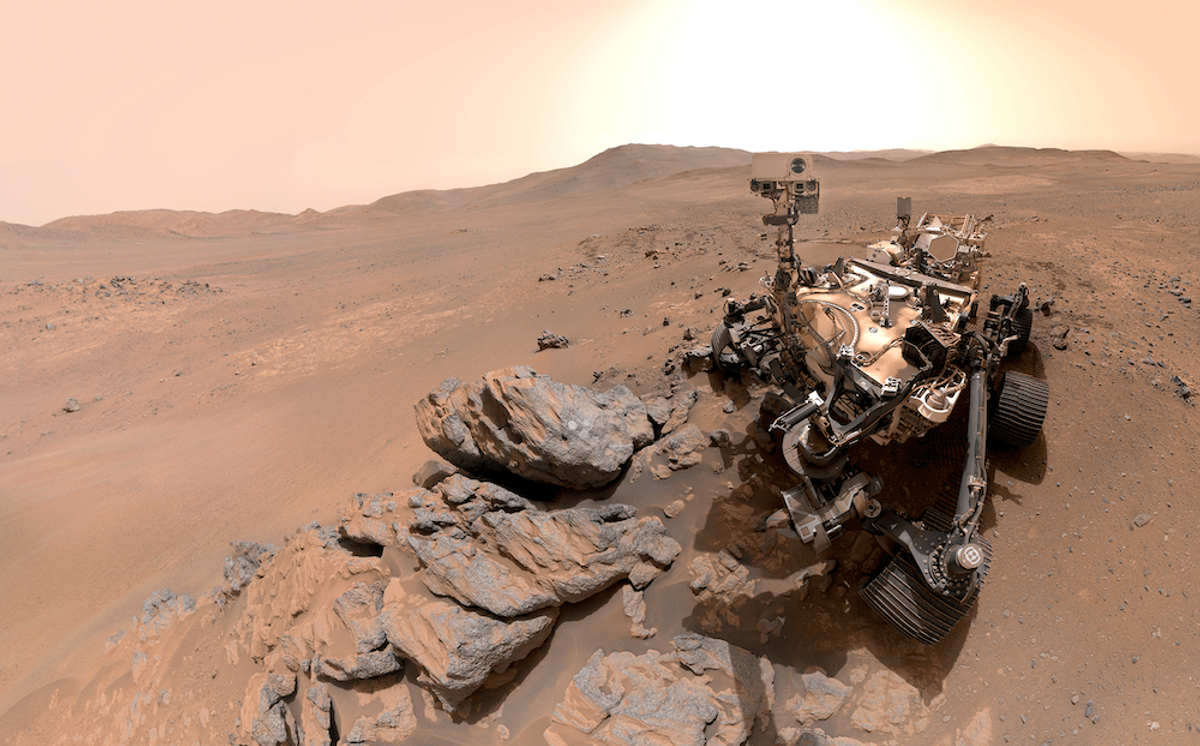
A statement from NASA clarified that the new directive isn’t “weakening” existing planetary protection protocols so much as updating them. “This directive moves NASA toward a quantitative, performance-based approach that measures actual contamination risk and applies protections accordingly,” the statement said. Additionally, missions looking for past or present life on Mars—such as NASA’s Perseverance rover—will “continue to carry requirements appropriate to protecting those investigations.”
Such cautions are crucial, experts say, especially since Perseverance has uncovered tantalizing hints of possible ancient biosignatures in some of the rocks it has studied; samples from those rocks are now in limbo, awaiting an as-yet-unclear ride back to Earth for further analysis.
“We are actively seeking to learn if the organics we have found on Mars are biological in origin,” says Linday Hays, NASA’s senior scientist for Mars exploration. This policy change will not threaten that goal, she says, but “will allow us to bring decades of science from our Mars exploration to help make our processes more straightforward for robotic and, in the future, human exploration of the Red Planet.”
Editor’s Note (9/30/26): This is a breaking news story and will be updated.
Subscribe to Support Independent Journalism
Great science journalism requires human expertise, time, effort and creativity. And it costs money. That’s why I and the journalists here at Scientific American hope you’ll join our community.
When you subscribe, you are supporting staff and freelance journalists who are passionate about telling science stories that are true, important and compelling. Our editors and reporters are often experts in their fields, which means they understand the nuances of big discoveries and can untangle the breakthroughs from the hype. With a subscription, you are also supporting rigorous fact-checking to ensure the words we publish are precise and accurate. And you’re supporting original illustrations, graphics and photos that bring you closer to an advanced laboratory, an ice sheet in Antarctica or a space mission in orbit. You’re helping us craft other types of high-quality journalism as well: Our newsletters are carefully written, edited and curated by staffers you have or will come to know and love. Our Science Quickly podcast is based on original reporting, collaboration with editors and scientists and exacting production.
Subscriptions keep this engine running so we can continue to deliver thoughtful, rigorous and independent science journalism to you. In an era of viral misinformation, this work is crucial. If you value what we do, I hope you’ll consider joining us as a subscriber