



























My Aunt’s Collection of Miniature Men Is Probably Not Harmless
“Aunt Yoanna” by Antoine Volodine, translated by Lia Swope Mitchell
Aunt Yoanna had a collection of homunculi. This wasn’t a secret, and it seemed like everyone in the family who lived nearby could see it, this collection, by going to visit her. Even in Aunt Yoanna’s presence, though, some people would shrug and cast unpleasant aspersions tending to call its existence into question, or at least diminish its importance. Grandfather Bödgröm was vehement on the subject. He had a loud, harsh voice, and harshly he’d explain that, even if the collection had indeed existed before the war, it was worth nothing today. Just after the hostilities ended, he claimed, the national guard had come through and destroyed everything as part of the battle against superstition. And it had never been reconstituted since, this collection. To hear Grandfather Bödgröm tell it, Aunt Yoanna was lying. She was some kind of dirty witch, that he didn’t dispute, but no, no way could anyone believe such a ridiculous old wives’ tale about homunculi. “You know what I say?” he opined. “She put some kind of rubber dolls in jars, that’s her homunculi! That’s all they are!” And he added that, if there were any homunculi in her house, no doubt you’d find them in her bed, because real men wouldn’t sleep with such a demon for anything in the world. He didn’t hold back his obscenities on the topic, calling her a harpie, a bimbo, a vicious slut. He was a man marked by violence and sex, a man of curses, foul language, and nastiness. When he started talking and got carried away on the subject, he’d snarl in such a threatening manner that everyone gathered around fell silent, frightened, petrified. I didn’t understand why Grandfather Bödgröm was so categorically insulting regarding Aunt Yoanna, why he totally lost his composure. It’s clear there was an old grudge between them, an old anger that sprang to life at the slightest provocation. Most of the time, Aunt Yoanna would leave and slam the door, but sometimes she remained seated, terribly pale, managing not to look at anything. She would not say a word back to her father. I saw her clenched hands, her blank eyes; I had the impression she was going to die, but I made no motion toward her. Like everyone else in the room, I waited, petrified, for Grandfather Bödgröm’s fury to diminish. To calm down after his terrifying speech, Grandfather Bödgröm would abandon his audience and go out in the yard to split logs for winter. The scene wasn’t frequent, but I’d witnessed it several times already, feeling fearful and helpless.
It wasn’t hard to see that Grandfather Bödgröm’s insinuations were completely baseless. Contrary to what he said, in my opinion, there was nothing demonic about Aunt Yoanna. All you had to do was get invited over to her place to understand that, and to see her collection of homunculi, all you had to do was take a circular glance around the large room where she welcomed visitors. The collection was there, maybe not very spectacular, but visible. Aunt Yoanna lived in a two-story house overlooking the left bank of the Kanal River. The neighborhood had been abandoned by the last ghosts of the proletariat after all the businesses in the region closed. All along the Kanal stood a mournful parade of workers’ shanties, gray and rotting with damp, and Aunt Yoanna’s house formed a bright, joyful spot among them. It was the only one to harbor a very white façade and a bright blue door without scratches, which Aunt Yoanna insisted on whitewashing and painting every year.
Aunt Yoanna wasn’t a very demonstrative person, and many people considered her unpleasantly cold, so she didn’t receive many visitors. Her collection of homunculi provoked general curiosity but also disgusted some sensitive souls in the family, and besides, they suspected her of hiding something, possibly some unmentionable part of her life. Nobody gave any credit to Bödgröm’s vociferous pronouncements, but in a way, they had the intended effect. Many believed she was hiding her own terrible secrets and they did not trust her. From their looks, from their closed mouths and glinting eyes, I could see the horrors that Grandfather Bödgröm spewed were spinning silently inside their heads.
But anyway. I didn’t think ill of Aunt Yoanna at all. I wasn’t one of the people mentally repeating, and certainly not softening, Grandfather Bödgröm’s nightmarish accusations. And I went to see Aunt Yoanna without wondering about them.
Once through the door, she’d invite visitors to sit in the main room, which was organized and decorated to look more like the inside of a nomad’s tent than a middle-class home. You’d take your seat on the cushions and soon you’d have a glass of sugared tea in your hands, spiced with herbs and seeds; she’d praise the juices or their curative, hallucinogenic, or aphrodisiac qualities, her comments varying to suit her guest. To me, she emphasized hallucinogenic concoctions.
“Who did you learn your knowledge of herbs from?” I’d ask.
She’d smile maliciously.
“Oh, you know I’m a bit of a witch,” she’d say, without answering.
Enthroned along the walls, on the low side tables, were large jars of thick glass, ten or twelve liters in volume. They held embryos in alcohol. The liquid was blurry, the fetuses inside floating gracelessly, pallid and distorted, with the heads of dropsical aliens. Five fetuses, with no anomaly I could see, aside from their distressing state of coiled incompleteness.
I got up to examine them without any great enjoyment, and, once I’d made the tour of the jars, returned to sit on the cushions.
“Oh, it’s no great collection,” Aunt Yoanna commented.
“I’d be surprised if there was another like it in the world,” was my faltering reply.
“True, Sam, it’s the only one,” she’d affirm with a note of irony.
In fact, Aunt Yoanna’s collection was located elsewhere. Her exhibit in the living room was a sleight of hand, meant to satisfy curiosity-seekers and silence those under Grandfather Bödgröm’s influence, who didn’t believe in the reality of her little museum.
One day, as we both lounged across the multicolored cushions on the sofa and chatted about everything and nothing, Aunt Yoanna turned the conversation to the family, to my grandmothers, my uncles, how I felt about the theory of blood and the theory of fire, how I felt about the idea of vengeance. I had long known we were in sympathy, but now I realized that her final judgment of me was still uncertain, and she was sounding me out to be sure what kind of boy I’d turned into. I’d just returned from a stay with distant uncles whom she didn’t hold in very high regard, and she wanted to know if any of their nonsense had gotten in my head, some social-democrat maunderings or inappropriate or apocalyptic nostalgias. She wanted to make sure that, over the last six months, I hadn’t changed course.
She asked me questions that became more and more indiscreet, more and more pointed.
This didn’t bother me. Maybe the tea she’d served me that day was not only hallucinogenic but also disinhibiting.
I was still going through what is insultingly called the crisis of adolescence, as if it were temporary and bound to end at adulthood. Let’s say I was seventeen years old at the time, although, since this number is purely theoretical, I could just as easily claim I’d just turned thirty. My age is my business. Let’s drop it, it’s not important. What was important, during this interrogation, is that I wanted very much to please her and, as an adolescent, I was not shy about proclaiming far and wide ideas meant to show I was a being of passion, ready to grapple with life. I wanted to be interesting and original. I didn’t beat around the bush; I expressed violent and extreme ideas on almost all subjects. At first, I was somewhat circumspect, but soon I was speaking with a stormy sincerity. Aunt Yoanna drew me into confessing sexual proclivities, giving an approving smile to my proclamations regarding free love, but what she wanted to learn most of all, what she forced me to reveal before her, were my ideas about vengeance and reprisal. Since I gave the opinion that merciless punishments should be reserved for bad people, she asked me to describe the radical retribution they deserved, and I was not stingy with the sadistic details. I expounded a bit in all directions, but this was what she wanted most insistently to test—my feelings on the law of retaliation, my conviction that, if the authorities couldn’t take care of it, you yourself must become the executioner.
To exert and inflict justice, become the executioner facing those responsible for suffering. She returned to the topic in various ways and, since I did not contradict myself in my statements, she nodded and encouraged me.
I had gotten worked up. I fell silent.
For a moment she sat dreaming, then she touched my arm, my knee, and she got up. I did, too. We left the main room, we went down a hallway, and she opened a door. She didn’t say a word, and neither did I. I let myself be guided. Beyond the door was a stairway, and we set out down the stairs toward the cellar. I had never gone this way, obviously. I’d never had a chance to go rummaging around in Aunt Yoanna’s house, to hang out there, whether on the ground floor or in the cellar. To my knowledge, Aunt Yoanna had never welcomed any guest beyond the warm and comfortable room where she offered tea along with the spectacle of embryos immersed in alcohol. Maybe she had lovers who accompanied her upstairs to her room, but she was very discreet about that. Grandfather Bödgröm, in his string of curses, accused her of leading the dissolute life of a slut, but no doubt this was pure and odious slander.
The stairs were clean and well-lit, with a hovering smell of plaster and detergent, and beyond that, the smell of fruit. The staircase was long and turned at least two corners, which prevented me from seeing where it ended. We arrived in a place where the ground was covered in fine gravel and, just as I was imagining we were headed toward some dark, sordid cave, we emerged in a sort of storeroom. The many well-placed lamps dispersed a pleasant light. A glass-paned armoire stood against one wall. Unlabeled bottles were lined up there, flasks, boxes. Next to the armoire was a wicker basket full of apples, emitting a powerful summery scent that sent me back to my childhood in the country: a childhood full of simple pleasures and carelessness.
Embedded in a large niche, apparently carved in the stone to accommodate the statue of a saint or demon, was an enormous control board, composed of several electrical units one on top of the other, forming a bright black mass, principally of ebonite, complete with a number of buttons, levers, and regulating devices. I felt like I was standing before the control panel of an industrial enterprise. Nothing like an individual home system.
I sent Aunt Yoanna a questioning look.
“Do you want an apple?” she offered.
I didn’t want one. The storeroom wasn’t at all disturbing, but I didn’t feel at ease. An irrational fear had just shot through me, no doubt sparked by my recent perusal of a collection of children’s stories—what if Aunt Yoanna wanted me to bite into a poisoned apple, and use witchcraft to reduce me to a brainless servant, a sex slave or something worse? For a second this fantasy paralyzed me. Only one second.
What if Aunt Yoanna wanted to use witchcraft to reduce me to a brainless servant, a sex slave or something worse?
“Well, um,” I stammered.
I was leaning over the aromatic basket.
I took an apple, then set it back among its fellow apples. Yellow, amber, attractive.
“A little later,” I said finally, as I stood up straight.
Aunt Yoanna noticed my confusion, but she didn’t hold it against me. Maybe she was aware that I might find our underground expedition disconcerting, even disturbing, because, among other reasons, she hadn’t told me what she planned to show me.
She approached the ebonite control board and pressed a big red button, then lowered one lever, then another. The operations were noisy. Evidently, they initiated something: openings in iron, closings, grinding electric currents. There were circuit breakers of various sizes, coupled with commands whose purpose I could not imagine.
Then she returned toward me and she opened the bottom of the armoire, a door without glass, and soon a cool smell of humidity and saltpeter escaped.
“Get down,” she ordered. “It’s through here.”
I obeyed. I got down on all fours. I had to go through a trap door. I don’t know why, since I was in reality and very far from literature, but I was reminded of those inane post-exotic stories where characters pass from one world to another, from life to death or worse, by crawling under sinks or through the bottom of who knows what dark cupboards. But it wasn’t a painful experience. Less than a half-meter, and already I was on the other side. I could hear Aunt Yoanna following at my heels. We both stood up at almost the same time. Now we were in the entry to a narrow underground passage, descending onward with a steep slope. A sinister odor hung above us, of stagnant water, black moss, black cockroaches.
“We’re going to pass under the Kanal,” Aunt Yoanna announced. “Does that bother you?”
“No,” I said. “But I can’t say I like it much.”
“Does it scare you?”
“No,” I said, without too much confidence.
Aunt Yoanna patted my back to encourage me. Acting in a friendly manner. I was in front of her, I turned back with a smile. After ten meters or so, stalactites began to appear overhead. They were still forming, and now and then I felt a cold droplet on my head or shoulders. Every five meters, the walls were reinforced by steel shutters painted in military green. The passage was well-lit with caged lamps.
“My collection is stored beneath the Kanal,” Aunt Yoanna explained. “If the slightest problem should arise, if the national guard wandered in here, for example, all it would take is a small gesture from me to drown everything instantaneously.”
“Don’t do that today,” I said.
Aunt Yoanna laughed. I felt tense. I knew too little about the surprise awaiting me. I regretted not taking an apple with me. I would’ve taken a bite; it would have given me more composure.
Then we stopped our descent as we arrived in a room with a vaulted ceiling. This dead end was our walk’s destination. A cement floor, walls made of large smooth stones, sealed with white mortar. Bright lighting. Well, not really a dead end, since a very solid iron door suggested a way onward, maybe another tunnel climbing toward the Kanal’s opposite bank, or to a secret chamber, an even more secret chamber. Unless it opened to a mechanism for instantaneous submersion, which Aunt Yoanna could initiate at any moment.
But that mysterious door, with floods and horrible swirling deaths threatening on the other side, wasn’t the most important thing in the room. The most important thing was Aunt Yoanna’s collection of homunculi.
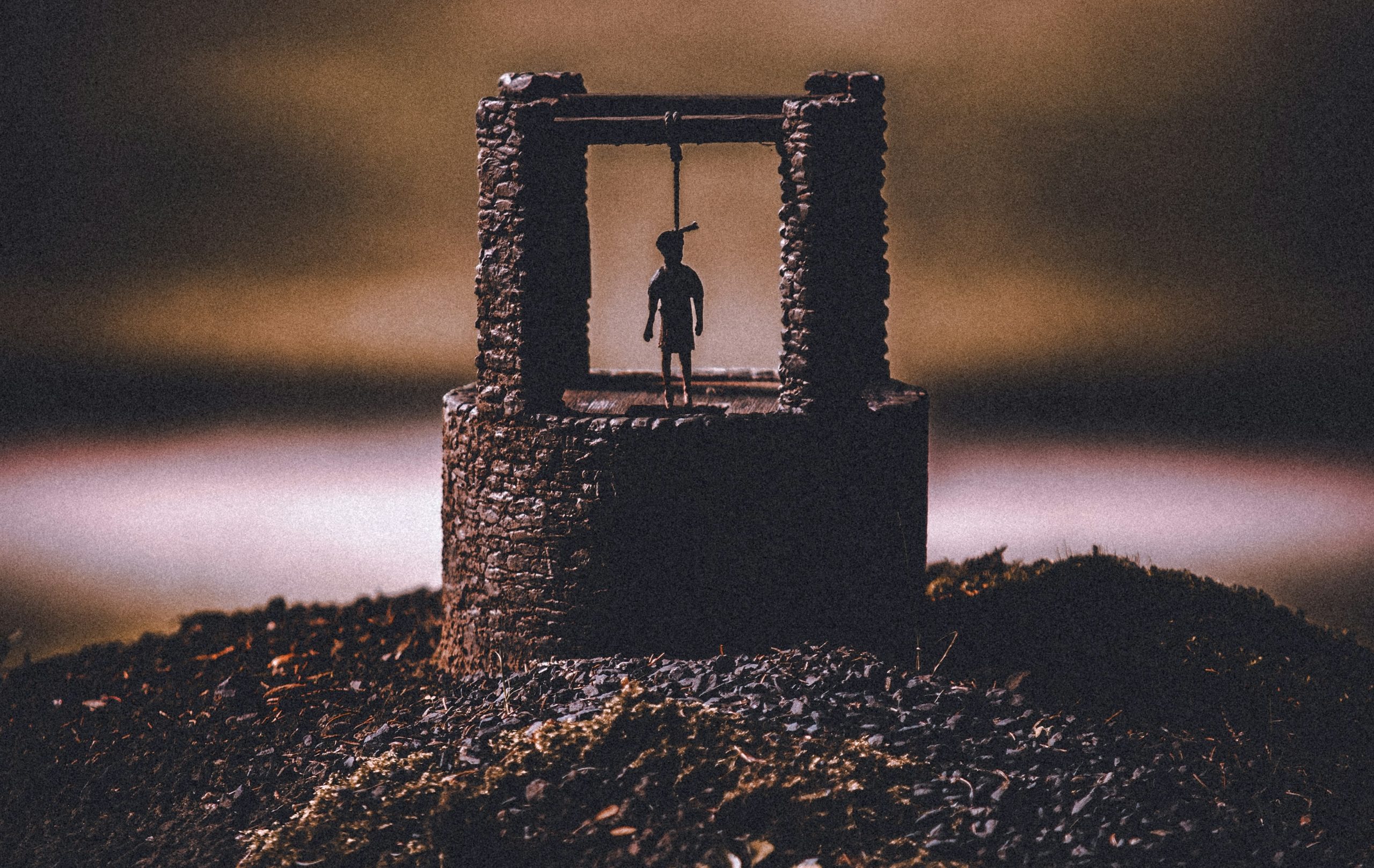
On narrow tables standing against the stone walls, Aunt Yoanna had set up rectangular containers, as wide as aquariums but taller, and without any liquid. I suppose you could call them terrariums. They were covered with mesh, intended to prevent any escape by the creatures held captive inside.
Twelve of them.
Twelve terrariums, that is. Each of these transparent boxes held miniature furniture. But not elegant furniture, like the minuscule artifacts in a doll’s house, those colorful things faithful to the originals, evoking well-being or even prosperity. Here was a decor much more limited and carceral. A modest mattress in striped fabric, a low table with feet stuck to the floor, a bucket, and, for seating, a sort of pouffe or ottoman, a seat, anyway, something between an armchair and a cushion, more comfortable than a chair but not necessarily well-suited to long periods of stillness. Each container housed a prisoner.
A homunculus.
Each was isolated from the others by opaque panels, so they couldn’t see each other and, perhaps, had no idea they were among others in this room, which must have looked immense to them. Under the incessant light shining from the ceiling, some of them were pacing back and forth, while others were lying down or sitting. Nothing like the fetuses bathed in formaldehyde. Nothing like those awful rubbery aliens with disproportionate heads decorating the living room in the house we’d left to go underground. No, what we had here were miniature men, no more than ten centimeters high. One was wearing a suit, like an office worker, another wore a winter coat, the next seemed to be in disguise, in carnival clothes made of a mess of multicolor patches, yet another was bare-chested, in underwear, exposing the hairy body of a microscopic Hercules.
The homunculi had noticed our presence and a few approached their prison walls to examine us. They pressed their hands against the thick glass, fingers spread wide, fingers that must have looked powerful from their perspective, whereas from ours, they looked like the fragile paws of mice or green frogs. Some of them drummed against the transparent wall to get our attention. For some reason that I cannot explain as anything other than an effect of witchcraft, they did not produce a sound.
“We can’t hear anything,” I commented.
“I cut off their sound,” Aunt Yoanna answered simply, without explaining any further.
We must have looked like giants, leaning over these Lilliputian creatures. Giant prison guards.
“Look closer,” Aunt Yoanna encouraged. “You’ll recognize one or two.”
Once I’d mastered the revulsion I was feeling, faced with these monstrous replicas of beings I was supposed to recognize, I put a name to some.
“Uncle Kroov,” I murmured. “Uncle Schlogott.”
I hadn’t seen either of them in reality, but these looked like the photographs I’d been shown. Uncle Kroov worked in the capital, in an office managing a reindustrialization that never took place, and Grandmother Rebecca said he’d embezzled fabulous sums of money before disappearing, who knows where. He was wearing his bureaucrat’s suit in his terrarium. Uncle Schlogott had been employed by the special forces of the national guard, and nobody in the family had heard any news of him for twenty or thirty years. He was easy to identify; he was the only man in the family that everyone compared to a gorilla. And there he was, in a box before my eyes, in his underwear, sprawled on an ottoman, indifferent to everything around him, as if permanently stupefied in the face of adversity.
“And . . .” Aunt Yoanna teased, pushing me toward another transparent cage.
I wasn’t sure. It was hard to believe.
“Grandfather Bödgröm,” I said finally.
“Oh yes, it’s Grandfather Bödgröm,” she confirmed.
Everything about him was dizzyingly reduced, but I could describe him just as if he were his normal size: tall, built like a blacksmith, gray hair and bristly beard, a mean eye, wearing a sheepskin hunting jacket and heavy black boots. His jacket had sleeves, but he’d pulled out his right arm and he was waving it, muscled and gleaming with sweat.
“It feels strange to see him so small,” I commented.
Grandfather Bödgröm was pressed against the glass and shaking his fist, as I’d often seen him do when overwhelmed with a hateful rage.
I leaned over to observe him better, then took a step back. I didn’t want to get too close. Grandfather Bödgröm’s gestures were hostile, and that hostility was directed at Aunt Yoanna, but, still, he was looking at me. I couldn’t understand what he was saying since Aunt Yoanna had cut off the sound, but I had the very distinct impression that, if he was pronouncing curses, they were directed at me, too. I felt like he could reach me, even if he had no axe and the lid was strong. One way or another, he was trying to get at us, Aunt Yoanna and me. I had stepped back swiftly, the same reaction, I suppose, as when you’re in a vivarium and suddenly find yourself nose to nose with a vile spider or scorpion. The glass isn’t nearly enough to contain the threat. Better to keep a little distance.
Aunt Yoanna stood right behind me and I was the one facing Grandfather Bödgröm. Very clearly, he saw me as his target. He was addressing me in a vehement, no doubt filthy manner, I could tell by his livid face. He was shaking both fists now, stomping heavily and roaring phrases at me that must have been terrible, and even if no sound passed through the transparent wall or the mesh high above his head, I had no trouble imagining what sort of abuse he was promising, should I ever cross his path outside, or should he find me again in the afterlife.
I had no trouble imagining what sort of abuse he was promising, should I ever cross his path outside, or should he find me again in the afterlife.
I’d always instinctively hated Grandfather Bödgröm, and every time I ran into him at family reunions, he seemed to consider me a negligible quantity, unworthy of interest or affection. I think I was just a dirty kid to him, always hanging onto women’s skirts.
“He’s angry,” I commented.
Aunt Yoanna behind me let out a breath that one might interpret as expressing mockery. Or satisfaction. Or maybe it was the muted whisper of a witch, a soft spell meant to calm Grandfather Bödgröm’s useless agitation.
Some of the other homunculi were thrashing around and talking or vociferating, as well, in their cells that were open for all to see. Their screeches did not reach us. The stone basement remained silent. The only sounds came from us, our shoes brushing the cement, our breath, a few exchanged words. Aunt Yoanna tried to explain the acoustic phenomenon that prevented the homunculi from making themselves heard, whether with their voices or by beating against the walls. Then she interrupted herself mid-sentence. She made a resigned gesture, as if to say, “Never mind, I’ll be quiet, I’ll drop it.” Her explanation was confusing, since she was reluctant to discuss the magical aspect that played a central role.
“Anyway . . . that’s how it is,” she concluded. “There’s no need to tolerate their whining.”
I nodded to indicate I was satisfied with her outline of a technical explanation. I had no need for specifics about the phonic isolation of the vivarium. I understood very well that she didn’t want to go on about her abilities as a witch, or the skills she used to maintain the homunculi in captivity underground, while their doubles continued living on the surface, with the appearance of normal adults.
“Does it work both ways, cutting off the sound?” I asked.
“No,” she answered. “There’s a filter. They can perceive only what frightens them.”
All the homunculi were gesticulating. There were about a dozen; eleven, exactly. The carceral set up comprised twelve containers, and eleven were occupied. All contained the same cruel and minimalist furnishings. Even Uncle Schlogott, the pygmy-sized gorilla, had left the ottoman where he’d previously lain in a state of neurasthenic collapse, and he was pressed against the window in a depressed, passive manner, staring at us despondently.
My first tour had been quick. Aunt Yoanna didn’t want me to leave it at that, and now she encouraged me to continue my visit. So I repeated my examination of the space, taking my time. I was fascinated. I won’t hide that, all the while, I felt a certain discomfort. I was examining these shrunken men, who called to me with supplications and insults I could not decipher, and my unease continued to grow. I was unable to give them a peaceful, objective look, and even as I saw them as unhappy mini-humans, transformed into toys through the violence of black magic, I also saw them as monstrous circus insects, alive and aware and interpreting their roles with aplomb, instead of belonging to the species whose behavior and aspect they aped.
I finished my second observational tour and I returned to Grandfather Bödgröm’s vivarium, next to Aunt Yoanna, who hadn’t moved while I was giving her collection a closer look. I went back to staring at Grandfather Bödgröm. I waited now for Aunt Yoanna to tell me more.
She chose to speak about Grandfather Bödgröm. She spoke of him in the most evil terms. It was strange, because she spoke of him easily, and he was facing us, unable to object to anything. Two giants were judging him with voices that must have resounded imperiously in his terrarium. And there he was in his glass prison, with no ability to speak, plead, or protest.
“Does he hear us?” I asked, uselessly, to verify.
“Of course he hears us,” she answered.
And swiftly she returned to her accusatory discourse, elaborating the disgraceful acts of which Grandfather Bödgröm was guilty.
Aunt Yoanna was not really Grandfather Bödgröm’s daughter. She was adopted. She’d hated him from the day he and Grandmother Abazane brought her home, even though she was very small, not even four years old. She’d gone against him in every manner possible, and there was no end to the conflicts that arose between them, perhaps with phases of lower intensity, to the extent that they could live under the same roof, but also with moments of open and violent conflict. In these situations, one almost always thinks the daughter’s hatred for the father is provoked by incestuous sexual abuse, but Aunt Yoanna made no such claim, although as I watched her let loose against this man, I suspected she was his victim, maybe not right away when she entered his household, but later on. She accused Grandfather Bödgröm of raping her sister, Aunt Margar, but not herself.
A step away, Grandfather Bödgröm had given up imprecations. He was no longer fulminating, no longer shaking his fists in our direction; he’d gone to sit on the ottoman, rubbing his beard while talking to himself, like a man possessed, or a drunk.
Her terrible indictment complete, Aunt Yoanna moved away slightly and fell silent. I let a few seconds of silence go by.
“How do they live?” I asked.
“They live here and elsewhere at the same time,” she explained. “They eat elsewhere, they shit elsewhere, they wash elsewhere. But they live here, and here they are under my power. One thing is certain: they do not sleep. The light prevents it. When they want something that resembles sleep, they put the bucket on their heads. They put their heads in the bucket. It’s the only way they can get a little darkness. But not enough for them to sleep. They can doze for a moment, in a pinch, but then they’re plunged into nightmare images. After five minutes, they put the bucket back down.”
“That must be hard on them,” I said.
I didn’t feel any compassion. On the contrary. I was filled with a nasty satisfaction, knowing they were all living in permanent state of insomnia and lack of rest.
Aunt Yoanna shook her head.
“Bah, no need to feel sorry for them,” she averred. “They’re all trash. There’s not one of them that’s any better than the others.”
I found myself interested in Grandfather Bödgröm again. Now he was slumped on his ottoman with a discouraged look about him, and he was grumbling in his beard. He didn’t look up at his jailers, the titanic creatures leaning over him, at my face that he perhaps did not recognize with such dimensions.
“You know, Sam,” Aunt Yoanna said. “They’re under my power. I enclosed them in there and they might stay there indefinitely. But any day I choose, something very bad can happen to them.”
I narrowed my eyes. I waited for her to continue.
“You see what I mean?” she went on.
“Something very bad . . .” I repeated. “I see, yes,” I hesitated.
A brief silence fell between us.
“But you can, too,” she said suddenly, at the end of this silence.
“I can what?”
She didn’t respond directly and abruptly returned to the subject of Grandfather Bödgröm. Once again, she accused him of revolting things; she completed her depiction of his crimes and misdeeds. Then she compared him to the other homunculi in her collection, who were certainly no better. All the prison-box denizens gathered in this room were characters who deserved a thousand deaths. Sometimes she’d spent years on the magical incarcerations here, she explained, since the process was long and complicated, demanding patience and strong nerves. You had to go through the black space and walk in fire without anyone suspecting your presence, so that, she went on, neither your prey nor some other witch or sorcerer of fire could intervene and ruin everything. It’s like hunting an animal that never shows itself, she explained. A formidable animal, always on guard, with powerful allies. Sometimes, she explained, the window for capture is only a few minutes. You have to act at the right moment. You cannot let the occasion slip past. Otherwise you have to start all over.
“If you want, I’ll teach you, Sam,” she promised.
Each homunculus was a small, solid, living creature, apparently autonomous, but that autonomy was limited, Aunt Yoanna explained. The homunculus was a replica that could come and go as it pleased within its container, but it possessed no independent fate. The link between the homunculus and its model was unbreakable. The original existed up on the surface, with the family, in the towns or the steppes, with no idea what was going on under the Kanal. Even in his worst dreams, his most disturbing dreams, he could not imagine his double vegetating in a secret room, languishing horribly under the bright lights that stayed on night and day, under Aunt Yoanna’s cruel surveillance. The homunculi, on the other hand, were fully aware of their status. They knew what was happening to them, what their magical imprisonment meant. They could feel, at every instant, the vibrating thread that attached them to their model. Their two fates were intimately linked, and although the characters up above were sometimes touched by a vague anxiety, they could not identify its source, whereas their shrunken doubles were constantly worried, on tenterhooks at the idea that their fate was in Aunt Yoanna’s hands. All you had to do was harm the replica, and the original would suffer the consequences.
“You see that needle?” Aunt Yoanna pointed.
I followed the direction of her finger. In the twelfth container, which was uninhabited and had no mesh cover, she had stored some miniature furniture and a few tools and instruments. I walked over, found a long needle next to a small trowel and a clamp. The needle struck me as very beautiful, precious and no doubt magical. It didn’t look like an ordinary tool, it was made of a bluish, mineral material, maybe a mix of lapis lazuli and turquoise. I took it in my hand and tested it. A great delicacy and yet, simultaneously, the stiffness of a dagger.
“You can avenge me for that living whorehouse,” Aunt Yoanna said.
I went back to the cage where Grandfather Bödgröm was staying. Everything I’d just heard about him filled me with rage.
It wasn’t possible to remove the mesh cover taking the place of the celestial vault in the homunculi’s carceral world. Grandfather Bödgröm had noticed the needle and watched with terror as I tried to introduce it into his space. He had no illusions about what I intended to do. He went crazy. He ran from one side of the empty space to the other, looking for a hiding place, which made no sense. Wherever he was, he was exposed. I got the needle through the metallic mesh and at first I maneuvered it rather awkwardly. I had doubts about what I was planning to do. I wasn’t quite sure if my objective was to hurt him or simply to terrorize him, to play with him, like a cat entertaining itself with a lizard or a mouse. Then I decided. I plucked up my confidence and, after a brief pursuit, I pinned Grandfather Bödgröm to the ottoman. Just as he ran in front of the ottoman, I knocked him over with the point, he fell, and forcefully I ran him through. He stilled there, his arms dangling, a long blue pin planted in the middle of his abdomen, between the navel and the heart.
Aunt Yoanna leaned over to see what had happened. She’d watched the chase without a word, but to avoid getting in my way, she’d stepped back a full meter. Now she had come close and she examined the container and its contents.
She commented: “Wow, Sam, you really went for it.”