


































Across 491 species of monkeys, apes and lemurs, same-sex sexual behavior was not distributed at random. It was more likely to have been documented in long-lived primates living with scarce food, more predators and demanding social hierarchies.
That pattern comes from a study led by Chloë Coxshall and published in Nature Ecology & Evolution in January 2026. The researchers combined published behavioral records with environmental, life-history and social data, then used models that accounted for the fact that closely related primates often resemble one another.
The result is evidence for context, not a demonstration that hunger, predators or hierarchy directly cause sexual behavior. This is one study, not settled consensus. It is a comparative analysis of species-level records, not a controlled experiment conducted across the primate order.
What the survey actually counted
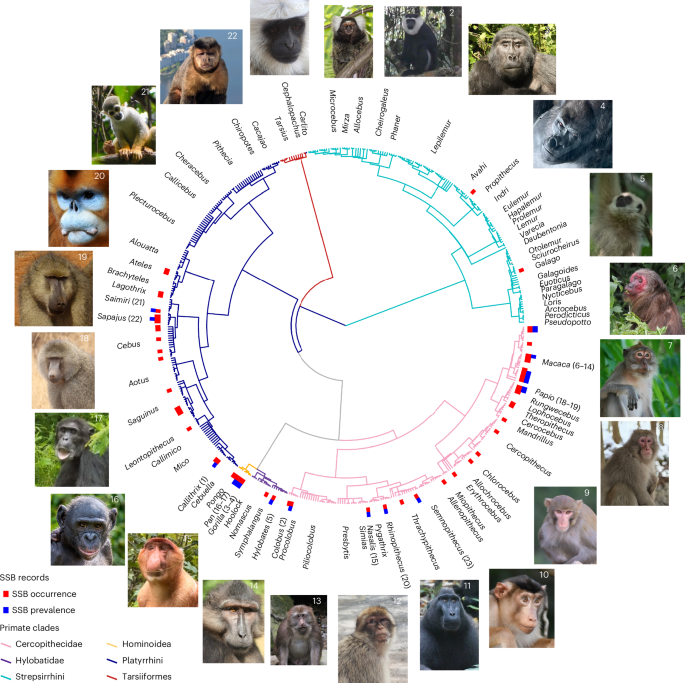
The researchers assembled data for 491 non-human primate species. Same-sex sexual behavior had been documented in 59 of them, including representatives of most major primate groups. The records included sexual interactions such as mounting and genital contact between members of the same sex.
Only 23 species had repeated observations detailed enough to enter the narrower prevalence analysis. That second sample matters because a report that a behavior has occurred is different from knowing how often it occurs.
The team’s public data repository makes the distinction visible. Its full file contains all 491 species and marks 59 with recorded occurrence. A filtered file contains the 23 species used for prevalence work.
Fifty-nine divided by 491 is about 12 percent, but that is not a reliable estimate of the biological prevalence across all primates. It is the proportion with documentation in this dataset. A zero can mean no behavior was found in the literature, not that researchers watched the species closely enough to establish its absence.
Fifteen traits and a shared family tree
The analysis compared 15 traits in three broad groups. Environmental measures included temperature, precipitation, cloud cover, vegetation biomass and the number of predator species. Life-history measures included body size, variation in body size, physical differences between the sexes, lifespan and adult sex ratio.
Social measures covered group size, group structure, hierarchy, mating system and the way infants are reared. These are broad species-level descriptions. They compress populations that may differ across sites and seasons into one comparative row.
The researchers used phylogenetic regression because a chimpanzee and a bonobo are not independent data points in the same way as a chimpanzee and a lemur. Related species inherit bodies, life histories and some social tendencies from common ancestors. A model that ignores that family tree can mistake inherited similarity for repeated evolutionary association.
They also used structural equation modeling to test how groups of traits might be connected. This method estimates paths within a proposed network. It can separate a model in which climate is associated with behavior directly from one in which climate is associated with life history and social organization, which are then associated with behavior.
Harsh ecology came with a stronger signal
Same-sex sexual behavior was more likely to be recorded in species from drier habitats, with lower food availability and greater predation pressure. Longer-lived species and those with stronger physical differences between males and females also had higher odds of documented occurrence.
The examples give the abstract variables some shape. Barbary macaques inhabit dry environments where food can be limited. Vervet monkeys live with substantial predator pressure. Chimpanzees are long-lived, while gorillas show pronounced differences in body size between the sexes.
None of those examples says that every animal under ecological stress responds in the same way. Dryness, food biomass and predator count were measured at species level, and the behavior was compiled from observations made under many different conditions. The analysis finds a cross-species pattern, not a moment-by-moment behavioral trigger.
Social complexity sat closest to the behavior
In the structural model, environmental and life-history traits were associated with same-sex sexual behavior mainly through indirect paths. Social complexity occupied the most immediate position. Species with complicated group structures and clear hierarchies were more likely to have the behavior documented.
“Direct” in this setting is a statistical word. It means the model included a path from social complexity to the outcome that was not routed through another measured variable. It does not mean the researchers experimentally made a hierarchy more complicated and watched behavior change.
The proposed biological interpretation is plausible. In some primates, sexual interactions can strengthen alliances, signal rank, ease tension or help repair relationships after conflict. Those social tools may become especially useful when scarce resources increase competition or predators make group cohesion valuable.
ScienceBlog’s first report on this study focused on this “social glue” interpretation. The fuller point is that ecology and life history may shape the kind of social system in which such behavior can serve several roles.
Why 59 is probably a floor, not a census
Behavioral databases inherit the attention patterns of the scientific literature. Chimpanzees, bonobos, baboons and several macaque species have been observed for years by multiple research teams. Many small, nocturnal or geographically restricted primates have not.
Same-sex behavior can also be omitted from field reports even when observers see it. That problem is not hypothetical. A 2024 survey of mammalogists found the behavior was widely observed but less often formally reported. The new analysis therefore risks false negatives: species coded as having no documented occurrence despite the behavior being present.
The researchers used a systematic search and phylogenetic methods, but modeling cannot recover observations that were never made or published. The fact that only 23 species supported prevalence estimates shows how thin the frequency evidence becomes once the question moves beyond simple occurrence.
This limitation could change the pattern in either direction. Better observation might add behavior across many social systems, weakening some associations. It might instead reveal that underreporting is widespread but the ecological and social gradients persist. The current data cannot decide which.
One behavior does not require one evolutionary story
The temptation is to replace an old single-cause explanation with a new one: same-sex behavior exists because it creates social bonds. The paper’s results do not require that conclusion.
Bonding, reconciliation, alliance formation and rank signaling are possible functions in some species and contexts. Other cases may reflect practice, high general sexual motivation, limited access to different-sex partners, recognition errors or a low cost to mating without first identifying sex. Several mechanisms can operate within one species, and the same visible act can have different consequences in another.
A 2023 phylogenetic study across mammals likewise found associations with sociality and conflict, while warning that incomplete records and alternative mechanisms remained important. A separate long-term study of male rhesus macaques estimated modest heritability while also finding strong environmental and social influence.
Those findings are compatible rather than contradictory. Genes can contribute to individual variation while ecology changes when a behavior is useful, tolerated or expressed. Evolution does not have to choose between biology and environment when both are parts of the same system.
Do not turn a primate pattern into a claim about people
The authors explicitly state that their study does not explain human sexual orientation, identity or lived experience. The outcome they measured was recorded behavior in non-human primate species. Human sexuality includes persistent attraction, identity, relationships, culture and individual meaning that are not captured by that variable.
Comparisons with other primates can establish that sexual behavior outside reproduction is part of animal biology. They cannot reduce human diversity to rainfall, predators or social rank. Nor can a cross-species association tell the story of any individual person.
The study’s contribution is more precise. Across a large primate family tree, documented same-sex sexual behavior clustered with ecological strain, long life histories and complex societies. The structural model placed social organization closest to the behavior, while the data limitations leave room for underreporting and multiple mechanisms.
That is enough to weaken the search for one universal evolutionary cause. Primate sexual behavior appears embedded in the conditions of a life: the habitat an animal occupies, the predators it faces, the years it survives and the relationships it must navigate.