








































Sizheng Ma already knew what he was looking for before he went looking. He and his colleagues had spent months working out, on paper, what a very particular twist of spacetime should sound like once it reached Earth as a gravitational wave. Then they turned to the loudest black hole collision LIGO has ever recorded, captured on 14 January 2025, and started hunting through the signal for that exact wrinkle. It was there.
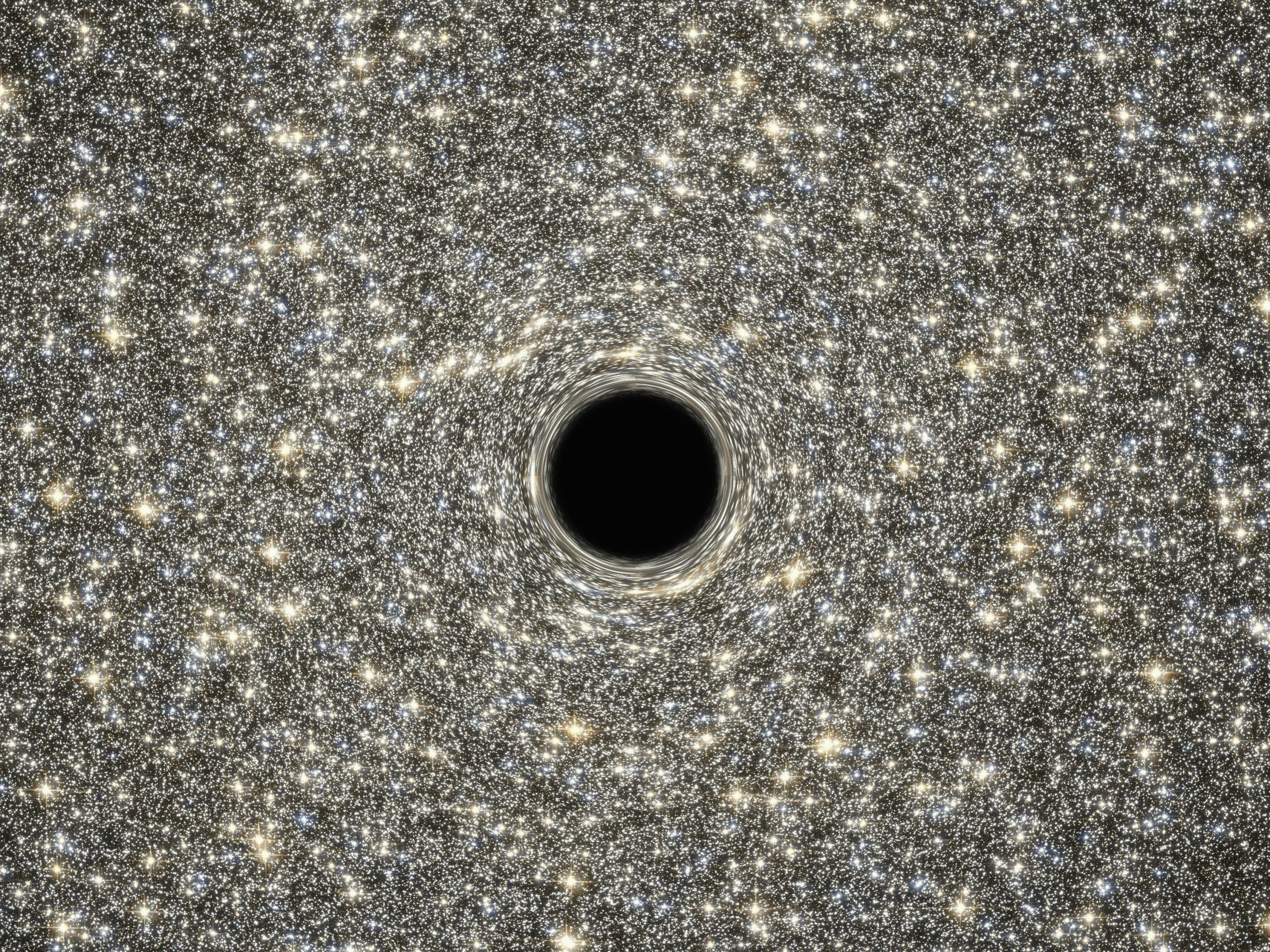
What they found is, in a sense, the imprint of a black hole’s outermost edge: the way its furious spin drags spacetime itself into a vortex around it. The work, published in Nature on 24 June, gives physicists their most direct handle yet on the region where gravity is at its most extreme.
To picture what “frame dragging” means, forget the black hole for a moment and think of a spindle turning fast in a vat of honey. The honey near the spindle gets caught up and hauled around with it. Near a spinning black hole, the honey is spacetime, and the dragging is so ferocious that nothing in the neighbourhood can sit still; everything is forced to rotate. When two such objects spiral into each other, the effect compounds. Like ice dancers pulling tighter and spinning faster, the closer the pair gets, the more violently the surrounding spacetime churns.
“The closer they get the stronger the swirling is, and at the end stage, the orbital motion is basically dominated by this frame dragging effect,” says Ma, a postdoctoral researcher in the strong gravity group at the Perimeter Institute in Canada.
That final moment, the brief transition as two black holes become one, is where the new signal lives. The team calls it a “direct wave.” It oscillates at very nearly twice the rotation frequency of the newborn black hole’s horizon, and it fades at a rate set by another fundamental horizon property, its surface gravity. Both quantities are encoded right there in the wave that crossed roughly 1.3 billion light years of space to reach us.
Why This Event, and Why Now
The collision itself, catalogued as GW250114, was not especially exotic. The two black holes weighed in at something like 30 to 40 times the mass of our sun, much like the pair behind LIGO’s very first detection back in 2016. What set this one apart was sheer clarity. A decade of chipping away at instrument noise has made the detectors enormously more sensitive, and GW250114 arrived as the loudest binary black hole signal on record, with a combined signal strength roughly four times the threshold most analyses need. Loud enough, in other words, to go digging for a feature nobody had ever pulled out of real data before.
Here it helps to know what gravitational-wave astronomers usually listen for. The dying notes of a merger, the so-called ringdown, are made of quasinormal modes: characteristic tones a black hole rings with as it settles, rather like a struck bell. Useful, certainly. But those tones are really tied to the light ring further out, not the horizon itself. The direct wave is different. It is the last gasp of radiation from the infalling matter as the horizon swallows it, carrying information from much, much closer in.
Isolating it was fiddly. The direct wave coexists with the louder quasinormal modes, so the team first had to filter those familiar tones out, mathematically, before the buried signal would show its face. When they did, the leftover oscillations matched their theoretical template strikingly well.
A Theory Built First, Then Confirmed
The order of operations mattered. “Prior to this paper, we put out a theoretical paper discussing how to interpret this signal, and then, with this theoretical understanding, we went on to search for this signal from the recent gravitational wave event,” Ma says. “We were quite lucky to see it because this event was the loudest to date.” The hard part, he reckons, was never the data crunching but the physics that came before it: working out which feature of the wave answered to which property of the horizon, and why it oscillates the way it does.
And when prediction met observation, Einstein held up. Again. The measured properties of the direct wave sit in full agreement with what general relativity says a spinning, well-behaved black hole should produce. “You can see this gravitational wave signal and you can overlay that with the prediction from Einstein and they agree very accurately,” Ma says. “If you think about it, that is amazing.”
There is a slight irony in that, of course. Plenty of physicists would dearly love general relativity to crack somewhere, because a crack is where new physics, perhaps a long-sought bridge to quantum theory, might leak through. The horizons of merging black holes, where gravity strains hardest, are about the most promising place to go looking for such a fracture. The tool Ma and his colleagues have built is, at bottom, a sharper probe for exactly that hunt; it just happens that on its first outing it found Einstein right rather than wrong.
For now the model remains, in Ma’s words, something of a toy: a first approximation that treats the infalling object as a simple point and fixes the remnant’s properties to their final values. He is already drafting a follow-up to firm up the maths and, he hopes, to track how these signals shift moment to moment rather than on average. As LIGO and its successors grow more sensitive still, every future merger becomes another chance to peer at a black hole’s spinning edge and ask whether the universe’s strangest objects are quite as Einstein imagined. So far, frustratingly or wonderfully depending on your taste, they are.
DOI / Source: Lu, Ma, Piccinni, Chen & Sun, Nature (2026)
Frequently Asked Questions
What is frame dragging, in plain terms?
It is the way a spinning massive object pulls spacetime around with it, like a spindle dragging honey. Around a fast-spinning black hole the effect becomes so strong that nothing nearby can stay still; it is forced to rotate along with the hole. The new measurement is the first time this dragging has been read directly off a black hole’s horizon during a merger.
How is this different from the ringdown signals LIGO already studies?
The familiar ringdown is made of quasinormal modes, the tones a black hole rings with as it settles, and those are tied to a region a little outside the horizon. The “direct wave” reported here comes from much closer in, the final radiation as matter crosses into the horizon, so it carries information about the edge itself. Teasing it out required filtering away the louder ringdown tones first.
Why does it matter that the result agrees with Einstein?
Each confirmation tightens the case that general relativity describes even the most extreme gravity correctly, which is remarkable for a theory now over a century old. But many physicists are actually hoping to find where it fails, since that is where new physics might appear. This technique gives them a sharper way to look at the one place a crack seems most likely.
Could this method be used on other black hole mergers?
That is the plan. The signal showed up clearly here mainly because GW250114 was the loudest event ever recorded, but as detectors improve, fainter mergers should become readable too. A systematic search across many events could test whether the effect behaves consistently everywhere gravity gets this strong.