










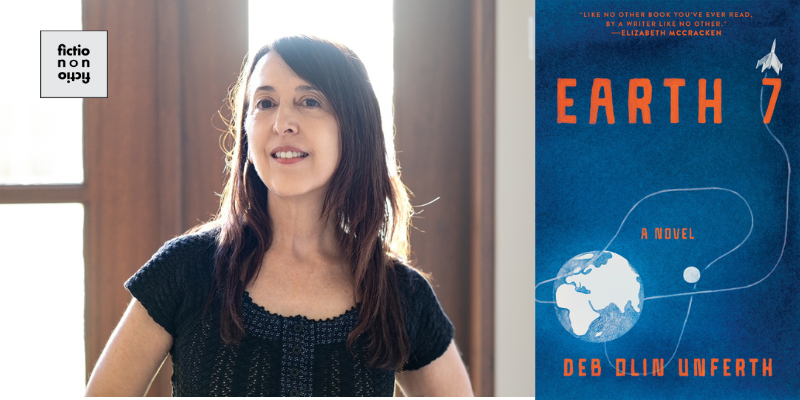


Writer Deb Olin Unferth joins co-hosts Whitney Terrell and Christian Barter to discuss the enduring power of apocalyptic narratives and her new novel Earth 7. The novel follows the life of Dylan, the daughter of a researcher, cast adrift on an earth that has been depopulated by war and environmental collapse. As Dylan’s mother tries to replicate and preserve the DNA of the earth’s now extinct flora and fauna, Unferth examines how proposed scientific solutions to global warming–like carbon capture, building artificial reefs, or shooting precious metals and sulfur into the sky–may exacerbate the problems they are meant to solve. She talks about the role apocalyptic narrative plays in a world that is, in many ways, already experiencing the apocalypse. She also reflects on her decision to “lean in” to the possibility of love and hope in the last third of the novel and explains how her optimism stems from the amazing beauty of the earth that we are living on now, even as we destroy it. She reads from Earth 7.
To hear the full episode, subscribe through iTunes, Google Play, Stitcher, Spotify, or your favorite podcast app (include the forward slashes when searching). You can also listen by streaming from the player below. Check out video versions of our interviews on the Fiction/Non/Fiction Instagram account, the Fiction/Non/Fiction YouTube Channel, and our show website: https://www.fnfpodcast.net/ This podcast is produced by Christian Barter and Whitney Terrell.
Deb Olin Unferth
Earth 7 • Barn 8 • Wait Till You See Me Dance • I, Parrot
Others
“The Second Coming”|William Butler Yeats • “September 1, 1939” |W. H. Auden • “Waking Early Sunday Morning” |Robert Lowell
EXCERPT FROM A CONVERSATION WITH DEB OLIN UNFERTH
Christian Barter: So the book is written from multiple perspectives but Dylan, who begins as a child at the start of the book, is the main character whose life this book follows. She grows up in a community of scientists and researchers, including her mother, and they’re all working on a project to solve DePop, the depopulation problem. Can you talk about that, how they see the solution, and what mankind is doing to try to solve this thing?
Deb Olin Unferth: I feel like the book is about extinction, about how we’re facing what they call the sixth extinction. We’re all very moved by that, right? You can’t think about the oceans, or the grasslands, or different countries that have vast wildernesses, and how it’s all dwindling, and we’re losing all of these species, no one can think about that without feeling bereft and helpless and despairing. There are all of these groups that are making various what they call “arks” or “seed banks” or “DNA banks” of different kinds that are that is going to contain the DNA of all this different plant life and animal life, the idea being that one day this, we’re gonna be better, we’re gonna solve it, and then we’re gonna have all this DNA, and we’re gonna make the animals and make the plants again, and it’s gonna be like Eden, but we are God. So I’ve been reading about those, and I’ve talked to some people who are involved in those projects. I needed that to be a part of the book, because they talk about it with such grandiose hope, but we all know that once the climate changes, it’s not going back to what it was, it’s going to change into something else. Even if we stop doing the things that we’re doing, it’s not like it’s just going to revert to how it was 100 years ago. So, I wanted the book to be about that hope and loss and longing. It’s strange, because that technology and that desire it’s like love of Earth, and yet here we are destroying Earth.
Whitney Terrell: Just to give listeners a sense of the geography of this space and of the novel, I’ll say what was in my head, and you can tell me whether I’m right or if I’m missing something. So the surface is inhabitable, but very desertified, it’s mostly sand, or at least the parts that most of the book is set in. In the beginning, Dylan and her mom live in pods underwater, which I guess are protecting them in some way from whatever happened at the surface, and since they’ve been living underwater, they have to have injections in order to be able to like go and survive on the surface. Is that right? And then there’s a different bunch of people who are living on Mars, and they’re doing their own thing up there. Am I missing anything
DOU: No, that’s great. My image was that the surface of the earth has become fairly uninhabitable. There have been various nuclear blasts plus all of the global warming that’s been going on, various kinds of catastrophes. As a result, because of the heat and all of these different things that are coming together to make the earth fairly uninhabitable on the surface, people are looking for other solutions. So, they build these pods underwater, and some people are living down there, and that’s where Dylan and her mother are living. Some people a few generations ago went to Mars. These Earth-sourced Martians don’t have any contact with the Earth that we know of at the start of the book, and then that becomes its own storyline. And then there are these refugee communities that are still living on the surface of the earth in these camps, and sometimes we run into them. There’s also the Company. There’s, I mean, it sounds like there’s a lot of world building, but I try to be really spare with that in the book. Just kind of
WT: But a lot of it comes through context. I world-built on my own using the clues that you gave me.
DOU: And you got it right.
WT: So, we’re going to talk about the characters in general, and talk about the novel and its plot, and how it moves forward, but before we do that, Christian and I were bantering at the beginning about apocalyptic narratives in general, and their meaning, why they come up at certain points in time. In the ’60s, obviously, there were narratives that had to do with fear over nuclear fission and the dangers of the bomb. You may have already answered this, that the answer is we’re in the apocalypse, but I wanted to know why you think those narratives are so resonant right now. Or have they always been part of the culture and there’s nothing particularly special about them today?
DOU: I feel like that apocalyptic narrative has always been with us. The thing that’s really changed in the last 100 years or so is that it seems to me that in the past it was always that God was going to smite us, drown us in a flood, or kill us all off. It’s only been in the last, like, I don’t know, not that long that the story has become, “Oh, we’re going to kill ourselves.” That, to me, is a very interesting development. If I think about all the different ways that this could happen, they’re building up. There’s more and more and more. So, I do think that it’s resonant now, and I do think it’s always been with us.
When I was growing up, the one that I remember so well was Y2K. Planes were going to fall out of the sky and people were going to be stuck in elevators for months, and the entire financial system was going to collapse. That one was so funny and sweet, and we were all so relieved when, you know, it didn’t happen. Or we weren’t even relieved, we were happy that we got to have all that fun. So, it’s always been with us in many different ways, and there have been ones everyone believed in. To some degree we were all like, “Okay, something’s probably going to happen with all of those zeros and ones.” It was this new mystery, it brought something new to the table that we didn’t have before.
Transcribed by Otter.ai. Condensed and edited by Rebecca Kilroy.