


















You get your James Bond fan card after the first time you watchGoldfinger and sniff witheringly, “It’s not as good asFrom Russia with Love.” You get your extra star, or maybe Double‑O status, when you grouse about whomever is up for being cast in the new film. And when the role is cast, the actor is too goofy, too boring, too blonde, too vanilla, too trained, not vanilla enough, not handsome enough, not zany enough.
James Bond casting for the fan is very much like Goldilocks but if she were deciding on who should next embody the escapist fantasies of the once-virile, now-frail British Empire. Or you could say it’s like that somewhat apocryphal Supreme Court obscenity ruling from 1964, in which Justice Potter Stewart said, talking about pornography, “I know it when Isee it.”
Get more Little WhiteLies
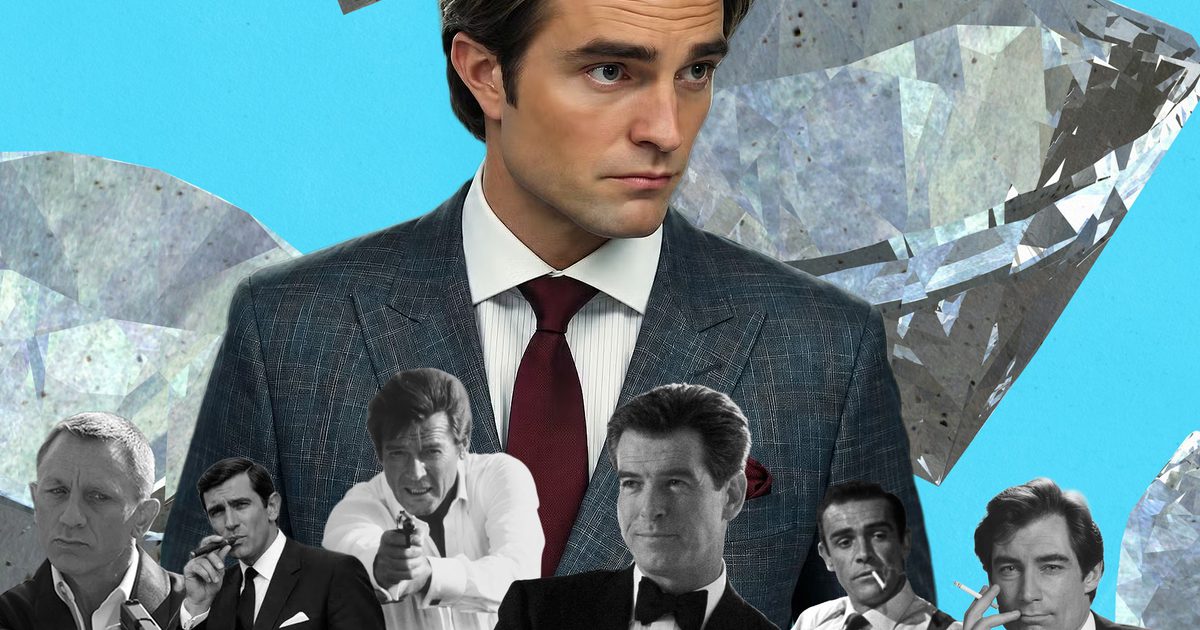
When Robert Pattison was announced as the new actor playing James Bond, all Icould muster was, “Well, at least it’s not Callum Turner.” Unenthusiastic, mildly curious, but mostly disappointed that someone whose public and screen persona is so carved in cement had been cast in the role that’s designed for actors to emboss something new onto. But, here’s Pattinson, already amovie star with afew franchises under his belt, pairing up with the most famous director of iMac commercials, Denis Villeneuve. How thrilling. But I’m happy to bewrong.
Back in the day Iwas vocally opposed to Daniel Craig when he was announced as the next 007in October 2005. Iwas 11 and had only been introduced to the world of Bond maybe three or four years prior via avideo game, Yet, he still seemed wrong to me. He had the face of aweathered canyon, he didn’t exude cosmopolitanism so much as he did dive bar bouncer. And, of course, those blue eyes, much too soulful.
But, as we came to find out, all those alleged flaws came to be Craig’s secret weapons: the world weariness on his face, the melancholy in his gaze, his overt lack of sophistication and earthiness. They all became defining traits of acycle of Bond films that, as much as they pulled from the adrenaline-pumping post‑9/11 action ofThe Bourne Identity andBatman Begins, felt like acoda to afranchise that had spent nearly its entire history mourning the death of the British Empire. Craig’s cycle was more of afuneral – films for the West in decline.
As of November 9, 2026, it seemed as if everyone and their mother had tested or been in talks to play James Bond. So it goes; the same thing happened in the mid-2000s, when names like Christian Bale and Clive Owen were in the mix, and Liam Neeson and Mel Gibson before them. That there is as much news aboutJack Lowden, Callum Turner, Jack O’Connell, and evenHarry Styles (LMAO) is frankly alittle surprising given how, afterSkyfall, interest in the franchise has seemingly dipped. ThoughSpectre made an excellent case for James Bond himself in the era of digital, diffuse warfare and the panopticon, Bond has been justifying his own existence since at leastGoldenEye and the fall of the Berlin Wall.
No Time to Die, after several delays and behind the scenes issues, seemed to leave little impression, even if they did kill off the character (still ashocking act, in my opinion). The new IOI video game007 First Light has received critical and audience acclaim, but the games are themselves independent takes on the series. But Isuppose, if Sherlock Holmes or Robin Hood (there was one of those that came out this year, sort of!) are any indication, if you have agood enough idea, any character, or piece of IP as the case may be, can remain immortal and withstand one reinvention after another.
Generally speaking, Idon’t think audiences really know what they want from James Bond, myself included. They know what theydon’t want. Few of the actors that have played him on screen have ever totally approximated Ian Fleming’s character, who Vesper Lynd describes inCasino Royale (1954) as such: “Bond reminds me rather of Hoagy Carmichael, but there is something cold and ruthless.” Athinly veiled avatar that allowed Fleming to fantasise about the power he wished he had been able to exert, the literary Bond is abruiser, amean sonofabitch, with, “dark, rather cruel good looks”. He’s scarred (literally, withШon the back of his right hand and agash on his right cheek), angular, slim, 6’, with along face and amouth that can bear its teeth when needbe.
The cinematic Bonds have ebbed and flowed as to their fidelity towards this description or the character’s temperament in the book (racism, sexism, abuse, happy trigger finger, etc.), and the throughline from Connery to Craig has ultimately always been kind of tenuous. Connery was atruck driver and body builder, Lazenby was apencil model, Moore was aTV actor, Dalton was aRoyal Shakespeare Company alum, Brosnan another TV actor, and Craig another stage guy and art house film regular. The cinematic Bond has always been, whether out of circumstance or intention, alittle bit chimeric.
But they all looked good in atux and, in the best of times, could wield the same kind of ferocity of asuperhero gone rogue, while wavering on his faith for Her Majesty just enough to go off the radar one moment (Licence to Kill,Skyfall, etc.) and then come running back when Mcalls the next. They have atortured relationship to duty itself: it is the thing that gives the Bond character meaning and also that which destroys him. He is constantly torn between his awareness that he is ablunt instrument of the nation and an individual without much of asoul left; it’s an uncanny analogy for the actor playing him.
The actors that were selected for the role carved Bond the cinematic figure as something both separate and, like the films themselves, somewhat reactive to the culture and cinematic landscape they inhabited. Adashing hero for an anxious Sixties (to stand in sharp relief to the mod-era), aslapstick clown for adisillusioned Seventies (to contrast against the Watergate paranoia), adebonair blank slate for the deadpan Nineties (to compete with the macho James Cameron acolytes), and so on. You don’t getMoonraker withoutStar Wars, orLive and Let Die withoutShaft, orGoldenEye withoutTrue Lies. You know thedrill.
Really, besides the tuxedo thing, one of the only consistent trademarks of Bond is that no movie star has played him. Nor should one, hence my own initial resistance towards Pattinson. If there’s one thing that’s my number one criteria for the new Bond it’s this: James Bond cannot be played by amovie star. James Bond makes amovie star out of the man. He’s an actor whose identity then becomessynonymous with Bond, not the other way around. He is acanvas onto which the audience can project their fantasies about sophistication, class, masculinity, sex, power, geopolitical intrigue and stardom itself. Bond occupies the slightly liminal space of both megastardom and anonymity: he walks into aroom and commands the attention of the villain, while moving swiftly through crowds like awell-heeled tourist.
As Bond is avessel for post-Cold War (or post-Empire) neuroses, so too must the actor be avessel for Bond’s talents and hangups, their idiosyncrasies lending areadingtoand interpretationof Bond while also crucially being able to pull off Bond’s ability to manipulate his visibility in any given room or space. He can make himself known at the baccarat table or disappear into the crowd during aCarnivale celebration in Rio. That’s only possible when the actor playing him doesn’t have an existing star persona overwhelming the role. (My personal picks? Daniel Kaluuya, Jamie Bell or Tom Francis.) But Bond’s body offers avesselfor the actor to thenbecome astar: the ways in which the actor makes his 007 unique then provides astructure for him to either deepen or deviate from when the actor goes on to other roles (Brosnan’s steely hit man inThe Matador;Dalton doing Moore inLooney Toons: Back in Action).
Ultimately, who we want/don’t want as Bond is heavily predicated on where an audience’s nostalgia resides. And that’s not only for aparticular Bond actor, but the way that the films were situated within abroader pop cultural landscape and how Bond himself does and does not stand apart from those en vogue archetypes. Have we graduated from the era of Nolan-esque funereal deconstructions of superhero mythos and returned to atime of stunt maximalism, àlaJohn Wick or evenThe Fall Guy? With Denis Villeneuve at the helm, will it just be another piece of stately brutalism and staring-down-the-barrel contests? With Nineties back on trend, will the next Bond embody that kind of semi-naïve urbanity?
Now that Pattinson has been cast, audiences will have no choice but to bring their knowledge and baggage of Pattinson’s career and stylistic tics to a60-plus year old character and franchise. Rather than ablank slate onto which we can project, he’s the weird little guy, the twitchy Chris Hansen, pale pale vampire, quirky Cronenberg collaborator, etc. (I echo others’ thoughts in believing Pattinson would make agreat Bondvillain.) He has apanoply of characters that everyone knows, unusual for aBond actor, and thus shaping the audience’s ability to imagine Bond as an every man who ascended into superstar secret agent almost by sheer force ofwill.
The announcement doesn’t matter. No one will be happy with the day of the press conference and naysayers will be the loudest section of the choir. Imight be among them. But this might be agood thing. The best any Bond actor has ever done is used Bond as away to prove themselves not just as journeyman but as capable of taking whatever bizarre, unique qualities they have as aperformer and sublimating them into Bond himself, using those idiosyncrasies as akind of authorship: Connery’s disaffectedness, Moore’s physicality, Dalton’s stately malevolence, Brosnan’s menswear readiness, Craig’s miserablism.
Whatever those supposedly deficient qualities (frankly, my main complaint about most of the recent contenders is that they are both too famous and also too boring, although Iam mostly talking about Callum Turner), hopefully the winner transforms those preconceptions into aframework through which to approach Bond. The only thing that will really have weight will be when whoever is announced actually slips on the jacket, puts the keys in the ignition of his Aston Martin, and introduces himself on screen with asmirk, adrink order, abullet to the head, and his name. Only then will we know if our new Bond deserves his license afterall.