
























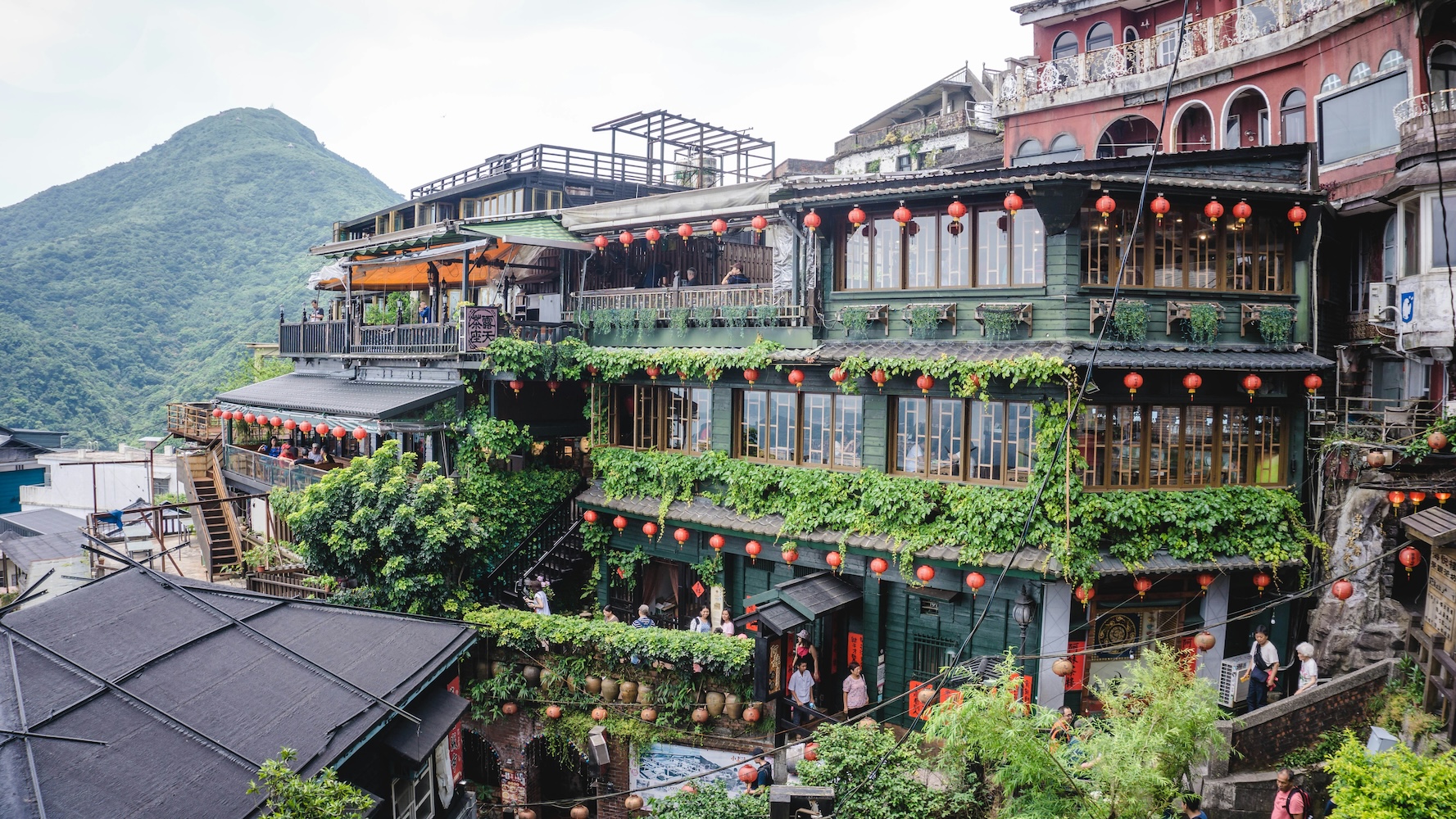

It had been four years since the air had hit me like this, heavy and warm. Coming out of the airport felt like stepping back in time, everything concrete, tinged with green. I was in Malaysia, a place that feels like home, although I’ve never lived there. I’d been deprived of my childhood tropics since early 2019. Now that I was back, escaped from Europe’s wintry entrails, I dedicated myself to plowing through every sensory culinary experience that I could: like an obsessive, covetous demon, I raked up guava pieces sprinkled with sour plum powder, fried king oyster mushrooms, brinjal stewed in thick red sauce.
But the durian—no condiments, no utensils, no plate even—trumped all these. I could smell it before I saw it, like a death or a thunderstorm on the horizon, a smell that leaves superstitions and pinched noses in its wake. Visually, the durian is spiky, large, hard, and green on the outside; creamy, sweet, buttery on the inside: back home they call it the king of fruit, partly because of its high price and addictive nature. During durian season, you can buy the fruit in white polystyrene boxes with the hard shell removed. You must eat it with your hands, tearing into the doughy yellow mounds that cover a hard seed. The flesh is a dense, heavenly concentration of pungent, fibrous honey. This is a very heaty fruit (energizing or stimulating, in traditional Chinese medicine), so you must never have it with alcohol. The flavor is sweet, solid, and electric, and lingers long after eating, like something warm on your breath—according to old lore, no soap brand can wash the smell off your hands, only water poured from the husk of the fruit itself.
The flavor is sweet, solid, and electric, and lingers long after eating, like something warm on your breath…
The durian is difficult to describe to those who have never encountered it, because the experience of durian—from its myths and quirks, to its many varieties and swinging prices—goes beyond the vocabulary of orthodox Western palates and newspapers. Traditional English-language food writing—a genre that rewards taxonomy, elevation, and reinvention—thrives on finding the perfect combination of words to capture the experience of a new flavor.
But sometimes, no word can depict an experience that is so totally foreign to the readers’ mind. Sometimes the word falls short of the thing entirely. My parents, for example, named me after a type of classic French plum. But the fruit I crave, the one I most deeply want to emulate, is the durian.
Before going home last December for the first time in years, I had spent my last few winters dreaming of durians. I moved from the US to France in the summer of 2020. It was the middle of the beginning of the pandemic, the second movement of worldwide protests against anti-blackness and police brutality, and the end of my five-year student visa. In short, I couldn’t return home, and my legal residence was now in France, a country I had visited but never lived in.
Bureaucracy hits like that sometimes, with no respect for narrative.
My first year in France, I didn’t go out much, due to a combination of remote work, Covid-19 restrictions, and a plain, lonely lack of places to go and people to see. I spent a lot of time filling out forms and calling various administrative departments, trying to lay the foundation for the rest of my life in a new nation-state—healthcare, taxes, housing.
To comfort myself as I lumbered through bureaucratic sludge, toward another winter away from home, I turned my thoughts to the food I missed. I stuck a postcard of tropical fruits to the wall. I wrote a durian manifesto. I found shriveled versions of herbs and leaves from back home and tried to approximate dishes whose flavors I only vaguely remembered. I saw my face in the mirror, and used an old trick to change its appearance, softening my gaze so that my reflection seemed blurry. In that fuzzy indistinction, I could imagine whatever I wanted. I could imagine that the weather was different, with sunshine outside my window instead of cold grey wind. I could imagine that I was home, and that I was myself.
I saw my face in the mirror, and used an old trick to change its appearance…
When I did leave the apartment, I walked anonymously, trying to locate the pace in my step that would allow me as invisible an existence as possible. I wandered into stores and mangled conversations in French, despite the fact that nobody who hears me speak thinks I grew up anywhere other than this France. But French wasn’t—isn’t—a language that fit me. My syntax is wobbly and simple. My vocabulary dates back to the francophone middle school I attended in Singapore in the 2000s, or to the Parisian seventies that my mother grew up in. Most of the time I manage fine. After four syllables—try intersectionnalité—my tongue stumbles. And beyond struggling with the words themselves, I struggle to identify the codes to go with them. Five years in a French middle school hadn’t taught me where to place my hands when ordering something from behind a counter, or whether I should sign off all my text messages with a first and last name, or whether it was too much to smile at a cashier from behind my mask. Now, somehow, every movement made me uncomfortable. It wasn’t just the language, it was everything about the world it operated, the way it made me shrink everything, from my words to my body. At some point, I knew I would have to make an adjustment.
I don’t remember when in my life I decided that, for practical reasons, it would not make sense to start questioning my own gender identity, because in the French language there is—according to most of its speakers and institutions—only “il” and “elle.” France is the country on my passport, and in some paperwork that I fill in. French is a language that I speak, sometimes with one half of my family and, for a time, in school. I don’t remember when I intuited that France would be the country I would have to live in once I had run through all the visas I’ve collected. Once I did, though, a question sometimes sifted front of mind when giving my pronouns in well-meaning settings on my US college campus: is this right, though? The response I gave myself each time: It doesn’t matter; it can’t matter.
Sharing pronouns became the norm while I was in college, but those parts of speech alone never seemed like the whole problem to me.
After all, in college, like everywhere else, I was always having to find shorthands to explain who I was and where I was from, some more or less satisfactory, and none of them entirely true on their own.
In introductory linguistics classes, I learned about symbols and referents. The symbol is the word, the phrase or language we use, and the referent is the thing itself in the real world. When we say “I am ___,” we are associating ourselves—the referent—to a name, so that others may know how to call out to us.
…for practical reasons, it would not make sense to start questioning my own gender identity…
I enjoyed those classes, the assignments to pick apart sentences and categorize each word by its function and type. I enjoyed rearranging words to see what meaning could come out. In English, I could be as complicated and long-winded as I wanted. But I lost that precision when I moved to France and found myself submerged in a flurry of administrative Madames that left me shockingly aware of something wrong in the way that I kept having to present myself through paperwork and in official phone calls. The bureaucratic demands were tiresome and endless. I had to draw on every last form and ID number attached to my existence and send it over and over to different email addresses. I was sick of form-filling, of follow-up calls, of being asked to send my visa, which I didn’t have since I was a French passport-holder: my technical existence seemed inscribed at a weird intersection of citizen and foreigner, unable to be processed by most humans in charge of untangling public administrative requests.
Administration is one of those tools, neutral in name and deadly in practice, that the capitalist state has historically wielded against minorities to exclude them from political and economic life. Immigrants, gay people, and—especially today—trans people are often trapped by the paperwork limbo operated by a state with vested interests in keeping certain people in extreme precariousness. Pointing to recent anti-trans legislation in the US, trans scholar Jules Gill-Peterson has argued that the state is trying to become cisgender: “The state has, at all levels from federal to local, attempted in different ways to exclude trans people not so much from citizenship as public life,” she writes. “If trans youth and adults lose access to public education, healthcare, restrooms, and legal recognition of their gender, there is essentially no way for them to participate in public life. They are not so much legally disenfranchised as in losing the right to vote or hold citizenship as they are expelled from the public sphere, exempt from care and support, as well as vulnerable to policing and violence.”
I was sick of form-filling, of follow-up calls, of being asked to send my visa…
Technically, when I moved to France, I wasn’t even an immigrant, I wasn’t even transitioning, and still the administrative work necessary to keep existing took a toll. There was a certain irony, I thought, in how I had been using logistics and practicality as an excuse to push back any thoughts about transition. I had worried that transitioning would make it more difficult for people to talk to me in this country, when the reality was that my very existence already seemed to be a glitch in the system, and that nobody was talking to me anyways. I would have to make myself known to the state, whether I wanted to or not.
In parallel, I could no longer deny or minimize the gap between my name and my self, the symbol and the referent. It was in my body, my words, everywhere. In this new country where so few people knew my name, I knew I would eventually have to respond to something, even if, back then, I would have rather refused any name at all.
Edouard Glissant of Martinique—philosopher and literary critic—once articulated that we should challenge the Western demand of “understanding” people, often framed in academic or journalistic contexts, and posed as a prerequisite for solidarity and compassion. While transparency and the search for knowledge are often presented as democratic, humanitarian projects, some of our differences are simply not knowable or definable to others. This shouldn’t mean we need to claim visibility as a political platform—our humanity shouldn’t need to be seen and understood in order to be respected. In Poetics of Relation, he named this “the right to opacity” and imagined a sharp ripost to his detractors: “As for my identity, I’ll take care of that myseIf.”
In this new country where so few people knew my name, I knew I would eventually have to respond to something…
The first time I read this, I imagined saying it myself to all the people, from bureaucrats and curious passers-by, who for whatever reason requested a play-by-play of my entire life trajectory in order to process me. It made me calm. I thought about my father, who loves durians. He’ll scoff disbelievingly at anyone who doesn’t, a bit of provocation. “What? What do you mean you don’t like durian?” It’s that performative sort of response to someone who doesn’t love something indisputably amazing. In his tone, I read a challenge: How can you claim to understand, when you’ve never known the first thing?
The durian’s reputation comes mostly from its smell. Everyone has a different way of describing it; to some, it’s like gasoline, to others like a rotting carcass. To me, the smell is of home. It’s a warm day with cups of room temperature tap water and hands curled slightly, resting over a plate, fingers golden from oil and good food.
Durian has long been a delicacy and prized fruit in the region, because it is significantly more expensive than other fruit. In his essay collection Durians Are Not The Only Fruit, Wong Yoon Wah, who grew up in rural Malaysia, explains that families often prized durian trees for this reason, as they could be an important source of income. Today, an entire transnational industry has evolved around the fruit. Demand has grown particularly in China, which imported US$4 billion worth of fruit from Southeast Asian countries last year (four times the volume in 2017), leading to competition and intranational squabbles over “durian diplomacy.” Certain variants are more expensive and sought after than others. No longer limited to polystyrene boxes sold by the road, durian can now be found in products from soap to chocolates. Thus, the durian has evolved into a veritable touristic weapon of choice in the region. At the same time, its undeniable pungency and tenacious grip in different local folklores is part of what makes it so unpalatable to a Western audience.
What does it mean today to be the king of fruit? The durian’s smell is too powerful for it to be co-opted like the jackfruit; too beloved to be eradicated or sanitized away like so much of nature has been in Singapore; every few years it causes the foreign correspondent industrial complex to show its ass when a Hong Kong-based Daniel attempts to describe it, compares the smell to death itself, and ends up getting roundly shamed on the internet. The durian has an extensive bibliography: oral, written, spiritual, extending far beyond the archives of the New York Times’ travel section. Its power comes from its polarity: either mesmerizing or repugnant to its beholders, the durian is incompatible with moderation and half-measures. It remains illegible outside its context.
When I finally managed to get myself into the national medical coverage system, I began the process of finding a doctor who would be able to prescribe hormones. This activated a whole other process of box-ticking, which required me to go from white-coat to white-coat explaining why I wanted to do this. At first, when they asked me what I wanted to get out of the treatment, I found myself spouting phrases that felt true but came out as nonsensically earnest as middle-school poetry: “I want to grow a shell,” I said. “I want to feel more solid.”
…its undeniable pungency and tenacious grip in different local folklores is part of what makes it so unpalatable…
Eventually I learned to recite the words and phrases that would unlock access to the treatment I wanted: “more masculine,” “less pronounced hips,” “facial hair.” Some of this was true, but I didn’t know how to explain—especially in French—that I wasn’t particularly able, or keen, to envision a certain version of my body that I was trying to achieve, but that there was definitely something I wanted to move toward. I wasn’t used to thinking about my own body so much, certainly as a mechanism of self-defense. I also don’t think my earnestness in this department would have helped me get the prized prescription.
At the same time, I kept thinking back to the durian—to how, no matter how much press and recipe development and glory and hate it receives, there is something about the fruit that people outside the region just don’t seem to understand. Durians became a defensive symbol for me then, an internal compass that I conjured to help keep my voice steady in medical appointments when I asked for what I wanted.
Durian takes us beyond the apples and oranges—the cisgenderism, the whiteness—toward the horizon of weirdness and extremity, to an unconditional solidarity with those whose existence is distant or different from our own. People from my home know: You don’t have to enjoy the taste of durian, or even understand why anyone else does. But it exists, and you certainly have to respect it.
In defending opacity, Glissant criticizes the Western demand for total transparency. He rejects that we should be explainable, and that this explainability should be linked to an essential, authentic, truth. I have been on hormone replacement therapy for over a year and when people ask me why, the answer I give often leaves them dissatisfied or confused, just like when they ask me where I am from.
I wasn’t used to thinking about my own body so much…
So often, the quest for authenticity turns into a hunt for purity, a hunt for immobility, for some truth about a culture that has somehow remained fixed in the chaos of history. Based on this metric, I feel like my identity is instantly fraudulent in almost any context, given how many of them I have moved through in my life. I am French, but I am not. I am home, but I am not. I am a man, but I am not. Sometimes this minutiae feels unfair: everything in this world is complicated if you ask questions. So many symbols we take as regional fixtures have complex origins. Why should their legitimacy need to be free from the movements of history and its humans?
Take rubber, for example, one of the primary exports from British-era Malaya in the early 20th century. Today, rubber plantations remain a local symbol in social and economic history. They are an iconic part of the landscape in Malaysia, lining highways and encasing past stories of migrants, coming mostly as low-paid laborers from colonial India to tap the smooth, grey-brown barks.
I am French, but I am not. I am home, but I am not. I am a man, but I am not.
But those trees aren’t native to the area: In 1876, a British plant collector smuggled rubber seeds out of Brazil (which had, until then, enjoyed a prosperous monopoly on rubber production) and sent them to Britain’s Kew Gardens. 1,900 germinated seeds were sent to the Peradeniya Gardens on Ceylon, which then sent twenty-two specimens to Singapore, where the first rubber plantation was developed in the Botanic Gardens. By 1920, Malaya (which then included Singapore) was producing half the world’s rubber. Wong Yoon Wah, the author of Durians Are Not The Only Fruit, grew up on a rubber plantation in Perak, Malaysia, which is also where he first encountered durians. In Wong’s essays, the sprawling diversity of plants, their legends and their origins all commingle, making for a collection that departs from clean, traditional botany and offers, instead, a portrait of life in rural mid-century Malaysia that brims with contradictions and unsolved mysteries.
I want to be truthful, which sometimes involves being complicated. But sometimes, I don’t want to explain. I don’t want my footnote to be longer than my main text. Sometimes, the explanations I could give only seem to hinder the truth more than anything.
Eventually, I started taking hormones. As I made the appointments and filled out the forms, I began to find the right cadence in my speech to ask questions, confirm dates, correct mistakes. The “honorific” box on the paper, the Madame I ticked, grew smaller as my world grew larger; I left my apartment more often. I met people, spoke to them, exchanged numbers. Ironically, once I was comfortably entered into the state’s system, I no longer felt so trapped by it.
Many trans people I know don’t trust the state. But depending on it, in many instances, is not really a matter of choice in our current capitalist system: you can’t choose to divorce yourself from the institutions that directly or indirectly provide you with the funds and care necessary to live.
…once I was comfortably entered into the state’s system, I no longer felt so trapped by it.
Gill-Peterson, who argues that the state is trying to become cisgender, posits that this is a recent narrative choice made to legitimize the states’ domination of social life. She compares this to the transformations that, in the 1940s–60s, made the US straight: “Rather than the state merely encountering gay and lesbians and then folding them into its political life (the liberal, progress narrative forwarded in mainstream LGBT activism), the state proclaimed itself straight in order to found its practices of administration and political domination on the exclusion and dispossession of homosexuality as uncivil.”
It’s not just the US. It’s not just France. I know I can’t be too sloppy with my metaphor and my angst against the West: Durians are banned in most public transit in Singapore. As I wrote this, politicians in Singapore were arguing about the constitutional definition of marriage. They, leaders of a state dependent on an extreme neoliberal free market, have been speaking for years now about the import of “cancel culture” and “Western values,” because apparently queerness is intrinsically related to those things.
In response to these attacks, one reaction is to cling on to historical truth, to show that state-sanctioned homophobia is in fact a colonial export: 377A, the code outlawing gay sex in Singapore and many other countries formerly under British rule, was instated under colonial rule. Gender remains a colonial construct, and many pre-colonial cultures, including the Indigenous Bugis people in Southeast Asia, have a recorded history of a wide diversity of genders.
But while these histories are precious, they remain understudied, and their contexts quite culturally specific in a region that is replete with differences and exchanges over time. More importantly, they should not mean that our present, breathing lives mean anything more or less. If we didn’t have an explanation, we would still be here. If we didn’t have a past, we would still be here. Shouldn’t that count for something?
If we didn’t have a past, we would still be here. Shouldn’t that count for something?
I know I may have to go back to some institutions and ask, again, for new corrections to be issued. For now, I’m able and content to live my life outside of forms. My body is changing like a new season. Maybe it is this, or maybe it is this burgeoning idea of the durian, like a charm or newfound spirituality, that has made it easier to know how to walk. You’re not a freak, I tell myself now in public spaces, listening to Prince and moving my hips and shoulders both. You’re just holding a durian. Logically, it is incumbent on the durian to be disliked, if what Westerners dislike is good food. That’s just what it is. A durian doesn’t come timidly through the door. A durian doesn’t feel shame. A durian is just a durian. Why get so mad about a fruit?
“The apple does not fall far from the tree,” is a saying in countries where many trees are limited by the feeble power of their temperate context to produce anything more interesting than apples. I prefer to think instead of rubber seeds, which can lie dormant for years after they have fallen, until one day in the future, they explode, with a sharp, riotous noise.
This essay, by M Jesuthasan, is the sixth in Electric Literature’s new series, Both/And, centering the voices of transgender and gender nonconforming writers of color. These essays publish every Thursday all the way through June for Pride Month. To learn more about the series and to read previous installments, click here.
—Denne Michele Norris
The post I Am a Man, but I Am Not appeared first on Electric Literature.