


































Few contemporary intellectuals defy categorization as completely as Howard Bloom. A former music industry publicist turned scientific theorist, Bloom has built a career exploring what he calls “mass behavior”—the patterns that govern everything from subatomic particles to human societies. His work bridges disciplines as diverse as evolutionary biology, cosmology, psychology, and cultural history, resulting in a body of writing that aims to explain not just humanity, but the universe itself.

From Rock & Roll to Radical Theory
Before becoming an author of sweeping scientific and philosophical works, Bloom operated at the center of popular culture, shaping trends in the music industry. But his deeper ambition was always scientific: to understand how collective systems function—how individuals form groups, how groups compete, and how large-scale systems evolve over time.
This ambition would define his books, each contributing to what amounts to a unified theory of reality.
Core Ideas Across Bloom’s Books
Bloom’s works are interconnected, each exploring a different layer of complexity—from biology to global systems to cosmic structure.
The Lucifer Principle (1995)
The Lucifer Principle explores the idea that evolution operates at the level of groups, not just individuals. It argues that competition—including destructive behavior—can be a natural and even necessary force in evolution.
Global Brain (2000)
In Global Brain, Bloom proposes that Earth’s life forms together create a vast, interconnected learning system—a “global brain.” This concept anticipated modern discussions about networks, collective intelligence, and the rise of the internet.
The Genius of the Beast (2010)
The Genius of the Beast reframes capitalism as an evolutionary system—one that fosters innovation and adaptation through competition.
The God Problem (2012)
In The God Problem, Bloom explores how scientific processes can give rise to structures humans interpret as divine, attempting to bridge science and spirituality.
The Muhammad Code (2016)
The Muhammad Code applies Bloom’s theories to geopolitics and religious movements, analyzing the dynamics behind modern global conflicts.
How I Accidentally Started the Sixties
In How I Accidentally Started the Sixties, Bloom offers a vivid, personal account of his role in the cultural upheavals of the 1960s, providing insight into how mass movements take shape.
Einstein, Michael Jackson & Me
A key work that ties together Bloom’s life and ideas is Einstein, Michael Jackson & Me. Part memoir, part intellectual reflection, the book connects Bloom’s experiences in both science and pop culture—linking figures as different as Albert Einstein and Michael Jackson to his broader quest to understand creativity, genius, and the forces that drive cultural and scientific breakthroughs.
It serves as a bridge between his personal journey and his theoretical work, illustrating how his time in the music industry shaped his understanding of influence, innovation, and mass behavior.
Spotlight: The Case of the Sexual Cosmos
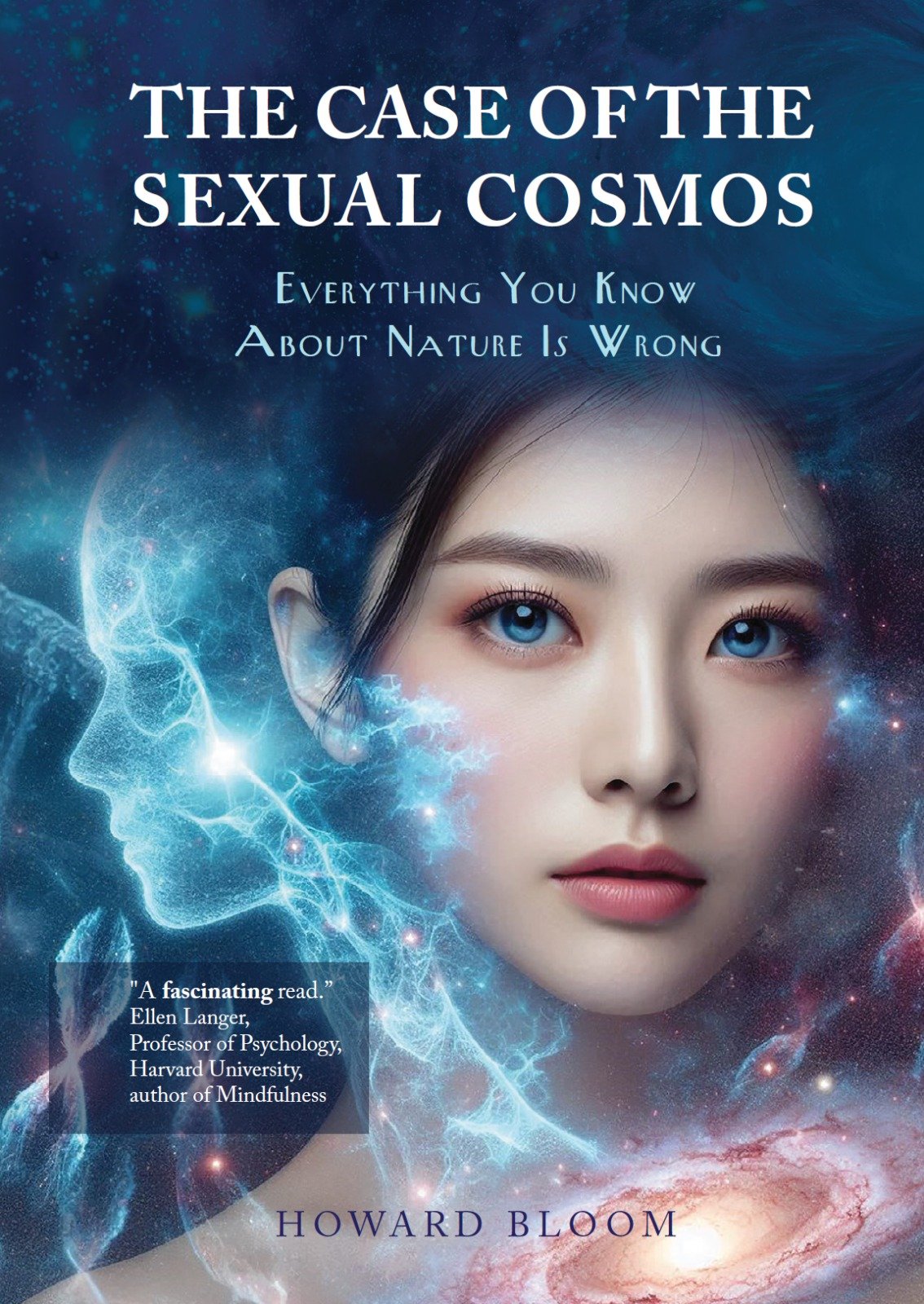
One of Bloom’s more recent and provocative works is The Case of the Sexual Cosmos, a book that pushes his ideas into even more ambitious territory.
At its core, the book challenges conventional views of nature as purely mechanical or indifferent. Instead, Bloom argues that the universe is driven by a kind of creative, generative impulse that resembles what we think of as sexuality—not in a narrow biological sense, but as a broader principle of attraction, combination, and innovation.
Key Themes of the Book
- Nature Is More Than Survival
Bloom pushes back against the idea that evolution is only about “survival of the fittest.” He argues that attraction, cooperation, and creative pairing are just as fundamental as competition. - The Universe as a Creative System
Drawing from physics and cosmology, Bloom suggests that the same forces that drive stars and galaxies may also drive life and intelligence. The cosmos, in his view, is not static—it is actively experimenting and generating novelty. - Rethinking Sexuality
The book expands the concept of sexuality beyond reproduction. Bloom frames it as a universal principle of fusion and innovation, present in everything from molecules combining to ideas merging in human culture. - Challenging Scientific Orthodoxy
As the subtitle suggests—Everything You Know About Nature Is Wrong—Bloom directly challenges established assumptions in science. He invites readers to reconsider deeply ingrained beliefs about randomness, order, and purpose in the universe.
Why This Book Stands Out
While many of Bloom’s earlier works focus on social systems or biology, The Case of the Sexual Cosmos reaches further, attempting to unify physics, biology, and human experience under a single conceptual framework.
It’s also one of his most visually and conceptually evocative works, as reflected in its cover imagery—blending human identity with cosmic structure, suggesting that the boundary between self and universe may be far thinner than we assume.
A Unified Vision: “Mass Behavior”
Across all his books, Bloom’s central idea remains consistent: systems organize into larger systems. Whether we’re talking about cells, societies, or galaxies, the same principles seem to apply:
- Individuals form collectives
- Collectives compete and cooperate
- Complexity emerges over time
- Innovation arises from interaction
His concept of “mass behavior” ties these ideas together, offering a lens through which to view both human history and cosmic evolution.
Conclusion
Howard Bloom’s work is bold, controversial, and unapologetically ambitious. With The Case of the Sexual Cosmos, he pushes his ideas to their furthest edge—arguing that the universe itself may be driven by forces more creative, interconnected, and dynamic than traditional science admits.
Whether one sees his ideas as visionary or speculative, Bloom’s writing challenges readers to think bigger: to see humanity not as separate from nature, but as an active expression of a deeply creative cosmos.