This article is part of “The New Nuclear Age,” a special report on a $1.5-trillion effort to remake the American nuclear arsenal.
Narrator: Twice a year thousands line up—many before dawn—in the middle of the New Mexico desert, just off of U.S. Highway 380.
They are nuclear tourists.
On July 16, 1945, the U.S. military detonated the first atomic bomb over this stretch of desert in New Mexico—a 24.8-kiloton blast code-named Trinity.
It was the culmination of the Manhattan Project, an all-out World War II effort by the U.S. military to build an atomic bomb before Germany did.
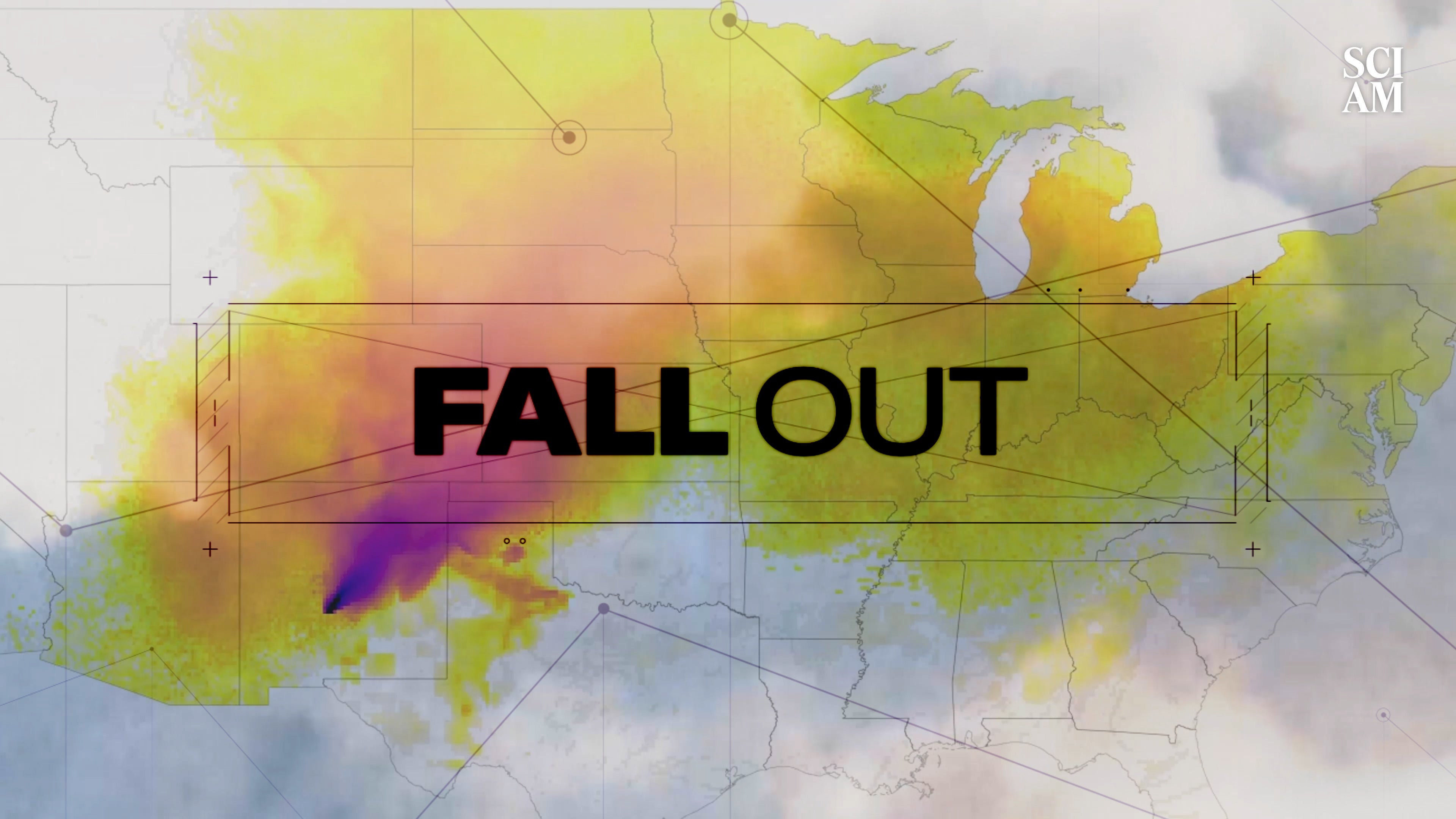
Although it was top secret, the blast could be felt 160 miles away. New scientific research shows that the fallout contaminated local residents, and spread radioactive particles across the U.S. and into Canada.
Soon after the test, the U.S. dropped two atomic bombs on the Japanese cities of Hiroshima and Nagasaki, killing more than 200,000 people. The war ended just days later.
Today that dark history seems lost on many of the visitors here.
But there are some here who are still dealing with the fallout of the Trinity test today.
These protesters are “downwinders,” those who were downwind of the Trinity fallout. They say that radiation from the blast has caused cancer for generations of their families.
Mary White grew up near the Trinity test site.
Mary White: My mother died of metastasized cancer. My sister died of the same. Dad died of leukemia. I have a sister who is a breast cancer survivor. One sister who is a uterine cancer survivor.
It’s the kind of thing that no one should ever have to experience, but we’re experiencing it much too often here.
Narrator: And today, nearly 80 years after the Trinity test, the downwinders have a new fear. For the first time, after decades of arms reduction, the U.S. has started making nuclear weapons again.
The U.S. has embarked on the largest and most expensive nuclear build-out ever.
It’s a project that will cost taxpayers trillions of dollars over decades. And most Americans, even many of those gathered here at the Trinity site, probably don’t even know it’s happening.
Sharon Weiner: Ask the average American what role nuclear weapons play, they’re either going to tell you, “What do you mean ‘we still have nuclear weapons’?”
Or if they think about it, they’ll probably assert that they provide security, because there’s this notion—it’s almost like a national story we tell ourselves–that nuclear weapons are necessary for our security.
Narrator: The U.S. military says that the “modernization,” as they call it, is necessary to replace an aging nuclear arsenal.
But critics argue that building these bombs comes with real risks, and even if the weapons are never used, making new warheads is dangerous and could lead to a repeat of previous environmental disasters.
—
Ty Neuman: The modernization effort that the United States is undergoing now is the largest modernization we’ve ever done in history.
Narrator: Brigadier General Ty Neuman is deputy director for plans and programs at the Air Force Global Strike Command.
He helped lead and shape the 2022 Nuclear Posture Review, a federally mandated report that establishes the country’s nuclear policy, strategy and capabilities.
Neuman says replacing the current nuclear arsenal with more sophisticated and powerful weapons is the military’s top national security priority.
Neuman: We’re now facing two nuclear peer adversaries that have or are building a significant nuclear enterprise of their own. In the case of the People’s Republic of China, they’re building a triad similar to ours.
Narrator: “Triad” refers to the three legs of the military’s core nuclear strategy.
More than 1,700 warheads are currently deployed on 14 submarines, on 60 Air Force bombers, and in 400 inter-continental ballistic missiles, or ICBMs.
Each ICBM has a warhead with at least 20 times the destructive power of the atomic bomb dropped on Hiroshima.
These ICBMs, known as Minuteman IIIs, sit inside 450 underground silos spread across North Dakota, Montana, Wyoming, Colorado and Nebraska.
And in the coming decade, each of the 450 silos will be replaced. The old missiles will be taken out, and new Sentinel ICBMs will be put back in.
Neuman: We think of the ICBM leg as the most responsive, being that the ICBMs are on alert 24/7, 365 days a year.
Narrator: But what the land leg does, more than any other part of the triad, is create targets in the U.S. where people live.
Weiner: U.S. ICBMs sit in silos in the ground. And we know that if the Russians and possibly the Chinese target those ICBMs, they’ll destroy them. And so if you know this, and you know that Russian ICBMs can arrive in this country in 30 minutes or less, well, that means you have an incentive to launch them on warning.
Air Force Announcer: Item 132. Launch closure door open. 5…4…3…2…1…launch.
Weiner: And once the ICBMs are launched, they can’t be recalled. They can’t be destroyed in flight. They’re going to their targets.
Narrator: Sharon Weiner is an associate professor, and a national security expert with a focus on nuclear weapons policy, at the School of International Service at American University.
Weiner: There are a whole variety of ways that system can mistake something for an incoming strike. And we know there have been hundreds of false alarms, hundreds of problems..
Nuclear weapons are outdated. What’s more horrible than a nuclear weapon and the threat that you could kill not just yourself and your adversary, but everybody else who’s not even involved in the conflict?
Neuman: It’s the ultimate foundation. It’s the, it’s the, it’s the safety mechanism. It’s the insurance policy that we have that protects our Americans. And I applaud our policymakers and our administration for fully supporting this and getting behind it, as well as the continued funding from Congress.
—
Narrator: The original placement of the missile fields was decided during the Cold War. They needed to be close enough to reach Russia but, theoretically, far enough from major population centers.
But new research shows that if a modern-day adversary were to target them, the damage and fallout would affect millions more people than previously thought.
Sébastien Philippe: When you’re attacking your missile silos with a nuclear weapon, you’re essentially blowing up the ground creating those gigantic mushroom clouds, which carry the radioactivity of the nuclear explosion itself.
And these mushroom clouds get dispersed by, by the local winds. A lot of that radioactivity gets pushed by winds that have much higher speed, essentially, than what you experience on the ground, and so a larger amount of radioactivity gets dispersed over hundreds of miles downwind.
Narrator: Sébastien Philippe is a research scholar at Princeton University’s Program on Science and Global Security focusing on nuclear weapons and emerging technologies.
Philippe’s model uses atmospheric transport software to track millions of radioactive particles as they are dispersed by the winds.
Philippe: The scale of the potential impact was way bigger than any other representation that I had seen before.
Narrator: Earlier maps made by researchers and FEMA, the Federal Emergency Management Agency, used averaged wind data and averaged nuclear impacts, not worst-case scenarios.
But Philippe’s work reveals the real cost of possible nuclear war.
Philippe: The radioactivity and the fallout from those weapons will cross the entire country—people living there would be at risk, one way or another, of receiving lethal doses of radiation.
—
Narrator: Nuclear modernization also means that the U.S. military is making warheads again, thousands of them, each with new radioactive triggers.
These triggers are called pits—hollow spheres of plutonium about the size of a bowling ball that make nuclear explosions possible.
Michael Ketterer: It is a an assemblage of subcritical masses of plutonium, which is intended to be smashed together by chemical explosives to produce a supercritical mass, which then explodes in an uncontrolled fission reaction, producing a lot of energy, which then serves as the trigger for a thermonuclear explosion.
Narrator: Michael Ketterer specializes in environmental chemistry.
He is professor emeritus at Northern Arizona University.
These days, he spends most of his time in the field measuring and monitoring soil for plutonium contamination.
Ketterer: As a result of nuclear weapons tests, plutonium is found pretty much everywhere on the Earth’s surface. So the default condition that we should expect in surface soils is perhaps about one picogram per gram. That kind of concentration of plutonium can be expected here and there and everywhere.
Ketterer (tape): It’s just in this top part of the mineral soil that the highest activity of the plutonium is usually found.
Narrator: Ketterer is looking at the fallout from our nuclear past that has lain hidden and undocumented.
Yet it is still dangerous decades after it was blown into the atmosphere—or leaked into the groundwater.
Ketterer: If you were to look at, say, a map of the whole continental U.S. or a map of the whole world, there are a few hotspots, so to speak, where there’s quite a bit more plutonium can be found. Rocky Flats is one of those hotspots. It’s one of the most prominent hotspots in the continental United States
Narrator: Rocky Flats, Colorado, 16 miles northwest of Denver, was home to a 6,500-acre nuclear weapons manufacturing complex. It operated from 1952 until its formal closure in 1992.
Today little remains of the plant that produced 70,000 plutonium pits during its operation.
Most of the land around it has been turned into Rocky Flats nature reserve, yet million-dollar houses have sprung up over the past several years around the edges of the reserve.
The only indication of its nuclear past is a local artist’s sculpture of a horse in a hazmat suit.
It’s called “Cold War Horse,” and it’s dedicated to those who became ill and died working at Rocky Flats.
But for Ketterer and others who are skeptical of the U.S.’s nuclear modernization effort, what happened in Rocky Flats is a sharp warning of what could happen again as the country ramps up its plutonium pit production.
The production facility at Rocky Flats manufactured the plutonium pits along with depleted uranium components for weapons. This generated tons of radioactive waste at the plant.
Jon Lipsky: From 1951 to 1975, there was actually no plan for the waste. The U.S. government did not have a policy about nuclear waste disposal.
Narrator: Jon Lipsky is a former FBI agent. He led an unprecedented raid on the Rocky Flats plant in 1989 for violating environmental protection rules.
Lipsky: The nuclear waste disposition was both open air incineration, like little barbecues on the, on the site. They would just burn the waste and hope for it to go away. And then, also, barrels were filled with aqueous waste. And that waste had nowhere to go except in the backyard.
Ketterer: The plutonium-laden cutting, cutting oils were placed in these steel drums. They were set out in the elements and essentially abandoned. Over time corrosion resulted in some of the drums rupturing, and this contaminated oil leaked out onto the soil, which then, through the action of wind and water, got spread in the environment.
Narrator: In 1992 the plant was closed. A year later the Department of Energy revealed that the Rocky Flats site contained at least 14 tons of plutonium, seven tons of enriched uranium, 281 tons of depleted uranium and 65 tons of beryllium.
After a $7-billion dollar,10-year cleanup effort, the Environmental Protection Agency declared the area safe in 2006. Early estimates said it would take nearly $40 billion dollars and 65 years.
Lipsky: What is now the refuge, the National Wildlife Refuge, was never touched. No action was taken. That means nothing was done. And the 20,000 acres—nothing was done. There’s no action. They weren’t cleaned up.
Narrator: But ground and groundwater contamination were not the only threats to the area. Two major fires at the plant, in 1957 and 1969, had already sent plutonium particles into the air. And winds spread them for miles.
Ketterer continues to find high plutonium contamination readings throughout the Rocky Flats area.
Ketterer: There’s two things that you always see: there’s elevated activities or concentrations of plutonium–there’s more than you expect in the Earth’s nuclear weapons test fallout background, and the plutonium is specifically attributable to Rocky Flats.
—
Narrator: With Rocky Flats closed, the U.S. military has returned to New Mexico, to the Los Alamos National Laboratory, or LANL, to restart its pit production program.
Billions have been earmarked for the production of new plutonium pits. To begin, the military had to rebuild and restart the LANL site, as well as the Savannah River plant in South Carolina.
The goal is to make 80 new pits per year by 2030: 30 at LANL and 50 at Savannah River.
At this pace, by 2080, all 4,000 nuclear weapons in the U.S. arsenal will have new nuclear pits installed.
But delays at the Savannah River site mean that LANL is the only facility in operation, and production is already behind schedule.
No plutonium pits have been made in the U.S. since 2013, and LANL’s Plutonium Facility Four, or PF-4, was previously set up as a research lab, not a manufacturing plant.
Robert Webster is deputy director of weapons at LANL. He’s in charge of all pit production and, in many ways, the core of the nuclear modernization effort.
Robert Webster: Yeah, there’s a ton of pressure to try to get to that 30 pit per year, and, and really, there’s a ton of pressure nationally to get to 80 pits per year as quickly as we can.
It’s a massive undertaking, both to transform PF-4 into having this branch, which is a production branch, in it.
When you’re dealing with very hazardous material like this, you’re having to add criticality safety engineers and safety basis design. You have to up the number of health [physicians] in the laboratories that monitor whether people have been exposed to anything.
Narrator: Webster says the rationale for rapid pit production is that the military fears the plutonium in old pits is aging, making weapons potentially unstable or ineffective. That’s why they have to move fast.
But some argue that new pit production is unnecessary.
Most of the active pits are only about 40 years old.
In 2006 a study by JASON, a group of independent scientific advisers to the government, said that pits could last for 100 years or more.
Jay Coghlan: So we don’t truly know how long pits might last. I don’t think the government wants an updated pit lifetime study because its conclusion would run counter to this very aggressive $60-billion program to expand plutonium pit production.
Narrator: Jay Coghlan is director of Nuclear Watch New Mexico, a nonprofit watchdog group that advocates for consistent U.S. leadership toward a world free of nuclear weapons.
Jay Coghlan (tape): Why is nuclear disarmament necessary? We survived the Cuban missile crisis only by luck. Luck is not a sustainable strategy, especially when we’re talking about civilization-ending weapons.
Narrator: In 2019, however, JASON released another report that reversed its previous statement. The group said that there was uncertainty to plutonium pit aging and recommended further study.
At LANL, like in Rocky Flats, the plutonium is handled by humans in glove boxes. Webster says that the safety mistakes made at Rocky Flats loom over his operation.
Webster: We are very well aware of that legacy. That would lead to, ultimately, in my opinion, to a choice of disarmament that we can’t afford to make.
Narrator: But on May 18, 2023, the National Nuclear Security Administration cited Triad National Security, a private contractor at LANL, for significant lack of attention and carelessness in protecting workers and the public.
The report detailed four nuclear safety events, including one glove box breach, and flooding. The fear with flooding is that water can enhance fission, causing plutonium to go critical.
According to SearchLight New Mexico, an independent investigative news organization, LANL has recorded 95 “process deviations” over the last five years, including safety incidents, emergency events, and protocol violations.
Webster says that the high numbers of incidents is a result of increased transparency at the lab.
Webster: This is why we encourage reporting. This is why our folks don’t get in trouble when they report these low-level things. This is why we take sometimes the hits out in, out in the public world with the number of incidents that are going on.
If I ever shut down that reporting, I run the risk of becoming Rocky Flats. And we will not do that while I’m here.
Narrator: Webster also has to deal with the nuclear waste LANL will produce. The current plan is to ship waste to the Waste Isolation Pilot Plant, or WIPP, near Carlsbad, New Mexico.
There it will be stored 2,150 feet under the ground…permanently.
But in 2014 a faulty waste shipment from LANL caused a fire at WIPP, which shut the facility for three years and cost $2 billion dollars to clean up.
Ketterer: The plutonium waste from pit production–we can expect those to be dangerous for well, at least 10 half-lifes of plutonium 239. So that’s putting it at about a quarter of a million years. It’s unimaginable that humans can contain things on that kind of timescale.
—
Narrator: On this night, the anniversary of the original Trinity test, Mary White and other downwinders are holding what has become an annual event.
It is a vigil in remembrance of those downwinders who have died of cancer.
And it also recognizes the long shadow nuclear weapons have cast over their community.
Woman at Ceremony: On July 16th, 1945, they detonated the bomb at the Trinity site. We started this 13 years ago to memorialize the people that we’ve lost in our communities as a result of being overexposed to radiation.
White (tape): Bobby Gonzales. Elizabeth Gonzales. Eloy Gonzales. Gilbert Gonzales. Ruth Tyler. Bennie Flores.