




















![The Voice Season 29 Knockouts Recap: [Spoiler] Wins All-Star Showdown](https://www.tvline.com/img/gallery/the-voice-s29-all-star-showdown-recap/l-intro-1775515759.jpg "The Voice Season 29 Knockouts Recap: [Spoiler] Wins All-Star Showdown")















Key Takeaways
- Monica Valluri and her team studied dwarf galaxies in the Virgo Cluster using the James Webb Space Telescope and found oversized black holes in two galaxies.
- NGC 4486B has a black hole that accounts for 4-13% of its stellar mass, unlike typical galaxies where it is about 0.1%.
- The strange orbital behavior of stars suggests that an asymmetric gravitational wave recoil kicked the black hole off-center after a merger.
- UCD736 is another galaxy with a black hole making up about 8% of its stellar mass, suggesting stripping by the Virgo Cluster’s gravitational forces.
- These findings indicate that dense cluster environments may lead to common patterns of black hole and galaxy evolution.
The stars don’t lie. That’s the operating assumption behind decades of work by Monica Valluri, a research professor at the University of Michigan who has spent her career writing code to do something that sounds deceptively simple: watch how stars move near the center of a galaxy and infer, from the precise curvature of their orbits, the mass of whatever gravitational monster is lurking there. Black holes don’t emit light, can’t be photographed directly, but they betray themselves through the motion of everything nearby. It’s detective work. Meticulous, mathematical detective work. And in two tiny galaxies in the Virgo Cluster, the stars have been pointing at something very strange indeed.
Three new studies published in the Astrophysical Journal Letters describe what Valluri and an international team found when they turned the James Webb Space Telescope on a pair of dwarf galaxies roughly 55 million light-years away. Both harbored black holes that were, by conventional astronomical measures, grotesquely oversized for their host galaxies. And one of them, the researchers now believe, is the aftermath of a collision between two black holes so recent that the merged remnant hasn’t yet found its way back to the center of the galaxy it’s supposed to inhabit.
In a typical galaxy, the central supermassive black hole accounts for about 0.1 percent of the galaxy’s total stellar mass. It’s a remarkably consistent relationship, observed across thousands of systems. Both of the galaxies studied here broke it badly. NGC 4486B, a compact elliptical galaxy orbiting close to the giant M87 near the heart of the Virgo Cluster, has a black hole somewhere between 4 and 13 percent of its stellar mass. UCD736, an ultracompact dwarf galaxy further out in the same cluster, weighs in at about 8 percent. These are not small deviations from expectation. They’re the kind of numbers that require an explanation.
In most galaxies, the central supermassive black hole makes up about 0.1 percent of the galaxy’s total stellar mass. An “overmassive” black hole exceeds this by a large margin. In NGC 4486B and UCD736, the black holes account for roughly 4 to 13 percent and about 8 percent of their host galaxies’ stellar mass respectively. This is thought to occur when the surrounding galaxy loses much of its stars through tidal stripping, leaving the black hole’s mass disproportionately large relative to what remains.
Black holes don’t emit light, so their masses are inferred from the behavior of stars nearby. By measuring how quickly stars move and in which directions near a galaxy’s center, astronomers can reconstruct the gravitational field and determine how massive the central object must be. The James Webb Space Telescope’s NIRSpec instrument captures spectra across a two-dimensional field of view, giving a detailed velocity map of hundreds of points simultaneously. Sophisticated modeling software then fits orbits to that data.
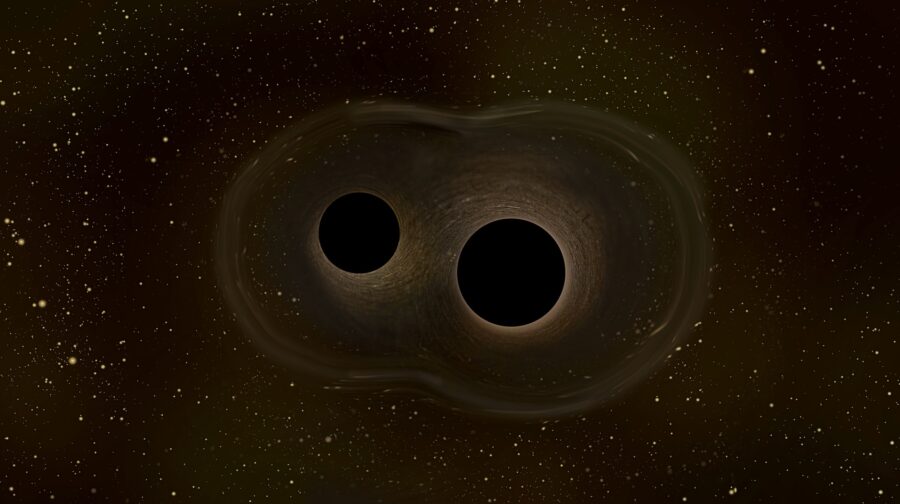
When two black holes merge, they emit gravitational waves, ripples in spacetime. If the merger is asymmetric, meaning the two black holes have different masses or spins, those waves are radiated more strongly in one direction. The resulting asymmetric emission delivers a kick to the merged black hole, pushing it in the opposite direction. In NGC 4486B, the estimated kick velocity is around 340 kilometres per second, enough to displace the merged black hole about 6 parsecs from the galaxy’s center, where it remains today, gradually sinking back.
An eccentric nuclear disk is a structure of stars orbiting a central black hole on elliptical rather than circular paths, with all the ellipses oriented in roughly the same direction. When you view such a disk from most angles, the stars are not evenly distributed around the black hole: they pile up near the far end of their orbits, where they move more slowly, creating a brightness peak. The black hole itself sits at a different location. From certain viewing angles this produces two distinct bright regions, which is what Hubble first observed in NGC 4486B in 1996, and what JWST has now allowed astronomers to explain.
The Virgo Cluster contains thousands of galaxies in a relatively small volume of space, bound together by enormous amounts of mass including dark matter. Smaller galaxies that orbit within the cluster pass repeatedly through regions of intense gravitational tidal forces. Over billions of years, these forces peel away the outer stellar envelope of smaller galaxies, leaving only the dense, tightly bound central nucleus. Because the central black hole sits in this nucleus and is itself very tightly bound, it survives the stripping process while much of the surrounding galaxy does not.
The explanation, the team thinks, is stripping. Both galaxies are almost certainly much diminished versions of what they once were. The Virgo Cluster is, in a very real sense, a hostile environment: thousands of galaxies packed into a region where the collective gravitational forces and dark matter distribution are strong enough to tear outer stellar material away from smaller members as they pass through. What’s left, after enough passes through this gauntlet, is the dense core, with the black hole more or less intact and an outer envelope largely gone. The ratio of black hole to stars looks enormous because the denominator has been dramatically reduced.
That’s the broad picture for both galaxies. But NGC 4486B has something else going on. Something that has puzzled astronomers since the Hubble Space Telescope first imaged it in the 1990s.
Most galaxies have a single central bright spot, a nucleus. NGC 4486B has two. And the black hole, when Valluri’s team mapped the star velocities in detail using JWST’s NIRSpec instrument in integral-field-unit mode, turned out not to be sitting between the two bright peaks, or at the photometric center defined by the galaxy’s large-scale structure. “You can see clearly that it’s off-center in NGC 4486B,” Valluri said. By roughly 6 parsecs, which doesn’t sound like much until you understand that the black hole in question is about 360 million times the mass of the sun. Supermassive black holes do not, under ordinary circumstances, wander around their galaxies. Gravity pins them to the center. Something had to have moved this one.
The JWST kinematic maps gave the team what they needed to finally understand what that something was. The velocity dispersion, a measure of how fast stars near the center are moving, peaked not at the photometric center but at the location of the fainter of the two bright peaks. That fainter peak, the team concluded, is the likely location of the black hole itself. And the entire double-nucleus structure, they now believe, is what happens when a black hole gets kicked sideways by a gravitational wave.
Here’s what the theory requires. NGC 4486B, already a tidally stripped remnant, was once home to two supermassive black holes, not one. Perhaps they arrived in a merger between the progenitor galaxy and a smaller companion, perhaps a billion or more years ago. The pair spiraled together, shedding energy by flinging nearby stars outward (a process called binary scouring, and probably what produced the unusually flat, low-density core that the galaxy also shows). As the two black holes got close enough that their gravitational wave emission dominated, they coalesced. And when two black holes merge, the waves they emit are not symmetric: the merger radiates gravitational waves preferentially in one direction, and the recoil from this asymmetric blast kicks the resulting single black hole in the opposite direction. In this case, Behzad Tahmasebzadeh, then a postdoctoral fellow at Michigan, led calculations suggesting the kick velocity was roughly 340 kilometres per second. The black hole, in effect, bounced out of position.
What the team found in the orbital structure of the galaxy’s central stars is consistent with this picture. About half the orbits in the inner nuclear region are retrograde, meaning the stars are circling in the opposite direction to what you’d normally expect. N-body simulations of what happens when a black hole is kicked predict exactly this kind of retrograde population, as the displaced black hole outruns stars that were on prograde orbits and flips their angular momentum in its reference frame. When the team ran models without any retrograde orbits allowed, the fit to the JWST data got substantially worse. The retrograde population is real, and it’s probably a fossil of the recoil event. “We believe this discovery is a smoking gun for that,” Valluri said, referring to the body of theoretical predictions about what post-merger galaxies should look like.
The merger itself happened perhaps 30 to 80 million years ago, in the team’s estimate. That’s genuinely recent by galactic standards; galaxies typically evolve across billions of years. The black hole is still settling back toward the center, a process their simulations suggest will take perhaps another 30 million years. In a modest sense, we are seeing it mid-fall.
The second galaxy, UCD736, has a quieter but still striking story. Its black hole is far less massive, roughly 2.1 million solar masses, but even that is enough to constitute about 8 percent of the ultracompact dwarf’s total stellar mass. Doctoral student Solveig Thompson, working at the University of Calgary, noted that the NIRSpec instrument gave the team access to galaxies too faint and small for ground-based telescopes to yield useful kinematic data. UCD736 is the smallest and least luminous object in which a massive black hole has now been confirmed. The progenitor galaxy, working backwards from the black hole mass via scaling relations, was probably comparable to a typical dwarf elliptical, on the order of nine billion solar masses. What’s left today, after the cluster stripped most of that away, is a system with a half-light radius of roughly 15 parsecs. Essentially nothing but the nucleus and its black hole.
Together, the two galaxies suggest a broader pattern. Dense cluster environments like the Virgo Cluster may be factories for objects that appear exotic precisely because they’ve been so thoroughly processed. Study enough of them, and you get a more complete picture of how black holes grow and how galaxies lose themselves in the crowd. The team plans to continue searching the Virgo Cluster for similar stripped systems, and those results, when they arrive, may clarify whether the stripped-nucleus pathway is common or exceptional. There’s reason to think it’s common. And there may be many more displaced black holes, still falling home.
Related
Discover more from European Space Agency Tracker
Subscribe to get the latest posts sent to your email.