










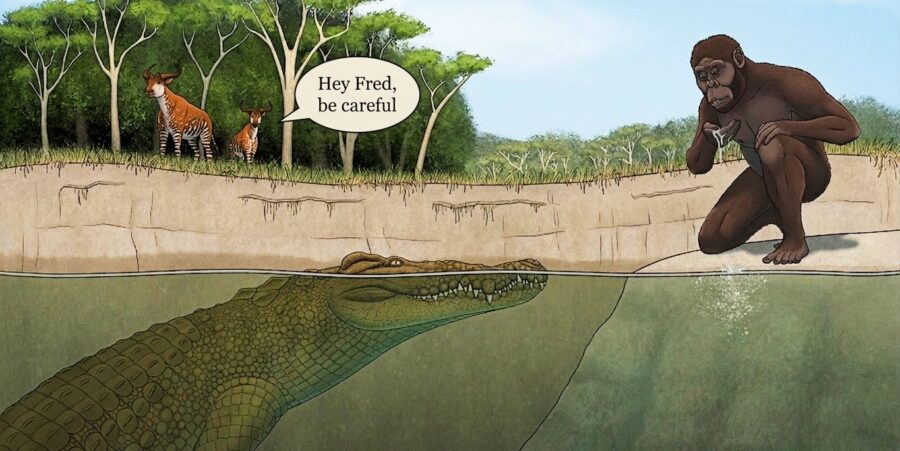


























Submerged to the nostrils in warm, slow water, the animal waited. It had been waiting a long time, probably; crocodiles are good at that. Around it, the Hadar floodplain spread out in a patchwork of gallery forest and open grassland, lakes edged with sedge, streams running amber with silt. And somewhere along the bank, at the edge of the water, a small group of upright hominins was picking its way down to drink. The crocodile’s eyes, raised just above the surface, tracked the movement. Then it chose its moment.
That crocodile now has a name. Researchers led by the University of Iowa have described and formally classified the species in a new study, calling it Crocodylus lucivenator. Lucy’s hunter.
The name is pointed. Lucy, the 3.2-million-year-old skeleton of Australopithecus afarensis found in the Afar region of Ethiopia in 1974, is probably the most famous individual in all of human palaeontology, a three-foot-tall hominin whose discovery confirmed that our ancestors walked upright long before their brains expanded to anything like modern size. What the fossil record had never clearly answered, until now, is what else was sharing that landscape with her kind. As it turns out: a very large, very capable crocodile that lived in the same river systems, at roughly the same time, in what is now the same patch of Ethiopian badlands.
The species was big. Adults reached somewhere between 12 and fifteen feet in length and could weigh upwards of 600 pounds (one estimate puts larger individuals at perhaps 1,300 pounds, roughly the mass of a small car). That made it the apex predator of the Hadar ecosystem, outranking lions and hyenas, and Christopher Brochu, a professor at Iowa who has spent 35 years studying ancient crocodiles and is the study’s corresponding author, is not especially coy about the implications: “It was the largest predator in that ecosystem, more so than lions and hyenas, and the biggest threat to our ancestors who lived there during that time. It’s a near certainty this crocodile would have hunted Lucy’s species. Whether a particular crocodile tried to grab Lucy, we’ll never know, but it would have seen Lucy’s kind and thought, ‘Dinner.’”
Brochu first encountered the Crocodylus lucivenator specimens in 2016, during a visit to a museum in Addis Ababa. He was not expecting much, he later recalled; but when he examined the fossils, the combination of features stopped him cold. The creature had a midline boss (a pronounced hump or ridge running along the top of its snout), a feature seen in some modern Central American crocodiles but not in the Nile crocodile, which is today’s African representative of the group. The snout itself was also elongated in front of the nostrils in a way that more closely foreshadows living crocodilians than the other ancient African species from the same period. Brochu thought this was probably a display structure, something males used to attract mates by lowering the head toward a female, the hump prominent and visible (a behaviour still observed in living species). A peacock’s tail, more or less, but on a 1,300-pound ambush predator.
The team examined 121 catalogued specimens recovered from Hadar, mostly skulls, jaw fragments, and teeth. That is a decent sample. And among them was one mandible that told a rather different kind of story.
“The fossil record preserves similar injuries in extinct groups as well, so this kind of face-biting behavior can be found throughout the crocodile family tree,” says Stephanie Drumheller, a teaching associate professor at the University of Tennessee who co-authored the study. “We can’t know which combatant came out on top of that fight, but the healing tells us that, winner or loser, this animal survived the encounter.” The jaw bore several partially healed injuries of the sort produced when one crocodile clamps its jaws onto another’s face during territorial or competitive aggression. Brochu and Drumheller are familiar with this kind of pathology in fossil crocodilians; the behaviour seems to have been common across the entire evolutionary history of the group. Whatever the outcome of that long-ago scrap, the animal in question lived on, its jaw knitting itself back together in the slow, unglamorous way bone heals.
What makes Crocodylus lucivenator particularly interesting is not just what it was but where it was not. To the south, in the Turkana Basin, Pliocene deposits have yielded as many as four different crocodile species living more or less simultaneously. Hadar, by contrast, appears to have hosted exactly one: this one. Christopher Campisano, an associate professor at Arizona State University and another co-author, has worked extensively at the Hadar site and describes a landscape that was in constant flux during the Pliocene, cycling through open woodlands, gallery forest, wet grassland, and shrubland as lake levels rose and fell across hundreds of thousands of years. “Interestingly,” Campisano says, “this crocodile was one of only a few species that was able to persist throughout.” Why Hadar supported a single dominant crocodylian while nearby basins hosted several is not yet clear; the researchers are fairly candid that they don’t have a good explanation.
The phylogenetic picture is likewise somewhat unresolved. Crocodylus lucivenator sits within a cluster of Palaeoafrican crocodiles that seems to be quite distinct from the lineage that eventually gave rise to today’s Nile crocodile, suggesting that the Nile crocodile’s ancestors arrived in East Africa comparatively recently rather than being the deep-time residents many people might assume. But where exactly Lucy’s hunter fits within that broader grouping partly depends on how much interpretive weight you give to certain skull features, and the authors acknowledge more than one arrangement can be considered equally valid given the available data.
Perhaps that’s fine. Palaeontology has always been comfortable with provisional answers, partial pictures, fossils that ask more questions than they resolve. What seems reasonably certain is that Australopithecus afarensis was sharing a river system with a very large, very patient predator for hundreds of thousands of years. The Hadar site, already a UNESCO World Heritage location for its hominin fossils, turns out to contain the record of an arms race of sorts, or at least of a predator-prey dynamic that shaped the anxious, riverbank-wary hominins who eventually became us. Whether they got better at avoiding it over time, or simply lucky enough to survive long enough to produce offspring, the crocodile was there at every water’s edge, waiting.
DOI / Source: https://doi.org/10.1080/14772019.2026.2614954
Frequently Asked Questions
What was Crocodylus lucivenator and when did it live? Crocodylus lucivenator, informally called “Lucy’s hunter,” was a large crocodile species that lived in what is now northeastern Ethiopia between roughly 3.4 million and 3 million years ago. Adults could reach 12 to 15 feet in length and weigh between 600 and 1,300 pounds, making them the dominant predator in the Hadar ecosystem. Researchers formally described and named the species in a 2026 study published in the Journal of Systematic Palaeontology.
Why is it named after Lucy? Lucy is the nickname for a famous 3.2-million-year-old hominin skeleton discovered at Hadar in 1974, belonging to the species Australopithecus afarensis. Crocodylus lucivenator lived in the same region and overlapping time period, making it a likely predator of Lucy’s species. The Latin name translates roughly as “Lucy’s hunter,” reflecting the crocodile’s probable role as the apex predator of the landscape our ancient ancestors inhabited.
How do researchers know it hunted early humans? They don’t have direct evidence of an attack, but the crocodile was the largest predator in that ecosystem, and hominins would have needed to visit rivers and lakes regularly for water. As an ambush predator, Crocodylus lucivenator would have been well positioned to target any animal coming to drink. The researchers describe it as a near certainty that the species would have preyed on Australopithecus afarensis, though whether any specific individual was taken can never be known from the fossil record.
What was unusual about this crocodile’s anatomy? Two features stood out. It had a midline boss, a raised hump along the top of its snout, similar to structures seen in some living Central American crocodiles but absent in the African Nile crocodile. Researchers believe this may have served as a display structure used by males to attract mates. It also had an elongated snout in front of the nostrils, a feature more characteristic of modern crocodilians than of other ancient African species from the same period.
Was this crocodile related to today’s Nile crocodile? Probably not closely. The phylogenetic analysis in the study groups Crocodylus lucivenator with a cluster of Palaeoafrican crocodiles that appears to be distinct from the lineage giving rise to the modern Nile crocodile. This suggests the Nile crocodile’s ancestors may have arrived in East Africa more recently than previously thought, rather than having a continuous presence there since deep in the Pliocene.
Related
Discover more from Wild Science
Subscribe to get the latest posts sent to your email.