




































The Murchison meteorite has been sitting in collections since 1969, when it broke apart over the Australian state of Victoria and scattered in pieces across paddocks and roadsides. Researchers have picked at it for decades. It is one of the most studied rocks not from this planet, stuffed with organic molecules, and a standing puzzle: which of those molecules came from space, and which it picked up here. A team preparing an instrument bound for Mars went looking for an answer, and found something a bit awkward instead.
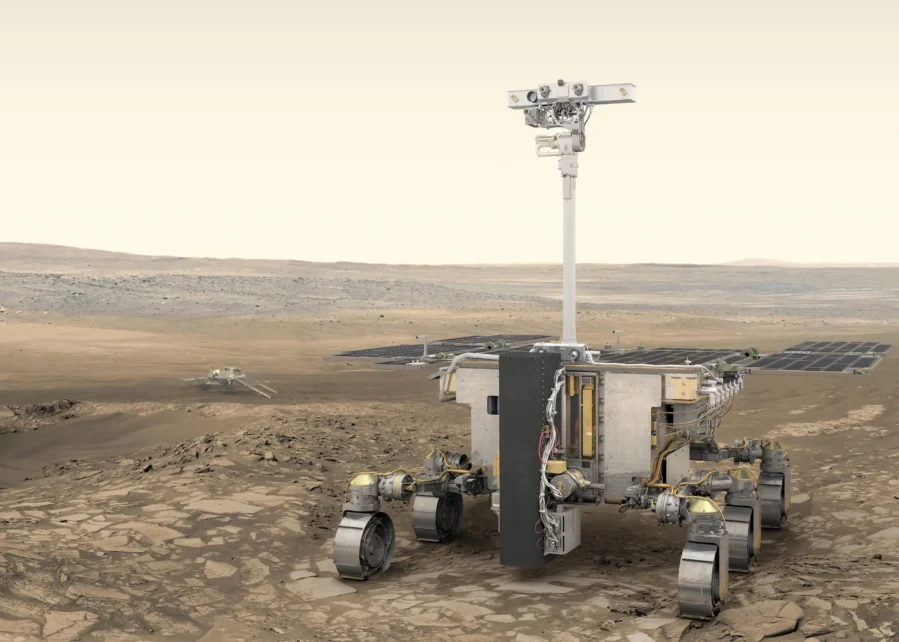
The instrument is MOMA, the Mars Organic Molecule Analyzer, and it is due to ride aboard the European rover Rosalind Franklin when she lands in 2030. Her job is to read the chemistry of Martian rock and decide, as far as any machine can, whether anything there was ever alive.
That decision turns on a property called chirality. Many organic molecules come in two forms that are mirror images of one another, like a left hand and a right hand, identical in every part yet impossible to lay perfectly on top of each other. Living things are fussy about which version they use. On Earth, life builds itself almost entirely from one handedness, and because life copies itself, any biology on Mars would have had to do the same. Get a sample with one form heavily outnumbering its mirror twin and you have a strong hint of something biological. Get a 50:50 mix, what chemists call racemic, and the case for life collapses. “Chirality is a valuable tool in the search for past extraterrestrial life,” says Uwe Meierhenrich of Cote d’Azur University, one of the study’s authors.
Two molecules carry most of the hope here: pristane and phytane, stubby hydrocarbons left behind when chlorophyll and certain microbial lipids break down. They are tough, the sort of thing that survives being buried for an age, which is exactly what you want from a biosignature on a planet where any life ended billions of years ago.
“If life once existed on Mars, then molecules like pristane and phytane represent important molecular biosignatures that could have survived to this day,” says lead author Guillaume Leseigneur of the Max Planck Institute for Solar System Research.
A Rehearsal With a Real Rock
So the team did a dry run. Rather than wait for Mars, they ran Murchison through the same chromatographic column that sits inside MOMA, using replica tubing identical to the rover’s, and tried to separate the left- and right-handed versions of pristane and phytane. Nobody had managed this in a meteorite before. The molecules are notoriously inert, which is half the reason they last so long and the whole reason they are a nuisance to pull apart. “Chiral separation of pristane and phytane requires high instrument sensitivity and measurement accuracy, both of which we show MOMA can achieve”, says co-author Fatma Yesil Sahan, also at the Max Planck Institute. It worked. The mirror forms came apart, cleanly enough to count.
Then came the awkward part. The team had assumed Murchison’s pristane and phytane were contamination, soaked up from plants or soil at the crash site, which would have left a lopsided, biological signature. Instead the meteorite gave back a flat 50:50 split. Perfectly racemic. Not a trace of the handedness that living tissue leaves.
That ruled out a fresh biological source on the ground. But it raised a sharper question, because racemic pristane is not a natural state for these molecules either. Homochirality is the default for anything biological; you only scramble it back to even by cooking the molecules for an extraordinarily long time. “Petroleum forms in these rocks over millions of years at great depths under the influence of heat and pressure”, says co-author Manuel Reinhardt of the University of Gottingen. The team checked the idea against oil shales of different ages, and the pattern held: the young, immature shales kept a strong biological lean, while the oldest, most thermally mature sample had drifted nearly all the way to racemic. Murchison matched the old, cooked oil.
The Contamination Came Out of the Sky
The only thing that fits is petroleum. Refined or partly refined oil, racemic by the time it leaves the ground, sprayed into the air as exhaust and lubricant residue and drifting far from any city. Older measurements back this up uncomfortably well. Pristane turns up in clean ocean air off the west coast of Ireland and, tellingly, off Tasmania, less than 500 kilometres from where Murchison fell. The Allende meteorite, sampled a mere seven days after landing in 1969, already carried measurable pristane and phytane. These rocks are not collecting contamination in the lab or under careless hands. They are picking it up from the atmosphere, on the way down and ever after, the way a cold window collects fog.
Which means a meteorite that has spent four and a half billion years drifting through space ends up carrying a chemical fingerprint of twentieth-century traffic. The study closes a question that has nagged at meteorite chemistry since the 1960s, when researchers first noticed that space rocks and earthly sediments shared the same suspicious hydrocarbons. The answer, it turns out, was us all along, or rather our engines.
For the Mars mission the upshot is mostly reassuring: MOMA can do the hard separation, and the team now knows precisely what an earthly false positive looks like, which is no small thing when you are deciding whether a planet once held life. But there is a stranger residue to this work. Our fuel exhaust is apparently thorough enough to leave its mark on objects that fell from the sky, in clean air, half a world from the nearest motorway. The rover will be watching for the signature of ancient Martian biology. It will also, whether anyone likes it or not, be carrying a reminder of what we have been pumping into our own.
https://doi.org/10.1016/j.epsl.2026.120141
Frequently Asked Questions
Why does the handedness of a molecule tell you whether something was alive?
Living things build themselves almost exclusively from one mirror form of a molecule rather than an even mix of both, because life copies itself and passes that preference along. A sample dominated by a single handedness points to biology, while a 50:50 split usually points to non-living chemistry. That makes chirality one of the cleaner tests for past life, on Earth or anywhere else.
Is it true that a space rock can pick up pollution from car exhaust?
According to this study, yes. Petroleum residues from vehicle exhaust and lubricants drift through the atmosphere as aerosols and settle onto meteorite surfaces during and after the fall. The molecules have been measured even in clean, remote air far from any city, which is how a rock from space ends up tagged with the chemistry of refined oil.
How does this help the search for life on Mars?
The Rosalind Franklin rover’s MOMA instrument will hunt for biological molecules in Martian rock, and pristane and phytane are prime targets. By rehearsing the difficult chiral separation on a real meteorite, the team confirmed the instrument can do the job and mapped out exactly what an earthly contaminant looks like. Knowing the false positive is half the battle when you are deciding whether a planet once held life.
What was actually new about this measurement?
It is the first time the mirror forms of pristane and phytane have been pulled apart and counted in a meteorite sample. That single result settled a decades-old argument about where these molecules in meteorites come from, and pinned the source on atmospheric petroleum pollution rather than biology at the crash site.
Quick Note Before You Read On.
ScienceBlog.com has no paywalls, no sponsored content, and no agenda beyond getting the science right. Every story here is written to inform, not to impress an advertiser or push a point of view.
Good science journalism takes time — reading the papers, checking the claims, finding researchers who can put findings in context. We do that work because we think it matters.
If you find this site useful, consider supporting it with a donation. Even a few dollars a month helps keep the coverage independent and free for everyone.