





















WashingtonWeeklyTimes.com
  • Home
  • US News
    Greg Abbott orders pause on Flock Safety funding amid privacy concerns

    Greg Abbott orders pause on Flock Safety funding amid privacy concerns

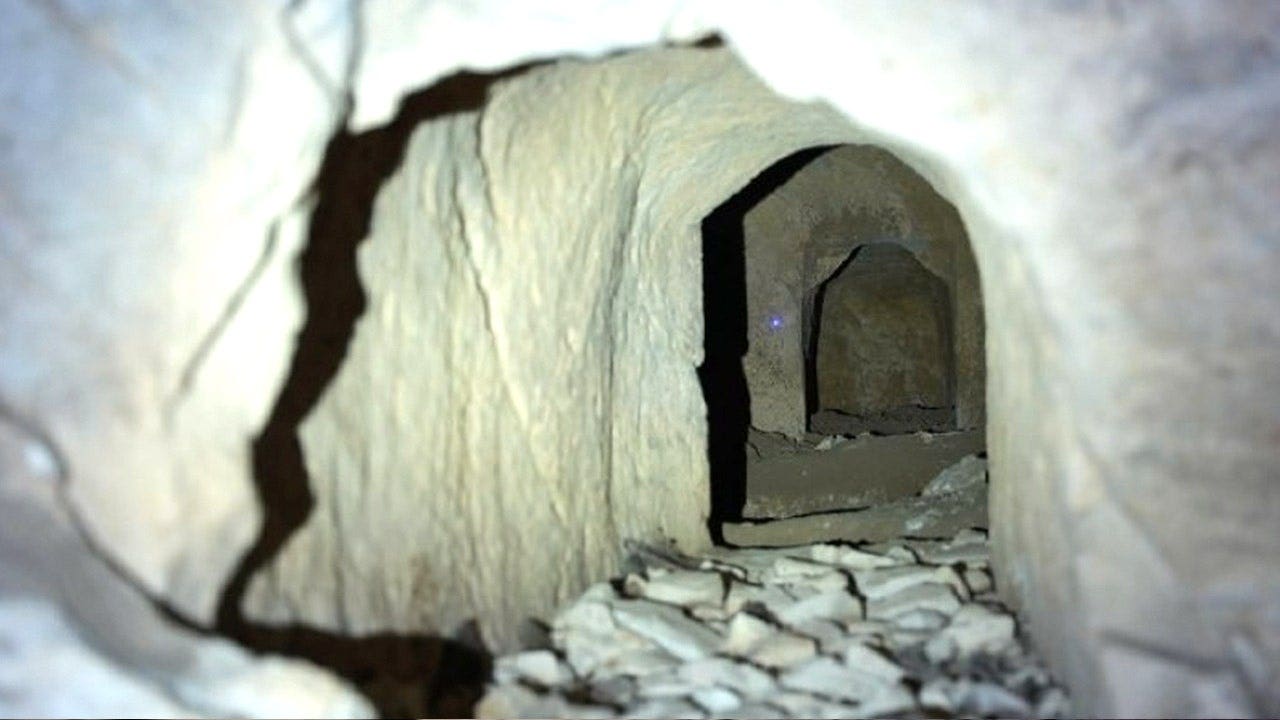
    Ancient burial cave is unearthed in Jerusalem during police operation

    Ancient burial cave is unearthed in Jerusalem during police operation

    King Harald of Norway dies at 89, Norway’s Crown Prince Haakon to succeed

    King Harald of Norway dies at 89, Norway’s Crown Prince Haakon to succeed

    California pastor pleads not guilty to child molestation in Ventura County

    California pastor pleads not guilty to child molestation in Ventura County

    Joshua Culver accused of forging Supreme Court order in Indiana case

    Joshua Culver accused of forging Supreme Court order in Indiana case

  • Politics
    Trump Mentally Collapses Over Report He Refuses To Go To Ground Zero On 9/11

    Trump Mentally Collapses Over Report He Refuses To Go To Ground Zero On 9/11

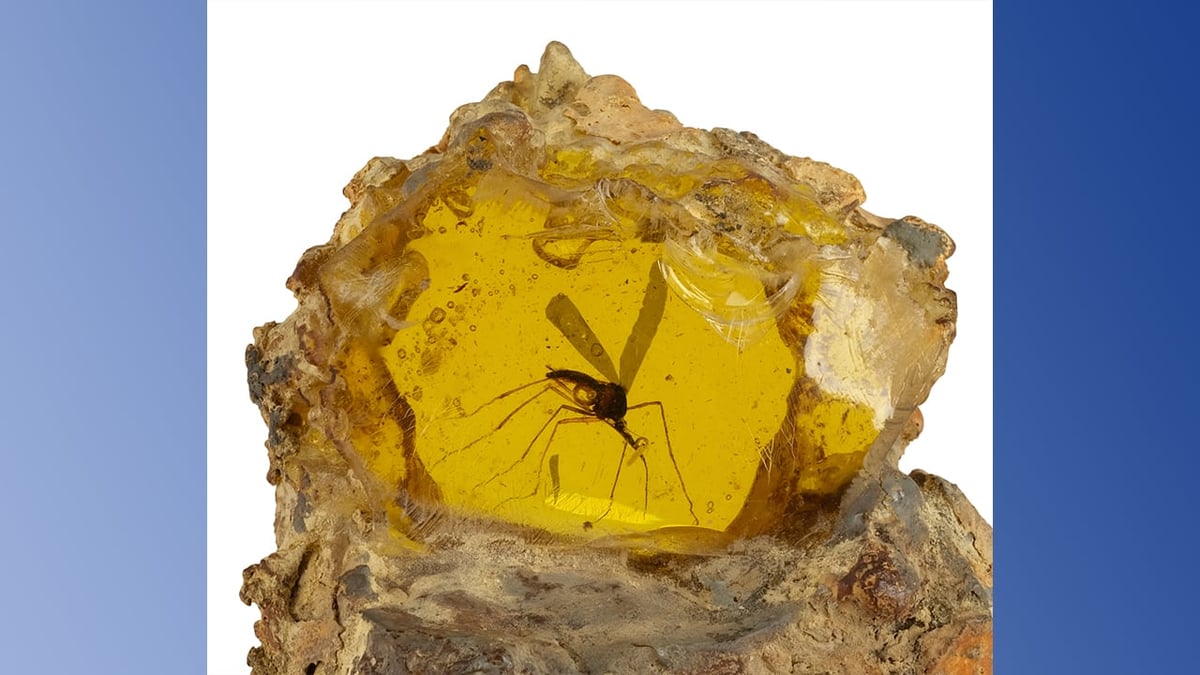
    Jurassic Park Mosquito Prop Sells for 3K

    Jurassic Park Mosquito Prop Sells for $403K

    Zohran Mamdani Posts Heartfelt Message About Career Criminal and Killer Who Died in Custody at Rikers Island: ‘Deeply Saddened’

    Zohran Mamdani Posts Heartfelt Message About Career Criminal and Killer Who Died in Custody at Rikers Island: ‘Deeply Saddened’

    Relentless Reporter Hounds RFK Jr. Into Fleeing From His Own Press Conference

    Relentless Reporter Hounds RFK Jr. Into Fleeing From His Own Press Conference

  • Business
    Offshore nuclear barges could power ports and data centers—starting with California

    Offshore nuclear barges could power ports and data centers—starting with California

    ‘Like at McDonald’s’: Sports nurse practitioner sold opioids to athletes like ‘you gotta pay for your burger,” DEA investigation finds

    ‘Like at McDonald’s’: Sports nurse practitioner sold opioids to athletes like ‘you gotta pay for your burger,” DEA investigation finds

    How to protect your money from tap-to-pay donation scams

    How to protect your money from tap-to-pay donation scams

    The  trillion national debt is growing and Boomers are getting 0k in Social Security benefits

    The $40 trillion national debt is growing and Boomers are getting $100k in Social Security benefits

  • Science
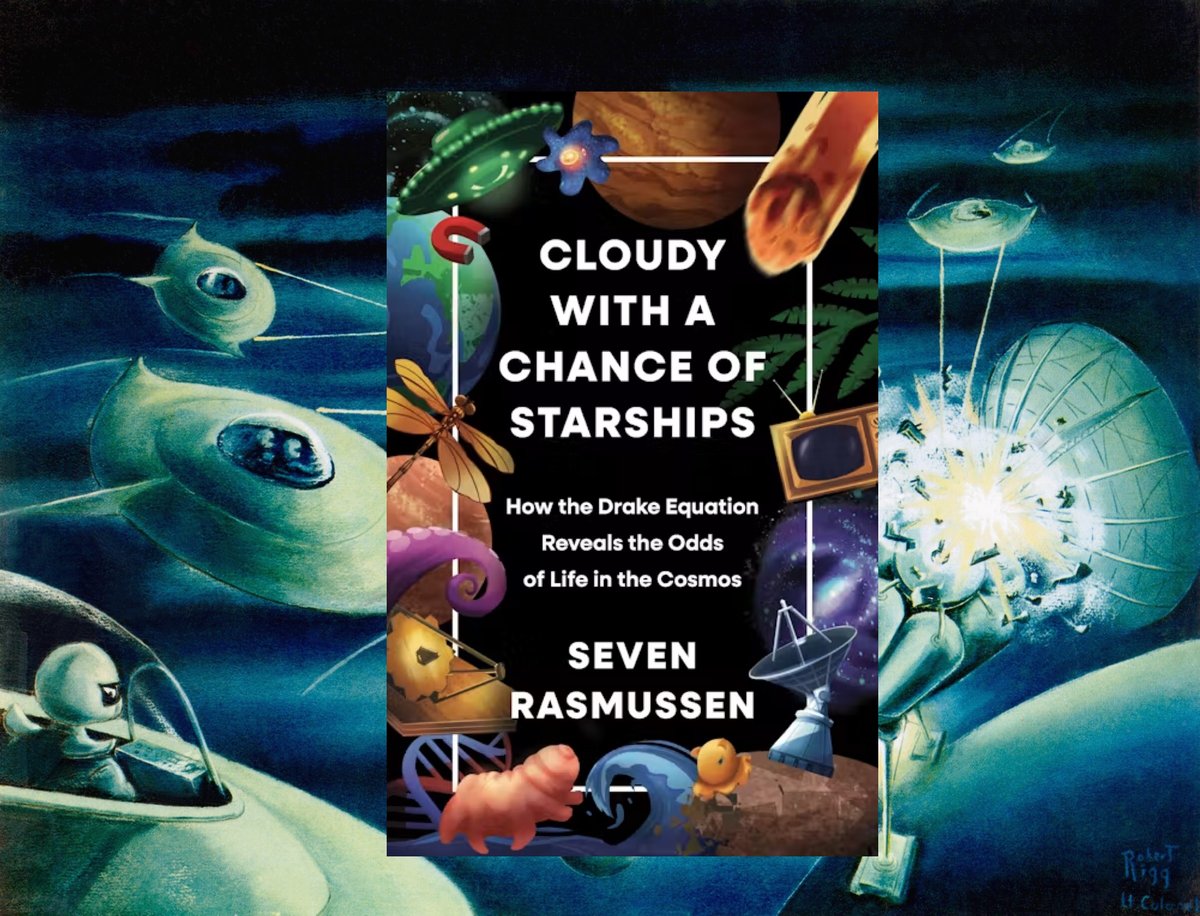
    Where are all the aliens? A new book explores possible answers

    Where are all the aliens? A new book explores possible answers

    There Are So Many Conspiracy Theories About Dolly Parton and Vaccines

    There Are So Many Conspiracy Theories About Dolly Parton and Vaccines

    Every autumn in northern Japan, carrion crows in the city of Sendai drop walnuts onto pedestrian crossings, wait for cars to crush the shells, then collect the meat during the red light — a technique that spread through the local crow population over roughly two decades and now shows up nowhere else in the country

    Every autumn in northern Japan, carrion crows in the city of Sendai drop walnuts onto pedestrian crossings, wait for cars to crush the shells, then collect the meat during the red light — a technique that spread through the local crow population over roughly two decades and now shows up nowhere else in the country

    Climate change is supercharging El Niños, coral records show

    Climate change is supercharging El Niños, coral records show

  • Technology
    Nvidia CEO Jensen Huang Took a Call From Donald Trump in the Middle of an All-Hands

    Nvidia CEO Jensen Huang Took a Call From Donald Trump in the Middle of an All-Hands

    a16z creates a .1B ‘Machine Age’ fund to ‘accelerate the physical buildout of AI’

    a16z creates a $1.1B ‘Machine Age’ fund to ‘accelerate the physical buildout of AI’

    6 Takeaways From the GTA VI Extended Look

    6 Takeaways From the GTA VI Extended Look

    Plaud’s new earphones come with an eSIM-enabled case for talking to AI agents

    Plaud’s new earphones come with an eSIM-enabled case for talking to AI agents

  • Lifestyle
    The Wellness Favorites You’re Loving Right Now

    The Wellness Favorites You’re Loving Right Now

    Countertop Materials and Everyday Kitchen Wear

    Countertop Materials and Everyday Kitchen Wear

    Sun Damage Repair, According to a Celebrity Dermatologist

    Sun Damage Repair, According to a Celebrity Dermatologist

    Elwood Expands Its Core Collection With Five New Vintage-Washed Essentials

    Elwood Expands Its Core Collection With Five New Vintage-Washed Essentials

  • Music
    Everything We Know About Grand Theft Auto 6 (Updating)

    Everything We Know About Grand Theft Auto 6 (Updating)

    Mac DeMarco Releases Four New Albums

    Mac DeMarco Releases Four New Albums

    JENNIE Drops ‘Fallen Angel’ EP With Dark Fairytale Music Video

    JENNIE Drops ‘Fallen Angel’ EP With Dark Fairytale Music Video

    Starsailor announce 25th anniversary reissue of ‘Love Is Here’

    Starsailor announce 25th anniversary reissue of ‘Love Is Here’

  • Television
    Sig Hansen Feels Betrayed After Crew Member Violates ‘Boat Code’

    Sig Hansen Feels Betrayed After Crew Member Violates ‘Boat Code’

    What Was The Significance Of Picard’s Borg Name In Star Trek: The Next Generation?

    What Was The Significance Of Picard’s Borg Name In Star Trek: The Next Generation?

    Dark Matter Season 2 Episode 1 Review: Finding “A Quiet Life” Isn’t As Easy as It Sounds

    Dark Matter Season 2 Episode 1 Review: Finding “A Quiet Life” Isn’t As Easy as It Sounds

    CNN Slammed for Fake Dolly Parton Memorial Pic

    CNN Slammed for Fake Dolly Parton Memorial Pic

  • Film
    The Dog Stars review – sickly sweet Americana…

    The Dog Stars review – sickly sweet Americana…

    Dave Franco Says Raunchy ‘Idiots’ Scene Is “Craziest Thing” He’s Done

    Dave Franco Says Raunchy ‘Idiots’ Scene Is “Craziest Thing” He’s Done

    Apple TV’s Ambitious Sci-Fi Dreams A Little Too Big

    Apple TV’s Ambitious Sci-Fi Dreams A Little Too Big

    The Dead Screen as a Mirror: Metacinema and the…

    The Dead Screen as a Mirror: Metacinema and the…

  • Literature
    Literary Hub » Helen Mirren is playing Patricia Highsmith?! Watch the trailer for A Talent for Murder.

    Literary Hub » Helen Mirren is playing Patricia Highsmith?! Watch the trailer for A Talent for Murder.

    15 Books We Read and Loved This Summer

    15 Books We Read and Loved This Summer

    Book Riot’s Deals of the Day for August 27, 2026

    Book Riot’s Deals of the Day for August 27, 2026

    Lit Hub Daily: August 27, 2026

    Lit Hub Daily: August 27, 2026

    Every Parent Needs a Tub of Their Own

    Every Parent Needs a Tub of Their Own

    Get your limited-edition Book Riot hoodie

    Get your limited-edition Book Riot hoodie

    Literary Hub » S. Shakthidharan on Hermann Hesse’s Siddhartha

    Literary Hub » S. Shakthidharan on Hermann Hesse’s Siddhartha

    The Dream of Homeownership Is Haunted by Eviction in This Debut Novel

    The Dream of Homeownership Is Haunted by Eviction in This Debut Novel

    Goodreads’ Most Anticipated BIPOC Books of Fall

    Goodreads’ Most Anticipated BIPOC Books of Fall

  • Contact
    • About
  • Home
  • US News
    Greg Abbott orders pause on Flock Safety funding amid privacy concerns

    Greg Abbott orders pause on Flock Safety funding amid privacy concerns

    Ancient burial cave is unearthed in Jerusalem during police operation

    Ancient burial cave is unearthed in Jerusalem during police operation

    King Harald of Norway dies at 89, Norway’s Crown Prince Haakon to succeed

    King Harald of Norway dies at 89, Norway’s Crown Prince Haakon to succeed

    California pastor pleads not guilty to child molestation in Ventura County

    California pastor pleads not guilty to child molestation in Ventura County

    Joshua Culver accused of forging Supreme Court order in Indiana case

    Joshua Culver accused of forging Supreme Court order in Indiana case

  • Politics
    Trump Mentally Collapses Over Report He Refuses To Go To Ground Zero On 9/11

    Trump Mentally Collapses Over Report He Refuses To Go To Ground Zero On 9/11

    Jurassic Park Mosquito Prop Sells for 3K

    Jurassic Park Mosquito Prop Sells for $403K

    Zohran Mamdani Posts Heartfelt Message About Career Criminal and Killer Who Died in Custody at Rikers Island: ‘Deeply Saddened’

    Zohran Mamdani Posts Heartfelt Message About Career Criminal and Killer Who Died in Custody at Rikers Island: ‘Deeply Saddened’

    Relentless Reporter Hounds RFK Jr. Into Fleeing From His Own Press Conference

    Relentless Reporter Hounds RFK Jr. Into Fleeing From His Own Press Conference

  • Business
    Offshore nuclear barges could power ports and data centers—starting with California

    Offshore nuclear barges could power ports and data centers—starting with California

    ‘Like at McDonald’s’: Sports nurse practitioner sold opioids to athletes like ‘you gotta pay for your burger,” DEA investigation finds

    ‘Like at McDonald’s’: Sports nurse practitioner sold opioids to athletes like ‘you gotta pay for your burger,” DEA investigation finds

    How to protect your money from tap-to-pay donation scams

    How to protect your money from tap-to-pay donation scams

    The  trillion national debt is growing and Boomers are getting 0k in Social Security benefits

    The $40 trillion national debt is growing and Boomers are getting $100k in Social Security benefits

  • Science
    Where are all the aliens? A new book explores possible answers

    Where are all the aliens? A new book explores possible answers

    There Are So Many Conspiracy Theories About Dolly Parton and Vaccines

    There Are So Many Conspiracy Theories About Dolly Parton and Vaccines

    Every autumn in northern Japan, carrion crows in the city of Sendai drop walnuts onto pedestrian crossings, wait for cars to crush the shells, then collect the meat during the red light — a technique that spread through the local crow population over roughly two decades and now shows up nowhere else in the country

    Every autumn in northern Japan, carrion crows in the city of Sendai drop walnuts onto pedestrian crossings, wait for cars to crush the shells, then collect the meat during the red light — a technique that spread through the local crow population over roughly two decades and now shows up nowhere else in the country

    Climate change is supercharging El Niños, coral records show

    Climate change is supercharging El Niños, coral records show

  • Technology
    Nvidia CEO Jensen Huang Took a Call From Donald Trump in the Middle of an All-Hands

    Nvidia CEO Jensen Huang Took a Call From Donald Trump in the Middle of an All-Hands

    a16z creates a .1B ‘Machine Age’ fund to ‘accelerate the physical buildout of AI’

    a16z creates a $1.1B ‘Machine Age’ fund to ‘accelerate the physical buildout of AI’

    6 Takeaways From the GTA VI Extended Look

    6 Takeaways From the GTA VI Extended Look

    Plaud’s new earphones come with an eSIM-enabled case for talking to AI agents

    Plaud’s new earphones come with an eSIM-enabled case for talking to AI agents

  • Lifestyle
    The Wellness Favorites You’re Loving Right Now

    The Wellness Favorites You’re Loving Right Now

    Countertop Materials and Everyday Kitchen Wear

    Countertop Materials and Everyday Kitchen Wear

    Sun Damage Repair, According to a Celebrity Dermatologist

    Sun Damage Repair, According to a Celebrity Dermatologist

    Elwood Expands Its Core Collection With Five New Vintage-Washed Essentials

    Elwood Expands Its Core Collection With Five New Vintage-Washed Essentials

  • Music
    Everything We Know About Grand Theft Auto 6 (Updating)

    Everything We Know About Grand Theft Auto 6 (Updating)

    Mac DeMarco Releases Four New Albums

    Mac DeMarco Releases Four New Albums

    JENNIE Drops ‘Fallen Angel’ EP With Dark Fairytale Music Video

    JENNIE Drops ‘Fallen Angel’ EP With Dark Fairytale Music Video

    Starsailor announce 25th anniversary reissue of ‘Love Is Here’

    Starsailor announce 25th anniversary reissue of ‘Love Is Here’

  • Television
    Sig Hansen Feels Betrayed After Crew Member Violates ‘Boat Code’

    Sig Hansen Feels Betrayed After Crew Member Violates ‘Boat Code’

    What Was The Significance Of Picard’s Borg Name In Star Trek: The Next Generation?

    What Was The Significance Of Picard’s Borg Name In Star Trek: The Next Generation?

    Dark Matter Season 2 Episode 1 Review: Finding “A Quiet Life” Isn’t As Easy as It Sounds

    Dark Matter Season 2 Episode 1 Review: Finding “A Quiet Life” Isn’t As Easy as It Sounds

    CNN Slammed for Fake Dolly Parton Memorial Pic

    CNN Slammed for Fake Dolly Parton Memorial Pic

  • Film
    The Dog Stars review – sickly sweet Americana…

    The Dog Stars review – sickly sweet Americana…

    Dave Franco Says Raunchy ‘Idiots’ Scene Is “Craziest Thing” He’s Done

    Dave Franco Says Raunchy ‘Idiots’ Scene Is “Craziest Thing” He’s Done

    Apple TV’s Ambitious Sci-Fi Dreams A Little Too Big

    Apple TV’s Ambitious Sci-Fi Dreams A Little Too Big

    The Dead Screen as a Mirror: Metacinema and the…

    The Dead Screen as a Mirror: Metacinema and the…

  • Literature
    Literary Hub » Helen Mirren is playing Patricia Highsmith?! Watch the trailer for A Talent for Murder.

    Literary Hub » Helen Mirren is playing Patricia Highsmith?! Watch the trailer for A Talent for Murder.

    15 Books We Read and Loved This Summer

    15 Books We Read and Loved This Summer

    Book Riot’s Deals of the Day for August 27, 2026

    Book Riot’s Deals of the Day for August 27, 2026

    Lit Hub Daily: August 27, 2026

    Lit Hub Daily: August 27, 2026

    Every Parent Needs a Tub of Their Own

    Every Parent Needs a Tub of Their Own

    Get your limited-edition Book Riot hoodie

    Get your limited-edition Book Riot hoodie

    Literary Hub » S. Shakthidharan on Hermann Hesse’s Siddhartha

    Literary Hub » S. Shakthidharan on Hermann Hesse’s Siddhartha

    The Dream of Homeownership Is Haunted by Eviction in This Debut Novel

    The Dream of Homeownership Is Haunted by Eviction in This Debut Novel

    Goodreads’ Most Anticipated BIPOC Books of Fall

    Goodreads’ Most Anticipated BIPOC Books of Fall

  • Contact
    • About
No Result
View All Result
WashingtonWeeklyTimes.com
No Result
View All Result
Home Science

Fossils Upend Conventional Wisdom about Evolution of Human Bipedalism

by Admin
November 5, 2022
in Science
Fossils Upend Conventional Wisdom about Evolution of Human Bipedalism


Long before our ancestors evolved large brains and language, even before they tamed fire or made stone tools, they started doing something no mammal had done before: walking on two legs. Skeletal adaptations for traveling upright are evident in fossils of the very oldest hominins—members of the human family—which date to between seven million and five million years ago. Moving on two legs rather than four set the stage for subsequent evolutionary changes in our lineage. It allowed our predecessors to expand their home ranges and diversify their diets, and it transformed the way we give birth and parent our children. This peculiar mode of locomotion was foundational to virtually all the other characteristics that make humans unique.

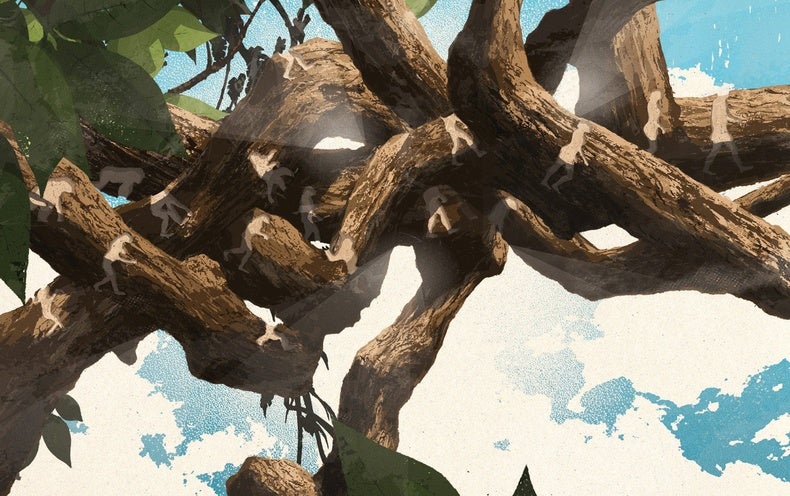
In the iconic representation of human evolution, a procession of ancestors starting with a chimplike creature ambling on all fours gives way to a series of ever more erect forebears, culminating in a fully upright Homo sapiens striding triumphantly on two legs. First popularized in the 1960s, the March of Progress, as this image and its variants are known, has decorated countless books, T-shirts, bumper stickers and coffee mugs.

But paleoanthropological discoveries made over the past two decades are forcing scientists to redraw this traditional, linear imagery. We now know that various hominin species living in different environments throughout Africa, sometimes contemporaneously, evolved different ways to walk on two legs. The emergence of bipedalism kicked off a long phase of rampant evolutionary riffing on this form of locomotion. Our modern stride was not predetermined, with each successive ancestor marching closer to a particular end goal (evolution has no plans, after all). Rather it’s one of many forms of upright walking that early hominins tried out—and the version that ultimately prevailed.

Mysterious Footprints

They didn’t want to get hit by a flying lump of elephant poop. Who would? So paleontologists Kay Behrensmeyer and Andrew Hill, who were visiting archaeologist Mary Leakey’s fossil site of Laetoli in Tanzania, hopped into a gully to take cover and gather more ammunition for the game of elephant dung dodgeball that had spontaneously broken out. It was July 24, 1976, the day of one of the most serendipitous discoveries in the history of paleoanthropology.

Hill and Behrensmeyer scanned the ground for dung but instead spotted fossilized elephant footprints and raindrop impressions hardened in an exposed layer of volcanic ash that fell 3.66 million years ago. A truce was called in the dung fight, and the others came to marvel at what had been found. Fossils speak broadly about an organism; fossil footprints capture precious snapshots of moments in time for long-extinct animals.

For the next few weeks Leakey and her team explored an area they called Site A, brushing aside overlying sediment to reveal thousands of footprints, mostly made by small antelopes and hares but also from ancient elephants, rhinoceroses, giraffes, large cats, birds and even a beetle. Hoping to find hominins in the mix, Leakey told the group to be on the lookout for bipedal footprints. Maybe they’d get lucky. That September they did. Peter Jones and Philip Leakey discovered five consecutive footprints made by something traveling on two, rather than four, legs. A hominin? Maybe, but the footprints were strangely shaped, and whatever made them had cross-stepped, moving the left foot over the right like a model on a runway rather than walking in the usual human way. The Site A bipedal trackway was a mystery.
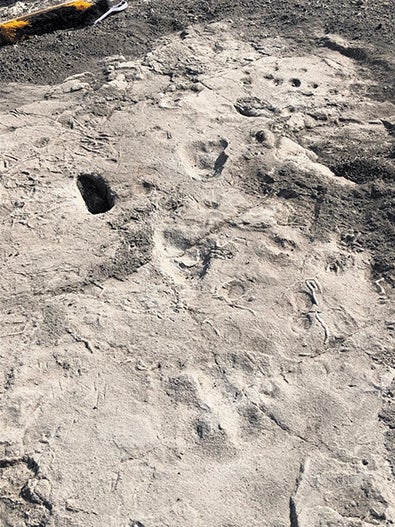
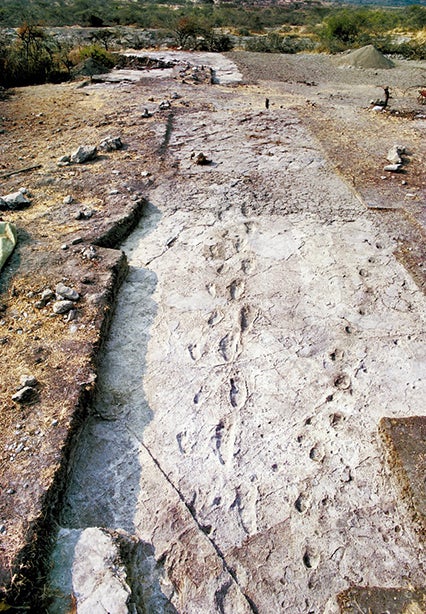
Fossil footprints from Laetoli, Tanzania, show that two different hominin species walked bipedally in this area 3.66 million years ago.

Fossil footprints from Laetoli, Tanzania, show that two different hominin species walked bipedally in this area 3.66 million years ago.
Fossil footprints from Laetoli, Tanzania, show that two different hominin species walked bipedally in this area 3.66 million years ago. The Site G trackway (bottom) is thought to have been made by Australopithecus afarensis. The Site A trackway (top) was made by a different, as yet unidentified hominin. Credit: Jeremy DeSilva (top); John Reader/Science Source (bottom)

Two years later two other members of Leakey’s team, Paul Abell and Ndibo Mbuika, discovered another bipedal trackway two kilometers west of Site A at a location dubbed Site G. Two or three, perhaps even four, individuals had walked stride for stride through the muddy ash, leaving 69 stunningly humanlike footprints. Most scholars agree these tracks were made by Australopithecus afarensis—Lucy’s species—fossils of which have been found at Laetoli. The Site G tracks were decidedly different from the ones at Site A, however. If a hominin made the tracks at Site G, then what kind of creature made the bipedal trackway at Site A?

In the mid-1980s University of Chicago anthropologist Russ Tuttle took a crack at solving this mystery. After comparing the shape of the Site A footprints with those made by unshod humans, chimpanzees, and circus bears trained to walk on two legs, Tuttle concluded that the prints were either made by a second species of hominin that roamed Laetoli during the Pliocene epoch or made by a bipedally walking bear. Perhaps because a linear view of the evolution of human bipedalism was the dominant paradigm, other researchers embraced the bear hypothesis. As a result, whereas the Site G hominin footprints were exhaustively studied and became world-famous, the footprints at Site A fell into obscurity. Three decades passed before anyone focused on them again.

Dartmouth College, where I teach anthropology, is a small liberal arts school in New Hampshire nestled in a valley between that state’s White Mountains and the Green Mountains of Vermont. Although the school is only two hours by car from metro Boston, its motto is vox clamantis in deserto, which translates to “a voice crying out in the wilderness.” Large swaths of sugar maples provide an ample supply of syrup, the famous Appalachian Trail abuts the campus, and bears—a lot of bears—live in the surrounding woods.

In 2017 my then graduate student Ellison McNutt, who is now a professor of anatomy at Ohio University, and I teamed up with local black bear expert Ben Kilham to collect footprints from cubs whose feet were similar in size to the tracks at Laetoli Site A. Using maple syrup and applesauce to tempt them, we persuaded the young bears to rear up on their hind legs and amble through an experimental trackway filled with mud. To our surprise, their footprints and gait mechanics were no match for Site A. Bears’ heel impressions are narrow, and their steps are widely spaced because their hip and knee anatomy causes them to wobble back and forth when walking bipedally. We started to have our doubts about the bear hypothesis.

More than 40 years have passed since the discovery of the Site A trackway. In that time, seasonal rains have slowly washed sediment from the barren hills at Laetoli, exposing tens of thousands of fossils. Teams led by Charles Musiba of the University of Colorado Denver, Terry Harrison of New York University and Denise Su of Arizona State University have recovered many of these fossils. We know from other sites that an extinct bear called Agriotherium did roam Africa during the Pliocene, but not one of the animal fossils these teams have recovered at Laetoli is from a bear. Someone needed to take another look at the bipedal tracks at Site A. But those same seasonal rains that gift us fossil bones and footprints also have the erosive power to take them away. We had assumed the Site A bipedal footprints were long gone. Thankfully, we were wrong.

In 2019 Musiba and I traveled to Laetoli and used Mary Leakey’s detailed drawings like a treasure map to identify the precise location where the mysterious bipedal footprints should be. Then we began to dig. After several days Tanzanian team member Kallisti Fabian called to us, “Mtu”—the Swahili word for “human.” He had found the footprints. The rains had not destroyed them but had covered and preserved all five of them with a layer of fine sediment. Using tongue depressors and thick-bristled brushes, we fully cleaned the prints, revealing never before seen details of the toe impressions, which we captured with high-resolution, 3-D laser scans unavailable to our colleagues working in the 1970s. The heel impressions of the Site A footprints are large, and the big toe is the dominant digit, as it is in humans and our ape cousins. This was no bear. A hominin made these tracks. But which hominin?
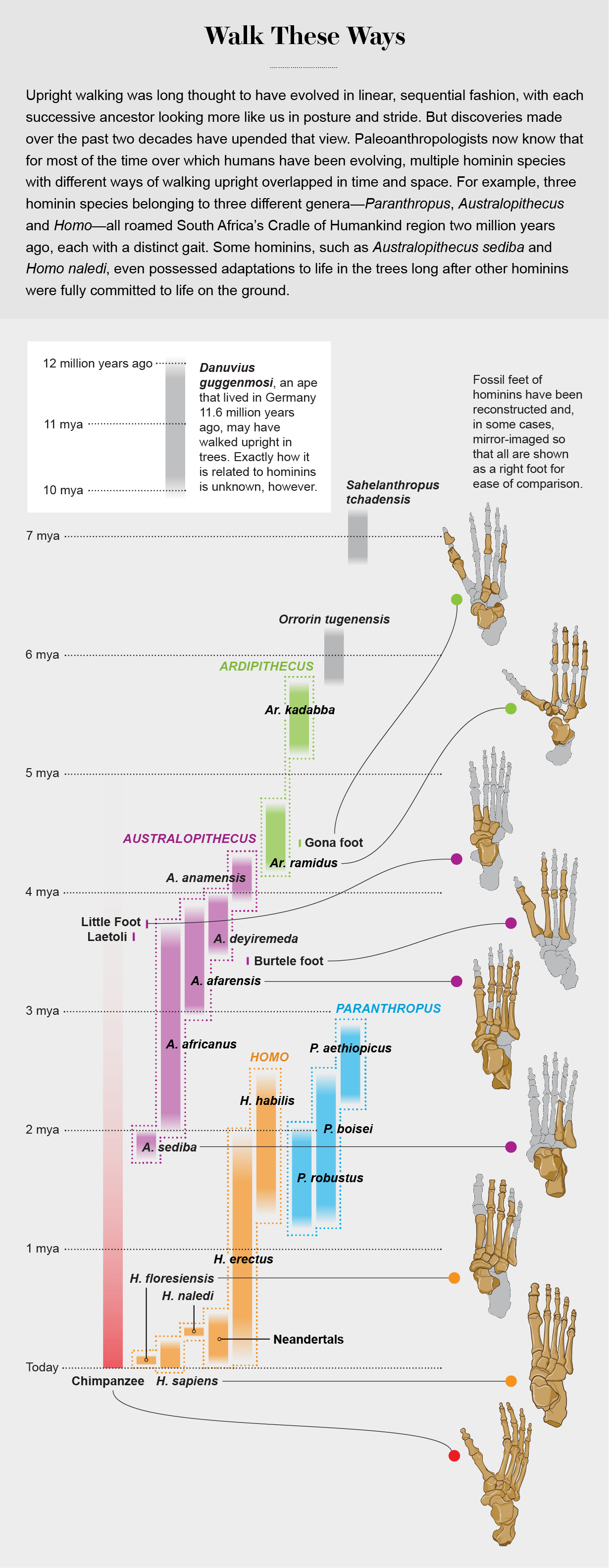
Family tree shows time spans associated with our evolutionary ancestors and highlights foot structures of various hominins.


Credit: Dino Pulerà (foot illustrations) and Jen Christiansen

Walk on a sandy beach, and you are sure to see a variety of H. sapiens footprints—small, flat prints made by a toddler next to the long, arched prints of her mother, for instance. Modern humans come in all shapes and sizes, and so do our feet. Almost certainly, the same was also true for A. afarensis. Maybe the footprints at Sites A and G were showing normal variation within a single species of hominin. If so, the small size of the Site A footprints might indicate they were made by a child of Lucy’s species. That’s what I originally hypothesized, anyway.

Footprint expert Kevin Hatala of Chatham University, who helped to discover and analyze 1.55-million-year-old Homo erectus footprints at Ileret, Kenya, joined our team, and together we compared the shape of the Site A footprints with the best-preserved footprints from Site G and another trackway discovered in 2015 at Site S, along with hundreds of footprints made by humans and chimpanzees. The differences we observed did not fit within the range of variation among footprints from people of all ages today.

We found that the Site A footprints had a shape that was as different from the Site G and S prints as a chimpanzee’s footprints are from yours and mine. That’s not to say the Site A footprints were just like a chimpanzee’s, only that they were very different in shape from those of Lucy’s species. Compared with those presumed A. afarensis footprints at Sites G and S, the Site A footprints were short and wide, the big toe stuck out to the side a bit, and there was some evidence the walkers had a more flexible middle portion of the foot.

In our paper describing these findings, published last December in the journal Nature, we claimed that not only were the Site A footprints from a hominin, but they also were evidence of a second species at Laetoli. As is expected in science, not all of our colleagues have fully embraced our interpretation. Some think we just found another A. afarensis footprint trail. But it is worth repeating that the Site A footprints were so different from the Site G Australopithecus prints that our field was convinced for decades that they were made by a bear.

It seems to me that shortly after ash fell from the sky 3.66 million years ago, two kinds of hominins, walking on slightly different feet in slightly different ways, moved north toward the Olduvai Basin in Tanzania, perhaps in search of water. Because it is thought that the footprint layer at Laetoli captures at most a few days of activity, this is the best evidence we have that different Pliocene hominin species not only were contemporaries but shared the same landscape. How they interacted—if at all—is anyone’s guess at this point.
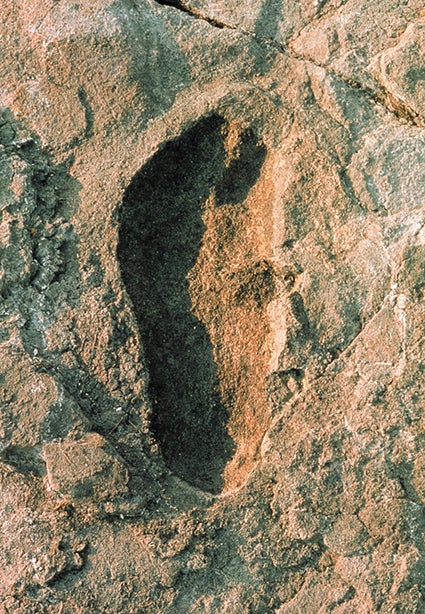
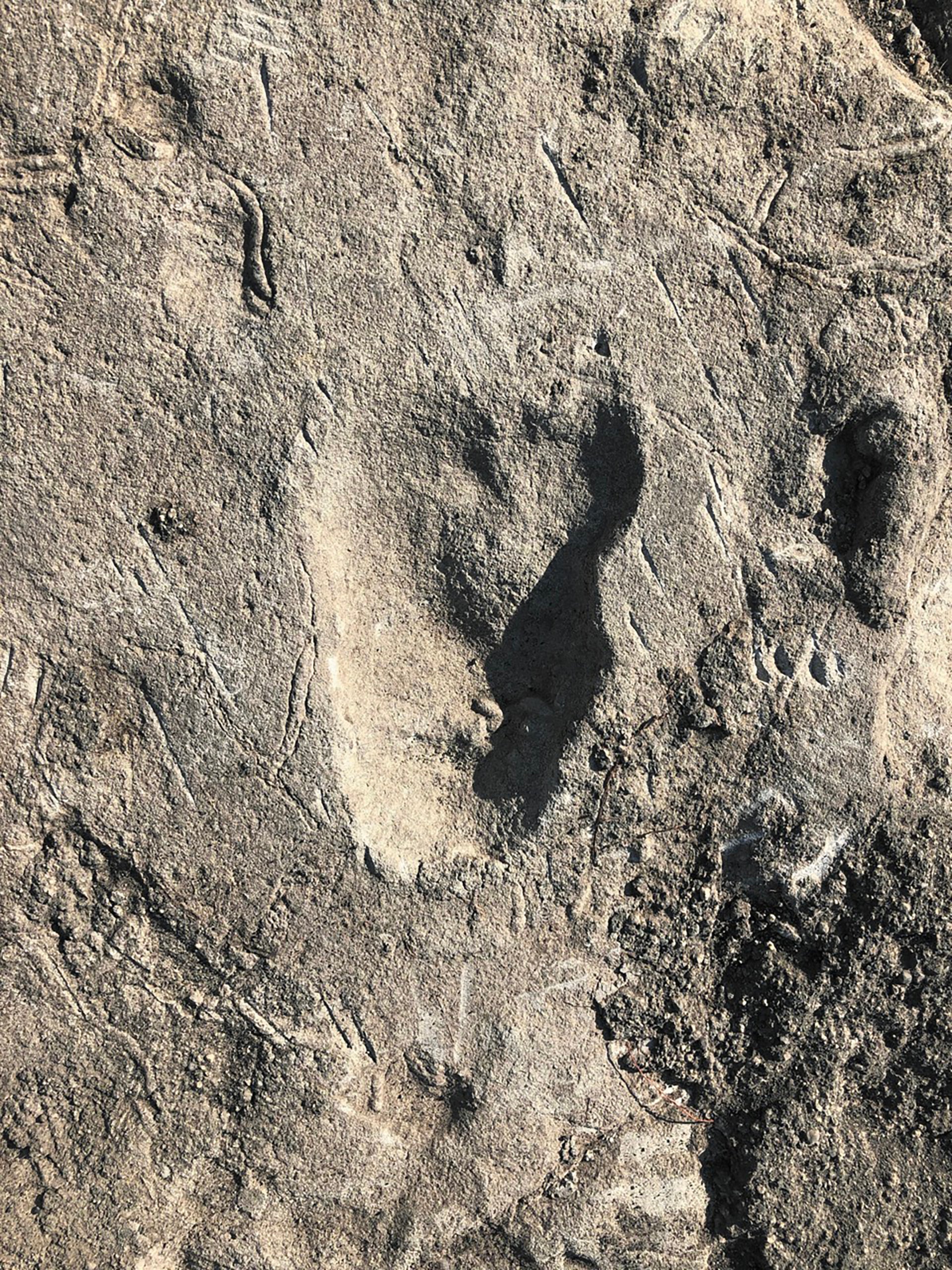
Laetoli Site G footprint presumably made by A. afarensis.

Site A print is short and wide; the big toe sticks out to the side.
Compared with the Laetoli Site G footprint (top), presumably made by A. afarensis, the Site A print (bottom) is short and wide; the big toe sticks out to the side. Credit: John Reader/Science Source (top); Jeremy DeSilva (bottom)

Fossil Feet

The rediscovery of the Laetoli Site A footprints and our conclusion that they were made by a second species are the latest additions to a growing body of evidence that the evolution of upright walking was a lot less linear, more complex and more interesting than we once thought. The other evidence comes not from footprints but from fossils of the hominins themselves. Isolated foot bones are rare in the human fossil record, and foot skeletons are even more elusive. So it is exciting that in the past two decades, paleoanthropologists searching in Africa’s Great Rift Valley and in caves in South Africa have quadrupled the number of fossils from the only part of a biped’s body usually in direct contact with the ground. Many of these new discoveries sample a pivotal period in human evolution, between five million and three million years ago, when our ancestors were becoming committed upright walkers. In 2017 McNutt and I teamed up with Bernhard Zipfel, a former podiatrist-turned paleoanthropologist at the University of the Witwatersrand in South Africa, to make sense of these finds.

Specifically, we sought to evaluate the received wisdom about the evolution of bipedalism in light of the new fossil evidence. According to the traditional view, hominins started out with a chimplike foot built for grasping tree branches. This foot evolved into a transitional foot capable of both grasping and walking, as seen in the fossil known as Ardi, a member of Ardipithecus ramidus that lived in Aramis, Ethiopia, 4.4 million years ago. Fast forward to Lucy, the A. afarensis individual who lived in Hadar, Ethiopia, some 3.2 million years ago, whose foot has a big heel and a stiff midfoot that were better adapted to life on the ground. With the emergence of our own genus, Homo, roughly a million years later, the foot became even better suited to terrestrial locomotion, evolving shorter toes and a high arch.
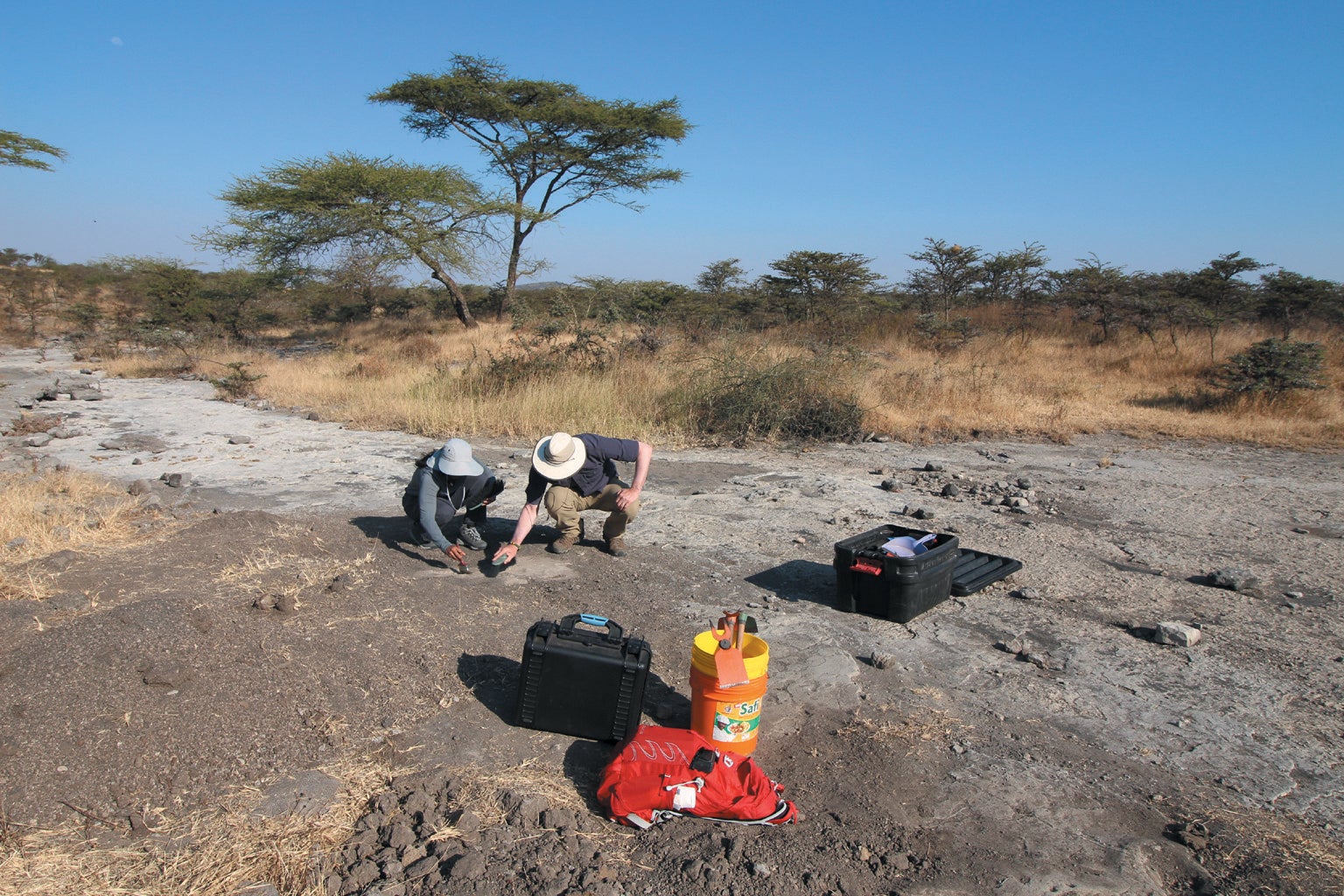
Researchers studying Site A tracks at Laetoli,
Decades after the discovery of the Site A tracks at Laetoli, researchers returned to study the tracks again. Although seasonal rains tend to erode footprints, in this case they covered them with a protective layer of sediment. Credit: Shirley Rubin

After studying all the foot fossils carefully curated in museums throughout Africa, we noticed a very different pattern emerging from our data. As bipedalism evolved in our earliest ancestors, there was a burst of evolutionary experimentation that resulted in different hominins having different foot forms. We identified five different foot morphs, possibly indicating five distinct ways of walking upright, in the two-million-year interval we studied. Between the chronological bookends of Ardi and Lucy are three other uniquely shaped feet. The first belongs to an Ardi-type creature, about the same age as that fossil, from Gona, Ethiopia; the second comes from a 3.67-million-year-old hominin from Sterkfontein, South Africa, dubbed “Little Foot”; and the third is a strikingly primitive foot from a site called Burtele in Woranso-Mille, Ethiopia, that dates to 3.4 million years ago. Although all five of these hominin feet exhibit both apelike and humanlike features, these traits occur in a completely different combination in each foot and do not follow the predicted pattern of becoming less apelike and more humanlike over time.

Like an ancient version of the story of Cinderella, perhaps one of these recently discovered feet will fit the mysterious hominin footprints at Laetoli Site A and reveal the identity of the track maker. We’ll see as we continue to explore these early stages of our evolutionary history.
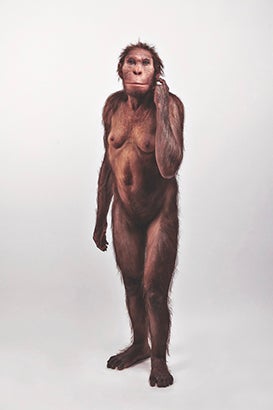
Australopithecus sediba.

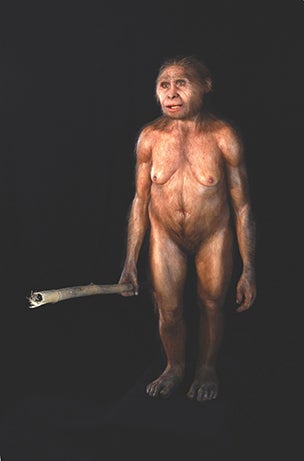
Homo floresiensis.
Multiple styles of upright walking continued to evolve even after the emergence of species with our modern human gait. Australopithecus sediba (top) had adaptations to both terrestrial and arboreal locomotion; tiny Homo floresiensis (bottom) had large, flat feet that might have required taking small, high steps. Credit: S. Entressangle and Elisabeth Daynes/Science Source (top); Sebastien Plailly and Elisabeth Daynes/Science Source (bottom)

Sustained Diversity

Intriguingly, the pattern of locomotor diversity is not limited to these early chapters of human evolution. Take, for instance, Australopithecus sediba. Rivaling the elephant dung fight in the lore of fortuitous paleoanthropological discoveries, this nearly two-million-year-old hominin was discovered in 2008 by then nine-year-old Matthew Berger. He literally stumbled over a rock containing a hominin clavicle and lower jaw while surveying for fossils at the site of Malapa Cave in South Africa’s Cradle of Humankind with his father, paleoanthropologist Lee Berger of the University of the Witwatersrand. In the months that followed, Berger and his team excavated the fossil-bearing cave walls and discovered two partial skeletons of a new species they called A. sediba. Berger invited me to study the foot and leg fossils shortly after I had completed my Ph.D.

I was shocked by what I saw. The shapes of the bones were all wrong. For a hominin of this time period, the heel bone was too apelike, and the midfoot, ankle, knee, hip and lower back showed strange traits in both skeletons. In isolation, these bones were bizarre. But in concert, they told the story of a hominin with a peculiar way of walking, one that was similar to that of humans today who hyperpronate, or excessively transfer weight to the inside of their foot. This gait can lead to joint pathologies in modern people, but Berger and I and our colleagues interpreted the peculiarly shaped bones of A. sediba as anatomical solutions to the problems modern humans face when they walk in this manner. In other words, we think this species was adapted to walk in this way. Why? The shoulders and arms of A. sediba indicate that it climbed trees, and its teeth preserve microscopic traces of plant cells derived from leaves, fruit and bark—evidence that this species frequently fed in trees. This way of walking was the compromise for a hominin well adapted for life in two worlds, navigating between the trees and the ground—long after other hominin species had fully committed to terrestrial life.

A. sediba was not the only hominin walking around southern Africa two million years ago. In 2020 a team of researchers led by Andy Herries of La Trobe University in Australia reported newly discovered fossils from the Drimolen Cave system, also in the Cradle of Humankind area. These fossils came from two other hominin species: the large-toothed Paranthropus robustus and the much more humanlike H. erectus. In other words, three different kinds of hominins from three different genera—Homo, Paranthropus and Australopithecus—were coexisting.

We know from a partial skeleton discovered in the 1980s along the western side of Lake Turkana in Kenya that H. erectus had a body form nearly identical to that of humans living today. Footprints on the eastern side of the lake confirm that these hominins walked like us. H. erectus—the likely ancestor to the lineage that led to our own species, H. sapiens—would have peered across its territory and seen two other bipeds from two different genera, Australopithecus and Paranthropus. Given the different shapes of their foot and leg bones, I think these hominins all had different styles of walking.

The pattern of diverse walking styles persisted even after Australopithecus and Paranthropus went extinct. As recently as 60,000 years ago, by which point H. sapiens was well established, the small human species Homo floresiensis, nicknamed the Hobbit, roamed its island home of Flores in Indonesia on relatively giant, flat feet and short legs with small joints. I wonder if the resulting gait would include the short steps and high knee drive of a person in snowshoes.

Perhaps gait differences helped hominins determine whether a group foraging in the distance belonged to their own species or another. And if gait did reveal the distant foragers to be from their same species, could the observers tell whether the other individuals were friends and family or strangers? Knowing the answer could have been the difference between avoiding conflict and inviting it. Gait, it turns out, is more than a means of getting from point A to point B.

Open Questions

Many questions remain about the evolution of bipedalism. We still do not know why upright walking was selectively advantageous for our earliest ancestors and extinct relatives. Hypotheses abound. In 1809 French naturalist Jean-Baptiste Lamarck speculated that humans evolved upright walking to see over tall grass. Six decades later Charles Darwin surmised that walking on two legs freed the hands to use tools. Other scholars have since proposed that it allowed our ancestors to gather and carry food or to wade through shallow water. Still others argue that it offered a more energetically efficient means of traveling between scattered resources. It seems to me, though, that efforts to identify the reason bipedalism evolved are a fool’s errand. Instead I think it’s possible—maybe even probable—that bipedalism evolved multiple times at the base of the hominin family tree, perhaps for different reasons, in different hominins living in slightly different environments throughout Africa. The diversity of foot forms found in Pliocene fossil sites across the continent supports such a scenario.

The fossil record of apes from the Miocene epoch (23 million to 5.3 million years ago) highlights other unknowns. Paleoanthropologists working in Africa have struggled to find ape fossils from this all-important time period when hominins diverged from other apes. But their counterparts in southern Europe have turned up an impressive collection of bones from apes that used to live in Spain, France, Germany, Greece, Italy, Hungary and Turkey. Judging from their hands, arms, backs, hips and legs, these European apes didn’t knuckle-walk like a chimpanzee. Instead some of them may have been able to move on two legs more often and more efficiently than modern African apes do. Depending on where these ancient apes—such as the 11.6-million-year-old Danuvius guggenmosi from Germany, first announced in 2019—fit into the family tree, it is even possible that the ape from which the ancestors of humans, chimpanzees and gorillas split was not a knuckle-walker at all but more upright, using hand-assisted bipedalism to “walk” through the trees. In that case, the unique hominin adaptation would be not bipedal walking per se but rather bipedal walking on the ground. If more fossils continue to support this hypothesis, then rudimentary bipedalism might turn out not to be a new form of locomotion at all; it may be an old one co-opted for a new environment as our ancestors shifted from an arboreal to a terrestrial existence.

This idea is controversial and in need of further testing. The challenge is that paleoanthropologists have yet to unearth fossil foot or leg bones from Africa during the key time period when the lineages that would eventually lead to humans, chimpanzees and gorillas were beginning to diverge, between 12 million and seven million years ago. To fill in that gap, we rely on the anatomy of those ancient apes from southern Europe. In a way, it is like trying to figure out what your great-grandmother looked like by studying tattered black-and-white photographs of your 19th-century cousins three times removed. They’ll provide some clues but not the full picture. We’ll see how this hypothesis holds up in the decades to come as more fossils are recovered from sites around the Mediterranean and in Africa. For now, though, the very beginnings of upright walking remain shrouded in mystery.

Once our ancestors got moving on two legs, they kept on walking, and that journey has continued right up to today. In a lifetime, the average person will take about 150 million steps—enough to circle Earth three times. We stroll, stride, plod, traipse, amble, saunter, shuffle, tiptoe, lumber, tromp, lope, strut and swagger. After walking all over someone, we might be asked to walk a mile in their shoes. Heroes walk on water, and geniuses are walking encyclopedias. But rarely do we humans think about walking. It has become, you might say, pedestrian. The fossils, however, reveal something else entirely. Walking is anything but ordinary. Instead it is a complex, convoluted evolutionary experiment that began with humble apes taking their first steps in Miocene forests and eventually set hominins on a path around the world.


Original Source Link

Previous Post

15 Best Ant-Man Quotes That Make Us Love Scott Lang

Next Post

Google Expands Flood and Wildfire Tracking to More Countries

Admin

Admin

Next Post
Google Expands Flood and Wildfire Tracking to More Countries

Google Expands Flood and Wildfire Tracking to More Countries

Nevada secretary of state stands by ban on hand-count of mail-in ballots

Nevada secretary of state stands by ban on hand-count of mail-in ballots

JUST IN: Singer Aaron Carter Dead at 34

JUST IN: Singer Aaron Carter Dead at 34

PopularPosts

The Kitchen review – vindicating and explosive

The Kitchen review – vindicating and explosive

January 20, 2024
LAURA INGRAHAM: Biden speaks to us as if we we’re deaf, dumb and blind

LAURA INGRAHAM: Biden speaks to us as if we we’re deaf, dumb and blind

April 28, 2023
FBI Director Patel reveals new evidence in Charlie Kirk assassination case

FBI Director Patel reveals new evidence in Charlie Kirk assassination case

September 16, 2025
26 Best REI Anniversary Sale Deals: Helmets, Fitness Watches, Outdoor Apparel

26 Best REI Anniversary Sale Deals: Helmets, Fitness Watches, Outdoor Apparel

May 27, 2022
Las Vegas Sands thinks more Asia casinos won’t hurt its business: ‘Four billion people are looking for a place to go’

Las Vegas Sands thinks more Asia casinos won’t hurt its business: ‘Four billion people are looking for a place to go’

January 31, 2025
15 Shows Set in Ireland to Stream This St. Patrick’s Day

15 Shows Set in Ireland to Stream This St. Patrick’s Day

March 17, 2024

Categories

  • Business (7,801)
  • Events (12)
  • Film (7,728)
  • Lifestyle (5,467)
  • Literature (5,846)
  • Music (7,784)
  • Politics (7,501)
  • Science (7,172)
  • Technology (7,726)
  • Television (7,794)
  • Uncategorized (6)
  • US News (7,835)

RecentPosts

Literary Hub » Helen Mirren is playing Patricia Highsmith?! Watch the trailer for A Talent for Murder.

Literary Hub » Helen Mirren is playing Patricia Highsmith?! Watch the trailer for A Talent for Murder.

by Admin
August 29, 2026

This morning, fans of both Patricia Highsmith and Dame Helen...

Everything We Know About Grand Theft Auto 6 (Updating)

Everything We Know About Grand Theft Auto 6 (Updating)

by Admin
August 29, 2026

As the November 19th release of Grand Theft Auto VI...

Offshore nuclear barges could power ports and data centers—starting with California

Offshore nuclear barges could power ports and data centers—starting with California

by Admin
August 29, 2026

As the U.S. paves the way for a nuclear renaissance...

Trump Mentally Collapses Over Report He Refuses To Go To Ground Zero On 9/11

Trump Mentally Collapses Over Report He Refuses To Go To Ground Zero On 9/11

by Admin
August 29, 2026

Donald Trump regularly shows the American people that he is...

Greg Abbott orders pause on Flock Safety funding amid privacy concerns

Greg Abbott orders pause on Flock Safety funding amid privacy concerns

by Admin
August 29, 2026

Flock surveillance cameras spark bipartisan backlash over privacy concerns Flock...

Where are all the aliens? A new book explores possible answers

Where are all the aliens? A new book explores possible answers

by Admin
August 29, 2026

We’ve been looking for aliens for as long as we’ve...

Archives

Editor's Picks

Book Riot’s Deals of the Day for August 24, 2026

Book Riot’s Deals of the Day for August 24, 2026

August 24, 2026

‘National Treasure 3’ in the Works and Has a Script, Director Says

August 23, 2026
Meta settles for  billion in lawsuit brought by 29 states over social media harms to children

Meta settles for $18 billion in lawsuit brought by 29 states over social media harms to children

August 26, 2026

Browse By Category

  • Business (7,801)
  • Events (12)
  • Film (7,728)
  • Lifestyle (5,467)
  • Literature (5,846)
  • Music (7,784)
  • Politics (7,501)
  • Science (7,172)
  • Technology (7,726)
  • Television (7,794)
  • Uncategorized (6)
  • US News (7,835)

Useful Links

  • Anti-Spam Policy
  • Copyright Notice
  • DMCA Compliance
  • Earnings Disclaimer
  • Fair Use Disclaimer
  • FTC Compliance
  • Medical Disclaimer
  • Privacy Policy
  • Social Media Disclaimer
  • Terms and Conditions

Copyright © 2022 by Washington Weekly Times. All rights reserved. All articles, images, product names, logos, and brands are property of their respective owners. All company, product and service names used in this website are for identification purposes only. Use of these names, logos, and brands does not imply endorsement unless specified. By using this site, you agree to the Terms of Use and Privacy Policy.

No Result
View All Result
  • Home
  • US News
  • Politics
  • Business
  • Science
  • Technology
  • Lifestyle
  • Music
  • Television
  • Film
  • Literature
  • Contact
    • About

Copyright © 2022 by Washington Weekly Times. All rights reserved. All articles, images, product names, logos, and brands are property of their respective owners. All company, product and service names used in this website are for identification purposes only. Use of these names, logos, and brands does not imply endorsement unless specified. By using this site, you agree to the Terms of Use and Privacy Policy.

We use cookies on our website to give you the most relevant experience by remembering your preferences and repeat visits. By clicking “Accept All”, you consent to the use of ALL the cookies. However, you may visit "Cookie Settings" to provide a controlled consent.
Cookie SettingsAccept All
Manage consent

Privacy Overview

This website uses cookies to improve your experience while you navigate through the website. Out of these, the cookies that are categorized as necessary are stored on your browser as they are essential for the working of basic functionalities of the website. We also use third-party cookies that help us analyze and understand how you use this website. These cookies will be stored in your browser only with your consent. You also have the option to opt-out of these cookies. But opting out of some of these cookies may affect your browsing experience.
Necessary
Always Enabled
Necessary cookies are absolutely essential for the website to function properly. These cookies ensure basic functionalities and security features of the website, anonymously.
CookieDurationDescription
cookielawinfo-checkbox-analytics11 monthsThis cookie is set by GDPR Cookie Consent plugin. The cookie is used to store the user consent for the cookies in the category "Analytics".
cookielawinfo-checkbox-functional11 monthsThe cookie is set by GDPR cookie consent to record the user consent for the cookies in the category "Functional".
cookielawinfo-checkbox-necessary11 monthsThis cookie is set by GDPR Cookie Consent plugin. The cookies is used to store the user consent for the cookies in the category "Necessary".
cookielawinfo-checkbox-others11 monthsThis cookie is set by GDPR Cookie Consent plugin. The cookie is used to store the user consent for the cookies in the category "Other.
cookielawinfo-checkbox-performance11 monthsThis cookie is set by GDPR Cookie Consent plugin. The cookie is used to store the user consent for the cookies in the category "Performance".
viewed_cookie_policy11 monthsThe cookie is set by the GDPR Cookie Consent plugin and is used to store whether or not user has consented to the use of cookies. It does not store any personal data.
Functional
Functional cookies help to perform certain functionalities like sharing the content of the website on social media platforms, collect feedbacks, and other third-party features.
Performance
Performance cookies are used to understand and analyze the key performance indexes of the website which helps in delivering a better user experience for the visitors.
Analytics
Analytical cookies are used to understand how visitors interact with the website. These cookies help provide information on metrics the number of visitors, bounce rate, traffic source, etc.
Advertisement
Advertisement cookies are used to provide visitors with relevant ads and marketing campaigns. These cookies track visitors across websites and collect information to provide customized ads.
Others
Other uncategorized cookies are those that are being analyzed and have not been classified into a category as yet.
SAVE & ACCEPT