






























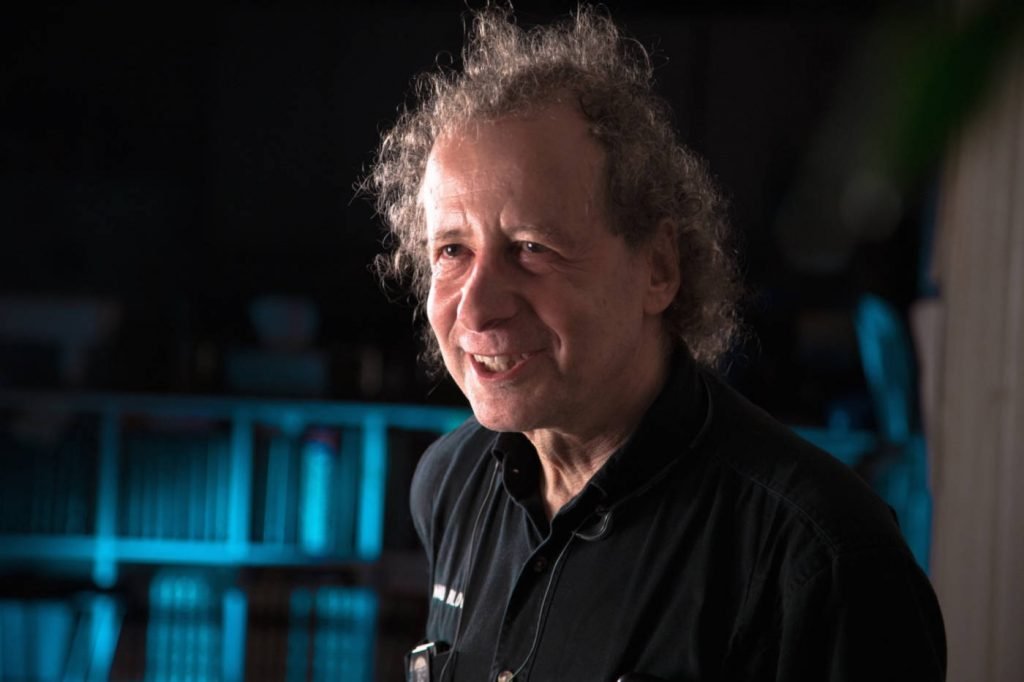
At 83, a man is supposed to slow down. He is supposed to tend his legacy, accept his lifetime achievement awards, and let younger minds carry the load. Somebody forgot to tell Howard Bloom. The Brooklyn-based thinker — hailed by Britain’s Channel4 TV as heir to the lineage of Newton, Darwin, Einstein, and Freud, and dubbed “the next Stephen Hawking” by Gear Magazine — celebrated his 83rd birthday this June the way he has celebrated every day for decades: by working on the survival and future of the human species. While his contemporaries write memoirs, Bloom is designing humanity’s next civilization.

Consider what occupies his desk right now. With Caltech’s Keck Institute for Space Studies, Bloom is at work on two projects of staggering ambition: the first parallel-processing multi-planetary mission — a coordinated reach to low Earth orbit, the Moon, and Mars — and an energy infrastructure for the entire solar system. As founder and head of the Space Development Steering Committee, whose ranks have included Buzz Aldrin, Apollo moonwalker Edgar Mitchell, and decision makers from NASA, the National Science Foundation, and the Air Force, he has spent years pushing humanity’s leap off-planet from concept toward blueprint. These are not an old man’s daydreams. They are working projects with some of the most serious space minds on Earth — and Bloom, in his ninth decade, is helping steer them.
The world has begun building institutions around him while he is still very much in motion. The award-winning documentary The Grand Unified Theory of Howard Bloom so electrified viewers Alex Watler and Josh Leet that they sought Bloom out to join the Howard Bloom Institute — only to discover no such institute existed. So they founded it with him, creating a multidisciplinary organization with a mission as vast as its namesake’s mind: to upgrade, uplift, and empower humanity, now and for generations to come. Most thinkers get institutes posthumously. Bloom got his in real time, because his ideas are needed in real time — and he continues to pour out commentary on the events of the moment, dissecting elections, culture, and crises with the same pattern-hunting eye he once trained on the Big Bang.
Hinton 
That eye has been sharpening for over seventy years. This is, after all, the mind that built a Boolean algebra machine at twelve, researched cancer at the world’s largest center for it at sixteen while conceiving a theory of the universe that anticipated dark energy, made kings of Michael Jackson, Prince, and Billy Joel as the most celebrated publicist in rock history, wrote books that the Office of the Secretary of Defense convened a symposium to study, and founded the scientific discipline of paleopsychology. Any of it would justify a comfortable retirement of laurels. Bloom treats it all as prologue.
Because underneath the dazzling résumé burns a conviction that gives his ninth decade its urgency: despite all our nightmares, humanity can survive and flourish — and the more we flourish, the more we do the work of nature and of the cosmos itself. That is the message of the Howard Bloom Institute, and it is the reason its founder refuses to coast. In an era drowning in pessimism, the man who has studied mass behavior from quarks to civilizations insists that our species’ greatest chapters are unwritten — and he intends to keep drafting them personally, from Brooklyn, for as long as the universe permits.

The smartest man in the room has been the smartest man in every room for seven decades — the science fair, the cancer lab, the record label, the Pentagon symposium, the Caltech workshop. At 83, Howard Bloom hasn’t slowed down. He has simply run so far ahead that it will take the rest of us years to reach where he is standing now.
Genius doesn’t retire. It accelerates. Howard Bloom, at 83, is the proof.