
























January, a Loss of Signs by Kira Homsher
I.
January. The dog and I have both injured our left knees. He tore his cranial cruciate ligament playing in my parents’ muddy backyard on Christmas day. I don’t know when, or how, I hurt mine. I don’t know exactly what’s wrong with it, either. I only know that it hurts: when I go up and down the stairs, when I bend to pet the dog, when I walk to my bus stop in the snow. By the end of the day, the pain radiates from my upper thigh to the bones in my left foot. My boyfriend says it’s just sympathy pains, as if they don’t really belong to me.
The dog’s surgery is scheduled for the 17th, just over a week away. He will not be able to run or jump or even use the stairs for a long while after. Gus is a 100 pound German shepherd mix, too heavy for us to carry to the second floor where we do most of our living. In preparation, Bryce and I remove the leaves from the dining room table and lug our bed down to the first floor, where we will sleep for the first few months of his recovery. I spend hours browsing the internet for necessities, pouring over essay-length reviews on pill pockets, pet gates, and inflatable cones. I order knee braces for both me and the dog. I order a tiny projector that will simulate a starry night sky on the ceiling—my cheap attempt at making the dining room a cozy place to sleep. I join a Facebook group where members share experiences managing their dogs’ recoveries from the surgery, exchanging tips and asking for advice. Every other post is a photo of a dog in a cone, staring up at the camera with glassy, mournful eyes. My poor baby, one woman writes. He is really just like my baby. Another posts a long, frantic paragraph citing research connecting the surgery to the development of bone cancer in dogs. No one seems to agree on the right decision. After a few minutes of scrolling, I remove myself from the group.
We are really in the end times now, my friend says. Smiley face.
Every night before the surgery, Bryce and I curl up on our floor bed with the dog to read Watership Down aloud to one another. We are fond of these fictional rabbits, their elaborate survival instincts and the great risks they take to make a better life for themselves. Around halfway through the book, Bryce flips to the map on the first page to trace their perilous journey from their old warren to the new one, across rivers and farms and fields. The entire map barely extends beyond five miles, which sounds like nothing at first. But then I think about the climb from the first floor of our house to the second and feel a sting in the back of my throat.
II.
On the last day of winter break, I come home from dinner at a friend’s house and check my phone: Los Angeles is on fire. Friends share pictures of glowing orange skies, of fallen trees, traffic jams, flaming beaches, ash and smoke. Animal shelters share pictures of pets that were abandoned in the evacuations. My aunt in Inglewood messages to say, Bet you’re glad you don’t live here anymore. And: The only time it ever rained was when you were here.
Before moving to Ohio, Bryce and I spent two rudderless years in Los Angeles, driving around in constant disbelief at all the spiky, improbable beauty surrounding us. It did something to me, that beauty. Driving to work, stuck in traffic, I would look out the window at the Verdugo mountains, varicose with shadows, and feel lucky to be alive, witnessing all of it. But life in Los Angeles was a lease, a loan. I knew we didn’t really belong there. I also felt I could have stayed forever, had something come along to make it possible: a job with healthcare, a starring role, a sign.
Nothing came. We left.
In LA I was constantly telling people how much I missed seasons, but now I’m not so sure. I think what I missed was the idea of seasons, the postcard images of colorful leaves and yellow lights glowing over snow-capped roofs. The reality is a little less quaint. It’s been below freezing here in Cincinnati for over a week and the sidewalks are covered with black ice. The days are swallowed up in impenetrable darkness.
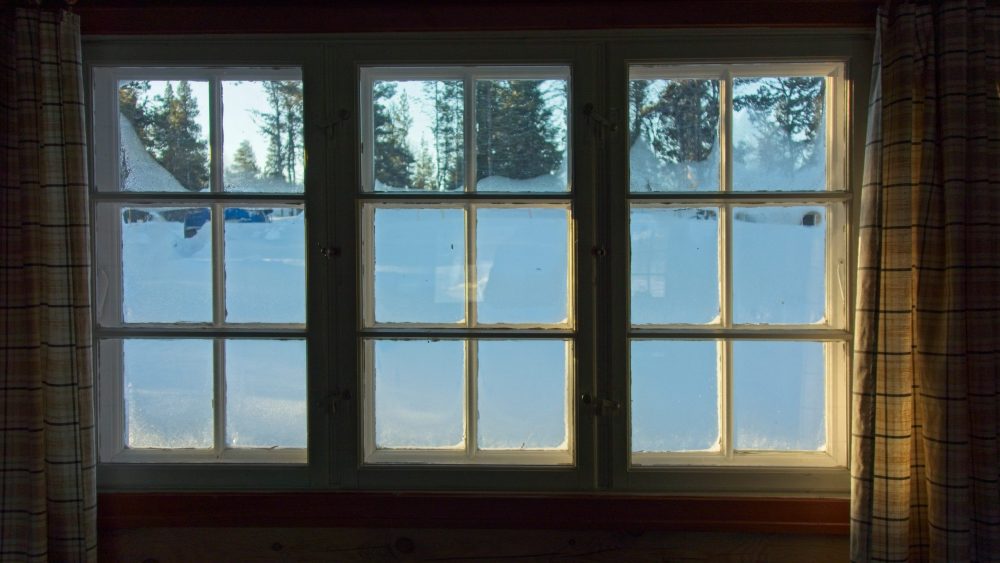
The next morning, we are snowed in. Gus’ favorite thing in the world is playing in the snow. For the past six years that we’ve had him, minus the two spent in California, Bryce and I have eagerly awaited each winter’s first storm for the sheer pleasure of watching him dart around in the fresh powder. Now, we close the curtains and avoid the windows. The blanket of white outside makes our neighborhood look like a foreign country, alien and untraversable.
A friend messages to let me know that, apparently, you can order a sled on DoorDash. I imagine doing this: summoning a sled to my front door while my former neighborhood goes up in flames.
We are really in the end times now, my friend says. Smiley face.
III.
This semester, I’m taking a course on ambivalence in Early Modern literature. I’m also teaching First Year Writing, ambivalently, to a class of equally ambivalent undergrads. Many of my students are working full- or part-time to put themselves through college, though they seem skeptical about its practicality. In our discussions, they express concerns that artificial intelligence will render their fields obsolete or unrecognizable. They use ChatGPT to write banal essays about the impact of social media on mental health and the advantages of limiting screen time and reconnecting with nature. I skim their clean, voiceless sentences, unsure how to feel. I am no longer confident in my ability to convince them that language is deserving of their time and attention. These are scarce resources.
In the literature course, I learn that the term “ambivalence” first appeared at the beginning of the 20th century, coined by a Swiss psychiatrist to denote schizophrenia. Ever since, it has been viewed largely in a negative light, a problem to be solved. Ambivalent people must orient themselves in a single direction and focus their energies on resolving contradictory emotions and uncertainties. They should know what they want and what they feel. Or, at the very least, they should want to know.
A group of feminist scholars from the University of Michigan have made a case for reclaiming the term’s etymology as ambi-valence, “ambi” signifying “both” or “around,” and “valence” signifying the “relative capacity to unite, react, or interact.” They argue that, contrary to its unproductive associations, ambivalence might be seen as abundant, teeming with possibility. Instead of simple uncertainty, ambivalence might instead be interpreted as the ability to contain several contradictory feelings at once, a useful skill in a polarized society.
The power in ambivalence, then, is in its capacity to resist progress narratives, and to transcend expectations of resolution, linearity, and arrival. To embrace something wilder, something darker.
IV.
When I think of ambivalence, I think of Emma, and our trip to Iceland. Seven years ago, in my final semester of college, my oldest friend and I traveled there for spring break. I had no particular interest in visiting the country, but Emma was determined to go somewhere original, somewhere no one else would think to visit. All her ivy league friends were vacationing to tropical islands that week: Bora Bora, Maui, Ibiza. None of my friends were going anywhere at all as far as I knew. Emma wanted to take pictures of us bathing in the Blue Lagoon, posing by scenic waterfalls, and pointing at the Northern Lights in the starry sky. She offered to pay for my ticket. I agreed to go.
As soon as we arrived in Reykjavík, it was clear that we had made a mistake. The city was an overpriced tourist trap; there were hamburgers and Americans everywhere we looked. The Blue Lagoon was fully booked, and we were too young to rent a car to drive out to the more beautiful parts of the country, the must-see locations that popped up when we googled “things to do in Iceland.” On the bus from Philly to New York to catch our flight, I’d lost my suitcase, which contained my diary—a leather-bound capsule of my 22-year-old self and all her ill-fated exploits—along with all my favorite pants, sweaters, and bras. On our first day of the trip, we stopped at a thrift store, where I bought a pair of too-big jeans and a striped long-sleeved shirt. I wore them all week under my bright orange coat, like a cartoon character.
Emma and I didn’t know what to do with ourselves in that strange little country. We’d done very little research before booking the trip, over-confident in our ability to meet people—men—who could show us around, which was our usual approach to travel. My only form of preparation was a short list I’d curated of random Icelandic words and their definitions, though I knew most people there were fluent in English. Neither of us were outdoorsy types; the only thing we knew how to do with nature was take pictures of it, usually from behind a glass.
We paid 100 dollars each for seats on a tour bus to Thingvellir, a national park about 25 miles north of Reykjavík. The guide told us it was the location of the first Viking commonwealth. I tried to take an interest in the history, watching the landscape melt and strobe through the window as he lectured. I skimmed my list of words and found Dýjamosi: bright green moss growing in quagmires. Emma messaged someone on her phone, her face hidden beneath her curtain of straight dark hair. She was in one of her moods and didn’t want to speak to me. Gluggaveður: window weather. I took a photo of the scenery, knowing she’d want it later for her Instagram story, to show everyone what a magical time we were having.
V.
A friend from my hometown outside of Philadelphia wants to have a phone call. The hard drive on his desktop computer has failed and, because he neglected to back it up, he has lost five years of personal and professional creative work.
I am reset to 2019, William says, as if I merely dreamed the last five years.
For years, he has been caught in the webbings of an endless sprawl of projects and ideas, always moving on to another before seeing through the last. He wants to know if I think he should accept his lot and start fresh, or if he should try to reproduce what he’s lost. I try to imagine what I would do in his circumstances. I tell him to take stock of what he can remember, a sort of inventory of loss, and to decide on the three most important items. He answers immediately: a short story, an elaborate board game he’s been painstakingly designing for years, and a 380-page document full of a decade’s worth of thoughts and observations.
Well, I say, you can’t possibly attempt to replicate that.
The power in ambivalence, then, is in its capacity to resist progress narratives, and to transcend expectations of resolution, linearity, and arrival.
William tells me he’d been fleshing out an idea for a short film about a man who wakes up on a mattress under a bridge having lost his memory, unable to recall who he is. The film would derive partially from his own experiences recovering from three separate concussions, each of which, he believes, has chipped away at some essential part of his personality. In a way, he continues, laughing bitterly, the hard drive is like a fourth concussion. The obliteration, the pointless attempts to piece back together what was lost. It’s futile to try and recover the old self because you’ve changed already. That person is gone.
We fall silent and, because I hate silence, I say something falsely optimistic, the only thing that comes to mind. I tell him that he could try to see the loss as a sign to start working on something completely new, an opportunity to break from his old creative habits, which have largely brought him stasis and frustration. Yeah, he says, sounding disappointed. Maybe.
Leirskáld: a bad poet.
After we hang up, I lay on my back on the carpet, staring at the ceiling, and wonder: If my house were to burn down, if my digital archives were to be wiped, what would I most want to save?
VI.
Bryce and I drop Gus off at the animal hospital on the morning of his surgery and spend the whole day pacing around the house, waiting for the call to pick him up. Neither of us wants to name all the things that could go wrong, but we are thinking of them: a reaction to the anesthesia, an issue with the implant, infection of the wound. Hours later, when they finally call, our nerves are shot.
Before we can take him home, a vet tech takes us into a private room to go over the post-surgery protocol. For the first two weeks, Gus must wear a cone and lick sleeve at all times and should only go outside to pee. We will have to help him walk by supporting his back legs with a sling that goes beneath his belly. The nurse tells us he’s on a high dose of anesthesia and might be unable to stand, but when they bring him out, he charges toward us on all fours, strong as a bull.
Gus doesn’t seem to understand what has happened to him. Despite being on an extraordinary cocktail of medications, he refuses to rest or to calm down. He presses his heart-shaped nose against the bars of his crate and bashes his cone around, whining to be let out. Bryce and I order Indian takeout and curl up on the floor bed beside his crate to watch a movie on my laptop; it’s about a little goldfish who loves a human boy so much she decides to become human too. She casts a spell and the magic overwhelms the ocean, triggering a tsunami. The island floods. Cars turn into boats, people and animals float across the village with placid expressions on their faces.
The movie ends, and the dining room goes dark. We turn on the stars and watch them shimmer down on Gus, who has finally fallen asleep. Now that we’ve gotten through one day, I know we can get through another. The island has already flooded. So now we float.
VII.
The literature professor assigns Shakespeare’s Sonnets 1–17, the “procreation sonnets.” Believed to have been commissioned by a wealthy family, the poems leverage every possible argument to convince an unnamed young man to find a wife and produce an heir. Brandishing metaphors of wilting flowers and deadly winters, the poet stresses the impermanence of the young man’s youth and the selfishness of his failure to extend his life and beauty through reproduction.
Reading the sonnets, I can’t help but think of the rabbits in Watership Down, risking their lives to secure female rabbits—does—to ensure the longevity of the warren. If they cannot mate, all their utopian dreams will die with them, and their adventure will have been for nothing. Reproduction as a necessary plot point. It’s strange to encounter this, both in the poems and in the novel. Artists no longer seem to think in these terms as far as I can tell. In the past year, I have read only books centering on the decision not to have children and what it means to reject this narrative, the universal narrative of life.
A few days after the surgery, I find an envelope in the mailbox. It’s from Mia, a dear friend who lives in rural Virginia. We met there while completing our master’s degrees and became fast friends, both of us starved for connection in the aftermath of the pandemic. Virginia was an unlikely place for either of us to find ourselves. Mia is Italian and moved there from Europe to live with her husband. I did not travel nearly as far but had spent most of my life in big cities and felt certain that I could never withstand living somewhere so cut off. In the end, I found that I liked it, and maybe even preferred it.
Inside the envelope are four sheets of paper, an extended letter spanning several months. When Mia first started writing the letter, she was meant to have a haircut that morning, but her appointment was canceled. She’d booked this haircut months ago, she wrote, thinking, How organized am I? and Great foresight! and This is the thing to do, a haircut, right at the end of the semester! She had even considered getting bangs. She said: Maybe this cancellation of my booking means the gods are trying to tell me I should not get a fringe?
Maybe it was a sign.
When she was younger, Mia wrote, many of her friends had dealt in signs. They would do tarot card readings or see a psychic over matters such as this. She was always looking for signs in her 20s: I was on high alert for life-changing turning points. It wasn’t just me though, it was in the air. She’d had a friend who was walking down the street in town when a car drove past and stopped. The driver rolled down the window and said he was in love with her, that she was the most beautiful thing he’d ever seen, and she got right into the car and married him soon after. After hearing about this, Mia became aware of a certain feeling when walking down the street or sitting on a train: Anything could happen, you could meet someone and change your entire life trajectory.
Needless to say, she wrote on the next page, the guy in that car turned out to be a lunatic, and my friend, who was really beautiful in a pre-Raphaelite way—pale skin, green eyes, reddish hair—dropped out of university, I think, and based on what the internet shows, is now obese and unemployed. Seeing the photos of her friend, she felt very old and judgmental, and also sad that they had lost touch. Mia swore she would never again look anybody up on Facebook.
The problem with the loss of signs, Mia explains at the end of her letter, is that once you believe there is no ultimate plan or scheme, You don’t know why you do what you do, or you don’t know what to do because you don’t know what it would mean to do it.
VIII.
By the end of our week in Iceland, Emma and I began to unravel. We couldn’t sleep. We lay beside each other in our shared double bed and Emma snapped at me to “stop breathing so loudly.” We weren’t getting anything out of our poorly planned trip, not even photographs, and we couldn’t afford anything; I’d started stealing hard-boiled eggs from the nearby convenience store salad bar every morning just to fill my stomach. We ransacked the medicine cabinet in our Airbnb hoping to find pills that might loosen us up a bit, or at the very least help us sleep, but the text on the bottles was in Polish for some reason, and completely indecipherable to us.
On our last night, we decided we’d do whatever it took to make some memories which, at the time, seemed like the only reason to do anything at all. We would get a nice dinner and then go find the Northern Lights. We walked around for a while searching for a restaurant, but everything was either packed or prohibitively expensive. Eventually, we ended up ordering beer and burgers at an empty Hard Rock Cafe. When they brought the bill, we burst into hysterical laughter at the total, tears streaming down our cheeks. We were so miserable, it was hilarious how miserable we were—two idiot Americans on an idiot vacation.
Emma and I locked eyes, then stood and fled the restaurant without paying. I felt bad for the servers, but not bad enough to go back and settle up. I worked in food service and felt I wouldn’t have cared if my customers dined and dashed. Of course, this wasn’t fair—I didn’t care about anything back then.
We tore down the icy streets. Soon, Emma began crying in earnest, convinced the Icelandic police would track us down and prevent us from leaving the country. I told her they had better things to do, but I wasn’t so sure; Reykjavík didn’t exactly feel like a criminal hotspot. We ducked into a gas station and bought a small bottle of vodka, a pack of cigarettes, and a box of cold chicken wings, then caught a bus to Seltjarnarnes, a little peninsula town just outside the city where, according to Google, we might find a free footbath with a decent view of the Northern Lights.
The sun vanished beneath the horizon as we neared our stop. The sky seemed to close itself to us. We got off the bus, and I knew instantly that the lights would not appear. Still, we trudged silently along the shoreline, following an arrangement of arbitrarily laid wooden planks that seemed to imply a trail. Emma thought it might lead to the footbath. A lighthouse glinted pale through the thick blue air, indigestibly picturesque. Blámóða: blue mist.
We shuffled through the freezing cold for another 15 minutes. The planks got farther and farther apart before disappearing in the sand. They didn’t lead to a footbath. They led to nothing. The sky was a dark mirror, empty of magic. Hopeless, I sat down on a patch of grass, shivering and hugging my knees. Emma removed the vodka, chicken, and cigarettes from the plastic bag and flattened it on the ground to make a sort of table. Side by side, we took blazing gulps of vodka, working our way through the ice-cold wings. A pile of sticky bones amassed by our feet. Emma struck a match to light a cigarette, inhaled, then passed it to me with clumsy gloved fingers. I breathed in the spark and sent a cloud of smoke into the sky, where it drifted for a moment before submitting to the enveloping blue.
We never saw the Northern Lights and, not long after we returned home, we stopped seeing each other. College was over and it was time for us to embark upon our future lives, which promised to be very different. It was like we suddenly realized we had nothing to say to each other anymore, so we never spoke again.
IX.
A couple weeks into Gus’ recovery, it starts to feel as though we have always lived in the dining room. The whole world begins and ends at the edges of our floor mattress. Everything beyond the window is Ice Land, white and drifting, and none of it has anything to do with us. I leave the house only to teach, or to attend the ambivalence class. On the bus to and from campus, I fail to notice anything around me. I stumble home through the snow, the frigid air numbing my brain. As soon as I step inside, I melt into a puddle on the floor, reflecting nothing.
Already, I know I will remember this period of my life as a room. The four walls feel peaceful and insulating, never claustrophobic. Time here is oozy and nonlinear. Instead of stretching forward, it curls up in a ball. I often forget what day it is. I forget what I did yesterday, and the day before. Bryce and I grow comfortably placid—and irresolute. We don’t discuss the future. We don’t want to think about moving back upstairs, or what comes after. For now, all of our decisions are made for us. Our schedule is defined by Gus’ immediate needs, and this is a kind of relief. We fill his bowl, take him out, wipe the snow off his paws with a towel. He is uncharacteristically patient with us when we loop the sling beneath his belly and help him limp out to the snow-covered yard to pee. At night, he sleeps sweetly in his crate, never complaining about the cone around his neck or the pain pills we smuggle into his bowls of kibble.
Sometimes we break the rules and remove the cone to let Gus sleep between us. He tucks his nose in the space between my neck and shoulder and huffs a big sigh. I roll over and wrap my arms around his great barrel chested body, burying my face into his fur. I think of the woman from the Facebook group: He is really just like my baby.
X.
In the ambivalence class, we discuss Lauren Berlant’s Cruel Optimism. The term names “a relation of attachment to compromised conditions of possibility.” Cruel optimism exists when the thing you desire is what prevents you from flourishing.
I turn 29 at the end of January, an ambivalent and cruelly optimistic age. 29 is a year for looking ahead and looking back, measuring expectations against realities. I thought I’d be a lot of places by now. Ohio was never one of them. I feel a winnowing of possibilities before me. I don’t know where to draw the line between myself and everything else. Events in books and stories my friends tell me sometimes feel as if they’ve happened to me. I’m starting to understand what my grandparents meant when they spoke about the way life can creep up on you, how the years start to blur by.
Smáminnka: getting smaller and smaller.
My whole life, I was sure I wanted to be a mother. When my friends expressed ambivalence about having children, I was privately smug about my inability to relate, proud of my uncomplicated self-knowledge. This was a thing I would do not because of some pact with my gender, but because I wanted to. Now, as I approach my 30s, that certainty seems to have evaporated. I am in pain almost every single day, riddled with dull aches I write off as arbitrary signs of getting older, or the inevitable consequence of poor exercise habits. The pain that radiates from my left foot to my upper thigh, the pinching sensation in my abdomen, the on-and-off soreness of my ribcage, the monthly migraines. I make appointments with specialists and go in for images I can’t afford, only to be referred to new specialists who request new images. I can’t imagine growing another human being inside of me, let alone caring for one. If I am already this tired, this tender, what would it be like inside my body if I was pregnant? If Gus’ recovery has shrunk the world to the size of a mattress, how small would it become with a child? A world the size of a fingernail?
At the same time, I never thought to imagine any other future for myself. I never needed an alternate fantasy; I knew the end point at which my youth would transform into something else, something that had less to do with me. I thought I knew the end point.
XI.
A second letter was enclosed in the same envelope from Mia, this one dated in November. Mia had finally taken her future into her hands and booked another hair appointment to get bangs. It felt like a big decision, but to be honest, I’m now already growing it out; it was no big meaningful decision at all. Nothing grand.
I feel a winnowing of possibilities before me. I don’t know where to draw the line between myself and everything else.
She wrote about a phone call she’d recently had with her mother in which she learned that her birth had been a total accident, that she never would have been conceived had her father not come home for lunch on a day he usually stayed at work. Her mother unknowingly had what at the time the doctors called a “second ovulation,” in what should have been her non-fertile days. It was this piece of news—that my conception was unforeseeable, fortuitous, and a bit miraculous—together with the fact that she and her husband had been trying to conceive for a year with no success, that caused Mia to have a simple revelation: “This” is “it.”
Whatever she had previously thought her life would be, this was probably it. Your life isn’t yours, she wrote. You think it is, you have to think you’re in control, of course, you plan everything out, but ultimately it is not as linear as you would think.
“I don’t know what I’d been expecting,” says Captain Holly in Watership Down. “You know how you let yourself think that everything will be all right if you can only get to a certain place or do a certain thing. But when you get there, you find it’s not that simple.”
XII.
Months pass. Gus’ leg begins to heal, and we move our bed back up to the second floor. In the fall, I travel to Michigan to present a paper on ambivalence in the 21st century novel. The paper begins with a review of several novel-writing guidebooks, all of which assert the need for a protagonist to have a strong goal or desire to propel the plot forward. According to the guidebooks, characters with ambiguous motives or feelings might be seen as lacking depth or development, making them harder for readers to connect with or invest in. I argue that this approach to character development is at odds with contemporary life, where relentless spectacle, overstimulation, and chronic uncertainty often inhibit decisive action. I ask what might happen if we instead choose to embrace ambivalence as a thematic concern and mode of narrative complexity, foregrounding mood, contradiction, and epistemological uncertainty over linear plot structures and formulaic storytelling.
Reading the paper aloud, my eyes flicking from the podium to the audience, I begin to grow more and more uncertain about whether the things I am saying have any merit to them. I feel I could just as easily make the opposite argument. Maybe characters should want things—maybe it’s important that fiction differentiate itself from real life to offer an escape from chronic uncertainty, or an example of how to live. After all, Watership Down wouldn’t be much of a story if the rabbits had never decided to leave their doomed warren in search of a new home. I arrive at the end of the paper and answer questions from the other conference-goers, feigning confidence in my answers, a little amused by the paradox of acting certain about the topic of uncertainty.
XIII.
Five years after Iceland, I saw Emma on Wheel of Fortune, a show she’d watched since we were kids. She always liked the kinds of shows where people became rich and famous overnight, and it had been a dream of hers to appear on one. Emma won an all-inclusive trip to Hawaii by guessing the missing letters for MAGICAL MOMENT and told the TV audience that she planned to use it for her honeymoon. This is how I found out my oldest friend was married. She told the host she’d celebrated her wedding the month prior, holding out her hand to reveal a bright diamond ring. The smile on her face looked a little strained, a little false, though maybe I was projecting.
Watching her face on the screen, larger than life, I felt suddenly cold. I missed her teeth. I thought of the two of us huddled in our Reykjavík apartment, our whole lives ahead of us, and wondered if things would’ve been different had we seen the Northern Lights, had we been granted a sign. A magical moment. Maybe I would’ve been there for the wedding, standing beside her in a green dress, close enough to be considered family.
XIV.
“This” is “it.” January again. A year has passed, and it’s easy now to forget that Gus ever injured his knee. He can play again, though not as much as he used to. He’s getting older, too. When it snows, we take him out to pounce in the fresh white powder, making up for lost time.
I’ve moved the night sky projector into my office. I like to lie on the ground and watch the green and pink light ripple across the ceiling like ocean waves, speckled with bright, simulated stars. It looks like the sky Emma and I imagined we’d see in Seltjarnarnes, the lights that refused to appear for us, perhaps because we were so intent on searching for them.
Kollgáta, the true answer to the riddle.
Mia is pregnant now, with a boy, and in good health. William never finished his board game, but he is at work on a new computer game called Pirate Simulator. I ask him to describe the gameplay mechanics, and he laughs and says: You’ll find no poetic resonances here. It’s all just about sailing around and trying to become the most notable pirate. I smile, already inventing poetic resonances, because hasn’t that been our 20s in a nutshell? Sailing from place to place, trying to become notable at something. I’ll turn 30 this month, and I still have no idea where to dock this ship. I have yet to become a notable pirate—maybe it’s that I lack a pirate’s ambition. I’ve been so preoccupied with all the water surrounding me that I forgot to search for treasure. But what if there is no treasure, no X marking the spot?
Maybe it’s all water. Maybe you’re supposed to learn to love the water.