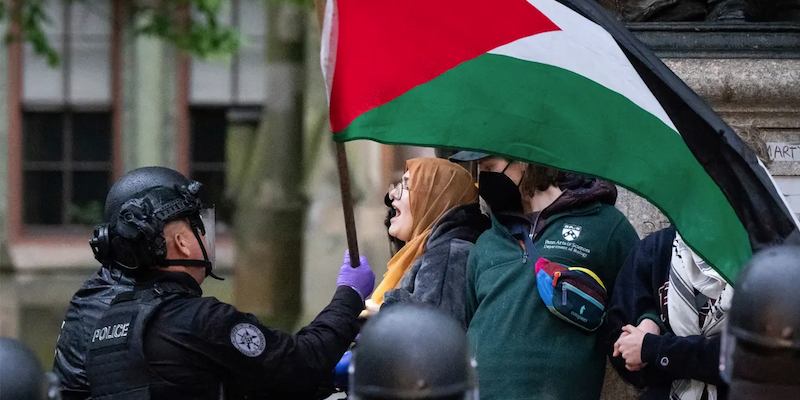
[To rise, she rises, I rise, we rise, an uprising]
لا يقيم العزيز في البلد السهل ولا ينفع الذليل النجاء
The noble never reside in easy lands,
and flight will not avail the lowly
This is a line of poetry by the Arab poet al-Harith ibn Hilliza, composed more than 1400 years ago. This is the tradition to which Palestine and Palestinian literature belong. Life, never easy for the noble and the just, is not worth living without dignity, he tells us. The line has been ringing in my ears for the past ten months. How difficult and treacherous our paths are, always, within this country and its institutions. We who strive to study Arabic literature with integrity. We who refuse to distort ourselves into the roles assigned to us by the racist tokenizing system of American academia. We who are perpetual guests in our fields of expertise, native informants, colorful faces to revamp the image of the colonial enterprise. We, the ceaselessly other, the continuously suspect.
*
November 2023
“But you do medieval Arabic literature so well. Why not focus on that?”
As we settled into our chairs around the square table, all of us probably regretted the choice of room. One of the walls was all glass and whoever passed by in the hallway could see us, as if on a screen. The tension was palpable. This was one of many meetings in which colleagues at my university tried to grapple with the horrific events of that past academic year by trying to salvage some semblance of collegiality. Since the Palestine Writes Festival and the horrors which occurred in October, “things were not right,” they’d say. They missed the way things used to be in our department—the pleasantness, the civility. We didn’t necessarily know each other well on a personal level, but at least we got along. Things always work better when we “leave our activism at home” is something I heard often. If only we could shut the world out and just focus on our “intellectual interests.”
“But, you know, Palestine is at the center of my intellectual interests,” I found myself saying to a group of colleagues one morning in November 2023. “I helped organize a literary festival. I was doing my academic and intellectual duty. I was celebrating Arabic literature. And my life was ruined because of it.” I could have gone on to remind my colleagues of things they already knew. How my family had received threats, how my partner Ahmad, a Palestinian poet, was advised to stay off campus for security reasons. How, at an institution intricately toing the lines of its donors’ interests, its commitment to protect only certain types of speech, and its adamant weaponization of all types of hate, being a Palestinian with a voice and a stand against genocide was too controversial.
I could have reminded them of the campaigns calling for our termination, even our deportation, which were popping up online. Some of these campaigns were being circulated by students at “our” university, students who are, unlike their pro-Palestinian peers, free to bully and terrorize as they wish. I could have reminded them of the death toll in Gaza (no, not the death toll, the cold-blooded murder toll). I could have read to them the headlines from that day which were etched in my mind. Israel was turning Gaza’s hospitals into graveyards. The word Shifa was haunting me that morning. Maybe they didn’t know all this, and I didn’t want to agitate more. My face was getting red, my temples throbbing, and my colleagues were already getting emotional and defensive. I tried to compose myself behind the phrase: “But Palestinian Literature is at the center of my intellectual interest.” They stared at me for a moment, and I truly believe they wanted to say something sympathetic, flattering even. They were sincere but, above it all, they were hurt. Their world was shaken. They were the injured ones, and I was the one who ruined things “as they were.” And then I heard: “But you do medieval Arabic literature so well. Why not focus on that?”
We are told that their lives, their deaths, even their literature does not necessarily fall within the purview of our intellectual interests.
I don’t remember what happened after that, but the words rang in my ears for days, a wounding reminder of my dispensability in that system. I and everything I do—my body, my mind, my health, my family, my work, my intellectual contribution, the centuries of literature to which I have dedicated my life—must all fit nicely into an arrangement designed for others’ benefit, others’ vanity, others’ comfort. As an Arab scholar of Arabic literature in the US, I have very few choices. I can either be a tool of the very system that objectifies me, exoticizes me, and is not willing to bat an eye when my entire culture is being exterminated, or else I am a threat. Not even a threat. I am a nuisance, a disturbance in the tranquil world of academics who are content to poke at the dead corpse of the other culture they study with a stick and call it “research” and “intellectual rigor.”
When over 40,000 Palestinians have been steadily exterminated for almost a year, after an entire people have been ethnically cleansed for 76 years, we are still expected to be silent. We are told that their lives, their deaths, even their literature does not necessarily fall within the purview of our intellectual interests. We are expected to be good academics, which means hypocrites and opportunists.
Something is wrong with me, and it warranted an intervention from my distressed colleagues. Why can’t I appreciate what I have? A solid excuse for apathy, for self-preservation (and all in the service of the collective peace of mind, of course).
It’s strange how the mind works, how self-sabotaging the survivor becomes, and how dark and winding the paths ahead seem.
*
February 1986
…at gunpoint with my back against the wall.
I was five years old, held at gunpoint with my back against the wall. It was winter break. I stood between my mother on one side and my little brother Ali on the other. We had come to our village in South Lebanon, as we always did, to spend the week of vacation with my grandparents. It was a crisp sunny day, and I stood at gunpoint with my back was against the wall. I was five, and because the soldier didn’t hold his rifle up, but let it slouch in his arms, I stood looking straight into the long dark barrel.
He moved up and down the line. He had led us all out of the house, the women and children, and yelled at us in his broken Arabic to stand up against the wall: my grandmother, my mother, my aunt, two neighbors who were sheltering with us, Ali, and I. Other soldiers were rampaging through the house. We later saw that they had slit open every pillow and every mattress. I wondered then what it was they were looking for in our sleep, in our dreams. We later saw that they had taken everything out of the fridge. The eggs were smashed. The fruit strewn on the floor was bitten into. The soldier charged with guarding us could not have been more than 18 years old and we stood there at the mercy of his judgement, his whims, perhaps even his fears.
This was an Israeli incursion into south Lebanon in 1988. It wasn’t one of the major escalations, but a “minor” invasion by which they went into south Lebanon, beyond the parts which it already occupied, to undertake a “precise” mission. They occupied our village for seven days. They kidnapped young men, blew up a house, and terrorized the village and the surrounding area.
I remember his hand shaking as he opened the front door and stood waiting for the Israeli commander and his soldiers to make it across the garden.
Growing up, I would return to these seven days in my memory. I liked to recall the “adventure” of that winter break. I’d ask my grandfather to tell me what happened when they led him and all the other men to the mosque, their hands raised above their heads. I’d ask my mother to confirm my memory of all the strangers who had to stay with us at my grandparents’ house because the roads were blocked. They were a group of men and women from the neighboring villages. One of them was a middle-aged man who smoked constantly. When the threat of a raid passed, he’d relax and become funny. He didn’t tell stories or jokes, but he had a way of adding a punchline to conversations.
I also remembered how terrified my grandfather was, a handheld radio at his ear all the time. He felt responsible for everyone, the family and the strangers in the house, but couldn’t hide the panicked look on his face. I remember his hand shaking as he opened the front door and stood waiting for the Israeli commander and his soldiers to make it across the garden. It would start with the commander asking my grandfather a few questions in Arabic and would always end with his soldiers turning the whole house upside down. Every single time.
But as many times as I had replayed the events of those seven days under Israeli occupation in my mind, the scene at the wall was always blacked out. It must have been so traumatizing that my five-year-old self stored it in a different place, separate from where I liked to remember the “adventure” of life under occupation.
That changed on September 20th, 2023. I sat in a long dark room. The lights went down, and the chatter subsided. The heads all turned to the screen. We were there to watch Darin Sallam’s Farha, a beautiful, harrowing film based on the life of her great grandmother, a Nakba survivor. In the film, Farha’s father locks her in a room to keep her safe and goes out to see what was going on. She ends up watching the Nakba unfold through a keyhole, before she escapes and walks all the way to a refugee camp in Syria, where she spends the rest of her life. The film allows us to experience Farha’s days in the room, as Palestine is being ravished and stolen outside. In one scene, a displaced family wanders into the yard. Farha watches as the armed Zionist men stand the mother, the father, and the young children up against the wall and shoot them. Only the newborn is left alive, left for one of the young Zionist soldiers to dispense with. The soldier couldn’t have been more than 18 years old. The Palestinian baby was left at the mercy of his judgement, his whims, perhaps even his fears.
I couldn’t breathe. A memory I didn’t know I had suddenly surfaced. I looked straight into the rifle. I saw the blue eyes at the end of the long black barrel. I heard the racket in the background. My heart stopped. I was seven and my back was against the wall.
It’s strange how the mind tricks itself, how scarring survival is, and how dark and deep the corridors of memory are.
*
July 2024
“Yes. No, of course not!”
Hate and threats have been coming by email and on social media for months, but yesterday, a letter came in the mail to my office. The advice is to keep a detailed record. Here’s my record keeping from that day:
The officer enters my office. He says he was sorry. “Professors are receiving them on both sides”.
“Both sides? There are “both sides” to this?” I say. “Yes. No, of course not,” he says.
He takes my information, my phone number, and pictures of the letter with his phone. He gives me his name, badge number, and a case number. He walks to the end of the hall, then comes back, smiling: “Sorry! I also need your birth date.” I give him my birthday. We promise each other to try and have a good weekend.
I leave the office and get in the car. He calls me (he has my number now) and says his boss wants him to take the letter. So, I drive back, and we ride the elevator up to my office together. He says: “I’m not trying to downplay this but there is no direct threat of physical harm. That’s when they usually ask for the letter.” He was trying to explain to me why he didn’t take it in the first time, I guess. “Probably just some kid with a printer,” I consider saying, to help him out, but then I get stuck on the thought of American teenagers with printers and guns. I say nothing. We walk into my office. I take the letter out of a drawer and look up to find him putting on a blue glove. “So, gloves and all?” I say. He laughs silently under his breath. We walk out and ride the elevator back down together. He asks me if I’m from the mid-west (because of my area code). I say that’s where I did my graduate work. He says he went to school there too. “But I’m originally from Lebanon,” I remind him. “Yes, of course,” he says. He gets off and waits for me. I tell him that I’ll ride the elevator one more floor down to my car. “Have a good weekend” he insists and walks away.
I can only hope the university will have the decency and the courage to stand up and defend both academic freedom and its own faculty.
In the car, I get a call for from another university official, higher up this time. She and I had spoken many times before on the phone. She tells me she’s sorry and that I should know they are thinking of me. She knows that the officer came and took the letter. They will investigate, maybe lift fingerprints but it’s hard to say with these things, she tells me.
She’d like to meet with me in person at some point for coffee or tea and to go over a security plan even if only psychological. A psychological security plan. She’s worked with people with “all sorts of trauma,” she assures me. “We can sometimes train our minds and hearts. It helps if we can remember which song puts us in the right place or who will pick up when we call.” She also just thinks it’s important that we meet in person before the next semester begins. “I’d like that,” I say. If only I could be taught to “train” my heart and mind in a time of genocide, to get them to cooperate with the university’s interests and serve the welfare of my department’s fragile ecosystem of collegiality and thinly veiled racism. Wouldn’t that be something!
It’s strange how the mind tricks itself, how scarring survival is, and how dark and winding the corridors of trauma are.
*
August 2024
when a bee stings you, when you wake up from a terrible nightmare, when you are crushed by decades of oppression, racism, apartheid, apathy, and injustice.
It’s my birthday. Nothing to celebrate. More than 40,000 friends, family, and kin have been murdered in Gaza, over 15,000 of them children. I take the train to DC. Ahmad has a poetry reading. I feel blessed to sit in the intimate audience and listen to him read from his book Border Wisdom—poems that transcend borders, barbed wire, languages, and the valley of silence from beyond which our dead loved ones look and listen.
I get a phone call from my lawyer. The Congressional Committee on Education and the Workplace, the same committee that has been bullying universities to crack down on free speech, the same committee that has been weaponizing antisemitism in the most vile—and antisemitic—ways in order to silence anti-genocide speech, the one that peddles lies and insists on the false conflation of Judaism and Zionism, is now interested in me personally. They have written to my university “requesting” my CV, my syllabi, emails and other Palestine-related communications.
While I will certainly not cooperate with this ridiculously misguided and arrogant “request,” I have no idea to what extent the university will give in to this bullying. I can only hope the university will have the decency and the courage to stand up and defend both academic freedom and its own faculty. So many professors all over the country have been intimidated, punished, and harassed for speaking out in support of Palestinians. This is a moment of reckoning for freedom of thought, in this country and throughout the world. When those who speak out in defense of the oppressed become targets, and those who spew hate have the right to harass and bully with impunity, then what is at stake is the very soul of our universities.
*
I am a scholar and a student of the Arabic poetic tradition. I study poets from Imru’ al-Qays to Mahmoud Darwish, from al-Samaw’al to Hiba Abu Nada. I am not willing to chop up this tradition into palatable and digestible bites. I will not truncate a poem if the ending makes you uncomfortable. I will not interrupt a poet’s conversation with their ancestors just because your Arabic skills are inadequate. I will not reframe myself and my language for your purposes. I will not purge my tongue of words that scare you because you don’t understand them.
There is no hope for us as a human race if we do not confront the double standards, the deep-seated racism of all our structures of life.
We can’t claim to be true humanists unless we enter the apprenticeship of the language and literary tradition we study as a way of seeing, a method of thought, a manner of existing and navigating the world. Gaza is not a subject to be chosen or dismissed. Its writers and artists are not bait for the next grant or fellowship. Its murdered children not material for an upcoming ethnographic study, a forthcoming anthology or art installation or digital humanities project. Gaza 2023 is a counterpoint in history, the end of the world as we know it. Nothing should ever be the same after this.
There is no hope for us as a human race if we do not confront the double standards, the deep-seated racism of all our structures of life, our delusional notions of democracy, human rights, peace, empathy, solidarity and so on. They are all hypocrisies if they include some and exclude others. And there is no exclusion more glaring and damning than what the world has now accepted as the “Palestine exception.” There is no hope for us if we do not heed the reckoning Gaza is calling us to now, the reckoning Palestine has been calling us to for the past 76 years.
And in the ivory towers of academia, there is no direction forward without a recognition of the exploitative nature of our institutions and their complicity in the violence we are now witnessing against Palestine and the Arabic tradition to which it belongs. This Genocide is calling us to wake up, to shake off the implicit and now blatantly explicit limits on our lives and our work. Innocent blood is demanding that we affirm our right to advocate for and defend the culture we study and its people as human beings before we even dare study them as creatives and intellectuals and mine their history and culture for our own profit.
And if the committee does get hold of my information, let them consider it a privilege to look through my CV, a record of which I am extremely proud. As they comb through my syllabi, I can only hope that they recognize the privilege of this invitation to the vast and generous world of Arabic poetry. As my students, this would be their chance to learn from Palestinian literature what life is, what dignity means, and what resistance to injustice looks like.
And as they dig into my information, violating my privacy and my First Amendment rights, maybe they will learn one word in Arabic, a word that to many oppressed people here in the US and across the globe means hope and agency. It is a noun from the verb iftaʿala, form 8 of the root verb n-f-d̩ (an Arabic dictionary entry I highly recommend). It is what you do when a bee stings you. It is how you wake up from a terrible nightmare. It is the only thing you can do when you are crushed by decades of oppression, racism, apartheid, apathy, and injustice:
Intifada.