





























Self-Portrait as a Tangle of Weeds by Geetha Iyer
I am the sort of writer who will put a tree in any piece of writing to improve it. But I am also the sort of writer who ignores houseplants. This contradiction in interests twisted upon itself some years ago when I moved to Panama newly married, following a spouse who worked as a tropical tree scientist. At some point during that first year, my writing projects fell apart. I was unemployed save for bit jobs here and there. In May, I decided, despite everything I knew about myself, to set up a small tropical garden in front of my house, my own plot of curated paradise, full of butterfly-attracting flower bushes, vines and ferns that tumbled in interesting patterns over the lips of their pots, succulents, orchids, club mosses whose leaves shone the oily blue of peacocks, beans, squashes, tomatoes, peppers, and a moringa tree to remind me of home.
We can laugh at my hubris now because I am no longer as sad as I was back then, and sadness is the only condition under which I would resort to gardening. Plants are just not compelling enough. They do not cry out for attention. They do not scratch behind their ears or fold their wings into pleats. They could have been painted onto the walls for all that I cared about them.
In Panama, we lived in a row house on Cerro Ancon, a nature reserve on a hill formerly quarried by the American military to build the Panama Canal, now used as a recreational and biocultural landmark by Panamanians and tourists alike. When I looked out the windows facing east, it was to a view of trees that mounded up the hill up to the summit, from which the flag of Panama fluttered, around which vultures spiraled, over which clouds would gather to rain down. Our west-facing windows were a wall of variegated greens, dense rainforest that made mockery of any sense of categorization—vines and trees and epiphytes and lianas that grew tangled upon and through each other’s limbs and leaves.
There was some landscaping around our house. A shallow trench separated our driveway from our neighbors on the left, and in front we shared a small rectangular plot with our neighbor on the right. All told, this might have been seven square meters of earth hemmed in by concrete, prefilled with plants that looked like swords, plants that looked like bleeding hearts, a short, palm-like tree that my spouse told me was a cycad, a birds-of-paradise hedgerow, and some grass no one had planted, all left to tend to themselves when we moved in.
All this was green enough to suit my passive interests. Not so, my spouse. In January of our first year living together, he stuck toothpicks into a couple of avocado seeds left over from lunch. He intended to germinate them in cups of water on the windowsill. When the seeds split down the middle and put out tap roots and their first pairs of leaves, I condemned the entire project. We intended to leave Panama within a year, I said. Trees lived for decades—we were being irresponsible.
They’re beautiful, he said to me. They might bear fruit. What’s wrong with watching them grow?
They’re sessile organisms, I said. They’re boring. I refused to look after them. This is, in fact, a subclause of our marriage contract, that I would have nothing to do with the tending of plants. I did not participate in the avocados’ transfer into pots, or their move downstairs to catch sun by the front door. I was too busy. I had a novel to write. I told myself that for a few months.
May, and the rain season pulled us under its blankets overnight, as if to make a clean break with summer. Though Panama lies eight degrees north of the Equator, its borrowing of Southern Hemisphere terminology reflects reality—December through April is summer, the dry season, a hot and gusty time for picnics on the beach and lolling about parks in flip flops. Winter is rainfall, cloud cover, wet sneakers, and the smeary softness of mold upon every surface.
There is neither glamor nor financial sense in choosing a profession in the arts.
Initially, I marveled at the sheer weight and clamor of the daily downpours, a superabundance of water unlike anything I had grown up with. I had always wanted to live somewhere that felt so alive, so richly biodiverse. I should have been so thrilled. So grateful.
But the lulls between storms began to haunt me. There was no wind, it seemed. From every window we could see myriad leaf forms from undergrowth into the treetops, from simple lobes to compound clusters, skinny blades to elephant-eared flags, all rain-fed and turgid, and still. Not a breeze to riffle the leaves, not even a whisper to flick a drop of moisture off a leaf tip. Humidity in a rainforest can seem so thick as to be solid, gluing everything in its place. It felt absurd, watching a vine dangling off a branch thirty meters from the ground, free to sway but unable to turn for lack of wind. Between the rains, the forest held its breath, heavy in the throat.
And I, too, was suspended. There is neither glamor nor financial sense in choosing a profession in the arts. You do it because you cannot imagine doing anything else, and in between those sporadic bouts of validation that come from having some ditty published here and there, the work is lonely. I would sit with my internal editor for hours on end, and we went back and forth on the quality of this sentence versus the next, the inadequacies of my daily fruit and fluid consumption, and the worth of my life in general. It was in self-loathing that I woke up in the mornings, with which I sat down to write or argue with myself, with which I chose what to wear and where to go. It was in aimlessness that I cut into a tomato for lunch one day, only to find the flesh around its seeds glowing green.
My mother has been a gardener for as long as I can remember. This is no easy feat, for we lived in Dubai when I was young, where temperatures hit the mid-forties Celsius each summer, and the earth is sand, unable to hold moisture and nutrients. But my mother is a force of nature. Once, she hitched a leg over the bedroom window of our first apartment and disappeared onto a narrow concrete awning over the street below. I was perhaps four years old, and desperately wanted to follow her. I thought I might never see her again, as children sometimes do. She reappeared, as mothers generally do, clutching three small, ripe tomatoes from the plant she had grown from seed in a little pot outside. I do not know how often she had gone out to water it, only that she returned that day, like magic, bearing fruit.
In Dubai, we lived in a series of apartments that my mother filled with a growing collection of house plants. She dusted their leaves, probed the soil around their stems for moisture and airiness, pruned them, and even spoke to them. By the time my parents could afford a house with a garden, my mother had honed the skills she had developed on house plants into a vision of orderly abundance. She selected outdoor plants for their heat tolerance—palms and bougainvillea, succulent ground cover, citrus trees, rosemary, aloe, and a curry tree grown from a sapling procured in India. Among these hardier plants she cultivated fruits and vegetables like eggplants, figs, okra, pomegranates, and tomatoes, taking care to plant the tenderest of these during what passed for winter in Dubai, and watering them judiciously to cope with the heat.
There are photos of our garden taken over ten years that illustrate the fervor of my mother’s caregiving—what started as a sand plot dotted with bare-boned shrubs and spindly trees turned into an oasis, a profusion of color and productivity, dappled shade over the footpaths and veranda, the little lawn meticulously picked clear of leaf litter, every plant trembling with flowers, fruit, and seed pods, a-burr with insects and birds who sought, like us, the solace and sustenance of vegetation.
Perhaps I was reminded of my mother when I cut into the tomato that became the first of my Panama gardening projects. Green is the color of sunlight spit out by cellular machinery that has no use for it. It means that microscopic biochemical processes are converting water and carbon dioxide into sugars. It means cell division, height and girth and inflorescence. More than anything, the vivid green of those tomato seeds signified something I had forgotten. That even if I felt stuck, so much else in this world was yearning for a chance to live that I might as well pay attention, to pass the time.
After the tomatoes came squashes. Chilies, then beans. Onions and garlic I pilfered from groceries. An assortment of seeds from the spice cabinet and some handfuls of lentils from the larder. Not all these germinations were successful, and eventually I began to buy herbs and vegetables from plant nurseries and supermarkets to supplement my efforts. A cluster of cheap pots. Sacks of forest soil. And then, ornamental plants, for the jazziness of their leaves or the promise of their flowers. A silver lace fern, perennial peanut with merry yellow button-blooms, a feathery club moss with leaves that shone blue when the sun caught them. When my in-laws came to visit, they mistook my sudden interest in plants for something sustainable and gifted us three varieties of lantana and a weeping firecracker plant to attract hummingbirds and butterflies to their traffic-light blossoms.
A certain madness can seize a person driven by desperation. I did not know why I was doing it at the time but something had short-circuited inside me and I now lived for these plants. Consider the squashes, for example, all writhing stems and saucer-sized leaves, with flowers bright and floppy as summer skirts. The whip-thin tendrils they put out from each growth node were touch-sensitive and would catch and curl upon anything. I would come out to water the pots and note how they winched themselves into corkscrews around bamboo stakes, a rope trellis, twigs of neighboring shrubs, even each other. By the next morning, their spiral grips would have tightened into green fists, pulling the plant further up and out of its root bed, a creature heaving itself out of the mud to seize the landscape around it.
For every failed starter pot, the squashes put out new growth, and that verve began to replace my emptiness. No, I was not talking to my plants, but I did anthropomorphize them. That is to say, I projected upon them my sense of self. I had become a sessile organism since moving to Panama. I was an uprooted transplant, far from family, disconnected by time and distance from my closest friends. I missed my friends so much that I had resolved not to make any more for fear of the wrenching separation that I knew would come when my spouse and I eventually moved countries again.
So much else in this world was yearning for a chance to live that I might as well pay attention, to pass the time.
The great myth of my generation is that technology connects us even though we no longer stay in our hometowns, because we must seek an education and a living, and the specifics of what we wanted were never guaranteed in the places we were born or raised. But I have yet to have a satisfying cup of tea with a friend over Skype. I have yet to know, let alone alleviate, in the long time between text messages, the ache of a friend’s spiraling dissatisfaction with her life, because I was not there to read her body language. I have yet to write an email to my mother that feels like it does when we speak in person, in a crude alloy of our mixed languages—English and Tamil, inflected with Hindi, punctuated with an emotional register beyond the scope of an emoji panel.
There are people I have not spoken with or written to in years because every time I try to do so online, I am overwhelmed. In a meeting face-to-face we would fill up the time with things of no consequence—the pettiness of a neighbor, the food strikes our cats were on, the snazziness of a new pair of shoes. But what takes precedence now is the desire to say, I miss you, without collapsing into heartbreak. Because there is nothing mundane left to fill the space between us. Instead, we are all just throbbing bundles of nerves who may just be doing alright, but are so often not, and where are the words to explain that state of being without devolving into the most vulnerable versions of ourselves, pixelated and jittery, our voices shot through with static. Where is the nuance in that?
One day, I came out to my squash pot to find the leaves on some of the vines wilted and yellow. I did not think much of it at the time—lack of nutrients, perhaps, or localized shock to one of the stems. But the next day, the yellow leaves were shriveling, and the day after that, they had turned brown. My squashes were dying from their extremities inward and I could not figure out what was causing it. I did some Googling. It might have been stem-boring beetle grubs. It could have been a fungal pathogen. There are kinds of sap-sucking bugs that can inject viruses into plants the same way mosquitoes do, had I considered that?
It became a moot point to try and figure out what was happening to my squashes because a couple of weeks later, they had been weed-whacked out of existence: a miscommunication from our landlord to the handyman who subcontracted the guy with the gas-powered whacker to trim the hedgerow in the front of the house. He had not considered that I had wanted my vines to wander aimlessly, that I had wanted to follow after them.
I did not weep, though I did mourn. But the thing is, I also felt a strange relief. I had never wanted to look after plants in the first place and it had taken me a long time to admit to myself that I was doing so only because I was depressed. I was attempting to keep something under control, and now I could be released from that illusion. I watched the nubbins of my squash stems desiccate and noted what grew up in their stead. I wasn’t expecting much, but the pots went wild, now that I wasn’t supervising them.
The biggest problem I see with maintaining a garden in the tropics—even a few humble plant pots outside the front door—is that it is only through force that one might maintain a boundary between the natural world and the built one. So long as there is sun enough, and rain enough, and life, everywhere ecstatic moving life tucking tendrils and dropping seed-laden droppings into fresh soil, gnawing through roots and cutting windows into leaves and turning corpses into nurseries and nurseries into graveyards, it is entirely possible for a fountain of squash vines to be replaced by a den of ferns blown in by spores. My tomatoes became entangled with a legume I didn’t recognize, its seed dormant in soil I had failed to weed. My orchids died and mosses grew in their stead. My club moss died and grasses colonized its pot.
I ceded command to natural forces. What would come would come, I thought. Within a year of my experiment in tropical gardening, almost nothing remained of what I had planted, and yet every pot overflowed with something that had come from elsewhere. How fabulous, I thought, this displacement. I do not have to tend to either myself or the plants around me, they shall just do what they will and I shall live, vicariously, through their efforts.
My plant pots thrived. My internal editor said I was growing and worshipping weeds but I preferred to call them volunteers because they had chosen these pots, these little neglects I left lying around my house. I took up plant identification, a feebler attempt at control that involved minimal effort, and a lot of reverse-image searching on Google. It was in Panama that I finally learned that globally, most house plants are tropical species, chosen because they would never drop their leaves in controlled indoor climates, even if outside it was blizzarding, or outside, it had not rained for eleven months. Half my mother’s house plants, and nearly half the food plants we ate, could trace their roots to Central or South America. Meanwhile, nearly half the ornamental outdoor plants I had grown and killed through negligence in Panama came from elsewhere in the tropics—Asian or African species chosen for aesthetics or, ironically, ease of growth.
The great myth of my generation is that technology connects us even though we no longer stay in our hometowns.
I am not sure which came first—sadness or the inability to write. My spouse’s job was renewed, and it became apparent we would live here indefinitely. So, a couple of years after moving to Panama, I adopted two kittens from my neighbors because I felt tired of living as if ready to blow away. I needed to commit to something alive that I would promise to take with me no matter where I went next. My spouse had legs and a passport, a sense of agency. But there, I thought to myself, following my kittens, those are my helpless little roots to tend. When they were old enough, I put harnesses and bright blue leashes on my cats and took them outside on walks. A single cat does not walk very far, and two cats will never walk in the same direction together, so I never left the perimeter of the row house on these excursions, and that suited me just fine. The cats took turns to press through the hedgerow of birds-of-paradise to nibble on unmown grasses. I stood between them, tugged gently on this leash or that to make sure they were always in my line of sight, never able to pounce on wildlife.
What does it mean to love plants—gardening, greenery, farming, parks, nature hikes, bouquets, pickling, tabletop hydroponics—when so much of what we do with plants is a pastiche of wild and untended nature? Everywhere I have lived, I’ve been surrounded by disturbance, amalgamations of the natural world in the form of planted, cultivated abundance. All plants are adapted for certain parts of the world—the particular challenges of their climate, the naturally occurring pests and pathogens in their ecosystems. Now, released from these origins, plants show up everywhere simply because someone loves them enough to let them be, regardless of whether they fit. In Dubai, a miniature fig tree at the dentist’s front desk, leaves glossy and ending in drip tips to let rain roll off as quickly as possible, so the plant could breathe—it will never rain in this office, but the fig’s leaves waterfall off the plant in emulation of a downpour. In Mumbai, tomatoes in everything—when my family once tried to cut back on how much we used to cook with, we fell into a funk, so deeply unheartened were we by food that did not run red and sour across our tongues. When I lived in the United States, Kentucky bluegrass painted across lawns in Michigan, Florida, Iowa, peppered with dandelions—one was a weed and the other a status symbol, and neither were eradicable now that they had put down their roots so extensively, now that their seeds were always in the wind.
And when I moved to Panama City—mangoes everywhere. I am not much of a fruit eater by nature but in Panama I wrote execrable poetry about what it meant to eat fresh mangoes so far from home. I picked them off street trees when they were still immature, green and tart as limes, with a resinous undertone that reminded me of pickles and also of the lengths that plants will go to, just to protect their tenderest parts from herbivory. Green mangoes fight your tongue—bitter, acidic, astringent sap that says, We are not for you.
Too bad, I thought, chewing them, You have become me now.
I didn’t belong here, this much I knew. The first inhabitants of this place we call Panama had other names for this region, other ideas of borders. Their descendants include the Naso, Emberá, Wounaan, Guna, Ngäbe, Buglé, and Bribri people. Spaniards claimed their lands. English pirates and Scottish mercenaries. The land became part of Colombia, before Americans helped it secede, only to then bisect the country to control the Canal, an artery of seafaring commerce. Panamanians today include descendants of Afro-Caribbeans who built the Canal and Chinese immigrants who built the railroad that flanked it.
I lived in a house that had been built, at first, as an American army barracks in the Canal Zone—its very rentability a function of that history, for how else does a newly married foreign couple find a home so centrally located in the city, where Panamanians commute two hours each way to work? Socioeconomics determined my ease of travel, my ability to choose a profession that paid sporadically, if at all. To watch, to wonder, to write, to edit, these were unearned privileges I squandered if I did not acknowledge their artifice. This is a painful realization to come to if you grow up loving words and how they sound off the page in your head. Was it any wonder, then, that I found it hard to write?
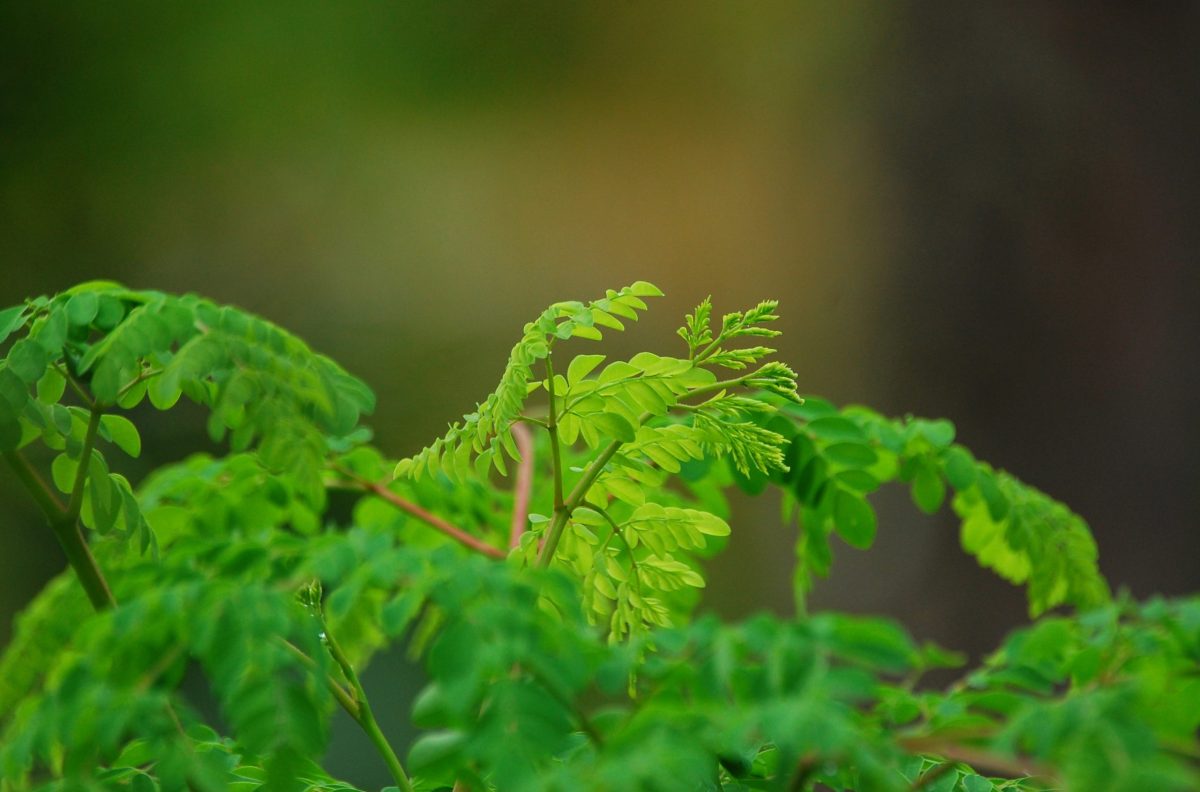
My only real success in tropical gardening was a moringa sapling my spouse brought home some time in our fourth year of living together, because I had told him so often that this was the source of my favorite food in the world. It was a tender thing, no more than a few delicate compound leaves on the end of a green stem. It could grow into a tree if I’d just let it. If I’d transplant it out of its pot. It could produce drumsticks—long, green, three-sided pods I could stew in tamarind broth, eat over rice, take me back home. I watched it grow in its pot with increasing fascination. Where all my other plants had failed, this one held on.
I am not sure which came first—sadness or the inability to write.
As with every other plant I had invested in, I began to project upon this spindly thing my entire identity. Moringa oleifera was a tree native to India, just like I was. Like me, it was unfussy about its living circumstances. Like me, it didn’t take itself too seriously, putting out copious branches from a slender, not-entirely upright stem. Unlike me, it grew tall—in fact, moringa trees grown for harvest are typically pruned short to reach their fruit. Like me, moringas were soft-wooded, easy to chop down. Like me, they would re-root wherever their broken stems touched ground.
It is unwise to plant non-native plants in a nature reserve, but when my moringa risked toppling over its pot, I gave in, found a shovel, forded my shapeless hedge of birds-of-paradise, and started to dig. The ground here was clay-rich and gummy, studded with rocks. Not a place for orchard trees, but the moringa, once planted in earth, flourished like no other plant I’d ever grown in a pot. Within a year its trunk was wide enough that my hands could not encircle it. It was a shaggy champion—unruly branches sprouting this way and that, reaching higher than the first-floor kitchen. It produced white flowers in little sprays. One year, at long last, it produced fruit. I picked them green. I made vatthalkozhumbu with them. I photo-documented the entire cooking process, astonished that such a thing could occur in a kitchen so far from Chennai, where this recipe was honed and taught to my grandmother, who could never have conceived of how far she would pass it on.
And yet I felt wracked with guilt whenever I looked at my moringa, ebullient in front of the house. I knew enough biology to understand that moringa possessed traits that lent themselves to weediness. It thrived despite nutrient-poor soils or low water availability. If its seed pods dried and snapped open, they could scatter oil-rich seeds to flutter, float, and root who knew where else. It regenerated from cuttings effortlessly.
When a large branch broke off our moringa in a rain storm, my spouse and I heaved it into the carport because I feared we would lose control of it if it resprouted. We took turns to saw the branch into armlength logs. The tree’s bark was thin-skinned and green underneath—meaning it could photosynthesize even without leaves. The logs sat in our carport, turgid as green beans. They put out shoot after desperate shoot from their sawn-off ends, from the nodes where we had snapped off their smaller branches. They tapped every inner reserve the tree had packed them with to give themselves another chance at life. We let the logs desiccate all the way through. It took months before they were truly dead.
Halfway up Cerro Ancon, this verdant forest island in the middle of Panama City, is an open, rocky cliff face. Not much can grow on bare rock exposed to sunlight, where the rain washes straight down. For the first years of my life in Panama, I took this to be just another feature of the landscape, no matter its discordance with the surrounding rainforest. It was only later that I realized that this was a scar—no, a gouging disfiguration—left over from American quarrying activities in the 1900s. Panamanians protested fervently to reclaim the Canal Zone from Americans. Memorial plaques on the summit of Cerro Ancon commemorate their fight for independence. Above my moringa, on the hill crest, the Panamanian flag waved. Below my moringa, I walked my cats on leashes because they were invasive species, and I would not have them killing native lizards or birds. And I was an Indian writer living in Panama off my Dutch spouse’s American income, stockpiling disenchantment with stories on my laptop that felt like lies. Was I not, as well, just a fucking weed?
I gave birth to a child, and a month later we moved from our home of five years to one further up the hill because its walls were built of brick, which the termites could not reclaim. In my final act of gardening, I chopped down the moringa tree to a stump, and dug up the root ball for good measure. My spouse borrowed a pick-up truck and we moved every gnarly root and hacked-down limb to the carport of our new house, to watch over them while they dried out. We froze some leaves for soup. We ate the last of the moringa pods.
At nine months, our child learned to walk, and we took her down the road to show her the old house. Our friends had moved in—Panamanian sisters with proper green thumbs. They had plant pots everywhere, growing herbs, flowering bushes, shrubs that produced fruits. Their cat and dog wandered among the pots and the birds-of-paradise hedge.
We had done a good job too, though. The moringa had not grown back. This is all I really wanted for myself, as well. To flourish for a while before I died. To nourish someone. To leave no greater trace.