
















.jpg "Clear Drop Soft Plastic Compactor Review: Eco Experiment")






















Key Takeaways
- Researchers found that deep sleep perception often coincides with immersive dreams or complete unconsciousness, while vague awareness leads to feeling less rested.
- The study linked brain activity, dream content, and subjective sleep perception, creating one of the largest datasets on this topic.
- Immersive dreaming may serve as a protective mechanism for sleep, maintaining a sense of disconnection from external disturbances.
- The quality of dreams, rather than mere presence, influences how deeply people feel they’ve slept, challenging traditional sleep theories.
- Future research may explore enhancing dream immersiveness to improve sleep quality in conditions like paradoxical insomnia.
Around 3 in the morning, something odd happens in the sleeping brain. The slow, synchronized waves that dominate early sleep begin to give way. High-frequency activity ticks upward. By every physiological measure the researchers could find, the brain is becoming more wakeful, not less. And yet, when the study participants were roused from bed and asked how deeply they had been sleeping, they reported feeling more deeply asleep than they had hours earlier. Not slightly more. Considerably more.
That contradiction sits at the heart of a new study from the IMT School for Advanced Studies in Lucca, published in PLOS Biology, and it turns out dreams might be the explanation.
For decades, the story of sleep depth seemed straightforward enough: the brain goes quiet, slow waves dominate, and the deeper the quiet, the more restorative the sleep. This is more or less what sleep staging captures, the progression from light N1 sleep down through N2 and into the slow-wave depths of N3, with each stage defined by increasingly synchronized, low-frequency brain rhythms. REM sleep, full of vivid dreaming and cortical activity that looks almost indistinguishable from wakefulness, was considered a sort of necessary interruption, not quite proper sleep. And yet people consistently report REM as feeling deep. Sleep researchers have noted this paradox for years without fully accounting for it.
Giulio Bernardi, a neuroscience professor at the IMT School and senior author of the new study, set out to probe it. His team focused on NREM2 sleep, the stage that makes up roughly half of a typical night and sits at an interesting middle ground: it has slow waves, but also plenty of variability in both brain activity and dream experience. Good territory, in other words, for trying to disentangle what actually makes sleep feel deep.
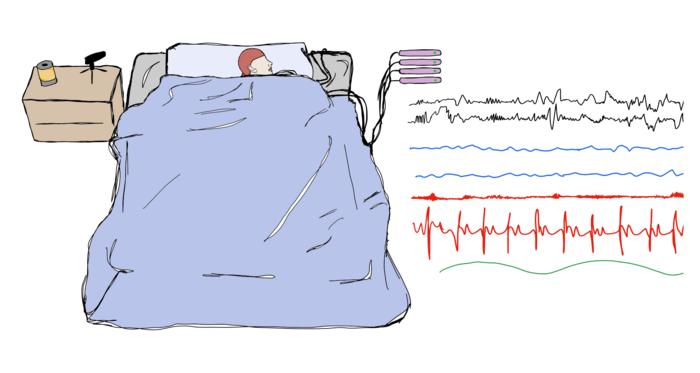
Across 196 overnight recordings from 44 healthy adults, each spending four nights in the lab wired to a 256-electrode EEG cap, the team collected more than 1,000 awakenings. Each time a participant was roused from NREM2, they reported what (if anything) they’d been experiencing just before the alarm, and rated how deeply they’d been sleeping. The result was one of the largest datasets ever assembled linking brain activity, dream content, and subjective sleep perception in a single controlled setting.
What emerged was, in a way, a hierarchy of sleep depth that nobody had quite anticipated. The people who reported the most vivid, immersive dreams, perceptual, sensory, sometimes bizarre, rated their sleep as deepest. So did those who reported nothing at all, complete unconsciousness. But the group in the middle, people who had a vague sense of presence or an awareness of time passing but no actual dream content, reported the shallowest sleep of all. “In other words, not all mental activity during sleep feels the same: the quality of the experience, especially how immersive it is, appears to be crucial,” Bernardi said. “This suggests that dreaming may reshape how brain activity is interpreted by the sleeper: the more immersive the dream, the deeper the sleep feels.”
Sleep trackers and lab recordings measure brain waves and body signals, but they can’t directly measure how immersive your dreams were. This research suggests that less vivid, more fragmentary dream experience, even during objectively normal sleep, may fail to create the subjective sense of deep disconnection from the world that restorative sleep requires. People with this pattern, sometimes called paradoxical insomnia, may be accurately reporting their experience rather than misperceiving it.
The picture is more nuanced than that. Vivid, immersive dreams and complete unconsciousness were both associated with the deepest perceived sleep in this study. What seems problematic is a middle state: a vague sense of presence or awareness without actual dream content, which was linked to the shallowest subjective sleep of all. The quality and immersiveness of whatever mental experience is happening matters more than simply whether dreaming occurs.
During vivid dreaming, the brain’s high-frequency activity, normally a marker of lighter sleep, seems to get absorbed into generating the dream itself rather than registering as wakefulness. The dream creates a rich internal environment that effectively decouples the brain from external signals, so the increased cortical activity doesn’t translate into a sense of being less asleep. Think of it as the brain being busy in a direction that keeps the sleeper anchored in sleep rather than pulling them toward waking.
That’s exactly what researchers are now asking. This study is correlational, so it can’t yet show that making dreams more immersive would improve subjective sleep quality, but it does provide a plausible mechanism worth testing. Controlled sensory stimulation during sleep, certain pharmacological approaches, or cognitive techniques that influence dream content are all candidate methods, and some are already being studied in adjacent fields.
That reshaping, it turns out, is literal. The team found that during NREM2, high-frequency brain activity normally predicts shallower subjective sleep, and this held up cleanly when participants reported no dream. But when they’d been having vivid dreams, the relationship weakened considerably. Wake-like cortical activation, which would ordinarily correspond to lighter perceived sleep, seemed to matter less when the brain was also generating immersive inner experience. The dream, essentially, was absorbing the brain’s alertness, redirecting it inward rather than outward.
There’s an intriguing time-of-night dimension to this. As the hours pass, homeostatic sleep pressure, the biological need for sleep that builds across the day, steadily declines. Subjective sleepiness tracks this faithfully: participants reported feeling groggier in the early morning hours and less so toward dawn. You’d expect perceived sleep depth to follow the same arc downward. It doesn’t. Instead, it kept climbing through the second half of the night, inversely correlated with actual physiological sleep need. The factor that tracked the rise in perceived depth was dream immersiveness: dreams became progressively richer and more vivid as the night wore on, and this correlated closely with participants feeling like they’d been in deeper sleep.
Bernardi and his team think immersive dreaming might be doing something close to what Freud, with characteristically grand intuition if not experimental rigour, proposed more than a century ago: acting as a guardian of sleep. The idea is that dreams maintain a sense of disconnection from the external world, creating an internal environment so absorbing that the brain effectively ignores perturbations, both from outside and from its own fluctuating physiology. Not merely a byproduct of neural reactivation during sleep, then, but an active mechanism for sustaining sleep’s subjective texture.
The clinical implications are worth dwelling on. There’s a well-recognised phenomenon called paradoxical insomnia, or sleep state misperception, in which people report sleeping terribly despite polysomnographic records showing apparently normal sleep architecture. It’s a frustrating condition, both for patients and clinicians, precisely because the objective measures look fine. The new findings suggest one candidate explanation: the quality of dream experience. Less immersive, more fragmentary or thought-like dreaming, which some insomnia patients show, might simply fail to provide the sense of deep disconnection that subjectively satisfying sleep requires. “Alterations in dreaming could partly explain why some people feel they sleep poorly even when standard objective sleep indices appear normal,” Bernardi said. “Rather than being merely a by-product of sleep, immersive dreams may help buffer fluctuations in brain activity and sustain the subjective experience of being deeply asleep.”
The study is correlational, and the team is careful about that. What it can’t yet tell us is whether you could actually improve someone’s subjective sleep quality by nudging their dreams toward greater immersiveness, through sensory stimulation during sleep, say, or via other interventions. That’s the next question. But the implication is at least clear enough: the brain’s capacity to generate rich inner worlds during sleep might be doing rather more work than we realised, holding the subjective architecture of sleep together even as the physiological underpinnings quietly unravel toward morning.
DOI / Source: https://doi.org/10.1371/journal.pbio.3003683
Quick Note Before You Read On.
ScienceBlog.com has no paywalls, no sponsored content, and no agenda beyond getting the science right. Every story here is written to inform, not to impress an advertiser or push a point of view.
Good science journalism takes time — reading the papers, checking the claims, finding researchers who can put findings in context. We do that work because we think it matters.
If you find this site useful, consider supporting it with a donation. Even a few dollars a month helps keep the coverage independent and free for everyone.
Related