








































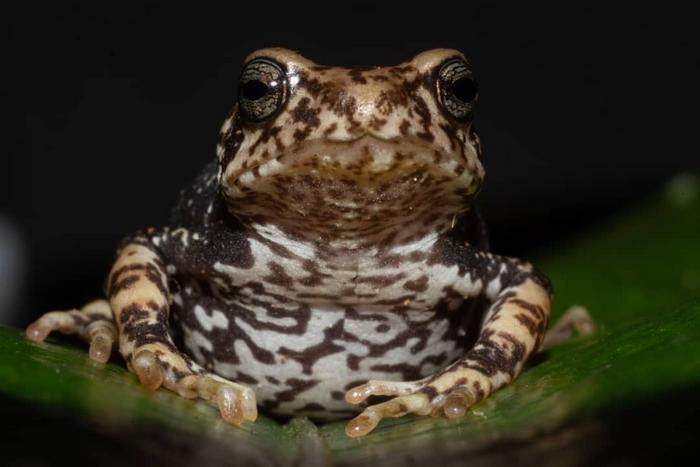
High on the misty slopes of Tanzania, a toad the size of a thumb pads along a wet leaf, its skin a patchwork of tawny browns and ash gray. No ponds are needed here. Instead of laying strings of eggs, the female toad will deliver tiny, fully formed toadlets that hop off into the forest. That quiet switch in strategy, hiding in plain sight, has just expanded by three species.
An international team working across museums and mountains has described three new live-bearing tree toads in the genus Nectophrynoides, all from the Eastern Arc Mountains. Each species gives birth to live young, a reproductive feat vanishingly rare among frogs and toads. The researchers stitched together modern fieldwork with genetics extracted from century old specimens, a detective story told through preserved tissues, field notebooks, and the calls of males recorded on foggy nights.
“It’s common knowledge that frogs grow from tadpoles, it’s one of the classic metamorphosis paradigms in biology.”
That reminder, from a study coauthor, is there to be artfully dismantled. In reality, frog reproduction is a kaleidoscope: foam nests, egg guarding, mouth and back brooding, and in this case, internal fertilization followed by birth of toadlets. The new paper formalizes three species in the Nectophrynoides viviparus complex: N. luhomeroensis from the high Luhomero peaks, N. uhehe from multiple Udzungwa forest fragments, and N. saliensis from Mahenge’s Sali Forest Reserve. Each has distinct body proportions and parotoid gland shapes, and each tells a slightly different story about life in fragmented montane habitats.
Old jars, new DNA, and a family tree
The twist came from museomics, a set of methods for coaxing short DNA fragments from historical specimens. The team carefully sampled name bearing types collected around 1900 and sequenced mitochondrial markers, then compared those to modern samples and the acoustic signatures of calling males. The result was a clarified phylogeny that restricts N. viviparus sensu stricto to the Southern Highlands and elevates three Eastern Arc lineages to full species. Where textbooks once saw one widespread species, the data now reveal a cluster of micro endemics.
One reason this matters is practical: conservation status hinges on true ranges. What looked like a resilient generalist turns out, in part, to be a set of local specialists. The authors estimate very small areas of occupancy for two of the newcomers. For N. saliensis in Sali Forest Reserve, the known range is measured in tens of square kilometers. For N. luhomeroensis, even within a national park, suitable habitat forms an island of grassland forest mosaic perched at 2,200 to 2,500 meters above sea level.
“Live-bearing is exceptionally rare among frogs and toads, practiced by less than 1% of frogs species, making these new species exceptionally interesting.”
That rarity is more than a curiosity. Live birth is a high stakes bet on survival away from streams and pools. It depends on intact forest canopies that keep humidity high and temperatures stable, on leaf litter that does not dry to a crisp, and on a food web that still hums. In places where logging, fire, or agriculture nibble at the edges, those bets get riskier. The authors point to deforestation, mining pressures, and climate change as looming threats across the Udzungwa and Mahenge ranges.
Three names, one urgent theme
N. uhehe is the hefty one, with large kidney shaped parotoid glands and a body size that can top 50 millimeters. It is scattered across several forest reserves, which sounds comforting until you map how many of those fragments have shrunk. N. luhomeroensis is smaller and rhomboid of gland, a high elevation specialist that may already be living on the climatic edge. N. saliensis, spearheaded of gland and subtle in limb glands, is known only from Sali Forest Reserve, a small and vulnerable patchwork of submontane forest and wetlands.
The paper’s taxonomic cleanup may ripple far beyond museum shelves. Red List categories that once leaned on a single, broad distribution will have to be recalculated. If history is a guide, at least one of these newly named species will end up threatened or worse. That would be a grim club to join. One viviparous relative, Nectophrynoides asperginis from the Kihansi Gorge, is already extinct in the wild.
Still, there is a hopeful undertone. By naming what exists, the researchers give park managers, communities, and policymakers something concrete to protect. The toadlets do the rest. Imagine a handful of tiny, warty new arrivals riding the sheen of a nocturnal leaf, the forest wet and loud around them. It is hard not to root for a strategy that skips the puddle and goes straight to a hop.
Vertebrate Zoology: 10.3897/vz.75.e167008
Related
Discover more from Wild Science
Subscribe to get the latest posts sent to your email.