







.jpg "What It’s Like to Have a Brain Implant for 5 Years")







.jpg "Angélique Kidjo Announces Album With Pharrell, Nile Rodgers, and More")















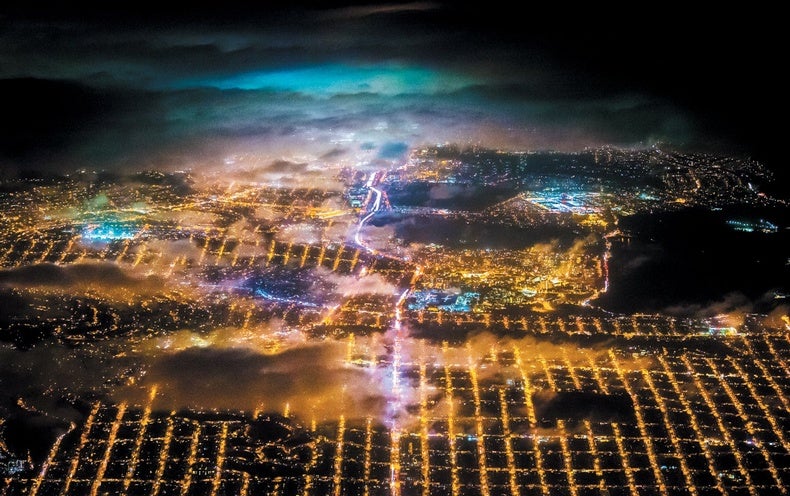
Darkness was falling at Kitt Peak National Observatory outside Tucson, Ariz. At this hour Michelle Edwards, the observatory’s associate director, would usually be inside prepping for a night on the telescope. But on this evening last December she stood alongside me in the twilight, watching two worlds collide. As the stars came out, electric lights dotting the landscape below turned on, too, leaving a diminished Milky Way arcing above the brighter civilization. “Holy crap,” Edwards said, taken aback by the enormous city glow.
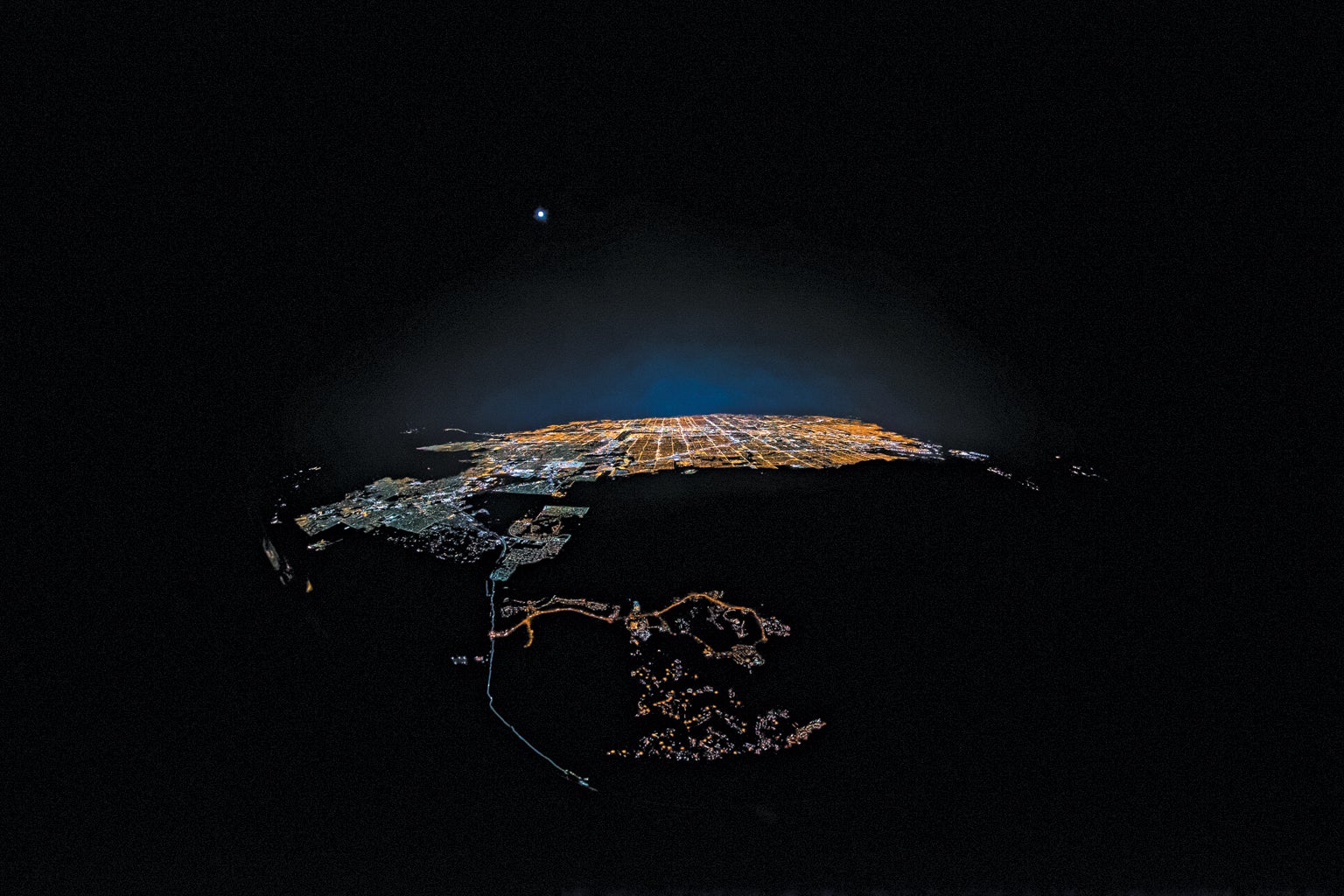
Tucson was a bright bubble eating the eastern sky and the shoulder of Orion. A snake of lesser lights—Interstate 10—wriggled out from the glow, winding 100 miles north toward the glare of Phoenix. To the south, across the Mexican border, loomed another luminous half-circle from the lights of Nogales.
All that light is an existential threat to high-grade stargazing on Kitt Peak. Over the decades astronomers have taken urgent steps to slow or even reverse its spread. For them, the boundary of each glowing dome was a battle line, expanding or shrinking with each skirmish won or lost; the imperfect darkness overhead was a testament to local policy and millions of collective actions—or collective shrugs and proliferations of gleaming billboards and streetlights.
Yet the glow keeps spreading. Under skies so filled with stray photons, it takes twice as long to resolve an astronomical target as it typically would, one Kitt Peak astronomer told me a few hours after sunset. Intense wildfires linked to global warming (such as one that swept the summit half a year after my visit) may pose more obvious risks to the telescopes there, but the subtle, pernicious effects of ever brighter nights could eventually become an even bigger threat to astronomy.
Species spiraling into oblivion, a few extra parts per million of carbon dioxide in the air, sea life gobbling up microplastics—many of our era’s ecological calamities are hard to see with unaided eyes. Not so with light pollution, even though astronomers looking through telescopes may have been the first to really notice it. Its impacts are not limited to astronomy, of course. Over the past decade biologists have discovered that wasteful nighttime lighting drastically disrupts animals, plants and the ecological relationships that knit the world together. These effects reach across entire regions of the globe, far outside of cities. “You need to think about it much more like we might think about plastic pollution or some of the climate change effects,” says Kevin Gaston, a prominent U.K.-based conservation biologist at the University of Exeter.
Researchers still maintain that we can reduce light pollution without much sacrifice. As new research reveals the scope of the problem, possible fixes become clearer as well. Light pollution is something we can understand and manage, like smokestack emissions or factory wastewater. The sooner we act, the better. Satellite measurements suggest that more than three in five Europeans and four in five North Americans live under skies too light-swamped to allow them to see the Milky Way. Other analyses show Earth’s artificially lit surface area bloating outward by about 2 percent a year, transforming the remaining map of true night into Swiss cheese. And although recent LED technology has made lighting cheaper and more energy-efficient than ever, consumers don’t seem to be pocketing those savings and reducing carbon emissions. Instead humanity seems to be switching on even more lights.
It doesn’t have to be this way. Dark, star-filled skies can once again become the rule rather than the exception, easing the burden on already struggling ecosystems while restoring some celestial wonder into ordinary human lives. Legislation aiming to achieve as much is already being drafted on multiple continents. Any solution, however, depends on questions more social than scientific: Can we sustain the necessary research to properly define and address light pollution? How much nighttime lighting do we really need? And most crucially, maddeningly—does anyone care?
To give scientists and the rest of us some credit, it has always been hard to assess the ecological implications of bathing the world in an eternal false twilight. To some creatures, a lamp is a siren call; to others, it’s a repulsive force field. Light’s timing, wavelength, direction and intensity, as well as the eyes of the beholder, all matter, and unlike mercury in tuna or DDT in bald eagles, photons don’t leave behind a lasting measurable chemical trace. Taken together, though, studies on at least 160 species provide ample evidence that artificial lights send the natural world a bewildering array of ill-timed signals—Wake up! Hide! Hunt! Fly this way! Change your metabolism!
One morning in May of last year, I drove out to a cattle farm in rural North Carolina to meet Murry Burgess, a graduate student at North Carolina State University who had strung up little Christmas lights over swallow nests built in the rafters of a barn. She went up on a ladder, pulled out what looked like squirmy, stubble-feathered dinosaurs one by one, and subjected each chick to a battery of tests while clutching it gently in her warm palms. The parents didn’t know to move their nests away from the lights, she said, and the light took a toll on their babies’ bodies. Compared with neighboring chicks growing up under no lights, coming of age under just one tiny bulb had made these birds stunted and underweight. “It’s crazy how light goes all the way in deep into their cells,” Burgess told me.
What harms individual baby barn swallows also operates on the scale of entire species, even ecosystems. Offshore, artificial light can cause reef-building corals that grasp toward the surface to stop spawning all at once, turning what should be synchronized explosions of fresh life into useless, mistimed puffs of eggs and sperm. In the U.S. alone, somewhere between several hundred million and one billion birds die every year after thwacking into windows, many of them beckoned by interior lights.
Insects especially are facing dire consequences. Moths keep flapping into lightbulbs for reasons scientists still don’t quite understand. Cricket calls are becoming decoupled from the rhythms of night and day. In the British countryside, research shows caterpillar populations plummeting in roadside hedgerows illuminated by LED streetlights. Light pollution is almost certainly hastening the so-called insect apocalypse, the planet’s declining portfolio of bug biomass, although little research has focused on this grim end point.
Light pollution ripples through multiple domains of life. In one 2017 experiment, scientists with night-vision goggles watching cabbage thistle plants confirmed that ambient light deterred nocturnal pollinating insects from making their rounds. Daytime pollinators couldn’t make up the deficit, so the plants bore less fruit, suggesting that the effects of brightening nights could eventually show up in supermarket aisles. And while nocturnal light can lead the insects we like to lose conviction, it can fill those we despise with passionate intensity: the mosquito Aedes aegypti, which causes a staggering 400-million-odd infections such as dengue and Zika a year, seems encouraged to bite more in the presence of artificial light, as does another mosquito species that spreads West Nile virus.
Such observations used to be documented one organism at a time in specialist journals, unconnected to a broader research program. But in the late 1990s a pair of grad students and self-described environmental “troublemakers” in Los Angeles began building up a dossier of these kinds of stories. Catherine Rich, a lawyer turned ecologist-in-training, got accepted to several Ph.D. programs, but when she went looking for an adviser who would let her study the effects of light pollution on wildlife, she found no takers. “I would hear things like ‘you might not get any results,’” she says. But Rich and her now husband Travis Longcore stuck with the issue and organized what would prove to be a seminal academic conference on the subject.
In their 2002 conference, a 2004 review paper and a subsequent book, Longcore and Rich steered clear of another, parallel field of research—the ongoing exploration of what living in a brighter outdoors and brighter-still indoor world does to human health. (We know light exposure at night is associated with myriad problems, ranging from the obvious, like sleep disruption, to the more surprising, like higher breast cancer risk, but it isn’t clear yet how much of this is from outdoor light pollution versus our glowing screens and indoor fixtures.) Even so, journalists and the public began to pick up on the idea that light pollution was real pollution, ecologically speaking. By 2011 high-powered European ecology laboratories such as Gaston’s picked up the topic and began cranking out their own results and meta reviews of the literature. As of this year, Longcore and Rich’s review paper has been cited more than 1,500 times.
Many of these results involve the easiest kind of light pollution to picture: a single, intense light source shining at you with the harsh glare of LED headlights on a new-model SUV. More recently, however, others have focused on the subtler, more encompassing light-bubble effect I saw from Kitt Peak. The latest, most painstaking ecological findings show that these levels of ambient light pollution have biological consequences, too, even with no specific light sources in sight.
A series of recent experiments, conducted in tanks and under domes bobbing in a German lake, showed that bright skies alone can cause sagging levels of melatonin—a hormonal messenger of darkness—and alter reproductive hormones in Eurasian perch. A separate paper last year showed that whiter nights disoriented dung beetles in South Africa, which look toward the Milky Way to guide themselves in the humble but essential task of burying poop in the savanna. Yet another 2021 study, led by Longcore, showed similarly low thresholds of light on stretches of California beach can prevent plovers from roosting and fish called grunion from throwing themselves ashore to spawn.
All this matters because domes of light from skyglow are visible for hundreds of miles across state and international borders, and studies show they lure migratory birds and insects at regional scales. Even in the rare corners of the planet these domes haven’t yet reached, organisms already seem attuned to the faintest changes in lighting. Over winter in the Arctic Ocean, for example, plankton rise and fall each day despite the sun never breaching the horizon. Artificial light from fishing or mining could also scramble that system.
There is no real, organized “pro-skyglow” opposition on the other side of all this funneling money to politicians or pumping out contrarian studies. The problem, scientists assert, is that current lighting trends are driven by unquestioned development and millions on millions of oblivious human decisions. Setting aside regions left in the dark by poverty and neglect, precious few communities have managed to slow down light’s advance.
Two weeks before my sojourn at Kitt Peak, I stood shivering in the late-night chill beneath the ponderosa pines around Lowell Observatory in Flagstaff, gazing up at a lunar eclipse. As Earth’s shadow slid across the face of the moon, the black of bare sky deepened, and the stars popped brighter, as if a photo editor were fiddling with the vista’s contrast levels.
The most memorable part of the whole experience, though, was the downward view overlooking Flagstaff. Almost no illumination besides individual stoplights shined back up. You could blink and convince yourself you were overlooking a sleepy coastal hamlet, not a mountain town of more than 75,000 hoping to snag tourists on their way to the Grand Canyon. It looked like a little corner of modernity had somehow taught itself to close its eyes and fall asleep.
To date, the most successful defenses of dark skies have been mounted in places where astronomers could rally around facilities with economic value. In 1958, around the same time Rachel Carson got the tip that spawned Silent Spring and modern environmentalism, astronomers at Lowell Observatory began to worry about spinning searchlights used in advertising spoiling their view of the sky. In response, Flagstaff put the world’s first light-pollution ordinance on the books. Arizona—not exactly a place famous for collectivist, big-government policies—has been the heartland of the dark sky movement ever since.
Two years earlier, a few hundred miles to the south, astronomers and tribal guides from the surrounding Tohono O’odham nation had ridden on horseback to the top of Kitt Peak, exchanging Western and Indigenous star stories by a campfire at the summit. Soon the federal government leased the land from the tribe in perpetuity, and bigger and better telescopes bloomed on the mountaintop.
As light pollution in nearby Tucson ballooned, Kitt Peak astronomers found allies such as Tim Hunter, a doctor who had grown up seeing the Milky Way through elms in the Chicago suburbs, then watched helplessly as artificial light dimmed the galaxy just like Dutch elm disease rotted the trees. Together Kitt Peak astronomer David Crawford and Hunter formed the International Dark Sky Association (IDA) in 1988, hoping to build a broader coalition that included their allies in Flagstaff.
Over the years, as advocates watched darkness retreat, the tools and techniques required to track it advanced. Light-pollution modeling progressed from pen-and-paper equations to computerized ray-tracing simulations. Sophisticated wide-angle cameras made it easier to measure skyglow from the ground, and satellite images started showing spidery webs of light spreading across the globe. The general trend was, and remains, dismal: the better researchers can study the problem, the worse it appears to be.
The IDA and its affiliated researchers reject the assumption that light pollution must intensify as cities grow. Usually crime prevention is the municipal excuse for banishing the night. But how well does this work? Perhaps the most definitive evidence that light suppresses crime comes from an experiment begun in 2016 in which criminologists lugged nearly 400 basketball hoop–sized lighting towers into public outdoor spaces in New York City housing developments. Powered by their own portable fuel generators, the blue-white fixtures were left on from sunset to sunrise—and outdoor crimes around the light towers at night dropped by about 45 percent.*
But dark sky researchers point out that these towers were far brighter than mere streetlights. They also note the ethically dubious nature of any anticrime policy that relies on subjecting majority-minority communities to prison yard–esque floodlights all night long. Indeed, across the continental U.S., the burden of light at night, like other known pollutants, falls harder on less powerful groups: according to a 2020 study from researchers at the University of Utah, Black, Hispanic and Asian American neighborhoods tend to be about twice as illuminated as white ones.
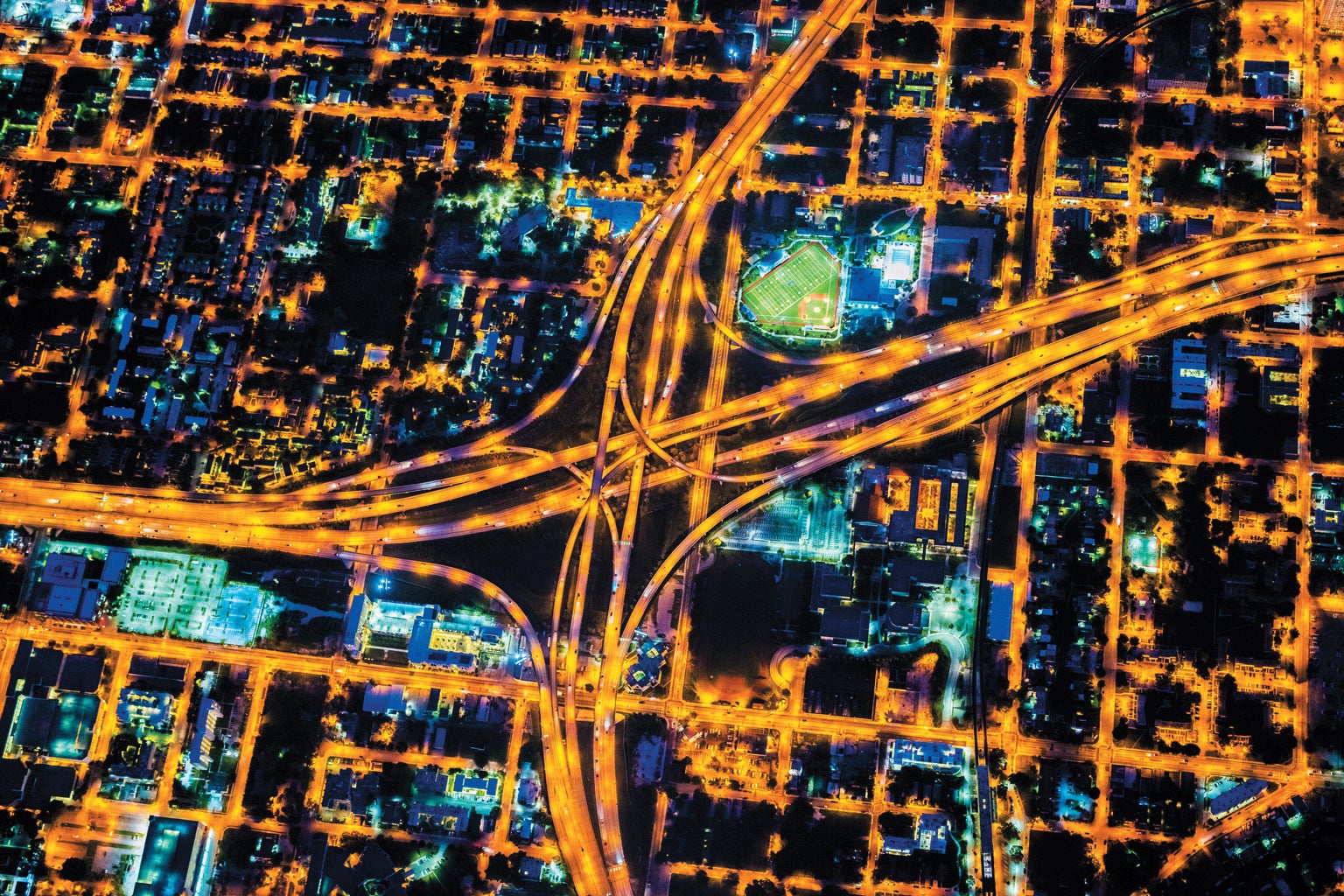
Road safety is another common rationale for the proliferation of lights at night. But here, too, scientists argue that brightness standards are driven by convention, not science. In 2018 lighting researchers from England and the U.S. scanned regulations in Europe and North America. “There appears to be little, if any, credible empirical support for light levels recommended in much current road lighting guidance,” they concluded.
Other lighting choices come down to industries and individual people, many of whom remain unreached or unmoved by the issue. Spend any time in dark sky circles, and you’ll hear talk of a curse: a moment of revelation, of veil lifting, when you suddenly see bad, wasteful lighting and then can’t unsee it. (Mine came on a walk in my Raleigh, N.C., neighborhood, when I realized a richer, whiter “historic” stretch of blocks had dimmer amber streetlights, and the adjacent historically Black neighborhood had harsher white fixtures.)
Many activists have also taken that curse as a call to action. The day after watching the lunar eclipse in Flagstaff, I sat down with Chris Luginbuhl in the city’s Dark Sky Brewing Company. Playing along, he ordered a “Circadian Rhythm.” That on-the-nose brew had run out, though, so he settled for a brown ale.
Luginbuhl, a former astronomer at the nearby U.S. Naval Observatory who has worked to protect Flagstaff’s skies for four decades, knows the field of dark sky science and its progress better than almost anyone. He and his coalition are “like the John Muir character,” one colleague told me, “kind of nutty but superpassionate.” Streetlights here are a dim orange because, as Luginbuhl explains, blue-tinged light is more disruptive to most animals at night (humans included), as well as to nearby astronomical observatories. That’s because bluer, shorter-wavelength photons scatter more readily in the air, creating a localized fog of light.
Nursing his beer, Luginbuhl praised his town as a paragon, a proof of concept that other communities could emulate. In 2017 the U.S. National Park Service deployed an ultrasensitive panoramic camera outside both Flagstaff and the similarly sized city of Cheyenne, Wyo., which does not have comparable dark sky ordinances. Cheyenne was 14 times brighter than Flagstaff, and the bubble of trapped light around it was eight times bigger. Luginbuhl says his strategy has been simply to show people the stars and convince them that being able to see them is a matter of choice—that there is no zero-sum conflict pitting growth against wilderness. “Do I think that stars will win out over light? Almost every time,” Luginbuhl says. “They’re mind-bending, and everybody needs to have their minds bent.”
In the spring of 1942 Nazi Germany sent U-boats slinking across the Atlantic to prey on American shipping lanes. Cargo sank by the ton, drowned bodies washed ashore, and it soon became clear that the submarine gunners were picking off ships at night by watching for their dark silhouettes against skyglow over the coast.
Elected officials and chambers of commerce in cities such as Miami were pressured to dim lights and turn off glitzy outdoor displays. Clearly, this light pollution had literal life-or-death stakes. For three months, though, community leaders dragged their heels, subverting a collective response, citing economic concerns. The carnage offshore ultimately moved President Franklin D. Roosevelt to issue an executive order that compelled coastal blackouts, and U-boat attacks waned as defensive patrols were stepped up and communities for many miles inland restricted their use of nighttime lights, even taping over car headlights. All this is within living memory: my late grandmother, a teenager at the time, told stories about how serious it felt to keep the lights off that summer in Wrightsville Beach, N.C.
“It’s like, oh, my God,” says Christopher Kyba, a physicist and dark skies advocate at the GFZ German Research Center for Geosciences in Potsdam. Even back then, “the U.S. government knew how to control skyglow! We’re not waiting for some breakthrough technology.” Smarter, more data-driven guidance on unnecessary lighting can exist; presumably the collective will to act on it can, too.
Barring that, it’s easy to imagine the planet’s wealthier regions cranking out ever more wasted light powered by wasted carbon, evaporating the remnants of true night like water from a drying lake bed and subjecting life on Earth to an additional stressor in a world increasingly full of them. Or—and this is also eminently possible—we can come to notice wayward light as we would a neighbor’s garden sprinkler accidentally set to water the street. With enough restraint, the Milky Way can shine once more above bustling human communities.
Pressure to dim the lights is building. Multiple U.S. states are reviewing proposed dark sky–friendly legislation. Campaigns to turn off lights during bird migration season are spreading all over the country; in Texas cities such as Dallas and Houston, for example, more than 100 downtown buildings dimmed their lights this past spring. And since 2001, when the IDA started recognizing places where dark skies are being preserved—Flagstaff, of course, was first on the list—nearly 200 such sites have been certified around the globe.
Even bolder policies are unfolding in Europe. In France, a law passed in 2019 bars businesses from leaving decorative lights and signs illuminated all night. In Germany, which has developed a legal action plan to reverse insect declines, controlling light pollution is considered to be a major goal. On the technology front, LED makers, sensing an unmet need, are adding dark sky–friendly, downward-pointing, long-wavelength fixtures to the market. And the Holker Lab in Berlin—the ones behind those fancy lake experiments on skyglow—have developed prototype lights that don’t emit the wavelengths disruptive to most insects. “The crazy thing about this problem,” ecologist Jesse Barber of Boise State University told me, echoing a sentiment common throughout dark sky circles, “is it’s so damn fixable.”
It’s hard to care for what you’ve never seen. The Milky Way—a glitter bomb of awe that all our grandparents and all preceding humanity could witness whenever they wanted—is the biggest reward for limiting light pollution. But unlike residents of the American West, who can summon its appearance with modest reductions in light, people in the more densely populated, brighter eastern U.S. can’t gain even a subpar view of our galaxy without hours-long drives to isolated pockets of darkness. There are other perspectives to consider, though.
Recently I learned of a quiet little wonder left in my own world: a species of ghost firefly was discovered haunting old pine stands near my home in the Piedmont of central North Carolina. The males of this species keep their lights on for up to 30 seconds at a time, scrawling faint, floating messages, and the females sit still below, gleaming back up silent, greenish answers.
In 2021 citizen scientists spotted populations of this firefly in some of the state’s most urbanized counties, where, of course, they had been all along. They easily could have been paved over to extinction before anyone noticed. The entomologist searching for the species, Clyde Sorenson of North Carolina State, even stumbled onto a population in his very own backyard. “I’ve been living there for 25 years,” he told me, sheepishly.
Desperate for a little reenchantment myself, I pulled up in his driveway one evening this past spring. We set out into the adjoining woodlot, wearing headlamps and crunching through leaves as a bullfrog bellowed in the background. This being a new species, we didn’t know the exact time of year to expect it or the right weather. We did know darkness was necessary.
Fireflies, obviously, are sensitive to levels of light, the medium in which they communicate. Studies show ambient light pollution obstructs firefly courtship to the extent that some species don’t even bother to try. As we walked that night, errant rays—from our phones, streetlights through the trees, the neighbor’s security floodlight—kept needling their way back in, illuminating all the fireflies’ likely hiding spots.
But then we saw three huddled females scintillating like misplaced stars, glowing from a shadowy crevice of glare-blocking leaf litter. Their bodies were the size of grains of rice. I leaned in close, and each firefly’s star divided into two emerald dots, two side-by-side light organs cranking out their own feeble wattage into the scattered remnants of the dark—a broadcast they continued for about half an hour, until that evening’s shift ended, and they winked out.
*Editor’s Note (9/29/22): This sentence was edited after posting to correct the description of when the blue-white fixtures were left on.