














.jpg "Clear Drop Soft Plastic Compactor Review: Eco Experiment")























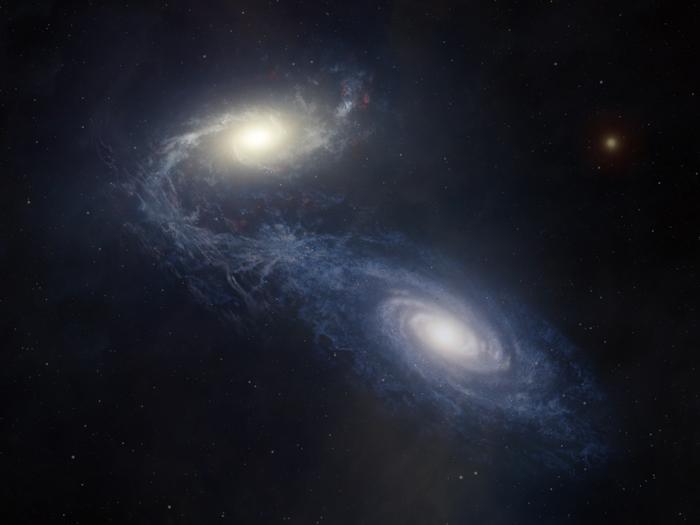
NGC 1365 hangs in the Fornax Cluster roughly 60 million light-years away, a great barred spiral with two curving arms and a bright, turbulent core: just the sort of galaxy you’d flip past in an atlas without stopping. It is not the largest galaxy known, nor the most exotic, nor particularly unusual in its basic architecture. What it is, it turns out, is legible. Pressed face-on toward Earth, wide enough in apparent diameter that astronomers can separate individual star-forming clouds rather than smearing them together into an indistinct blur, NGC 1365 offered something that no galaxy beyond our own had ever offered before: a readable chemical autobiography, written in oxygen, going back 12 billion years.
The team that read it, led by Lisa Kewley at the Center for Astrophysics | Harvard & Smithsonian, published their findings this week in Nature Astronomy. The technique they used, which they are now calling extragalactic archaeology, may change how the field reconstructs the histories of distant galaxies.
The premise rests on a fairly straightforward piece of stellar physics. When massive stars die, they explode as supernovae, seeding surrounding gas clouds with heavy elements. Oxygen is among the most abundant of these, and the pattern of oxygen concentrations across a galaxy functions something like a geological stratum: richest at the centre, where star formation ignited earliest and has had longest to accumulate, thinning outward toward regions that formed their stars later or received diluting inflows of fresh, unenriched gas from smaller merging galaxies. The gradient is never simple, though. Mergers flatten it. Galactic bars channel gas in unpredictable directions. Active nuclei can suppress the very star formation that creates the enrichment. Every galaxy’s oxygen map is a palimpsest, each process leaving its own overwriting signature on the one before.
Reading that palimpsest required resolution that most surveys have never achieved. Earlier work on NGC 1365 made do with single points of measurement hundreds of parsecs across, effectively averaging away the fine structure that carries the historical signal. Kewley’s team used an instrument on the Irénée du Pont telescope in Chile called the TYPHOON survey, which employs a technique of stepping a long slit across an entire galaxy to build a three-dimensional spectral data cube. The result, for NGC 1365, was 4,546 individual measurement points at a spatial resolution of 175 parsecs, roughly ten times finer than comparable studies.
Three distinct chemical zones emerged. The innermost region, extending about seven kiloparsecs from the galaxy’s nucleus, showed a steep oxygen gradient: heavily enriched at the centre, dropping sharply outward, the signature of sustained star formation fed by gas channelled inward along the bar. Beyond that, a shallower gradient extended through the main disc and the spiral arms. And beyond that, at radii of 17 kiloparsecs and further, the oxygen abundance went essentially flat: a chemically uniform outer disc that looked, in the data, like it had assembled as a single unit rather than building gradually from the inside out.
“We want to understand how we got here,” said Kewley. “How did our own Milky Way form, and how did we end up breathing the oxygen that we’re breathing right now?”
To answer that question for NGC 1365, the team turned to a suite of cosmological simulations called IllustrisTNG. The TNG50 run, the highest-resolution version of the suite, models roughly 20,000 galaxies evolving from shortly after the Big Bang to the present day, tracking gas flows, star formation, black hole growth, and chemical enrichment in detail fine enough to compare directly with Kewley’s observational data. The team searched the entire TNG50 sample for a simulated galaxy that matched NGC 1365 in both stellar mass and oxygen-abundance gradient structure. Out of 20,000 candidates, one matched cleanly: a simulated galaxy now referred to as TNG0053, which independently reproduced not only the three-zone gradient but also the grand-design spiral morphology. “This study shows that the astronomical processes we model on computers are shaping galaxies like NGC 1365 over billions of years,” said Lars Hernquist, Mallinckrodt Professor of Astrophysics at Harvard and a key architect of the Illustris simulation programme.
The simulation’s evolutionary record told a specific story. The innermost region formed earliest, around 12 billion years ago, when the young galaxy merged with several small dwarf galaxies whose collisions triggered massive inflows of gas into the nuclear regions; sustained star formation over the subsequent billions of years built up the steep oxygen gradient seen today. The main disc gradient assembled more gradually, through a series of minor mergers and periods of quiescent star formation spanning most of cosmic time. The flat outer disc is the most recently formed component: TNG0053’s outer gas disc expanded substantially between about six and eight billion years ago, the result of a merger with a dwarf galaxy of roughly a billion solar masses that delivered a slug of gas and triggered a new burst of star formation. The outer disc did not grow slowly outward. It arrived.
That last finding may be the most surprising. Flat outer gradients have been observed in several nearby spirals, including our own Milky Way, but their origin has been contested: some models attribute them to ancient evolutionary processes, others to relatively recent gas redistribution. TNG0053’s history argues for recency, at least in this case, with the outer disc assembled perhaps five to eight billion years after the Big Bang rather than primordially.
The method has limitations worth naming. TNG50, though the highest-resolution Illustris volume, contains a small enough number of simulated galaxies that only one closely matched NGC 1365, which narrows the statistical confidence you can draw from the comparison. The simulation’s best-matching galaxy also lacks a bar, despite NGC 1365 having a prominent one, which probably introduces some differences in how the inner gradient formed. Future work will need to apply the technique to larger simulation volumes and broader galaxy samples before the approach can be considered fully general.
Still, the scope of what has been achieved is not trivial. For as long as extragalactic astronomy has existed, the deep histories of galaxies beyond our own have been largely inaccessible: you can measure what a galaxy looks like right now, but the billions of years of mergers and star formation and gas accretion that shaped it have left no obvious archive. Galactic archaeology inside the Milky Way has worked because we can resolve individual stars old enough to carry the chemical signatures of the early universe in their atmospheres. Until now, no one had demonstrated that a comparable record could be read in the gas of another galaxy from the outside. NGC 1365, chosen partly for its convenient face-on orientation and partly for being close enough to resolve at the required scale, has shown that the chemical fossil record exists and can be decoded. The question now is how many other galaxies will sit still long enough to be read.
Whether the Milky Way would show the same three-zone structure, or something different, is one of the things Kewley’s team intends to find out. Our own galaxy’s orientation makes it harder to map this way. But the method, apparently, works. What was once astrophysics has become, in a small but genuine sense, archaeology.
DOI / Source: https://doi.org/10.1038/s41550-026-02808-7
Frequently Asked Questions
What is extragalactic archaeology and how does it work?
Extragalactic archaeology is a new technique for reconstructing the formation history of galaxies beyond the Milky Way by reading the chemical patterns written in their gas. Massive stars produce heavy elements such as oxygen when they explode as supernovae, enriching surrounding gas clouds. By mapping how oxygen concentrations vary across a galaxy at very high spatial resolution, astronomers can infer when different regions formed their stars, whether the galaxy has experienced recent mergers with smaller galaxies, and how gas has flowed in or out over billions of years.
Why was NGC 1365 chosen for this study?
NGC 1365 is a nearby spiral galaxy, about 60 million light-years away, that happens to be oriented nearly face-on toward Earth, making it possible to resolve fine structural detail across the full disc. Its relatively close distance and large apparent size allowed the TYPHOON survey team to achieve a spatial resolution of 175 parsecs per measurement point, roughly ten times finer than most comparable surveys, which is the resolution needed to separate the three chemically distinct zones that encode the galaxy’s history.
What did the study find about how NGC 1365 formed?
The study found that NGC 1365 assembled in three broad phases. The innermost region, around the galactic bar, began forming about 12 billion years ago through mergers with dwarf galaxies that triggered intense star formation near the nucleus. The main disc built up more gradually over the following billions of years. The outer disc, which shows a strikingly flat oxygen-abundance profile, appears to have assembled relatively recently in cosmic terms, between about six and eight billion years ago, when a merger with a dwarf galaxy of roughly a billion solar masses delivered a large inflow of gas and triggered a new wave of star formation.
How do computer simulations fit into this kind of research?
The IllustrisTNG cosmological simulations model the formation and evolution of approximately 20,000 galaxies from shortly after the Big Bang to the present, tracking star formation, gas flows, chemical enrichment, and black hole growth in detail fine enough to compare with observational data. In this study, the team searched the entire TNG50 simulation sample for a galaxy that matched NGC 1365 in both mass and chemical-abundance structure, finding one close match whose recorded evolutionary history could then be used to interpret what the real galaxy’s chemical patterns mean in terms of its merger and star-formation history.
Can this technique be applied to other galaxies, including the Milky Way?
The technique works best on galaxies that are relatively nearby and oriented face-on, so that high spatial resolution can be achieved across the full disc. The researchers plan to apply the method to other galaxies in the TYPHOON survey sample. The Milky Way presents a different challenge because we sit inside it, making face-on mapping impossible, but the underlying principle of reading chemical fossil records to reconstruct galactic history applies to our own galaxy as well, using complementary approaches that study individual stars rather than gas clouds.
Related
Discover more from European Space Agency Tracker
Subscribe to get the latest posts sent to your email.