





































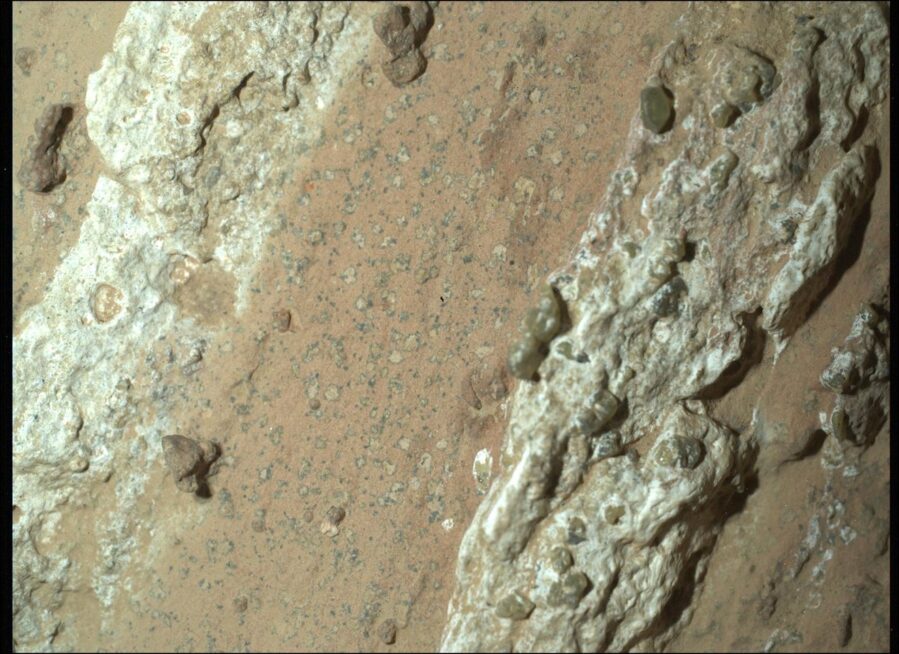
A rock sample collected from an ancient Martian riverbed contains what could be the strongest evidence yet of past life on the Red Planet.
NASA’s Perseverance rover pulled the sample from a rock nicknamed ‘Cheyava Falls’ in July 2024, but it took a full year of analysis before scientists felt confident enough to publish their findings in Nature. The rock, spotted with distinctive leopard-like markings, contains a combination of organic compounds and mineral patterns that on Earth typically signal microbial activity.
‘This finding is the closest we have ever come to discovering life on Mars,’ said acting NASA Administrator Sean Duffy. The sample, called ‘Sapphire Canyon,’ represents what researchers consider the mission’s best candidate for containing signs of ancient biological processes.
But here’s the thing about potential biosignatures: they’re maddeningly ambiguous. The same chemical fingerprints that scream ‘life’ to astrobiologists can also form through purely geological processes. It’s a scientific puzzle that has kept the Perseverance team analyzing data for months.
The rover discovered Cheyava Falls while exploring the Bright Angel formation, rocky outcrops along Neretva Vallis, a quarter-mile-wide ancient river valley carved into Jezero Crater. The arrowhead-shaped rock, measuring roughly 3 by 2 feet, immediately caught scientists’ attention with its colorful spotted pattern.
Leopard Spots Tell A Story
Those spots aren’t just pretty to look at. High-resolution imaging revealed a distinct arrangement of minerals that the team dubbed ‘leopard spots,’ each containing iron-rich compounds called vivianite and greigite. On Earth, you’d find vivianite in sediments and peat bogs, often around decaying organic matter. Certain microbes can produce greigite as part of their metabolic processes.
‘The combination of chemical compounds we found in the Bright Angel formation could have been a rich source of energy for microbial metabolisms,’ said Joel Hurowitz of Stony Brook University, the paper’s lead author. ‘But just because we saw all these compelling chemical signatures in the data didn’t mean we had a potential biosignature.’
The rover’s instruments detected organic carbon, sulfur, oxidized iron, and phosphorus, ingredients that could have supported ancient microbial life. The minerals appear to have formed through electron-transfer reactions between sediment and organic matter, exactly the kind of energy-producing process that microbes use to survive.
Yet the scientists remain cautious. These same minerals can form without any biological input through high temperatures, acidic conditions, or organic compound reactions. The Bright Angel rocks show no evidence of extreme heat or acidity, though it’s unclear whether the organic compounds present could have triggered the reactions at low temperatures.
Younger Than Expected
The discovery surprised researchers for another reason: the rocks are among the youngest sedimentary formations Perseverance has investigated. Previous assumptions suggested signs of ancient life would be confined to older rock layers.
‘Astrobiological claims, particularly those related to the potential discovery of past extraterrestrial life, require extraordinary evidence,’ said Katie Stack Morgan, Perseverance’s project scientist. ‘Getting such a significant finding as a potential biosignature on Mars into a peer-reviewed publication is a crucial step in the scientific process.’
The finding hints that Mars could have remained habitable longer than previously thought, or that older rocks might harbor life signs that are simply harder to detect. It’s worth noting that this ‘younger’ rock is still billions of years old, formed when water flowed freely across the Martian surface.
Sapphire Canyon joins 26 other rock cores that Perseverance has collected since landing in February 2021. The samples await future retrieval missions that could bring them back to Earth for more detailed analysis in terrestrial laboratories.
The scientific community uses frameworks like the Confidence of Life Detection (CoLD) scale to evaluate potential biosignatures. This discovery represents just the first step on a seven-point progression toward confirming extraterrestrial life. And while the team can’t rule out non-biological explanations, the paper’s findings make those alternatives increasingly unlikely.
For now, a spotted rock in an ancient Martian riverbed holds humanity’s best shot at answering whether we’re alone in the universe. The answer, as always in science, remains tantalizingly just out of reach.
What Makes A Biosignature?
A potential biosignature is any substance or structure that might have originated from biological processes but requires additional study to confirm. On Earth, certain mineral combinations and organic compounds reliably indicate past microbial activity. On Mars, scientists must eliminate all possible non-biological explanations before claiming discovery of ancient life. The process involves analyzing chemical signatures, mineral arrangements, and environmental conditions to determine whether observed features could have formed without biology.
If our reporting has informed or inspired you, please consider making a donation. Every contribution, no matter the size, empowers us to continue delivering accurate, engaging, and trustworthy science and medical news. Independent journalism requires time, effort, and resources—your support ensures we can keep uncovering the stories that matter most to you.
Join us in making knowledge accessible and impactful. Thank you for standing with us!