









































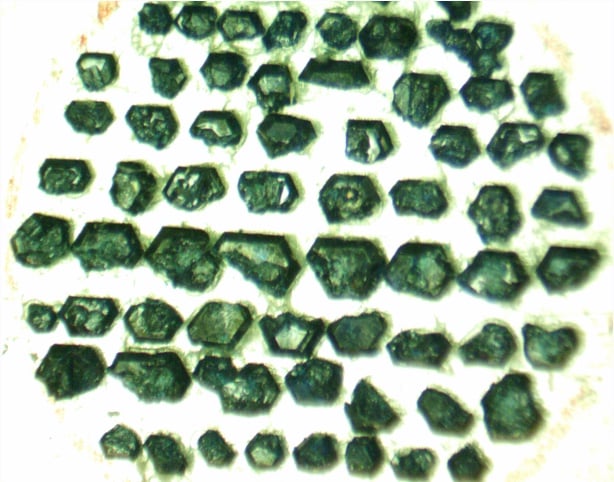
The blue green crystals look calm in the hand, but inside them the magnetic spins never settle, a restless behavior that could help build sturdier qubits.
In work from SLAC National Accelerator Laboratory and Stanford University, published in Nature Physics by Young Lee and colleagues, researchers used high precision neutron scattering at Oak Ridge National Laboratory to show that zinc barlowite hosts the hallmarks of a quantum spin liquid, a long theorized state in which magnetic spins continue to fluctuate even near absolute zero. Their measurements, combined with simulations, strengthen the evidence that kagome lattice materials can support deeply entangled spin behavior that may offer a more robust foundation for quantum information.
A Magnetic State That Never Freezes
A quantum spin liquid is a state where spins never find a stable orientation. In most magnets, spins either align in parallel or alternate in opposite directions. But in a kagome lattice, the triangular geometry frustrates these arrangements, so the spins flip continually and remain correlated across the lattice. That frustration, and the long range entanglement it encourages, could provide a natural mechanism for protecting quantum information from local defects.
First author Aaron Breidenbach captured the uncanny behavior with plain language.
“But in special configurations of atoms, the magnetism is fidgety, unable to find an ideal direction.”
This fidgeting is precisely what makes the state valuable. If entanglement stretches across many atoms, a local imperfection cannot easily collapse the stored quantum information. That property is difficult to engineer in other qubit platforms, and it is one reason spin liquids have drawn growing attention from physicists searching for stable quantum materials.
Growing a Reluctant Crystal and Watching It Scatter
Zinc barlowite does not occur in pure enough form in nature, so the team spent about a year growing crystals in the lab. Because the mineral is fluorinated and can damage quartz, they lined the growth tube with Teflon, heated the ingredients to produce a temperature gradient, and slowly coaxed crystals to form in deuterated water. Once the growth finished, the researchers picked apart hundreds of small clumps and aligned the final pieces into a single oriented sample.
At Oak Ridge, they cooled the crystal to two degrees above absolute zero and fired neutrons into it. A conventional magnet would have produced a sharp line in the scattering spectrum. Instead, the team saw a broad continuum of energies, a signature that the spins were fluctuating in a coordinated but never ordered way. They also detected the scattering patterns expected from spinons, quasi particles that reflect the fractionalized behavior unique to this class of materials.
Co lead author Arthur Campello emphasized how stubbornly the spins resisted order.
“You can go as low in temperature as you want, you never see any evidence that the spins order.”
The data matched simulations of spin liquid behavior, and the patterns closely resembled earlier findings in herbertsmithite, suggesting that zinc barlowite and herbertsmithite may share a universal scattering signature. That consistency strengthens the case that the kagome lattice can host genuine spin liquid physics rather than material specific quirks.
Looking ahead, the team aims to grow cleaner crystals to refine the neutron measurements and to map how far the entanglement extends. If the correlations can be tuned or stabilized, zinc barlowite may offer clues to creating more robust qubits and perhaps to exploring whether frustrated spin systems can be pushed toward superconductivity. For now, the crystals remain what they first appeared to be in the lab, beautifully colored minerals whose magnetic interior never stops shifting, quietly teaching researchers how quantum matter behaves when it refuses to sit still.
Nature Physics: 10.1038/s41567-025-03069-3
If our reporting has informed or inspired you, please consider making a donation. Every contribution, no matter the size, empowers us to continue delivering accurate, engaging, and trustworthy science and medical news. Independent journalism requires time, effort, and resources—your support ensures we can keep uncovering the stories that matter most to you.
Join us in making knowledge accessible and impactful. Thank you for standing with us!