





















.png "Kelela, Kurt Vile, Olof Dreijer, and More: This Week’s Pitchfork Selects Playlist")


















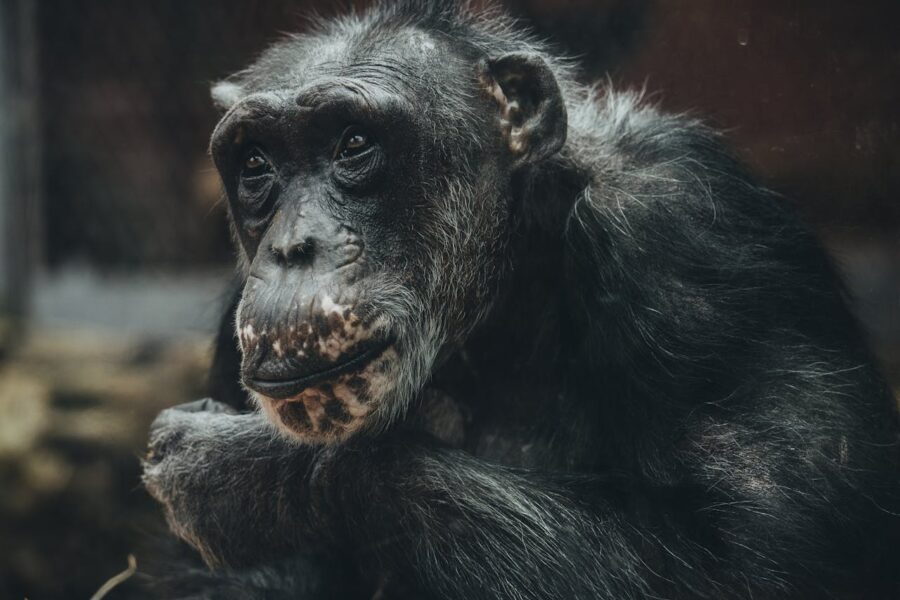
On a June morning in 2015, two clusters of chimpanzees approached each other near the centre of their territory in Kibale National Park, Uganda. This sort of encounter happened all the time. Chimps at Ngogo lived in a fission-fusion society, splitting apart and reuniting throughout the day as they moved through the forest. But this time, something went wrong. The western chimps didn’t rejoin the group. They ran. And the others chased them. What followed was six weeks of avoidance, the longest period of sustained separation researchers had ever recorded at the site, and the opening act of what would become the first well-documented civil war in a nonhuman animal.
Aaron Sandel at the University of Texas at Austin and his colleagues have now published the full accounting of that war in Science, drawing on three decades of behavioural data, network analyses and demographic records. The picture it paints is, frankly, grim.
The Ngogo chimpanzee community was massive by chimp standards. Nearly 200 individuals, including more than 30 adult males, all sharing a single territory. For roughly twenty years of continuous observation starting in 1995, they operated as one group. Males formed dominance hierarchies, hunted together, groomed each other, patrolled their borders side by side. Substructure existed (researchers could identify a “western cluster” and a “central cluster” within the larger community) but membership was fluid. About 29 percent of individuals switched clusters from one year to the next. They mated across cluster lines too; between 2004 and 2014, 44 percent of infants were sired by parents belonging to different clusters.
Not with this level of documentation. A suspected fission at Gombe in Tanzania during the 1970s resulted in lethal violence between former groupmates, but that case was complicated by provisioning practices and limited observational data. The Ngogo split is the first permanent group fission in wild chimpanzees backed by decades of network analysis, GPS ranging data and continuous behavioural monitoring, making it possible to trace how relationships deteriorated step by step.
That remains one of the study’s more puzzling findings. Standard models predict that larger groups should dominate in intergroup conflict. But the Western chimps, despite being outnumbered roughly three to one, launched all the observed lethal raids. The researchers believe their tight-knit social bonds, some stretching back years before the split, gave them a cohesive advantage that outweighed the Central group’s numerical superiority.
The study doesn’t make that claim. What it does suggest is that the social processes capable of producing collective violence, polarisation, shifting group identity, escalation, don’t require the cultural scaffolding (religion, ethnicity, ideology) often assumed to be necessary. That doesn’t make war inevitable; it means the relational dynamics underlying conflict may be more ancient and more broadly shared than many researchers have assumed.
The researchers point to several compounding factors: the group’s unusually large size, deaths of socially connected individuals in 2014, an alpha male changeover, and a respiratory epidemic in 2017 that killed some of the last chimps bridging the two clusters. Whether intervention at any of those points could have held the group together is unknowable, but the paper suggests that the loss of key connecting individuals may have been a tipping point.
It challenges the idea that civil conflict always requires ideological or ethnic divisions. The Ngogo chimps had no cultural markers to divide them, yet their community polarised and descended into sustained lethal violence anyway. The authors argue that many human conflicts may also originate in the breakdown of interpersonal relationships rather than entrenched cultural divisions, a possibility that could shift how we think about conflict prevention.
Then the bonds started fraying. The research team used three independent statistical methods to analyse the social networks, and all three flagged 2015 as the point of rupture.
Several things may have contributed to the collapse. Five adult males and one adult female died in 2014, causes mostly unknown, wiping out more than 10 percent of the mature male population. A new alpha male took over in 2015. And in January 2017, a respiratory epidemic tore through the community, killing 25 chimps, including some of the last individuals who maintained connections across both clusters. The researchers argue that no single factor caused the split. It was more like a cascade, one destabilising event compounding the next, weakening the social ties that held a very large group together.
By 2018, the divorce was final. Social network analysis showed two completely disconnected components. No affiliative relationships remained between the groups. Reproduction across the divide had already ceased; the last infant conceived by parents from different post-fission groups dates to March 2015. What had been the centre of a shared territory became a border.
And then the killing started. The smaller Western group (10 males, 22 females aged twelve and over) began launching coordinated raids into Central territory. They killed at least seven mature males. Beginning in 2021, the attacks expanded to infants: 17 documented infanticides, roughly two per year. Altogether, Western chimps were killing an average of one adult male and two infants annually. The real toll is probably higher. Fourteen additional adolescent and adult males in the Central group disappeared between 2021 and 2024 with no signs of illness, their bodies never recovered.
One detail that unsettled the researchers’ expectations: all the observed attacks were initiated by the numerically smaller Western group. Standard models of intergroup conflict predict that larger groups should have the advantage. But the Western chimps had something the models don’t always account for, cohesion. Their core members had been tightly bonded for years, a clique of three adult males who’d stuck together through all the cluster shuffling of the pre-split era. The team suggests that social cohesion, forged through enduring relationships, could outweigh raw numbers.
This sort of lethal aggression between chimps from different groups isn’t unprecedented; males regularly kill outsiders during territorial disputes. But killing former groupmates is another matter entirely. These individuals had lived together, groomed together, patrolled together, in some cases for years. The Gombe chimpanzee community in Tanzania was suspected of a similar fission in the 1970s, but provisioning and limited observation muddied the data. Genetic evidence suggests permanent fissions in chimps happen perhaps once every 500 years. The Ngogo case is, by a considerable margin, the best-documented example we have.
“A hostile split among wild chimpanzees is a reminder of the danger that group divisions can present to human societies,” writes James Brooks at the German Primate Center in a commentary accompanying the study. He also stresses what made this research possible in the first place: thirty years of continuous field observation, the kind of long-term commitment that is increasingly difficult to fund and sustain.
The implications reach well beyond primatology. A dominant framework in conflict research holds that cultural markers (ethnicity, religion, political ideology) are what bind groups and fuel hostility toward outsiders. That framework has always struggled with civil wars, situations where a previously unified community fractures along lines that didn’t exist before. The Ngogo chimps offer a stark test case. They have no religion, no political parties, no flags. Yet their social networks polarised, new group boundaries emerged, and collective violence followed. The researchers argue this supports what they call the “relational dynamics hypothesis”: that shifting interpersonal ties and local rivalries, quite independent of cultural markers, can fracture communities and catalyse killing.
The paper ends on a note that is quietly devastating. The authors suggest that perhaps we focus too much on the grand cultural divisions, ethnic, religious, ideological, when trying to understand why groups turn on each other. Perhaps the answer sometimes lies in something smaller. In the daily acts of reconciliation and reunion between individuals. In the small social repairs that, when they stop happening, leave a community brittle enough to break.
Source: Science, DOI: 10.1126/science.adz4944
Related
Discover more from Wild Science
Subscribe to get the latest posts sent to your email.