












































The most sensitive molecular ruler on Earth just tightened its grip on a constant that underwrites modern physics.
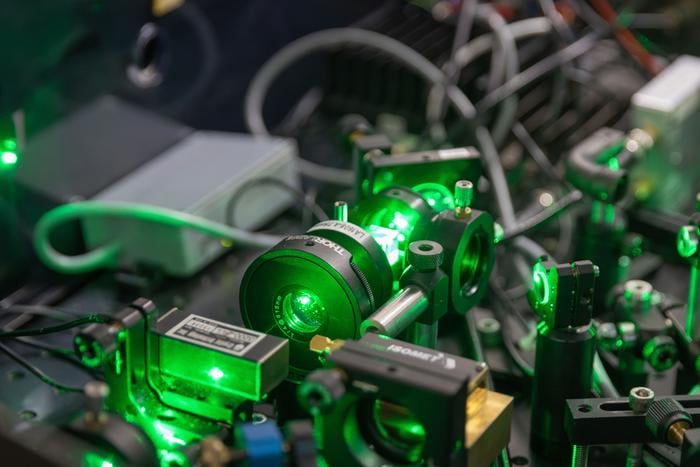
Working at Heinrich Heine University Düsseldorf, researchers used Doppler-free laser spectroscopy on the hydrogen molecular ion, H2+, to pin down the proton-to-electron mass ratio with an uncertainty of 26 parts per trillion. The study, published in Nature, not only leapfrogs earlier attempts by about three orders of magnitude in accuracy, it even outperforms Penning-trap mass spectrometry, the long-time gold standard for such measurements. That level of control does not just make for tidy lab notes. It opens a lane to test whether nature hides tiny discrepancies that point beyond the Standard Model.
“We are comparing ultra-precise theoretical predictions for H2+ with similarly precise experimental measurements to search for the tiniest discrepancies.”
That is how Professor Stephan Schiller frames the stakes. Tiny discrepancies. The phrase sounds fussy, but in physics those slivers are where revolutions begin. Here, the team corralled a small number of H2+ ions in a radiofrequency trap alongside laser-coolable atomic ions, letting the cold atoms sympathetically cool the molecules. Then they executed a special spectroscopy geometry to cancel the Doppler blur and shaved away meddling electric and magnetic field effects. Outcome, line resolutions approaching 2.2×10¹³ and a transition frequency determined with 8×10⁻¹² fractional uncertainty.
Turns out, the simplest molecule is a gift that keeps giving. H2+ is a three-body system that theorists can compute with rare confidence, which means experiments can be compared against predictions without drowning in unknowns. That clean matchup matters. When theory and experiment march in lockstep, we gain trust in the constants tucked into our equations. When they do not, those same constants might be whispering about a fifth force, extra spatial dimensions, or other uninvited guests.
“Any variances we find could point to a new ‘fifth force’, which might exist beyond the four fundamental forces we know.”
That is lead author Dr Soroosh Alighanbari, who also notes the technique’s potential to probe hidden dimensions by watching gravity’s behavior at small scales. The team’s method, which uses ion trapping, laser spectroscopy, and laser-frequency metrology, is precise enough to revisit the bedrock: the proton-to-electron mass ratio, a dimensionless number that sets the scale for how mass shows up in molecular vibrations and rotations. They report an uncertainty of 26 parts per trillion, beating comparable approaches by a factor of about 2.3 in some cases. The result agrees with Penning-trap values, an important cross-check, and, quietly, it helped refine the deuteron-to-proton mass ratio as well.
Here is the overlooked angle: these feats are not only for particle hunters. Metrology flows downstream. Better constants sharpen quantum sensors, stabilize optical clocks that anchor financial networks and GPS, and tune spectroscopic tools used in semiconductor manufacturing and medical imaging. If you sell timing, bandwidth, or resolution, you care about a world where tiny discrepancies either vanish or finally speak.
And there is an audacious next chapter. The same Düsseldorf approach could, in principle, compare a transition in H2+ with the antimatter version, anti-H2+, once synthesized at CERN. If matter and antimatter disagree, even slightly, that would crack the veneer of CPT invariance. It would also feed the old cosmological riddle of why the universe kept matter at all. The researchers say their method could enable a much more sensitive CPT test than today’s options.
For now, the headline is about control. They canceled Doppler smear by design, measured and corrected Zeeman shifts with care, and tamed a.c. Stark effects from the lasers, even tracking Autler–Townes splitting. The pay-off is not just a pretty number. It is a rare, quantifiable alignment between the most exacting calculations and an experiment that can answer back. The real surprise came when the molecular debut of H2+ at this accuracy level did not merely join the club, it set the agenda.
There is still room to tighten things further, the team argues, by mapping all spin components of a transition to erase spin-structure uncertainties, and by pushing toward quantum-logic spectroscopy on molecular ions. If those efforts squeeze another order of magnitude, tiny discrepancies might finally stop being tiny.
Explainer: What Is Doppler-Free Spectroscopy And Why H2+?
When atoms or molecules move, their emitted or absorbed light is Doppler-shifted, which broadens spectral lines and hides fine details. Doppler-free spectroscopy cancels this motion-induced blur by arranging lasers and trapped particles so that the shifts oppose each other, revealing the true line center. H2+ is ideal for extreme precision because it is the simplest molecule, so theorists can compute its energy levels with exceptional accuracy. By cooling H2+ ions using nearby laser-cooled atoms, then probing a carefully chosen rovibrational transition with an ultrastable laser referenced to an optical frequency comb, researchers can compare measurement and calculation at parts-per-trillion levels. If any consistent mismatch appears, it could flag new physics, like a fifth force or tiny violations of fundamental symmetries.
Journal: Nature
DOI: 10.1038/s41586-025-09306-2
If our reporting has informed or inspired you, please consider making a donation. Every contribution, no matter the size, empowers us to continue delivering accurate, engaging, and trustworthy science and medical news. Independent journalism requires time, effort, and resources—your support ensures we can keep uncovering the stories that matter most to you.
Join us in making knowledge accessible and impactful. Thank you for standing with us!