







































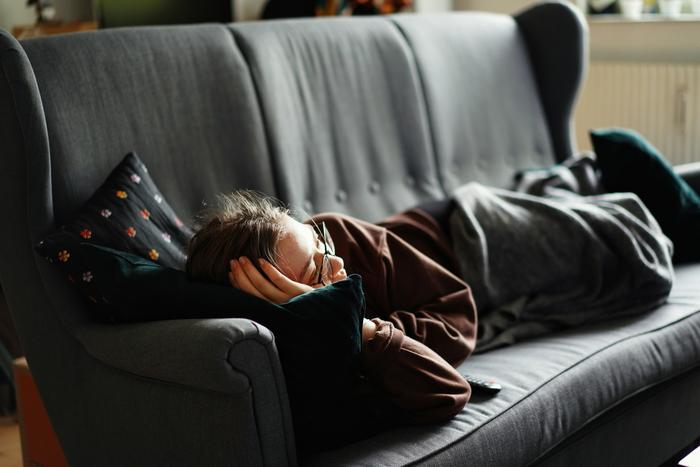
You’re alone. Maybe you’ve been alone all day, or maybe it’s just that particular kind of loneliness that arrives when everyone else has stopped replying to messages. The screen glows. You settle in for one more episode. Just one. That’s what you told yourself three hours ago.
For about one in three people who binge-watch regularly, this moment has become something darker than casual entertainment. It’s stopped being a choice. Researchers from Huangshan University in China have now mapped the psychological machinery behind this shift, and their findings reveal something unexpected: it’s not simply about escaping bad feelings. The pull toward addictive viewing works through two completely different emotional pathways at once, and understanding that distinction might be the key to intervention.
The researchers examined 551 adults in China who all watched television series regularly. Each person consumed at least 3.5 hours of consecutive episodes per week and finished more than four episodes in a single sitting. Two-thirds of them showed enough signs of addiction to be classified as addicted. This wasn’t casual watching. These were people whose habit had begun taking over their lives: relationships strained, work or study disrupted, sleep sacrificed. The distinction matters because not all heavy viewing looks the same psychologically, even when it looks identical on the surface.
What emerged from the data was striking: loneliness predicted addictive binge-watching reliably and significantly. But here’s the surprising bit. It didn’t predict non-problematic binge-watching at all. You can watch television for five hours straight, night after night, and feel perfectly fine about it. Or you can watch for five hours and feel trapped. The difference appears to pivot on emotional regulation, and specifically on whether you’re watching to feel better or to feel less bad.
Two Different Paths to Addiction
The first pathway is escapism. When lonely, people reach for the remote to run away from their isolation, to create a barrier between themselves and those uncomfortable feelings. The second is what researchers call emotional enhancement: the active pursuit of positive emotions and enjoyment through viewing. Both, seemingly paradoxically, were equally important in driving addiction. Loneliness didn’t simply push people toward avoidance. It also made them hungry for the specific pleasure and mood-boosting that storytelling provides.
“We don’t typically think about binge-watching that way,” says Xiaofan Yue, who led the study. The conventional wisdom suggests that addiction stems primarily from negative reinforcement, from running away from something painful. But the data revealed a more intricate dance. Escapism explained about 56 per cent of the relationship between loneliness and addiction. Emotional enhancement accounted for another 37 per cent. Together, these two emotion regulation strategies almost completely mediated the effect. Loneliness didn’t make people addicted to television series directly. It made them desperate to regulate their emotional states, and television series happened to be the mechanism they’d chosen.
This distinction has real practical implications. If loneliness drives addiction primarily through escapism alone, interventions might focus on helping people face their feelings, sit with discomfort, build tolerance for negative emotions. If it’s primarily emotional enhancement, you’d focus on finding alternative sources of pleasure and satisfaction. But when both are happening simultaneously, the picture becomes more complicated. A therapy that simply teaches people to tolerate loneliness without addressing their hunger for positive emotional stimulation might fail. Similarly, one that ignores the avoidance component in favour of mood-boosting activities could miss something crucial.
The research team was deliberate about separating addictive from non-addictive binge-watching in their analysis. Previous studies had mostly lumped them together, assuming that anyone watching vast quantities of television was engaging in similar behaviour. But the team found that loneliness didn’t correlate with non-problematic viewing at all. Someone can genuinely love television, watch enormous amounts of it, and not be lonely or using it as an emotional crutch. They’re engaged in what researchers call flow: deep absorption in a narrative, genuine enjoyment, intrinsic motivation. The addiction piece emerges when the motivation shifts from desire to compulsion, when the behaviour begins serving as an escape valve for emotional distress.
The participants in this study were all Chinese, recruited through online streaming communities and social media. They were young, mostly college-educated, largely employed as office staff. The findings emerged from survey data collected over five days in March 2024, so these represent associations rather than proven causal chains. It’s possible, in theory, that addiction causes loneliness rather than the reverse, that the neurological and psychological effects of problematic viewing then deepen social isolation. The researchers acknowledge this limitation straightforwardly. They also note that their definition of binge-watching was traditional: consecutive episodes of series, not the newer phenomenon of short-form content consumption on platforms like YouTube or TikTok, where the dynamics might differ substantially.
What the study does clarify is that binge-watching addiction, at least in the form examined here, functions as a multifaceted coping strategy. It’s not one thing. It’s not simply a way to kill time or escape boredom. For people struggling with loneliness, it serves simultaneously as a refuge from painful feelings and as a source of comfort and connection through narrative. The characters on screen become proxies for relationship, the emotional arcs of stories become substitutes for the ups and downs of actual social life. And because both pathways feed the behaviour, addressing only one leaves the other undisturbed.
The Bigger Picture
If loneliness is genuinely a primary risk factor in problematic binge-watching, then interventions might need to tackle isolation directly rather than focusing solely on viewing habits. Conversely, the findings suggest that not all intensive television consumption represents pathology. The person who watches eight hours of a compelling series in one weekend, loves every minute, and returns to their regular life feeling refreshed isn’t necessarily in trouble. But the person doing the same thing while feeling increasingly hollow, increasingly trapped, increasingly unable to stop, is operating in a different neuropsychological space entirely.
The trickiest part of this research is what it doesn’t yet explain: the direction of causality, the long-term trajectory, and whether the emotional regulation strategies involved are ultimately effective or self-defeating. Does binge-watching genuinely improve mood and reduce isolation in the moment, only to deepen loneliness later? Or does it provide real, sustained emotional relief that simply comes at the cost of lost time and neglected relationships? Without longitudinal data tracking people over weeks and months, we can’t know whether the emotional satisfaction these individuals report is temporary or lasting, whether it genuinely helps or whether it’s the psychological equivalent of reaching for sugar when you’re hungry.
What we do know is that the human pull toward emotional regulation is profound. Lonely people don’t simply suffer passively. They reach for tools, for strategies, for anything that might ease the internal pressure. The fact that some of them reach for television series more intensely and more problematically than others suggests there’s something particular about that medium’s capacity to meet both the need for escape and the hunger for positive emotion simultaneously. Understanding that dual action, that synergy between running away and reaching toward, might be the crucial insight that helps people recognise when their relationship with streaming has crossed from pleasure into compulsion.
For now, the research stands as a map of the psychological territory. It shows that within the broad category of binge-watching, there’s a subset of behaviour driven by specific emotional needs, shaped by particular personality structures, and rooted in genuine psychological distress. It suggests that anyone struggling with compulsive viewing might do well to examine not just how much they’re watching but why: whether they’re mostly trying to feel better about themselves, or mostly trying to feel nothing at all. Because understanding the difference between those two things might be the first step toward choosing something different.
If our reporting has informed or inspired you, please consider making a donation. Every contribution, no matter the size, empowers us to continue delivering accurate, engaging, and trustworthy science and medical news. Independent journalism requires time, effort, and resources—your support ensures we can keep uncovering the stories that matter most to you.
Join us in making knowledge accessible and impactful. Thank you for standing with us!