







































Scientists peering billions of years into the cosmos have uncovered the invisible scaffolding that shaped our universe. A Rutgers-led team analyzed over 14,000 ancient galaxies, creating the most detailed maps yet of dark matter’s distribution in the early universe.
The research reveals something unexpected about these cosmic lighthouses called Lyman-alpha emitters. Despite dark matter creating vast gravitational wells where galaxies should flourish, only 3% to 7% of suitable cosmic neighborhoods actually host these glowing star factories.
“We wanted to find the dark matter whose gravity drives galaxies to merge and grow. Understanding where it is and how it has evolved helps us understand how the universe itself has evolved.”
The study, published in Astrophysical Journal Letters, examined galaxies from three distinct epochs: 2.8 billion, 2.1 billion, and 1.4 billion years after the Big Bang. These weren’t just any galaxies, but special ones that emit a distinctive hydrogen glow, making them visible across cosmic distances like beacons in the dark.
Mapping the Invisible Universe
Dark matter remains one of astronomy’s greatest mysteries. It doesn’t emit light, doesn’t interact with normal matter in obvious ways, yet comprises roughly 85% of all matter in the universe. Scientists know it exists only through its gravitational fingerprints on visible matter.
The Rutgers team used a technique called clustering analysis, measuring how these ancient galaxies clumped together compared to random distributions. Think of it like analyzing the pattern of streetlights in a city to understand the underlying road network, except the “roads” are invisible streams of dark matter.
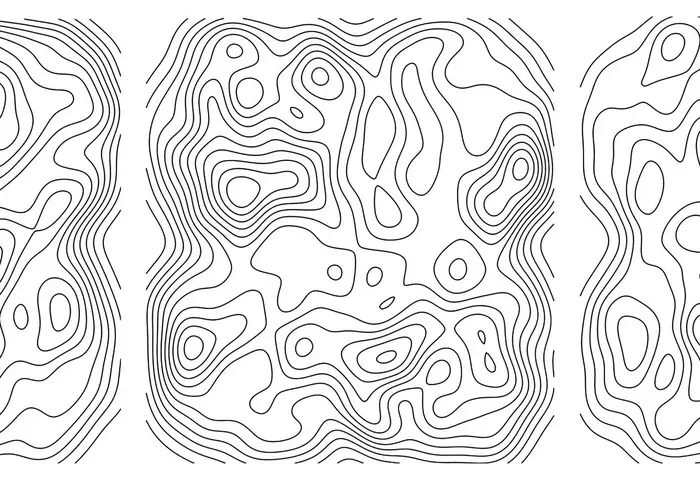
“Visualizing that with a contour map, much the way that a hiking map shows elevations, lets us observe the ‘fingerprints’ of dark matter in the distant universe.”
The data came from the ODIN survey (One-hundred-square-degree DECam Imaging in Narrowbands), which used specialized filters on Chile’s Blanco telescope to capture light from hydrogen gas in distant galaxies. Lead researcher Dani Herrera, a Rutgers doctoral student, processed images covering nine square degrees of sky.
Cosmic Real Estate Mystery
The most intriguing finding challenges assumptions about galaxy formation. In regions where dark matter created the deepest gravitational wells, perfect for galaxy formation, most remain surprisingly empty of these bright, star-forming galaxies.
This scarcity suggests Lyman-alpha emission represents a brief, intense phase of galaxy evolution. The researchers estimate these cosmic lighthouses shine for only 40 to 180 million years, a blink of an eye in cosmic terms. During this period, galaxies undergo rapid star formation with minimal dust interference, allowing hydrogen’s characteristic glow to escape into space.
The pattern also reveals these ancient galaxies likely evolved into galaxies similar to our own Milky Way or the Large Magellanic Cloud. By tracing their dark matter environments, scientists can essentially predict which cosmic neighborhoods will become major galactic metropolises billions of years later.
The research provides crucial insights into how the universe transitioned from its smooth, early state to today’s web-like structure of galaxy clusters, filaments, and vast cosmic voids. As the ODIN survey continues, it will examine over 100,000 such galaxies across seven cosmic fields, potentially revealing even more secrets about dark matter’s role in cosmic evolution.
These findings suggest the universe’s most spectacular star-forming galaxies represent fleeting moments of cosmic construction, briefly illuminating the otherwise invisible architecture that shapes everything we see.
The Astrophysical Journal Letters: 10.3847/2041-8213/adec82
If our reporting has informed or inspired you, please consider making a donation. Every contribution, no matter the size, empowers us to continue delivering accurate, engaging, and trustworthy science and medical news. Independent journalism requires time, effort, and resources—your support ensures we can keep uncovering the stories that matter most to you.
Join us in making knowledge accessible and impactful. Thank you for standing with us!