






















.jpg "Angélique Kidjo Announces Album With Pharrell, Nile Rodgers, and More")

















The leg comes off cleanly. A wooden plank, applied with enough force, severs one of the four limbs from the machine’s body. The robot staggers, recalibrates and then continues forward across the gravel, slower perhaps, but moving, its control system quietly redistributing the work among what remains. The detached leg, meanwhile, begins making its own way home.
That demonstration, staged and filmed by Sam Kriegman’s group at Northwestern University, is more than a party trick. It points toward something that robotics has struggled with for decades: machines that actually survive contact with the world.
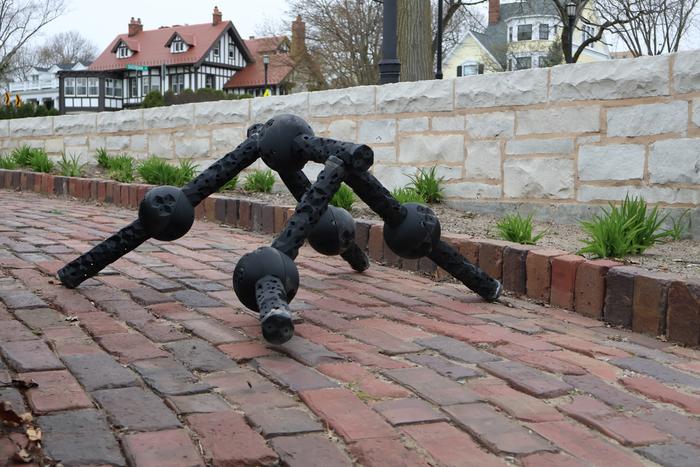
The robots in question are what Kriegman calls “metamachines”, assemblies built from autonomous modular legs, each roughly half a metre long when extended, each containing a motor, a battery and a circuit board inside a central sphere. “Inside the sphere, the robot has everything it needs to survive: a ‘nervous system,’ a ‘metabolism’ and ‘muscle,’” Kriegman says. “By that, I mean a circuit board, a battery and a motor. The modules are mechanically simple. They can only rotate around a single axis, but they are surprisingly athletic and smart.” Any single module can roll, jump (up to 37 centimetres, or roughly 154% of its own link length) or turn. Bolt several together, and something more interesting emerges.
The variety of forms that emerge is part of what makes the work unusual. Rather than designing robot bodies themselves, Kriegman’s team fed the modules into an evolutionary algorithm and let it churn. Hundreds of billions of possible configurations exist within a five-module system; the researchers compressed that design space into eight dimensions using a neural encoding technique, then used Bayesian optimization to traverse it efficiently, training each candidate design in simulation before selecting the most promising for physical assembly. “We simulated the Darwinian process of mutation and selection within a virtual, physical environment,” Kriegman says. “This is survival of the fittest, accelerated by computers and made real by athletic modular building blocks.”
The results looked nothing like a dog. Or a human, for that matter. The three-module design adopted a rolling, lurching gait reminiscent of a seal hauling itself across a beach; the four-module version moved in the asymmetric style of a tripedal animal; the five-module design propelled itself with compound limbs acting in sequence. A manually designed quadruped, built as a comparison point, moved with the sprawling lateral undulation of a lizard. All four configurations were then taken outdoors and pointed at whatever the campus grounds happened to offer: sand, mud, grass, tree roots, leaf litter, gravel, uneven brick. None had been trained on any of it. Zero-shot transfer from simulation to reality, with no fine-tuning.
The paper, published this week in PNAS, reports that all configurations handled the terrain, not perfectly, but consistently. The three-module design occasionally flipped itself on loose, low-friction surfaces, triggering its self-righting behavior (a separately learned policy, essentially an instinct baked in during simulation) before resuming. On some terrain the different bodies had clear affinities: the lizard-like quadruped preferred sand and hard surfaces; the seal-like three-module design performed well on hard ground and mulch but displaced loose gravel with its trailing limb before gaining speed. Each body, in a sense, had its own character.
“These are the first robots to set foot outdoors after evolving inside of a computer,” Kriegman says. “They are rapidly assembled and then quite literally hit the ground running. They can move freely in the wild and easily recover from major injuries that would be fatal to every other wild robot.”
The damage resilience is perhaps the most striking part. Most legged robots are architecturally centralised (a single torso from which legs depend), meaning structural failure anywhere in that chain is broadly catastrophic. The metamachines have no such single point of failure, because each component is itself a functional agent. The team trained an “amputation-agnostic” controller by generating expert movement policies across multiple damage scenarios, distilling their knowledge into a single policy that generalises in real time. When tested on previously unseen amputations (one hindlimb removed, both hindlimbs, all but a single module the policy retained locomotion consistently, at roughly 105 percent of the undamaged robot’s speed when intact, and useful forward movement in all tested damage conditions. “It can sense its surroundings, move from place to place, compute and learn,” Kriegman says. “Metamachines can be rapidly assembled, repaired, redesigned and recombined. Once assembled, they immediately move themselves across a wide array of unstructured environments.”
There are real limits here, worth being clear about. The robots cannot yet autonomously absorb new modules, reconfigure themselves in response to damage, or create copies of themselves. They currently communicate with a remote computer via WiFi (though the walking policies are, in principle, small enough to run onboard). And the docking system, bolted together with M4 machine screws and square nuts, rated to 150 Nm torque and 4 kN shear, which is genuinely impressive for 3D-printed hardware, and still requires human hands to assemble.
But the broader ambition matters, too. Kriegman reflects on earlier work from his lab, which produced robots that could cross a tabletop but were essentially blind to their own bodies: “Our previously evolved robots couldn’t sense their own bodies or coordinate themselves. But they still taught us a lot about how evolution works and how to distill those lessons into useful technologies. Evolution can reveal new designs that are different from or even beyond what humans were previously capable of imagining.”
The team reckons the modular leg design is simple enough to standardise and mass-produce, and the cylindrical link arms are entirely inert, 3D-printed structures bolted onto the sphere, meaning anyone with a printer and a screwdriver could substitute different geometries and experiment with new configurations. That distributed tinkering, they suggest, could generate morphological diversity beyond what any centralised research effort is likely to produce.
What that looks like in practice is harder to say. The designs the algorithm currently favours recapitulate some things evolution found in animals, broadly interpreted, and invent others that have no obvious biological analogue. The more interesting question, perhaps, is what happens when the design space is opened further and the machines are given the ability to rebuild themselves after damage. At that point the line between a robot and something stranger starts to blur.
DOI: https://doi.org/10.1073/pnas.2519129123
Frequently Asked Questions
Why can’t normal robots just adapt when they lose a limb? Most legged robots depend on a central body with legs attached, so damage anywhere in that chain tends to cascade through the control system, which was designed around a specific configuration. The Northwestern metamachines work differently because each module is itself a complete agent with its own power and processing, so the robot has no single point of failure to exploit. The team’s “amputation-agnostic” controller learns from multiple damage scenarios simultaneously, then generalises to damage patterns it has never seen before.
How does the AI actually design new robot body shapes? The researchers encoded the hundreds of billions of possible ways to connect up to five modules into a compact eight-dimensional space using a neural compression technique, then used a search method that builds a probabilistic map of which regions of that space tend to produce good locomotion. Rather than testing every possibility (computationally impossible), the algorithm directs its attention toward promising areas while training each candidate design in physics simulation before selecting the best performers for physical assembly.
Do these robots look like animals? Not exactly, and that’s rather the point. The three-module design discovered by the algorithm moves with the galumphing gait of a seal; the four-module version resembles a tripedal vertebrate (the configuration that naturally emerges when a quadruped loses a front leg). A manually-built comparison quadruped moves like a sprawling lizard. None were designed to resemble anything in particular, and the shapes emerged from what the algorithm found actually worked.
Could this approach lead to robots that repair themselves in the field? That’s the direction the work is heading, though it isn’t there yet. Currently the robots require human hands to bolt modules together, and they cannot autonomously reconfigure in response to damage. But the modular architecture is designed with that future in mind: once a module separates from the body it becomes an independent agent, and the researchers envision future systems in which separated modules could eventually rejoin or be reassembled without human intervention.
There’s No Paywall Here, But We Depend On You!
If our reporting has informed or inspired you, please consider making a donation. Every contribution, no matter the size, empowers us to continue delivering accurate, engaging, and trustworthy science and medical news. Thank you for standing with us!
Related