



























In 2017, Honey & Wax Booksellers established an annual prize for American women book collectors, aged 30 years and younger. Our goal, at the time, was to expand the popular perception of who book collectors are (and can be) by highlighting original collections built by young women, often without the knowledge or help of the rare book trade. By celebrating their achievements, we hoped to inspire potential collectors to look at their shelves differently, to identify patterns and projects, to think creatively about the aspects of the historical record they might recognize and preserve.
The response to this prize over the past nine years has exceeded all of our expectations, and this year’s cohort of collectors was particularly strong. We are delighted to announce the $1000 winner of the 2025 Honey & Wax Book Collecting Prize:
WINNER

Alexandra E. LaGrand, 29, (she/her), a doctoral candidate at Texas A&M University, for “Archiving the Shakespearean Breeches Actress.” LaGrand’s research on the nineteenth-century British stage led to her interest in actresses in breeches roles: performances in which a woman plays a part originally written for a man, as Sarah Bernhardt did when she starred as Hamlet.
LaGrand’s winning collection brings together almost forty printed and manuscript artifacts that document Shakespearean breeches actresses over the long nineteenth century. The collection includes books, letters, signatures, playbills, prints, a theatrical scrapbook, a prompt book from an 1878 production of Macbeth featuring “Miss Lewis” as Donalbain, and a core collection devoted to Charlotte Cushman, the first internationally renowned American actress, who was celebrated for her breeches roles:
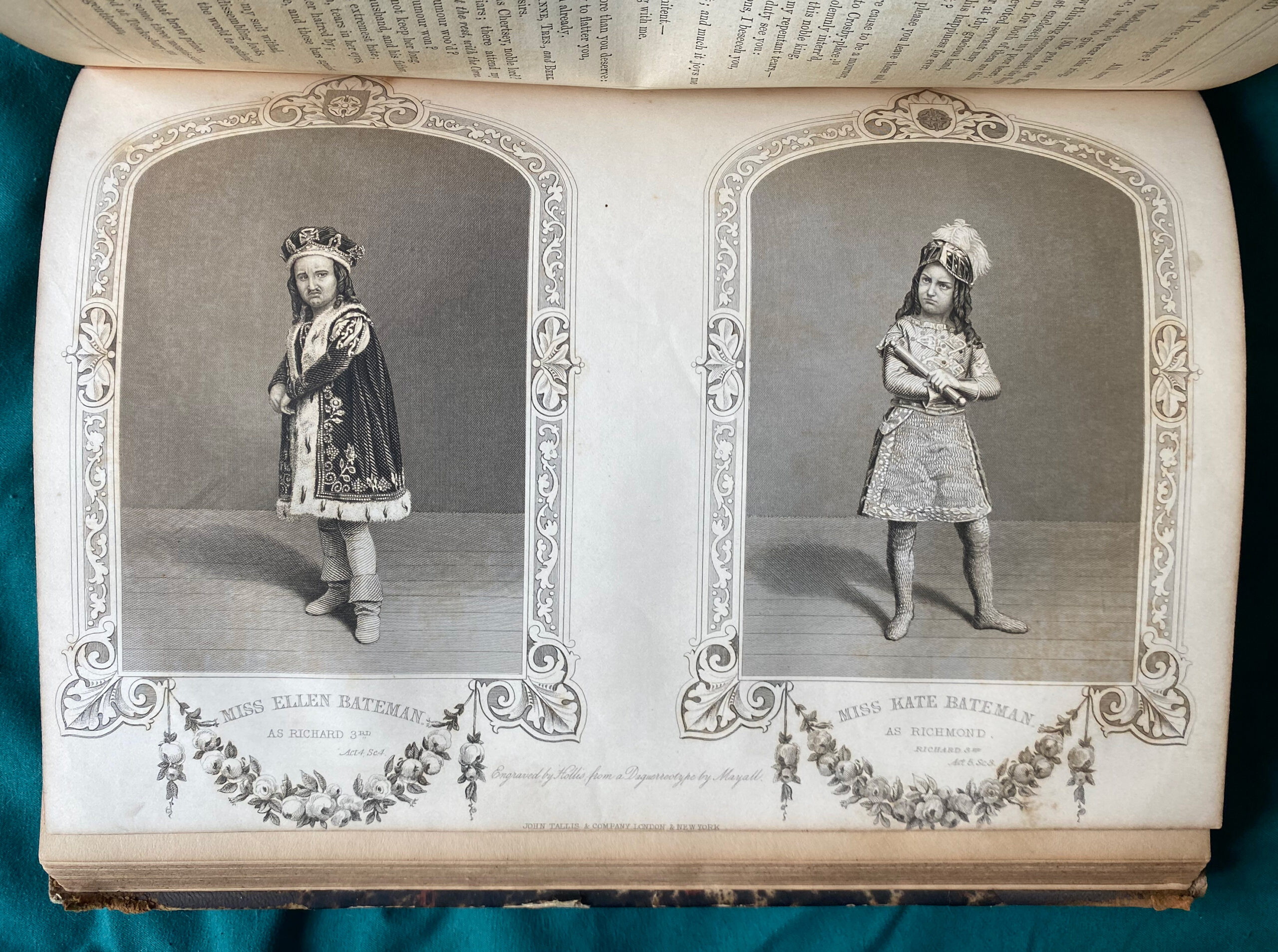 “I wanted to collect items [Cushman] had touched in order to closely feel the history of her career. This manifested through collecting ephemeral items such as a manuscript letter by her and a signature card, but also books, including an 1868 first edition of Henry Wadsworth Longfellow’s New England Tragedies, which bears her inscription to one of her lovers. As I collected more Cushman items, I grew more ambitious, seeking out wholly unique and thus more special and valuable items that documented her career, such as a grangerized first edition copy of Emma Stebbins’s 1878 biography of Cushman, featuring extra illustrations and materials tipped in throughout, an undated playbill featuring Cushman in the role of Romeo at the Winter Garden Theatre in New York, and even a carte-de-visite photograph portrait of her costumed in the role of Romeo.”
A digital humanist, LaGrand has created a public database, Points Like A Man, to compile historical records of genderfluid Shakespearean performance. We were impressed by the energy that LaGrand brought to the material side of her project: her bibliography describes a suspenseful, unfolding process of discovery, as each chance find in a bookstore or at auction or online opens up new paths of inquiry, highlighting the way that digital and archival resources enrich and expand each other.
You can read LaGrand’s winning essay and bibliography here.
*
We are also awarding five honorable mentions of $250 each:
HONORABLE MENTIONS
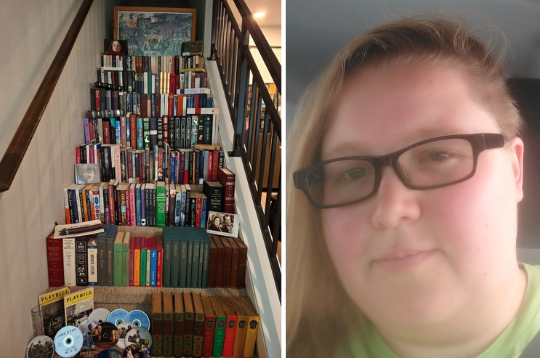
Ashleigh McConnell, 29, (she/her) of Washington State, a recent master’s graduate in Emergency Management pursuing a career in disaster preparedness and recovery, for “My Journey with Jane: A Tale of Discovery and the Birth of a Collector.”
McConnell has collected over three hundred editions and variants of her favorite book, Jane Eyre by Charlotte Brontë, with the goal of owning “a Jane Eyre edition from every year from 1847 to the present.”
McConnell began collecting during a study abroad trip to Europe, where she sought out copies of Jane Eyre in the native language of each country she visited. Over time, her collection became a memoir on the shelf, a tangible reminder of places she traveled, people she met, and bookshops she explored. She sought out a fresh edition of Jane Eyre in each of the lower 48 United States: “I discovered small town bookstores, library sales, antiques alleys, and used book stores of all sizes and shapes. Each new copy I found had its own character and its own story.”
Single title collections are popular in the book world because they create opportunities for collectors to explore a favorite book from multiple angles. McConnell eventually pursued not only copies of Jane Eyre, but prequels, sequels, pastiches, retellings, screen adaptations, the script for a theatrical performance, and even a “choose your own adventure” version of Brontë’s classic. We enjoyed the energy and creativity McConnell brought to her quest.
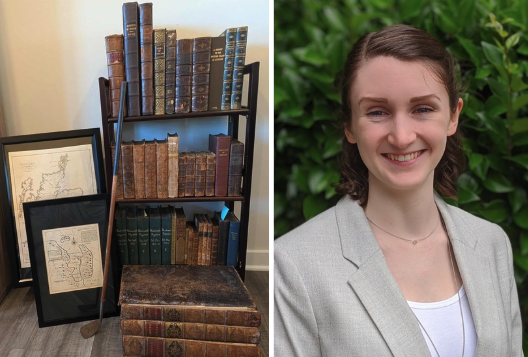
Nat McGartland, 30, (she/her), a doctoral candidate at the University of Maryland and instructor at UMD BookLab, for “Quhare scant wes Scottis: A Political History of the Scots Language.”
McGartland collects books that document Scots as a language of its own, a distinct historical and political mode of expression, rather than simply a regional dialect of English.
McGartland’s collection includes dictionaries, glossaries, and appendices in Scots, as well as landmark publications like the 1790 first printed edition of The Brus, the oldest work in Scots, and Gawin Douglas’s Scots translation of the Aeneid, which predates the first English translation. The renewal of interest in an independent Scotland, reflected in the highly contested 2014 referendum on the question, inspired McGartland to redirect her collecting focus: “I’ve found myself moving from the historical to the contemporary. I’m interested in Scottish women poets, fiction writers, speakers of the language in the present day . . . [and] the revival of Scots in literature particularly since the 1980s.”
McGartland uses her historical collection of Scots classics to inform and contextualize her emerging collection of Scots writing in the present: a pivot that strengthens both collections.
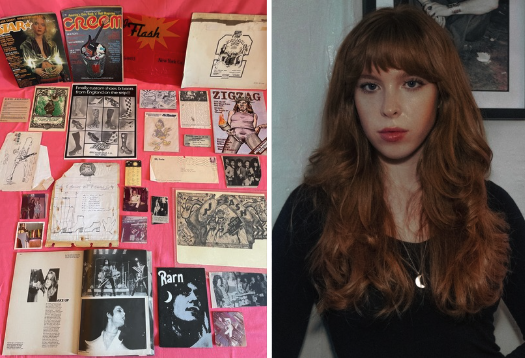
Bella Savignano, 24, (she/her), an administrator at Swann Galleries in New York City, for “Flashbang: Amplifying a Revisionist History of Glam Rock.”
Savignano’s collection began with a fluke gift: an old box of photographs, film negatives, and “assorted pieces of paper” from Jumpin’ Jack Flash, the NYC clothing and custom shoe store that defined the emerging “glam” aesthetic for rock stars, local musicians, and fans in the 1970s.
“I was curious about the mutant style that emerged when British glam fashion touched down in New York City […], the boutique’s role within it, and how it pertained to the local scene. As I devoted my free time to investigating my newly acquired archive, I was shocked to find very little. The brands that the boutique sold were iconic and are held within many important collections, but the store itself was lost to time.” Inspired by Jumpin’ Jack Flash’s advertising maquettes, footwear guides (one with a note to call Bootsy Collins’s agent), and snapshots of employees and patrons in full regalia, Savignano set out to fill in the archival gaps of that moment in all its feathered and sequined glory.
The result is a kaleidoscopic picture of the New York glam rock scene, as Savignano tracks down magazines, posters, concert tickets, even a manila folder of clippings about the New York Dolls collected by a contemporary fan. We appreciated Savignano’s focused attention to the material castoffs of a subculture, both to reconstruct its atmosphere and to weigh its impact.
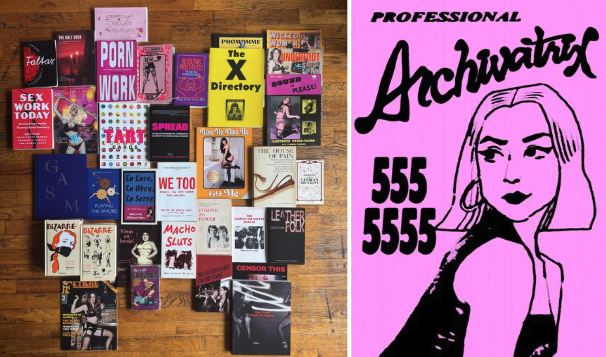
Amalia V., 29, (she/her), a professional dominatrix (and self-described “archivatrix”) in New York City, for “Collecting Sex,” a collection of over 150 books, magazines, zines, and pulps “at the intersection of one or more of the following categories: sex work, queer BDSM, and Female Domination (FemDomme.)”
Often printed and distributed outside mainstream publishing channels, these historical materials constitute “a form of cultural preservation for communities who are often ignored, reviled, and even punished for simply existing.” Amalia V. understands her collection as “a critical intervention in this blatant censorship of erotic laborers in our sex-phobic American cultural landscape. I might get kicked off of social media, but Mark Zuckerberg can’t pry my collection of kinky books from me.” We were struck by the rare and often ephemeral titles she managed to track down, including publications from the House of Milan (the only 1970s fetish publishing house headed by a woman), Mama Vi, Patrick Califia, and the leatherdyke collective Samois.
In lieu of a headshot, Amalia V. has provided an illustrated portrait in the style of the “tart cards” created by London sex workers in the late twentieth century, a graphic tradition well-represented in her collection. We were impressed by the nuanced view of contemporary sex workers that her collection offers, illuminating their identities as parents, activists, and community members.
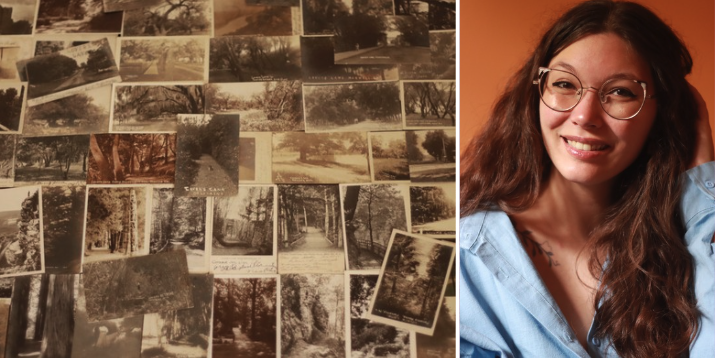
Jaeden Yoshikawa, 30, (she/they) of Mankato, Minnesota, a professional archivist enthusiastic for new career opportunities, for “A Trip Down Lover’s Lane: A Collection of Lover’s Real Photo Post Cards.”
Yoshikawa collects scenic ephemera depicting local “lover’s” tourist sites (Lover’s Lanes, Lover’s Leaps, Lover’s Retreats), aiming to explore “what defines a space for lovers, and how the histories and legends tied to these places might offer deeper insight into human relationships and sexuality.”
Yoshikawa focuses primarily on real photo post cards (RPPCs), “small-batch” postcards created directly by vernacular photographers from film negatives, rather than mass-produced printed images. RPPCs of lover’s locations have a special poignance, since the images often feature people known to the photographers, perhaps even lovers themselves. She also considers the iconography of lover’s sites on vintage ephemera, including sheet music: “The markers we’ve established for Lover’s Lanes are present even in these artistic renditions, showing tree-lined paths and shaded places for lovers to promenade. . . . I’d love to find a Lover’s Lane with a sandy beach path, or in a flowering garden, or in a desert somewhere to act as an outlier to the collection.”
We admired the depth and originality of Yoshikawa’s project, and soon began seeing images of woodsy “lover’s” tourist attractions everywhere, drawn into the cultural phenomenon her collection explores.
To see last year’s winners, click here.
The co-founders of the Honey & Wax Prize, Heather O’Donnell of Honey & Wax Booksellers and Rebecca Romney of Type Punch Matrix, would like to thank the 2025 prize sponsors: Biblio, Bibliopolis, The Caxton Club, Christie’s, and Ellen A. Michelson.