






























A Goat Farmer Is Only as Vulnerable as Her Goats
This article is free to read. So is every article Electric Literature publishes. No limits, no paywalls—now or ever. But we rely on your support to keep it that way.
We need to raise $35,000 by April 15 to keep the lights on, and time is running out.
Help us reach the next milestone—$15,000 by Wednesday—by donating now.
—————
An excerpt from Surrender by Jennifer Acker
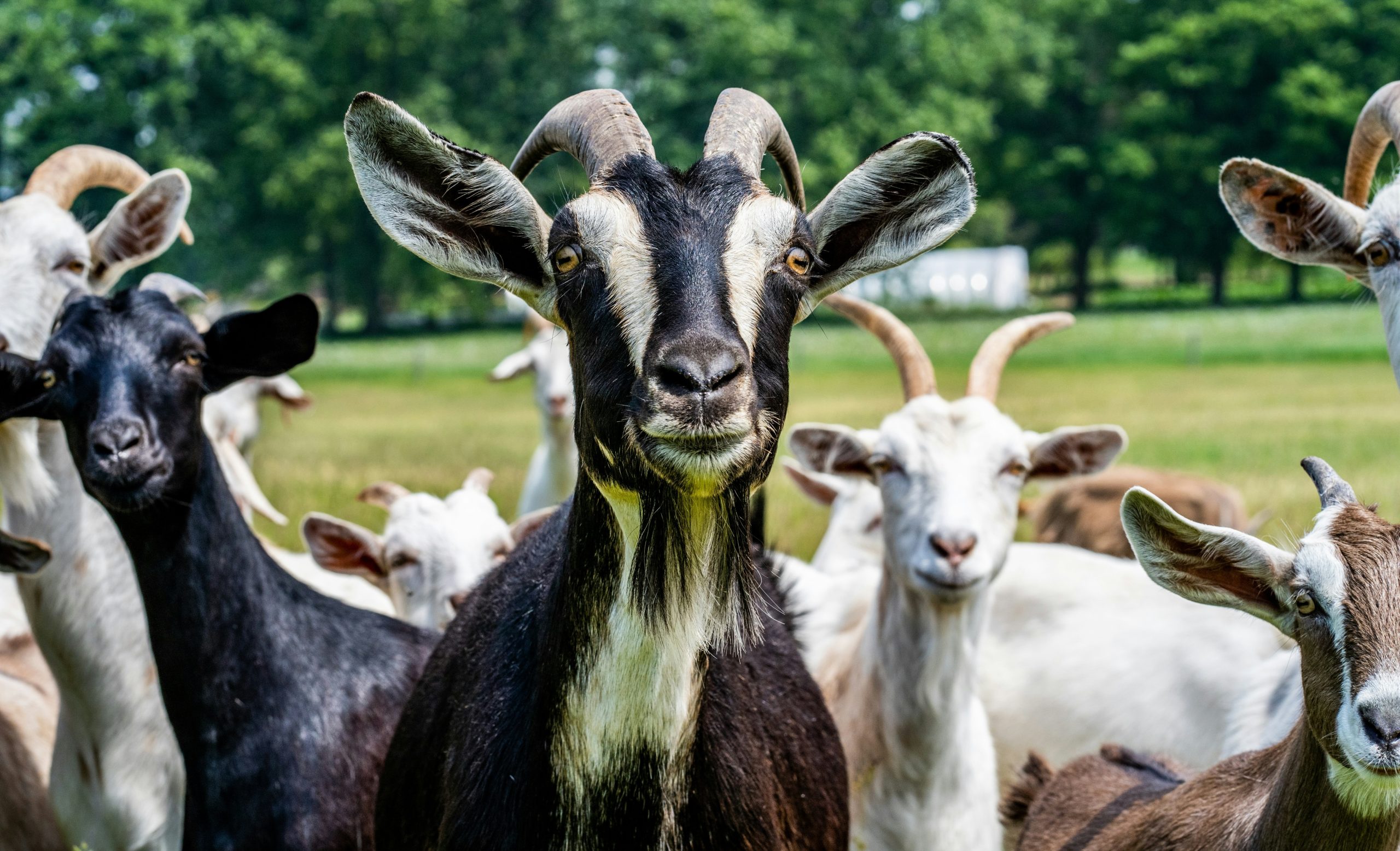
I was a small child, my head the height of theirs, when I noticed the black parts of their eyes were shaped like shoeboxes. But I didn’t know then that their rectangular pupils are adaptive. Goats take their meals on savannas or other wide-open spaces that leave them vulnerable to predators and the beating sun. Horizontal pupils let in less light from above and allow a wide field of vision.
Living with five Nubians—four does and a buck—I witness how nimbly they manage difficult terrain and remain vigilant at the same time. Because a misstep can be fatal.
The does greet me this morning by nibbling my flannel shirt, which I imagine tastes of woodsmoke and chicken broth. The barn smells of sweet-sharp hay, of pine dust, a wisp of ammonia that lets me know the straw bedding needs to be changed. It’s the heart of winter, and I pull the girls close.
The does are two months pregnant, so I’ve stopped milking to allow the young mamas to build their strength and keep their vitamins, which they’ll need to give birth to healthy kids come April.
A lot of people choose not to freshen does in their first fall, but I was impatient to grow my herd, to get a revenue stream going to stabilize the farm, and Judy said that as long as the girls were good sized and healthy, they’d be fine to breed. I’m thrilled every time I look at this burgeoning pack of curious females.
Yet it’s my first time as a goat midwife. Can I really manage the upcoming births on my own? We have no money to hire a helper or to call the vet if something goes wrong.
At least I have Judy on speed dial.
Opening the chicken coop, I let the birds loose and empty a bin of kale stems and squash rinds as an enticement to venture farther afield. Few eggs to collect this time of year, when the days are so short. The birds are healthy but they look horrendous, the runts and weaklings’ backs picked clean of feathers. Their bare pimpled skin shames me, even though my father’s hens looked the same, no matter what he did. “Lucy,” he’d tell me, “there you see the meaning of pecking order.”
I’d planned a lot of indoor projects for the winter milking break, but that was before Michael lost our money and we needed immediate income. So today, instead of YouTubing a toilet fix, I’ll be testing the endurance of my gluteal muscles, sitting on my flat butt at the Edin General Store.
I hear Michael calling me as soon as I take my boots off downstairs. He’s perched on the side of the bed, eyes a faded brown, head bald, just a few stray tufts to the side. A birdlike Roman nose that anchors his still-handsome face.
He tells me he wants to go for a ride in the new snow. He gestures out the window at the thick layer smothering the fields. We look together at the boot prints I’ve made between the house and the barn. “You’ve already been out in it,” he says. “Now it’s my turn.”
Not only does he want to see the snow, but there are library books being held for him, and a bacon and egg sandwich at Franco’s with his name on it. “Let’s go out for breakfast, bella. I’ll read you the obituaries. You love the life stories.”
Of course I do, and I love it when he reads to me, but we don’t have enough time for an outing. I offer to run out and pick up the books and the sandwich.
But no. He wants to get out of the house. His voice is both firm and pleading.
Changing his own socks into thicker woolens and wedging shoes onto his swollen feet can stretch to a quarter hour. Then getting his arms into each sleeve of a parka, plus scarf and hat. The driveway has been plowed but there’s still a slick of ice, and I shiver just thinking about leading him across it to reach the passenger door, then holding the full weight of his seventy-nine-year-old, six-foot frame to transfer him into the depths of the car seat.
I don’t want him to feel a burden, and I don’t want to pity him, so I tell him simply that we don’t have time. I’m due soon at the store.
This does not sit well. Michael’s forehead reddens and the corners of his mouth press down. He repeats his desire for an egg sandwich.
In case what he really wants is to be doted on, I say, “Why don’t you come into the kitchen, I’ll fry you eggs and toast, and you can admire the snow from there. See if there are any deer in the back field.”
“You’re just being selfish,” he mutters.
I pause, startled. These short, angry flares are new and I’m not yet used to them. They’ve arrived in the wake of the giant loss Michael incurred, which has thrown me back into the vexed center of my parents’ financial strain. We always had enough, but there was no fat in the budget, and Mom and Dad never once took a vacation longer than a three-day weekend, or pricier than an unelectrified lakeside bungalow. I have, it seems to me today, simply given up city comforts for the quaintly beautiful privations of the country.
I shower quickly, warmed by the hot water if dismayed by the rusting tub. I emerge with a soothing voice and suggest to my husband that I put on a movie. Make popcorn. We have a complete library of Gilbert and Sullivan and he chooses The Pirates of Penzance. “Watch with me, bella,” he says invitingly. He pats the couch cushion next to him. Removes his glasses and rubs his eyes as if to better appreciate me. Smiles. His bad mood has apparently already vanished, as quickly as our savings account dropped to zero. But I cannot stay. I have too much to do.
How do I manage my anger and despair? Well, that’s why a woman has a barn.
Because I’m late—flustered by the regrettable exchange with Michael, then by trying to settle him down in front of the TV and set aside something for his early dinner, labeling the container with masking tape that says eat me—Shruti is behind the counter at Edin General, where I should be, ringing up two Slim Jims, a string of lotto tickets, and three packs of Camel Lights. I’m sweating, my scarf trailing to the floor to the extent that I step on it and nearly choke myself.
“I can see how it’s going,” Shruti says, pointing to my pink face and hair matted across my brow. She takes the scarf, the hat, and my jacket, putting each in its cubby or hook to the side of the counter. As always, she looks immaculate and yet perfectly casual in her jeans and clean sneakers and brown and cream cardigan with coconut shell buttons. The color combination makes me think of Felicia, my favorite doe, and for a moment I long to be back in the barn surrounded by lop ears and so many beating hearts.
“Tough morning?” Shruti asks with concern.
If I say anything about the murky state of my husband’s mind, or the dire straits of our financial situation, I’ll cry myself a river. A nod is all I can manage.
Shruti tries another tack. “Did you see the game last night?” She is a Celtics superfan, having become hooked on the NBA through trying to bond with her son, now an assistant professor at one of the nearby colleges. “If he doesn’t give us grandchildren in five years, we’re going to sue him,” she joked recently. Shruti is dying to attend a Celtics game in person, though when I ask her why she hasn’t looked for tickets, she shrugs sheepishly and says her son is too busy to go with her. Apparently, Hari, her husband, does not share her passion.
“Sorry, hon. Missed it,” I say.
She tells me “our” team lost to Philadelphia 89–80. “Kyrie didn’t play,” which I guess explains everything.
Glumly thinking about her team’s loss, Shruti gives me a last look of concern, then leaves for the back room, where she has calls to make.
How do I manage my anger and despair? Well, that’s why a woman has a barn.
I open the cash register to the hand-worn scent of bills and coins and ink from leaky pens. The ding and thrust of the jaw opening and closing has the satisfying feel of childhood toys.
Shruti has given me the exalted title of associate manager to justify paying me ten dollars above minimum wage plus a small bonus at the end of the year. In addition to staffing the register, I help with inventory, checkout, writing and proofreading announcements and advertisements. Shruti and Hari hired me in part for my deep roots in the community, even though I explained that I’d been away so long, my contacts were limited to my parents’ now elderly friends and those from high school who never left. “Those are precisely the people we want to attract,” Shruti assured me.
“How much is this, and how do you eat it?” A lanky, dark-haired boy with bangs in his eyes holds up a package of Shruti’s frozen samosas. They are delicious, as good as Michael and I have eaten in any restaurant. I tell the kid what they are and how to reheat them in the oven so they get nice and crispy. A package of six is ten dollars, but because I want him to try them, I give it to him for five bucks and plan to slip the other five from my wallet into the register once he leaves.
“They go well with beer,” I say. “Try that IPA in the blue can; it’s from a brewery just on the other side of the river.”
“Yeah, I’ve heard of it,” he says, and shrugs. “Okay.”
I pack everything up and take his card. Then I hold out the chutneys, mint and tamarind, displaying them in the palm of my hand like precious stones. I explain they’re like salsa, a dipping sauce. “Come back and let me know if you like them.”
As much as I love Shruti, I often find the store disquieting, not only because I see people I used to know, or should know, or no longer want to know, but because I can be interrupted at any moment. That’s what makes retail the pits, as my mother used to say. It’s hard to believe that I worked for twenty years in a field where all you do is talk to people. I always found PR spiritually effortful, but I thought that’s just what a real job was. To make real money, you had to escape the provinces and do things you didn’t want to do.
I’m relieved when the doorbell sounds the young man’s exit. My eyes mindlessly follow him to his car waiting on the road’s shoulder, engine running.
Just then, the door to the house across the street opens, and a tall, well-shaped woman in stylish thick-heeled boots rushes down the stairs to the street.
My breath catches. I lean closer and jut my nose into the windowpane.
Then I rush to the back room, where Shruti is on the computer. “The woman across the street in the old Masonic Lodge. Do you know her?”
My friend peers at me over her computer glasses. “Alexandra Stevens? Just a little. I met her on the sidewalk last week. Why?”
“We went to high school together.”
“Were you friends?”
“Very close, for a time. Do you know why she’s here?”
Shruti looks at me curiously, a sly smile playing on her lips. “I guess she couldn’t stay away, like you.”
I shake my head. Back then, Sandy didn’t have a country bone in her body. That was part of what drew me to her.
I want to rush out and hug her. To share the shock of being back in Edin as adults. But I’m also hesitant. I’d always assumed Sandy left the way she did because she couldn’t stand to stick around our dumpy town anymore. And that included dumpy me. I look down at my wrinkled, untucked shirt and my dirty boots. Well, she wouldn’t be surprised at Lucy in the present day.
I return to the counter and watch out the window as Sandy fishes for her keys. I’m crouching. I don’t want her to see me. When I think of it through Sandy’s eyes, I’m embarrassed to be working at the store. More than once, living in New York over the years, I thought, If only Sandy could see me. She never did, and after all our teenaged talk about getting out of this place, it looks as if I’ve never left.
What’s she doing back, and what would she think of me now? I also can’t help but wonder if she’s sorry.
It was, at first, a triumphant return.
I quit Columbia’s PR office, and Michael retired from the university’s Classics Department. We planned to subsist on his 403(b) and our joint savings, while he enjoyed the writing life and I took over my father’s farm.
What a wonderful idea this was!
My husband was seventy-seven, and I was thirty years younger. We thought we had ten good years ahead of us. Michael was healthy, still walked all over the city, and his mother had lived to ninety-five. We still had sex most Saturday mornings. He’d never been self-conscious of our age difference. I wasn’t embarrassed, but I did notice the way people looked at us, wondering if we were a couple or father and daughter.
Five years before our move, during a stretch of intense craving that felt like the kind women describe when they want a baby, I suddenly wanted to keep goats and make my own yogurt and cheese. My father, thrilled, swiftly began a persuasion campaign. He was waiting for his heart to give out, and he told me bluntly that he’d die easier knowing the land would continue as a farm. He lived in fear of our family’s acres morphing into suburban sprawl. I was the only one left to save them. My mother was long dead, and my sister had left Edin at fourteen for boarding school and now lived contentedly in Westchester County.
Dad always said our land was more than a source of income. It was a landmark in town, referred to by our family name, the Richard Farm, and he’d been generous in allowing a local organization to build a section of trail across one corner of the back field that connected to a longer walking route through the conservation area. Dad wanted people to enjoy the farm’s bounty, whether by walking across it or eating what we raised.
Columbia gave me an unpaid leave, and I interned with Judy Martin at Birchbark Dairy in the Berkshires, two hours west of Edin. I’d called her after discovering her ash-covered, aged goat cheese at Murray’s.
Farming, that summer, was an urge I suddenly couldn’t ignore. And having reached my forties, I felt more entitled to follow such urges than I did when I was young.
Judy, who wore her hair in two gray braids, a whimsical daisy or dandelion woven in, would wake us before dawn and carry strong black tea with milk and honey in a thermos to the barn. After three hours of milking, feeding, and making the rounds, we’d return to the kitchen and eat hard-boiled eggs. Judy didn’t talk much until she’d eaten. If she thought I needed to witness something, she’d whistle like a whippoorwill and point. Those largely silent mornings of companionable labor were often my favorite parts of the day. Feeling a part of a natural rhythm and relishing the glowing sunrise on my cheeks.
Michael visited once during my months apprenticing with Judy, but for the most part he fell back into his urban bachelor routine of movies on Tuesdays and chess on Fridays. Cooking for a friend on Saturdays. In truth, that was still his routine after we married, except I didn’t play chess, and his social circle expanded slightly to include friends of mine from college and the office, women who were mystified by the age of my romantic partner but did their best to be supportive.
At Birchbark, I went to bed with earth under my nails and the smell of milk in my nose. I slept like the newly born.
At the end of the summer, I didn’t want to leave. I didn’t want to go back to city life. But I did, stuffing disappointment under my blazer each morning. I tried to imagine a way I could ease Dad’s worries about encroaching development and satisfy my own new craving for space, for the heady scent of summer soil, for raising bleating baby goats. Would my urban husband go for it?
He would. Michael still adored his graduate students and paternally advising them, but he’d grown distant from the undergrads and tired of his own performance in the lecture hall. I’m ready for the next adventure, he told me. A little house in the country in which to write his slim, popular Roman histories.
I took Michael to the farmhouse deck and spread my arms at the vision I had been nurturing for the better part of a decade. Behind us were the house, twenty acres of vegetables, and the country road. In front of us unfurled another twenty acres of relatively flat field, but then the land sloped upward into uneven hills, forested along the top ridge. You could see these hills from the road. Bikers and drivers often paused in the spring to photograph the flowering meadows and, in the fall, the brightly burning leaves.
Michael shook his head in wonder, the look that I was going for. The one that came across his face when he stood inside the Pantheon, no matter how many times he’d peered up into its dome. “Carina come una foto.”
These fields are more than a pretty picture to me, though. They’re a source of profound nourishment.
We decided to move to Edin, provided I agreed to first spend six months in Rome, the city he’d eagerly shared with me over the years.
When I told Dad that I’d take over his farm, I felt like the prodigal daughter. A grin an acre wide spread across his face.
“I never gave up on you,” he said. “No matter all your years away.” Then he cautioned me, “But you really have to do it. Work the land, I mean. That’s the only way to keep the tax breaks. Otherwise the property taxes and the upkeep will eat you out of house and home.” He died a year later, fully at peace, he assured me. My sister Sue was perfectly happy to leave the farm in my eager hands.
Of course I would farm it. I just needed to start small and learn along the way. At that point, Michael and I had plenty of savings to keep us going until the land turned a profit.
Our parallel visions of country cultivation and literary productivity worked according to plan our first year back in Edin, as Michael typed away on his Olivetti and I planted my first garden in thirty years. The harvest went smoothly, and I reopened the farm stand at the corner of the front field. I made a plan for our hundred and one acres. Built a rudimentary milking parlor and cheese room to get my state inspection. I wanted to start out all organic for the dairy, but the price of organic feed shocked me into making that a goal for a few years down the line.
After Judy’s does kidded last spring, I took home two mamas, Nana and Brie, and Nana’s two doelings, Bora-Bora and Felicia. Also a proven buck, Derek Jeter (Judy is a Yankees fan). I handled the kids from the get-go to accustom them to my voice and smell. It was love at first sight.
Also in April, I deducted the cost of every purchased animal and pound of feed and, in exchange for the near evaporation of my property taxes, swore to the government—as Dad had done—that I would not develop the land for ten years.
I handled the kids from the get-go to accustom them to my voice and smell. It was love at first sight.
Slow and steady, I’d build my dairy, consulting with Judy along the way.
And then six months ago, the whirlwind summer harvest underway, as we were dripping in tomatoes and melons and everything green, something curious occurred. When I went into the bank to apply for a home equity loan to replace our leaking roof and invest in more animals and equipment, I discovered a craterous hole in our savings.
Had we been swindled? I raced home to ask my husband what he knew.
As he explained, his eyes expanded, the pupils widening into larger and larger circles. A look I’d seen before. Sudden, extravagant purchases used to appear in our apartment from time to time: a top-flight Vitamix, tickets for a last-minute flight to San Francisco. Many of these luxuries on the border of affordability I was guilty of enjoying. Neither of us grew up with money, and we relished the finer things. His excuse was always some discount or time-limited window (truffles enjoy such a short harvest season!). In this case, he had “loaned” the money to Alfie Romano, a beloved former grad student, Italian-American like Michael. Alfie had always been special. He’d dined at our apartment nearly every Friday for five years. Michael had been devastated when Alfie quit the program, but I had seen that the young man was not cut out for the slow pace of academia. He was a thrill seeker with great ideas but poor execution. Unfortunately, Michael had never been able to recognize his brilliant student’s flaws. So when Alfie launched his machine translation company and exhausted his first and second rounds of funding, he’d come to Michael as a last-ditch effort. “I couldn’t bear to tell him no,” my generous husband said, his long face pulled down into sadness. “Besides,” he said brightly, “it can’t fail. We’ve gotten in on the ground floor!”
“There’s no ‘we’ here,” I said, still in shock. “What were you thinking, doing this without talking to me?”
“We’ll be fine,” Michael said. “We’ll get it back and then some.”
“When?” I reminded him about the leaking roof, the sagging barn. The dairy enterprise that lay dormant, waiting for funds to expand. My whole reason for moving back to Edin.
“Soon, my dear. Be patient. Genius takes time.”
I was furious. A hole gaped in the pit of my stomach. How would we manage?
But I also saw something terrifying in that moment. The flippancy of his answer told me that Michael had not thought through Alfie’s plan. When I asked him questions, he was evasive when normally he’d have exuberantly dived into the details. Something had clouded his judgment. Had Alfie pulled a fast one? Or was the problem internal to my husband?
Genius might take its sweet time, but I didn’t have to wait long for the results of Alfie’s venture. Michael woke up one morning three months ago, took a phone call in his office (my sister Sue’s old bedroom), and reported that Alfie’s business had failed. “It is no more,” is the way he put it.
There would be no return on investment. Nor a return of our investment. The ground floor had fallen through.
Yet Michael seemed to show no real understanding of the bind this placed us in. “I’m in my last years, I don’t need much. I’ll eat like a bird,” he said. Was that a serene smile on his face? Why did he show no remorse?
I called Judy in a cold panic.
“Good thing you’re freshening the does,” she said matter-of-factly. “Now you’ll have something to sell.”
I heard voices in the background. “You have company?” I asked. “I don’t want to keep you.”
“One of those silly talk shows,” she said in the same even tone.
I was too concerned with my own predicament to ask what she was doing inside at noon on a Saturday at the height of breeding season.
During my internship, I had asked a lot of questions. Usually, they were about the goats. But one morning, standing in the hayfield, Judy about to mount the tractor, the July sun shining down from high above, I asked if she ever got lonely; her closest neighbor lived two miles down a dirt road.
“Sometimes, at Christmas, I wish someone would roast me a goose,” she said, half smiling. “Big, luscious meals are for sharing. Of course, I have Brad, but he likes to travel with his friends and I’m not the hosting kind of mother, so I try not to put pressure on him.” She looked at me with eyebrows raised, wondering if I understood.
I did. Possibly I was so drawn to Judy because my mother died when I was in college; that would be the psychoanalytical interpretation. Except Judy wasn’t maternal in a classically nurturing way. She was about the transfer of information and valuing every living being’s special properties.
“So yes, I do get lonely for conversation. For sharing milestones. But the day to day . . .” She shook her head. “Nah. I have an abundance of life to keep me company.”
God, I admired her in that moment. I never again doubted her solitary contentment. I can do this on my own, I said to myself after hanging up. Just like Judy.
When I arrive home from the store, Michael is already asleep. I change into my barn clothes. A frigid sleet is from the sky.
But the does’ comically droopy ears lift my spirits. As I feed them, I admire Brie’s rich chocolate brown coat. She’s the most aloof of the four. Nana’s face is beige and white, and she’s still protective of her daughters, Felicia and Bora-Bora. Felicia has a wispy black beard and rubs her head against the side of my thigh affectionately. She’s my favorite, for the way she tilts her head when I speak to her, as if ardently listening.
All four paw the floor and bang impatiently against the slats that separate them from the feed trough.“I’m on it,” I tell them. I pour fresh water, noting with satisfaction the success of my low-budget solution to keep the water from freezing: a plastic bottle filled with saltwater floating on the surface, bobbing just enough to break up any ice. Someday I’d like to heat the goats’ drinking water in winter, to lessen the shock to their systems, but right now the extra electricity is beyond our budget.
I haven’t eaten since lunch but it’s been a long day. I chomp a wedge of Judy’s alpine-style cheese, call that supper, and get into bed.
Some hours later I’m awakened by a crash. Followed by a weak cry.
Michael is tipped over the sofa, his white T-shirt gleaming under a sliver of moonlight. Bare legs like plucked drumsticks.
He must have heard me come into the living room because he says, his voice muffled by the cushions, “I can’t move.”
My heart speeds up as I race toward him, nearly tripping on the coffee table. “What happened?”
“Lavatory,” he says. Where he was headed. “Carpet.” The shag that tripped him.
“Does anything hurt?”
Together we bend his knees so his lower legs are flat on the floor and he is able to wrestle his arms underneath him and push his torso up so he’s in a kneeling position. He’s sweating lightly and I feel his heat. Not once in the past few months have we been naked together, touching like we used to. He clasps his hands into a mock prayerful position. “Like the good Catholic I am.”
Please, God, let this not be the first of many. That is my useless supplication.
I get him up on his feet and walk gingerly to the bathroom. I wait while he waits—“Damn prostate”—and then support him as he walks back to bed, a noticeable wobble in his step.
“Do you need anything checked out? Sure nothing hurts?”
“I fell into the sofa, bella,” he says testily. “Not the bookcase. I’m fine.”
Despite his protests, I sit with him while he settles himself and falls back asleep.
And then I get to work. I turn on all the lights and pull on thick gloves, gather a pair of pliers and a large, sharp X-Acto. The first incision is tough, exhilarating work. I cut another strip and another, moving furniture as I go. With pliers I pull up the staples and then tug on the golden shag. Decades-old dust rises and I cough, remember a mask Dad kept in the pantry, and fit that on.
As I yank and pull with all my strength, I think about Sandy, the glimpse of her out the store window. An unnamable emotion rises within me. Am I still mad at her for leaving the way she did?
We were besties for all of high school—as soon as Sandy moved here from suburban Connecticut before the start of our freshman year and we both went out for soccer. We loved each other; I feel sure of that. We were always hanging our arms over each other’s shoulders, wrapping them around waists, sleeping with legs intertwined. This felt natural and normal, but sometimes we were made to think it wasn’t. Some guy would say, “Why don’t you two make out already?” But that didn’t bother us. It was strange that I was closer to Sandy than I was to my sister Sue, and for a while I think my parents felt bad about the contrast, but they liked Sandy so much, she was soon part of the family.
Summer after senior year I was working for Dad on the farm, which Sandy thought a bad idea. “Scoop ice cream with me,” she said. “All you’ve ever done is farm. Employers want to see a diversity of experience.” Something she’d read in the newspaper or heard from our drippy guidance counselor. She’d convinced the owner of the ice cream stand to give her the title of manager because she thought that would help her get better internships in college. But Dad counted on me, and I liked being outside. I didn’t want to sweat inside some tiny shack, even with Sandy by my side.
The plan that final day had been for me to ride my bike to The Big Dipper, then we’d put my bike on the back of her car and drive out to the lake. The previous night had been normal, cozy; we’d gotten tipsy on my father’s beer after swimming in the river all afternoon. Sandy fell asleep in my bed. The next day I rode the fifteen mountainous miles to the shack. But when I got there, her boss said she’d never shown up. Nor did she after I waited for her all afternoon, the boss finally taking pity on me and giving me a milkshake, an order gone wrong.
Too embarrassed to call my parents, and knowing they were busy anyway, I rode all the way back home, up and down the fierce hills, crying most of the way.
I called Sandy’s house, and her mother told me she’d left early for college. “She didn’t tell you?” Mrs. Stevens sounded surprised. “Guess that explains her bitchy mood.”
Sandy wrote one rambling, apologetic letter to me at Barnard once classes had started. I wrote back, holding my anger and pretending I understood that she was just “super anxious to get a job and settle in before Sept.” I asked if she’d be home for Thanksgiving, but I never heard from her again.
“Girls this age,” my mother said, shaking her head. “I know I was one, but I’ll never understand them. I can’t believe Sandy, our Sandy, would be so rude and heartless. Try not to take it too hard, chicken.”
Mom tried her best, but how do you get over such heart- break at eighteen?
I labor, sweating heavily, until the ghostly pre-dawn hours. Tomorrow I’ll call the plumber and fix up the back bathroom so my beloved no longer has to traverse the living room to pee in the middle of the night. Should have done that months ago. But months ago that haunted look didn’t flicker in Michael’s eyes. A look I mistook, at first, for guilt over throwing away our savings, but now I wonder if there isn’t something else going on. Something we both have chosen to ignore.