Unless you’ve been on an extended digital detox this year, you can’t have missed how a certain flavor of AI hype has been accelerating down the tracks like a runaway train. But far from the viral buzz swirling around developments in generative AI tools like ChatGPT and DALL-E, Konux, a Munch-based deep tech AI scale-up, has been quietly trucking along applying machine learning to transform transportation on the railways. It’s building out a SaaS business powered by proprietary sensing hardware and AI that drives a predictive maintenance software-as-a-service play which is upgrading railway infrastructure, one switch at a time.
Its mission is to drive digitization and transformative change atop what remains the most sustainable mass transit option humanity has — rail travel — using AI plus IoT (Internet of Things) to add intelligence to fixed rails by capturing real-time data on what’s happening on and to the railway network.
It’s doing this at a time when rising demand for train travel as consumers look for ways to reduce their carbon footprints is fuelling a push by governments and railway operators to digitize networks and transform established ways of working with the help of new technologies. That’s creating opportunities for startups to roll up their sleeves and get their hands dirty, although Konux reckons it was first to the punch. (And no surprise it was founded in Germany where the question of whether trains are running well and on time is a perennial political issue.)
“The core problem is something that actually is a dirty problem,” says Konux CEO Adam Bonnifield, discussing what makes this AI business different from the ones hogging most of the global limelight right now. “It’s not one of these clean, AI model-building totally digital problems. It’s the dirty problem of getting sensors to survive the environment, extracting the data, making sense of it, fitting it within the business problems, with the customer, and then bringing along the organisation on a journey through a bunch of organisational changes.
“These are the problems that make your change impactful and leave a legacy behind, I would say.”
Unpacking Konux’s business a little more, it’s using deep tech methods and stress-tested connected hardware to gain visibility into the loads and forces railway lines are accommodating day in, day out — measuring vibration through the tracks to pick up anomalies that may signify failures incoming — and then presenting its probabilistic analysis of what’s going to happen to the infrastructure over the next few months. Its AI-driven predictions were developed to a 90% accuracy standard, per Bonnifield.
The customers for its technology, railway operators, receive predictive maintenance insights delivered in an accessible software interface that’s designed to take the strain out of running vital infrastructure. No more flying blind with scheduled guesswork; track-mounted sensors and machine learning models aim to empower operators to make smarter calls around maintenance, underpinned by what are now “billions” of train traces recorded over a decade or so of Konux’s team attacking this data problem.
At the passenger end of the line (assuming successful implementation of the tech and use of the tools), this application of AI should manifest as reduced service downtime and fewer delays. So forget sloppy general purpose AI; here’s a data-play on rails which signals how machine learning that’s tightly targeted at a specific problem can be the truly impressive feat of engineering.
In addition to predictive maintenance, Konux’s AI + IoT approach supports rail operators with further business intelligence around network traffic and usage; plus — more recently — support with scheduling. Currently it offers three products; the aforementioned Konux Switch (predictive maintenance); Konux Network (usage monitoring and inspection planning); and Konux Traffic (smarter timetabling).
The idea is to leverage AI and IoT to power data-driven decisions that can drive optimization around other aspects of rail operation, expanding out from Konux’s first focus on tracking infrastructure stress at key points on the network. (Switches being both essential for routing train traffic around a network and vulnerable to failure, given they are mechanisms with moving parts.) Per Bonnifield, it expects to be able to develop more products as it continues to deepen its view of what’s going down on the rail line.
Overall, the tantalizing pitch for what Konux’s AI- plus IoT-enabled digitization of the railway will be able to achieve — by, essentially, doing away with the need for unplanned maintenance — is the unlocking of serious amounts of unrealized capacity. Being able to run twice as much capacity off the same train tracks is the promise.
And if humanity can get that much extra out of an existing low carbon form of transportation without needing to physically expand railway infrastructure it bodes well for tackling the climate challenge. Indeed, it’s exactly the kind of optimization we have to shoot for if we’re going to avoid climate disaster. (NB: For now, Konux is still only monitoring a minority of the rail networks where its products have been deployed — but of course it’s gunning for full digitization and maximum impact.)
“You can run twice as much passenger and cargo throughput and in a safer way,” asserts Bonnifield, fleshing out the startup’s transformative promise — if Konux can scale uptake of its tech across the railways. “Because you have more visibility into what’s actually happening in the network.”
“This is one of the biggest pain-points that the people who operate these networks have; that they’re operating completely in the dark,” he goes on. “They put together these timetables, and they put together these maintenance regimes, and these inspection regimes, and they’re guessing — based on, for example, planning inspections in a network.”
“It’s very rare to say when you when you join a company if we’re successful we will be a major force in saving the planet,” he adds. “And it’s not that hard to draw a pretty straight line between the work we’re doing today and that impact, right, and so that’s, I think, a very uplifting thing about the power of AI.”
The lack of visibility rail operators typically have on what’s happening to the tracks means delays can easily cascade into major bottlenecks that cause huge operational disruption — expressed as sheer misery for passengers wondering how, for instance, a five minute late train on the display board has suddenly flipped into a 50min+ delay. By giving operators greater visibility into their networks, Konux’s conviction is that dynamic traffic management becomes possible and small delays don’t have to cascade into major bottlenecks. With, then, the ability to unlock substantial rail capacity wins by taking advantage of reduced delays and fewer shutdowns plus more reactive and dynamic train routing. (You could even envisage the system offering dynamic speed-per-weight recommendations on loaded trains with the goal of minimizing wear-and-tear on the tracks, for instance.)
“If you can approach this traffic management problem differently, where you’re able to better anticipate the kind of cascading effects of disruption which is a hard optimization problem to solve and you need a lot of data about what’s happening in the network [to do it],” says Bonnifield. “This can therefore be a game changer in how you manage [rail network disruption] from a passenger perspective. All you know is that the train to London is always on time but… from the perspective of the people who are operating the network, it’s a completely different way of getting you the right train at the right time.”
“We know we will need to double the capacity of rail networks. Just because it’s what’s going to be demanded by our global climate commitments,” he continues. “So there needs to be this massive push to rail as a preferred mode of mobility. And today, there is no solution for it. Because we can’t build more track, at least not in Europe… so we need to figure out how to rethink the way that we operate and maintain rail networks in order to find this missing capacity.
“This is the problem that animates mostly all the people who work in this company today. That we all know we need to do this in order to meet our our global climate goals. And we see this as an important piece of the constellation of revolutions that will need to happen in order to make that possible.”
While railway operators have always had access to some data, such as the number of trains running through a particular switch, they haven’t had visibility into specifics like how fast each train moved over that bit of track nor how heavy it was at that point in time; so haven’t been in a position to quantify the exact, cumulative stresses being imposed on the more vulnerable parts of the network so as to make more informed predictions about infrastructure failure. Which is where Konux’s proprietary sensing hardware comes in.
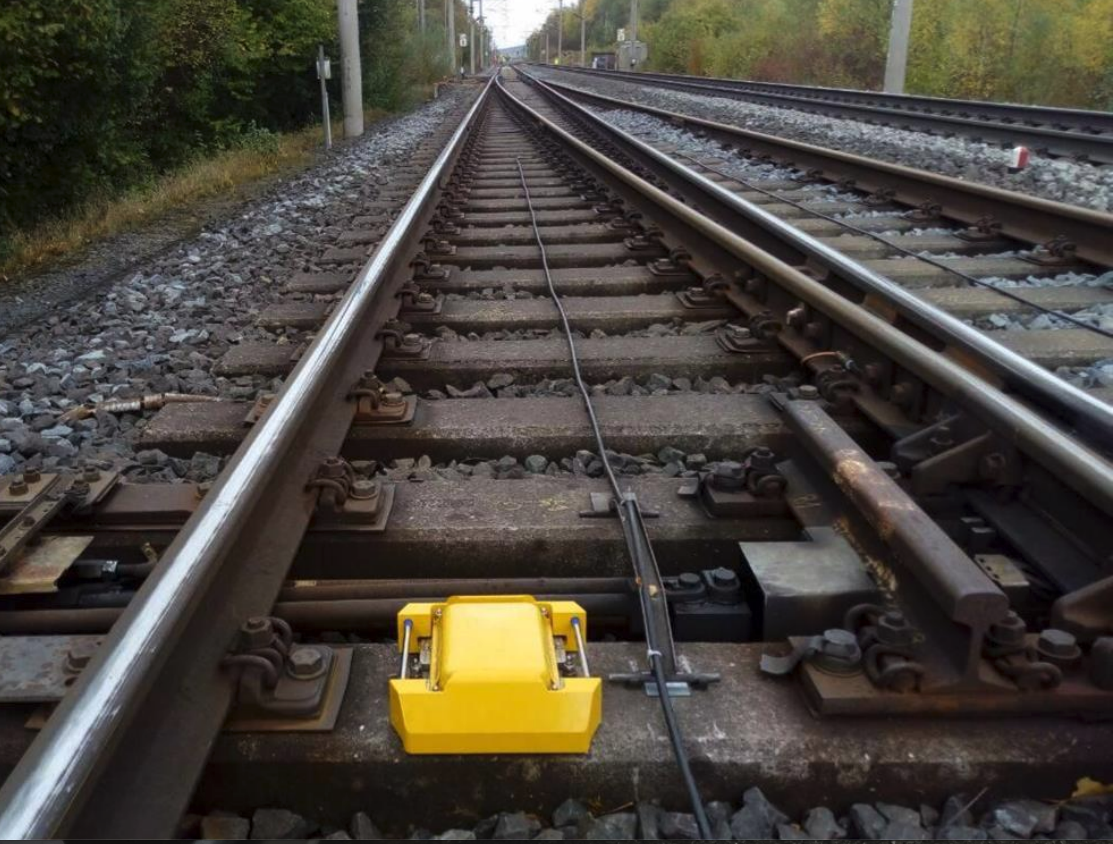
Konux’s IoT device in situ where it’s able to monitor the condition of a railway switch (Image credit: Konux)
Underpinning its products are robust, track-mounted sensors (painted an eye-catching high-gloss yellow) which contain a series of accelerometers that measure force and the acceleration of force onto the rails. This ground-level data is fed into its AI models which estimate what’s going to happen to the tracked component in the near term. (Konux says its Switch product estimates how the condition of switches will develop over the next 90 days, which allows operators to identify early signs of degradation so they can plan ahead for inspections and prioritize maintenance based on actual network usage.)
“As you can imagine, you have a few trains which are extremely high stress, high energy, cases that could cripple a network ultimately,” notes Bonnifield. “By being able to kind of detect the load factor of these trains and their speed and kind of really understanding what’s actually happening — the underlying ground truth of what’s happening in the network — this is a game changer for how to manage and operate them because you’re using real data at that point.
“So being able to give the people who are heroically operating these networks more visibility into what’s actually happening and lighting up their understanding of what’s going on, and then to make very, very strong predictions as to how they how they should do things differently, these are both the main drivers of where you find that [50% extra] capacity.”
As well as relying on track-level data captured by its own hardware, Konux loops in other sources of open and third party data to supplement its view of local rail conditions — such as temperature at a specific location; and visual data from partner companies that operate cameras mounted on trains (i.e. to do a visual check on an asset which its sensors have detected as potentially degrading).
The goal is for its platform is to be the intelligent processing center that drives smarter rail running by empowering operators to gain network visibility so they can continually make data-driven decisions.
“Ultimately, we see ourselves as an AI company first,” he tells TechCrunch. “We built an AI company. We built, essentially, a very, very good analytical software company at solving this problem. And then we built the first of its kind sensing device to be perfectly matched to the needs of an AI company — but we’re totally agnostic; we will fuse data and integrate data with wherever we can find it. Anything that’s valuable. It just so happens to be the case that this sensing problem is an extremely challenging problem. And so we needed to be the first people to solve it. But if we would have been able to acquire the data easily, and there was somebody else that did it, we would have done it a different way. But, you know, we really want to be the brain, not the hands, not the legs, we want to be the brain of the network.”
“The goal, of course, is to take what makes these infrastructure managers, these asset owners, expert at what they do, and really make that a bigger and bigger part of their day,” he adds. “So rather than say you have to actually survey every single asset in your network, we say we’re going to do that for you automatically. Rather than say, when you see a problem you have to actually physically go out and see what the problem was, we’re going to visualise that for you. And we’re going to tell the story of it. We’re going to alert you when there’s a problem and give you even a recommendation if we can — to make the brainpower of these people as highly leveraged as possible.”
Konux was founded all the back in 2014, when its founders had the germ of an idea to apply AI in challenging industrial environments. That plucky startup alighted on the railway as its battleground and has since grown into a well-capitalized scale-up — with some $130.6 million raised to date (including an $80M Series C in January 2021) — which has tested and deployed products with operators across some ten markets at this point.
Years of R&D and testing went into developing Konux’s predictive AI models. This included deploying prototypes and trialing hardware across multiple countries and in different railway operating conditions in order to be able to gather diverse enough data to build a model that’s “generalizable across basically any environment”, as Bonnifield puts it.
“This is one of the hardest things to do because it’s very hard to know if the [AI] models we’re building are overfitting to a specific environment or some specific set of dynamics. So we really still think of the core IP that we built is really this data that we’ve collected — and the know-how of how to make sense of the data. And then just the overall pipeline that manages it,” he adds.
While Europe is where Konux has most widely deployed kit currently it has also installed its connected devices on railways in China, India and Japan.

Konux CEO Adam Bonnifield (Image credit: Konux)
The business is now gearing up for a major expansion in its home market of Germany, with Deutsche Bahn (DB), the country’s national rail service. (Konux won a DB tender for a long term framework agreement for the digitization of switches at the end of 2020.)
This will see it expand from having around 1,000 of its sensing devices deployed on train tracks globally today to installing an additional 3,500 over the next year or so in Germany alone, on the most trafficked parts of DB’s rail network — growing its total operational footprint 10x within a year, according to Bonnifield.
“This is going to be this incredible step-change for this company,” he says. “The last eight years has been a very important and challenging job of just pioneering a lot of the kind of organisational change and solving the technical problems required to basically introduce next generation AI and IoT to this industry. So for the first time, we’ll be rolling out at scale, in the largest European rail network, and in the highest trafficked, highest capacity, part of the network — the main corridor of the country of Germany.”
To get to this milestone, he reels off a long list of “firsts” Konux had to chalk up — starting with being the first company to certify “such an IoT device” and “the first AI company in rail”. Per his telling, it was also the first company to do a SaaS contract with a rail network, which marks a sea-change from the expensive capital investments transport giants were used to inking. And the first tech start-up to be awarded a rail tender. Going through that government regulated approval process then required another first, since standards for assessing the performance of its AI models had to be invented.
“None such performance criteria existed previously,” he notes. “What does it mean to do predictive maintenance and what does it even mean to performance predict the future? I mean, this is totally novel to this industry because they haven’t worked this way before.”
“There was a whole bunch of firsts. There was basically this massive amount of effort — first to build this deep tech company and then to build this organisational transformation company and so to see that finally manifest in a massive rollout at scale is, yeah, it’s incredible,” Bonnifield adds.
“So our goal [with the DB expansion] is to prove that this solution works at scale — in the highest criticality area of the largest and most important European rail network — as a sort of proof point to say, therefore, this is just a better way of doing things.”
The challenge doesn’t stop there, of course. Getting railway operators on board with such root-and-branch reworking of how to monitor and maintain fixed infrastructure in what is absolutely (and necessarily) a safety-first environment is a massive, ongoing business transformation challenge, too.
“When we think of our sales pipeline, this is really our pipeline,” he goes on. “Our pipeline is not convincing the customer that what we do is valuable — because they know it is. It’s the pain they live every day. It’s the crisis that they’re currently kind of struggling to survive. The sale, so to speak, is kind of cooperatively attacking this problem of organisational change.”
“A lot of barriers are there for good reasons,” Bonnifield adds of rail industry processes and safety protocols. “It’s a publicly regulated industry where safety is at a premium — where nations depend on it to survive. So there needs to be an extremely rigorous, incremental revolution type process to walk through the different stages of changes that need to happen in order to make this possible.
“So, for us, that’s technically certifying our devices which we’re going to then put in the field. That they’re not interfering with the electromagnetic spectrum. That they’re physically robust and not bouncing all around. That they stay fixed to where they’re supposed to be. It’s about proving that the approach is viable from a business perspective. That it could fit within the regimes of the way that these rail networks operate. That it actually performs and adds value.
“For about a year, we were just making predictions and then just looking at the delta between the predictions that we made and then what was actually happening in reality to prove that when we said something that was going to fail would fail, that it actually did fail. And we were held to this 90% accuracy standard, which is very hard when you’re predicting the future to say 90% of the time you’re right.
“But this is what was required to really get the point to where our AI models were performing enough that we could say not only does this work but this works spectacularly well — this works almost perfectly — in order to then justify and say, okay, so now we’re gonna switch this on, and roll out at many thousands of devices all around the country.”
A data-driven technology that’s been trained, tested and honed over years to meet publicly regulated safety standards — and can be relied upon to deliver highly accurate predictions to unlock major capacity wins — sure sounds like the kind of AI that’s worth the world’s attention.
The next stage of Konux’s DB rollout will take it up to monitoring 15% of relevant network assets for the major rail operator in its home market so it’s still a long way off its ambition of total network coverage (in Germany and, well, beyond). But after years of hard (and dirty) work laying the foundations that underpin its digitization sales pitch it looks well positioned to keep building momentum and scaling up its growth track.
While, for now, Europe remains the startup’s main focus — as what Bonnifield calls an “incredible proving ground” for its tech (given the high demands for safety and performance; and because the railways have so much regional political importance) — as befits any ambitious scale-up Konux of course has big plans for international expansion, with the goal of getting its tech into markets across North America, Latin American and Asia too.