


































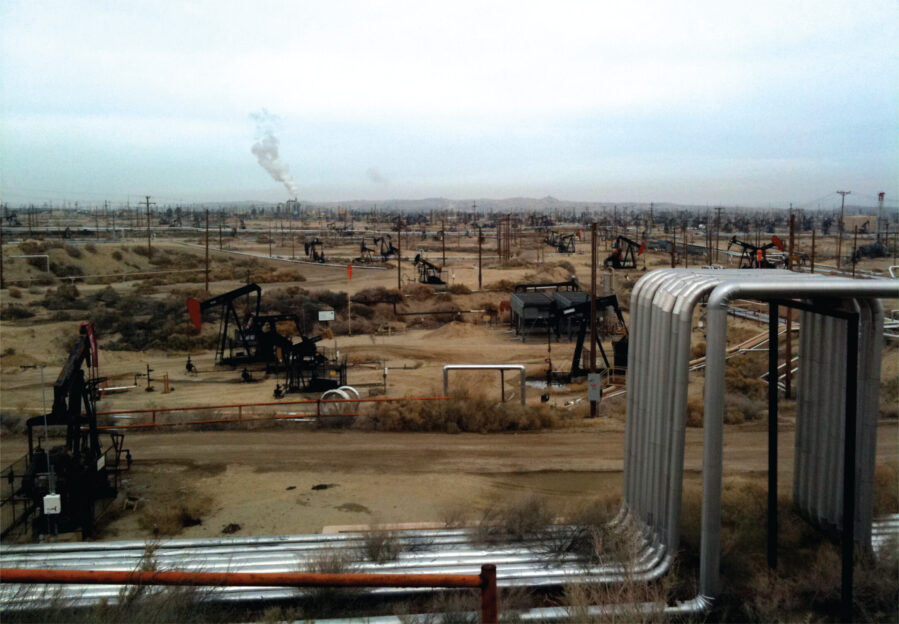
Buried in the plumbing of a petroleum refinery somewhere in Texas, deep in the maze of steel towers and pipes that crack crude oil into usable fuels, sits a threshold no one designed for. Below about 65% capacity, the machinery simply can’t operate safely. Not “inefficiently” or “unprofitably.” Can’t operate at all.
This is what University of Notre Dame researchers Emily Grubert and Joshua Lappen call “minimum viable scale,” the point where energy systems built for growth collapse when forced to shrink. It’s a problem hiding in plain sight across America’s fossil fuel networks, from refineries to gas pipelines to coal mines, and it threatens to turn the energy transition into something far messier than current planning assumes.
“Systems designed to be large and growing behave differently when they shrink,” says Grubert, who studies sustainable energy policy at Notre Dame’s Keough School of Global Affairs. The issue isn’t just academic: fossil fuels still provide 80% of global energy, and we’ve spent decades building networks that assume they always will.
Consider what happens when electric vehicles slash petrol demand. Refineries are designed to maximise gasoline production, with jet fuel and asphalt as byproducts. If a refinery can’t run below that 65% threshold, you might suddenly lose jet fuel supplies even though planes aren’t going electric. The entire product slate collapses because one piece fell below its cliff edge.
Gas pipelines face a different trap: a financial one. The fixed costs of maintaining thousands of miles of pipes get spread across fewer customers as homes switch to electric heating. Bills rise. More people leave. Bills rise further. “As fewer users shoulder the costs of the entire system, they will face growing incentives to exit, producing conjoined cost and reliability spirals,” the researchers write in Science.
Then there’s coal, where the constraint is managerial rather than physical or financial. Mines plan years ahead to extract specific coal seams. Power plants can only burn specific types of coal from nearby sources. Close one mine, and you can trigger a cascade of plant closures—or vice versa. The fates are linked, but the owners rarely coordinate.
These aren’t hypothetical scenarios. Refineries already go through “turnarounds” every few years—major overhauls requiring huge capital investments. Each turnaround becomes a decision point: reinvest or shut down? In a shrinking market, the answer increasingly tilts toward closure, potentially leaving entire regions with sudden fuel shortages or price spikes.
Current energy models assume smooth, linear declines in fossil fuel use. That’s probably fine early on, when you’ve got hundreds of facilities and closing one barely registers. But at deeper levels of decarbonisation—exactly where climate targets demand we go—each closure matters more. A system of 130 refineries behaves very differently from a system of 30.
“None of these systems were designed with their own obsolescence in mind,” notes Lappen, a postdoctoral researcher at Notre Dame’s Pulte Institute. “None of the engineers, founding executives, economists or accountants involved ever imagined a system that would gradually and safely hand off to another.”
The researchers argue that the current American approach—bailouts when things fail, bankruptcies when they collapse—won’t work at the pace and scale transition demands. Instead, they propose four strategies: develop high-resolution models that track when specific facilities approach their minimum viable scale; establish coordination across ownership boundaries (tricky when anti-collusion laws forbid it); shift unprofitable but necessary systems to public management; and guarantee long-term liabilities so companies don’t just walk away from environmental cleanup.
That last bit matters especially. As systems become unprofitable, they may need significant new investment just to remain safe in the short term, even whilst committing to closure. It’s the opposite of how markets normally work, which is why Grubert and Lappen reckon governments will need to step in.
The risks extend beyond economics. These are high-hazard systems. Failures can kill workers and communities that depend on reliable energy. Even short disruptions cause havoc. And if the transition becomes chaotic enough—power cuts, price spikes, supply failures—public support for decarbonisation itself could evaporate.
What makes this particularly thorny is that the data needed to manage these thresholds is often hidden. Companies guard operational details for competitive advantage. Anti-collusion laws prevent coordination. Information asymmetry actually increases as systems shrink, because remaining players gain more market power and more incentive to keep secrets.
Grubert sees a way forward through better planning. “We will be more creative and more successful if we think about the process outside the moment of crisis,” she says. That means shifting attention from just building renewable energy to actively managing fossil fuel decline—identifying which facilities matter most, coordinating closures, ensuring replacement systems are ready.
It’s unglamorous work compared to the excitement of new solar farms and wind turbines. But getting it wrong could trap us in what the researchers call an “expensive, unstable mid-transition state”—neither fully fossil-fueled nor fully renewable, and unable to reliably be either.
The energy transition isn’t just about what we’re building. It’s about what we’re decommissioning, and whether we can do it without the lights going out.
Study link: https://www.science.org/doi/10.1126/science.aea0972
If our reporting has informed or inspired you, please consider making a donation. Every contribution, no matter the size, empowers us to continue delivering accurate, engaging, and trustworthy science and medical news. Independent journalism requires time, effort, and resources—your support ensures we can keep uncovering the stories that matter most to you.
Join us in making knowledge accessible and impactful. Thank you for standing with us!