


































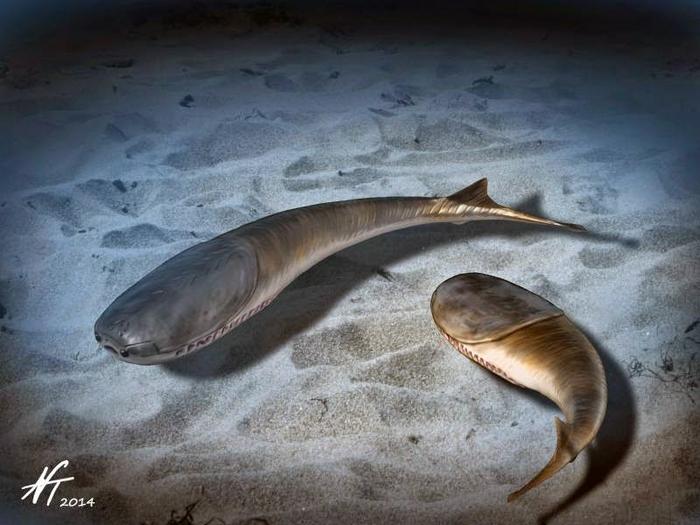
Every fish you have ever eaten, every frog that has croaked outside your window, every bird and mammal and reptile on Earth owes its existence to a disaster. Not a slow, grinding change. A wipeout. Around 445 million years ago, glaciers swallowed the planet, shallow seas drained away, and roughly 85 percent of marine species vanished. The creatures that ruled the oceans, bizarre eel-like animals called conodonts and towering shelled mollusks, were decimated. And in that wreckage, our ancestors finally got their chance.
A new study in Science Advances traces how the Late Ordovician Mass Extinction cleared the path for jawed vertebrates to take over the seas. Before the freeze, fish with jaws were marginal players, struggling against entrenched competition. After? They inherited an empty ocean.
The research team, led by Professor Lauren Sallan and PhD student Wahei Hagiwara at the Okinawa Institute of Science and Technology, assembled a database spanning two centuries of fossil discoveries to reconstruct what happened. The extinction unfolded in two brutal pulses as Earth swung from greenhouse warmth into an icehouse and back again. Gondwana, the southern supercontinent, was smothered in glaciers. Ocean chemistry went haywire. And when it was over, the old ecological order was gone.
Survivors huddled in isolated pockets while the world recovered
The takeover was not immediate. The fossil record shows a long, quiet period of low diversity before jawed vertebrates began their rise. What mattered was geography. Surviving fish were marooned in refugia, stable pockets of habitat cut off by deep water. These isolated zones became evolutionary incubators.
“We pulled together 200 years of late Ordovician and early Silurian paleontology, creating a new database of the fossil record that helped us reconstruct the ecosystems of the refugia,” Hagiwara said.
One critical refuge sat in what is now South China. There, researchers found the earliest complete fossils of jawed fishes related to modern sharks. These animals stayed geographically trapped for millions of years, slowly diversifying in their quiet corner of the world. Only later, as oceans shifted and barriers fell, did they spread outward and begin to dominate.
The pattern is familiar to paleontologists. Mass extinctions do not just subtract species. They reorganize life. The same cycle played out after later catastrophes, including the end-Devonian extinction. Each time, a dominant group collapses and something waiting in the wings steps forward.
Reset, Not Replacement
What strikes the researchers is how ecosystems rebuilt themselves. The new world looked structurally similar to the old one, with predators and grazers and filter feeders filling similar roles. But the players had changed. Jawed vertebrates did not invent new ways of living. They occupied niches left empty by the dead.
“We have demonstrated that jawed fishes only became dominant because this event happened,” Sallan explained, “and fundamentally, we have nuanced our understanding of evolution by drawing a line between the fossil record, ecology, and biogeography.”
This is not a story of gradual improvement. It is a story of survival after collapse. The traits that would eventually produce sharks and salmon and, much later, amphibians crawling onto land were already present in those early jawed fish. They just needed room. The extinction gave it to them.
Science often presents evolution as a march of progress, each generation a little better than the last. But the fossil record keeps offering a messier picture. Sometimes the future belongs to whoever is left standing when the dust settles. Our own lineage, it turns out, owes its existence not to being the best, but to being in the right refuge at the right time. Small comfort, maybe. But true.
Science Advances: 10.1126/sciadv.aeb2297
If our reporting has informed or inspired you, please consider making a donation. Every contribution, no matter the size, empowers us to continue delivering accurate, engaging, and trustworthy science and medical news. Independent journalism requires time, effort, and resources—your support ensures we can keep uncovering the stories that matter most to you.
Join us in making knowledge accessible and impactful. Thank you for standing with us!